
Key takeaways
- Planned maintenance is the TPM pillar that schedules work from equipment criticality and failure history.
- It is a system that combines preventive, predictive and corrective approaches, not one technique.
- Operators take over routine care through Jishu Hozen; maintenance keeps skilled and periodic work.
- MaintWiz is an AI CMMS built for TPM: PM schedules, work orders and compliance sit on the same equipment list as the other pillars. All eight pillars, 5S, OEE, Kaizen and one point lessons run in one AI CMMS, operators capture on mobile, tags become work orders, IoT signals raise work orders and ePTW covers safety. The whole roll-out takes 6 to 8 weeks.
Meaning
What does planned maintenance mean in TPM?
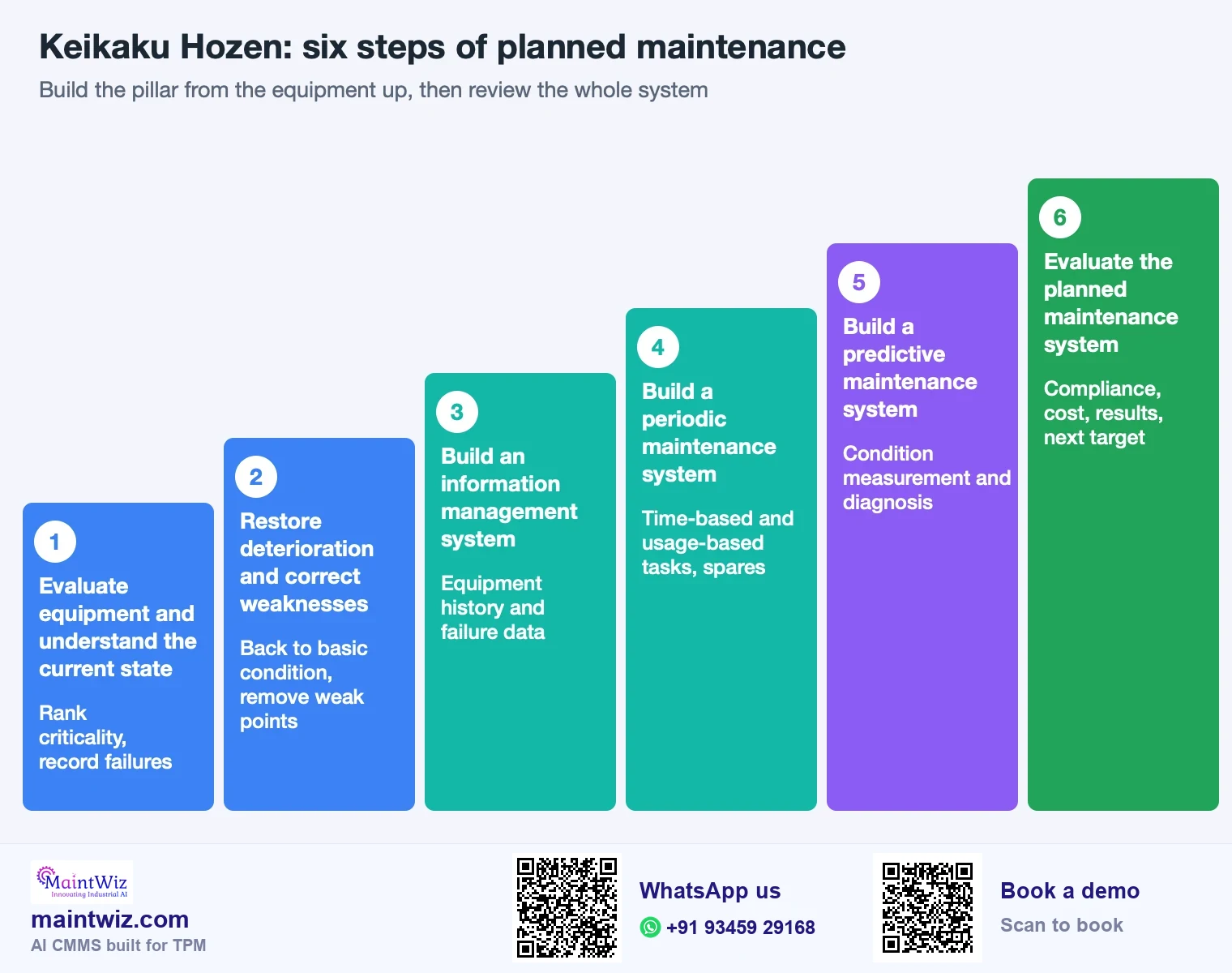
In the TPM structure the planned maintenance (Keikaku Hozen) pillar builds a maintenance system around the equipment's actual failure modes and history. It works with autonomous maintenance: operators keep the basic conditions (clean, lubricated, tight), which lets maintenance concentrate on periodic work, condition checks, repairs and improvements that need skill.
What are the six steps of the planned maintenance pillar?
- Evaluate the equipment and understand the current state.
- Restore deterioration and correct weaknesses.
- Build an information management system.
- Build a periodic maintenance system.
- Build a predictive maintenance system.
- Evaluate the planned maintenance system.
A Step 0 for preparation comes before them, which is why the planned maintenance pillar audit scores Step 0 to Step 6.
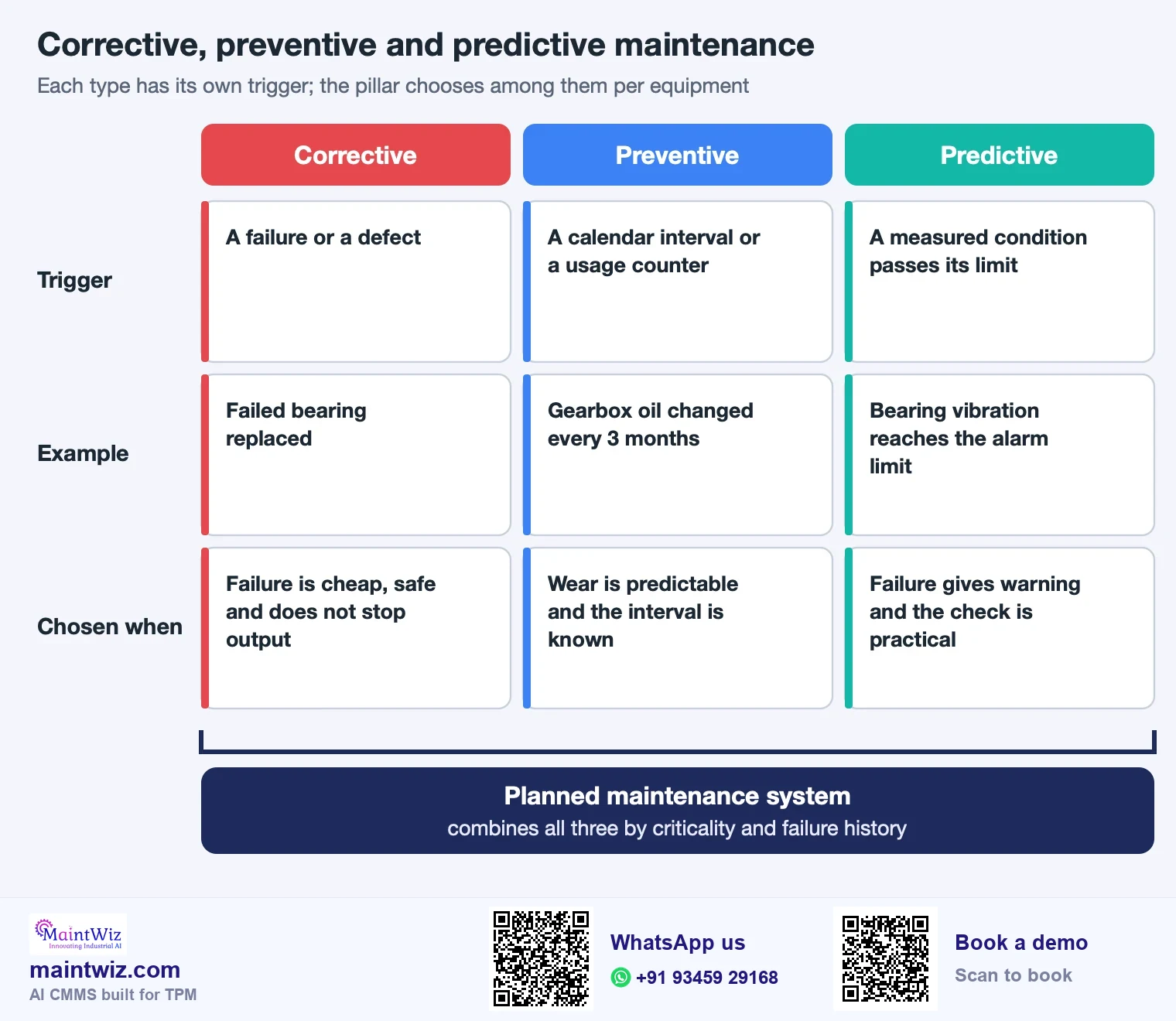
How does planned maintenance differ from preventive and predictive maintenance?
| Type | Trigger | Example |
|---|---|---|
| Corrective (run to failure or repair) | After a failure or fault | Replace a failed bearing |
| Preventive (time or usage based) | A calendar or counter interval | Lubricate a gearbox every three months |
| Predictive (condition based) | A measured condition crosses a limit | Replace a bearing when vibration rises |
| Planned maintenance (TPM pillar) | A system that combines the above by equipment criticality and failure history | A PM plan per equipment, reviewed from failure data |
Planned maintenance is therefore a system, not a single technique: preventive and predictive tasks are chosen where they pay back, and corrective work is accepted where a failure is cheap and safe. Operators take the routine side of that split; autonomous maintenance vs preventive maintenance sets out who does what.
Downloads
Planned maintenance templates: PM schedule, criticality and pillar audit
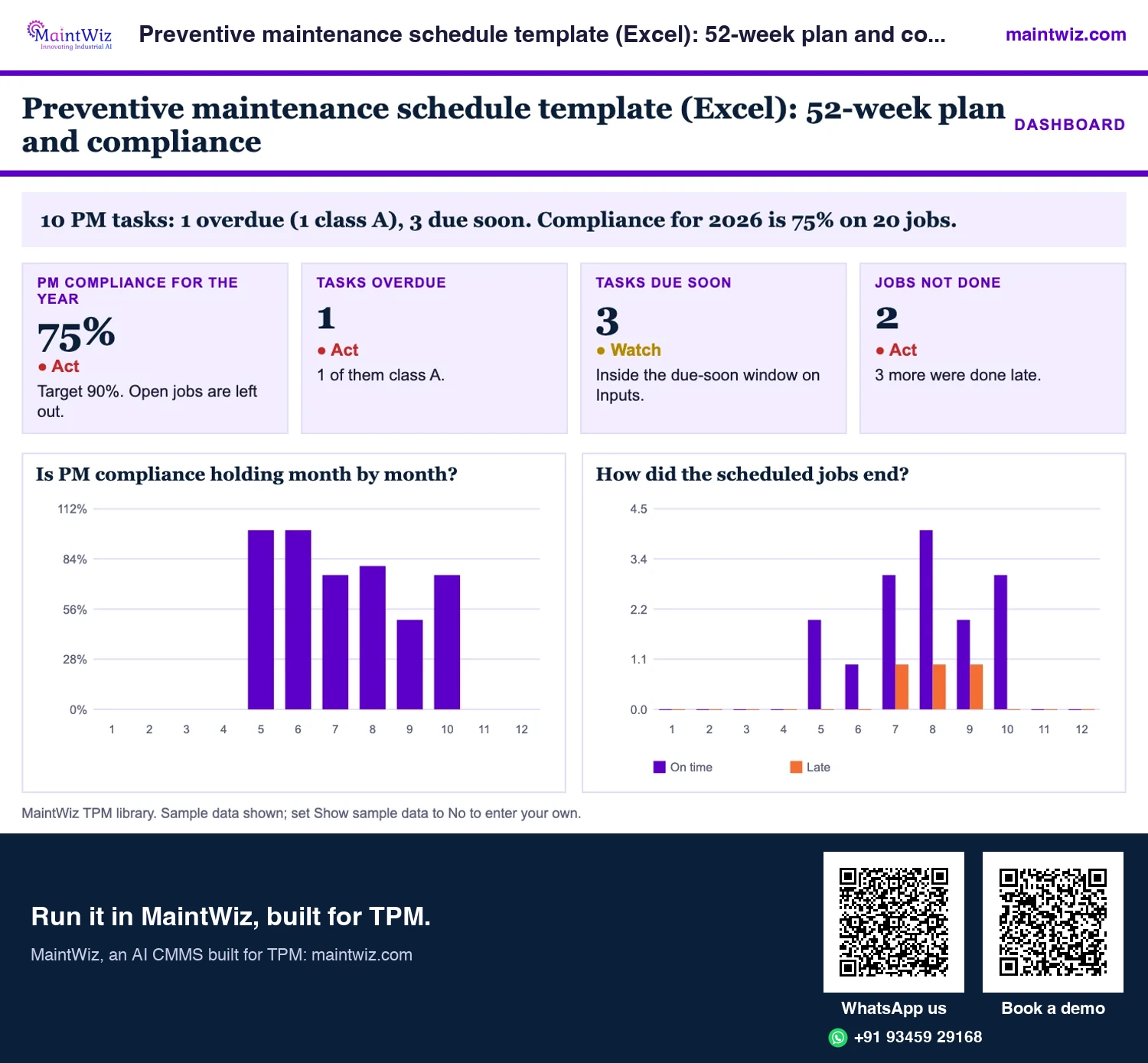
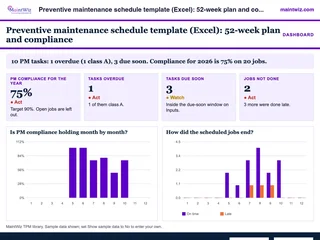 ExcelPreventive maintenance schedule template (Excel): 52-week plan and compliance
Plan preventive maintenance on a 52-week calendar with calendar, running-hours and condition triggers
- Sheets
- Dashboard, Inputs, Tasks, Log, Compliance, 52-week plan, 52-week plan (2 x A4), Read me
- A4
- Version
- v1.2, 5 November 2026
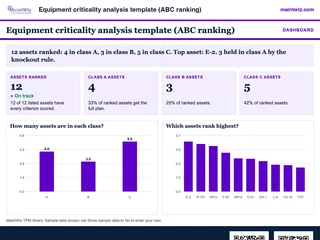 ExcelEquipment criticality analysis template (ABC ranking)
Score equipment on safety, environment, production, standby and detectability, rank it A, B or C
- Sheets
- Dashboard, Inputs, Criteria, Strategy, Assets, Read me
- A4
- Version
- v1.1, 5 November 2026
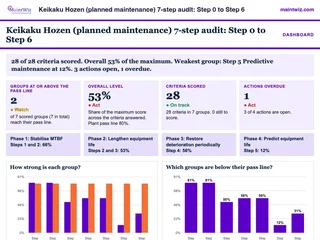 ExcelKeikaku Hozen (planned maintenance) 7-step audit: Step 0 to Step 6
Score 28 criteria across Keikaku Hozen Step 0 to Step 6, see the weakest step and the zero-breakdown phase
- Sheets
- Dashboard, Inputs, Audit, Actions, Read me
- A4
- Version
- v1.1, 5 November 2026
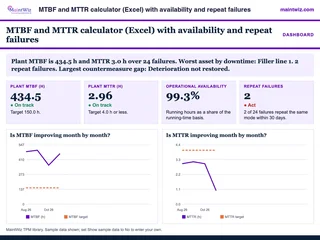 ExcelMTBF and MTTR calculator (Excel) with availability and repeat failures
Log failures and read MTBF, MTTR, inherent and operational availability by asset
- Sheets
- Dashboard, Inputs, Assets, Failure log, Results, Read me
- A4
- Version
- v1.1, 5 November 2026
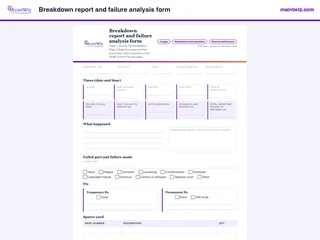 PDFBreakdown report and failure analysis form
Record a breakdown with failure-to-call time, a phenomenon sketch
- Pages
- 2
- A4
- Created
- 5 November 2026
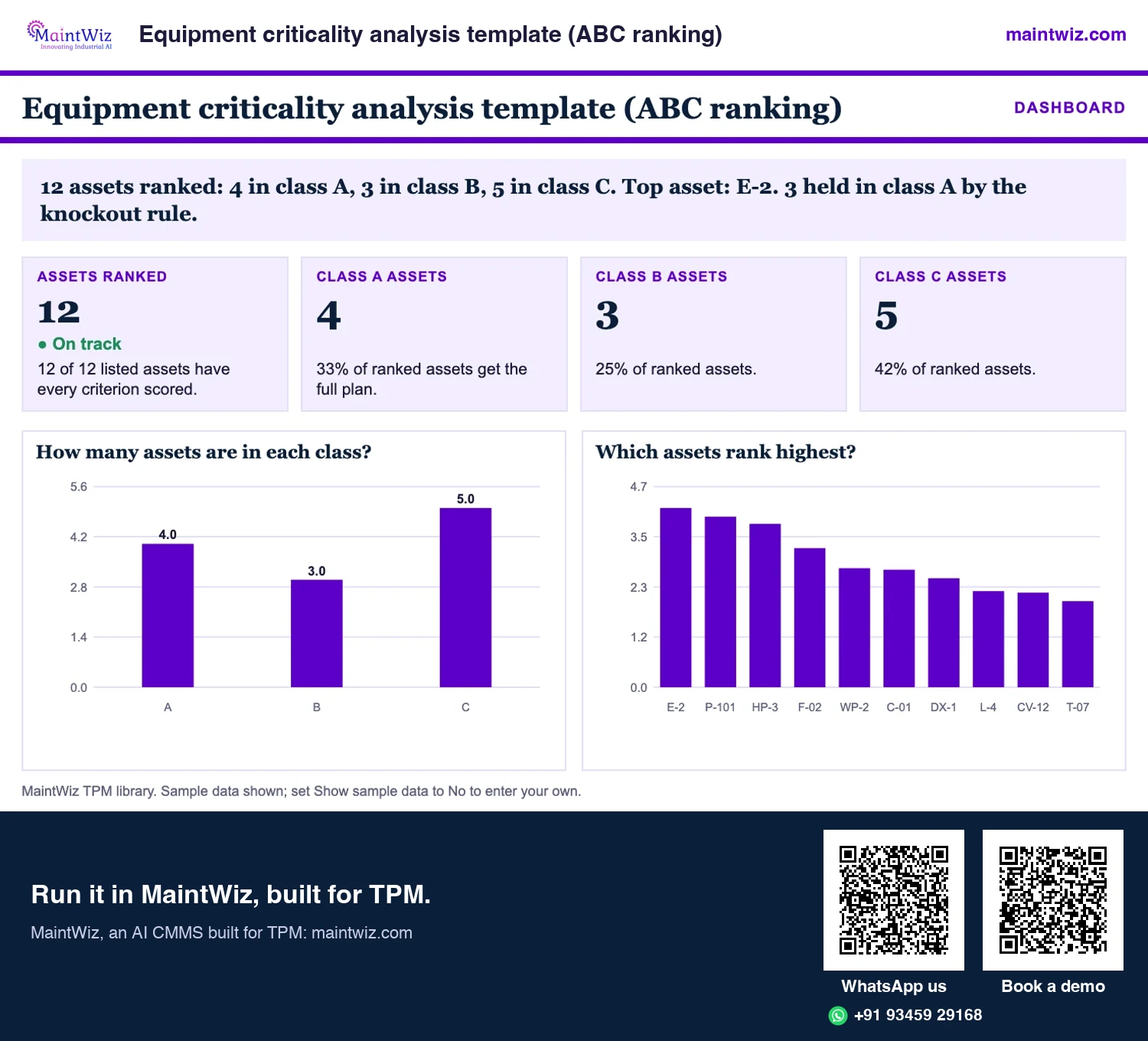
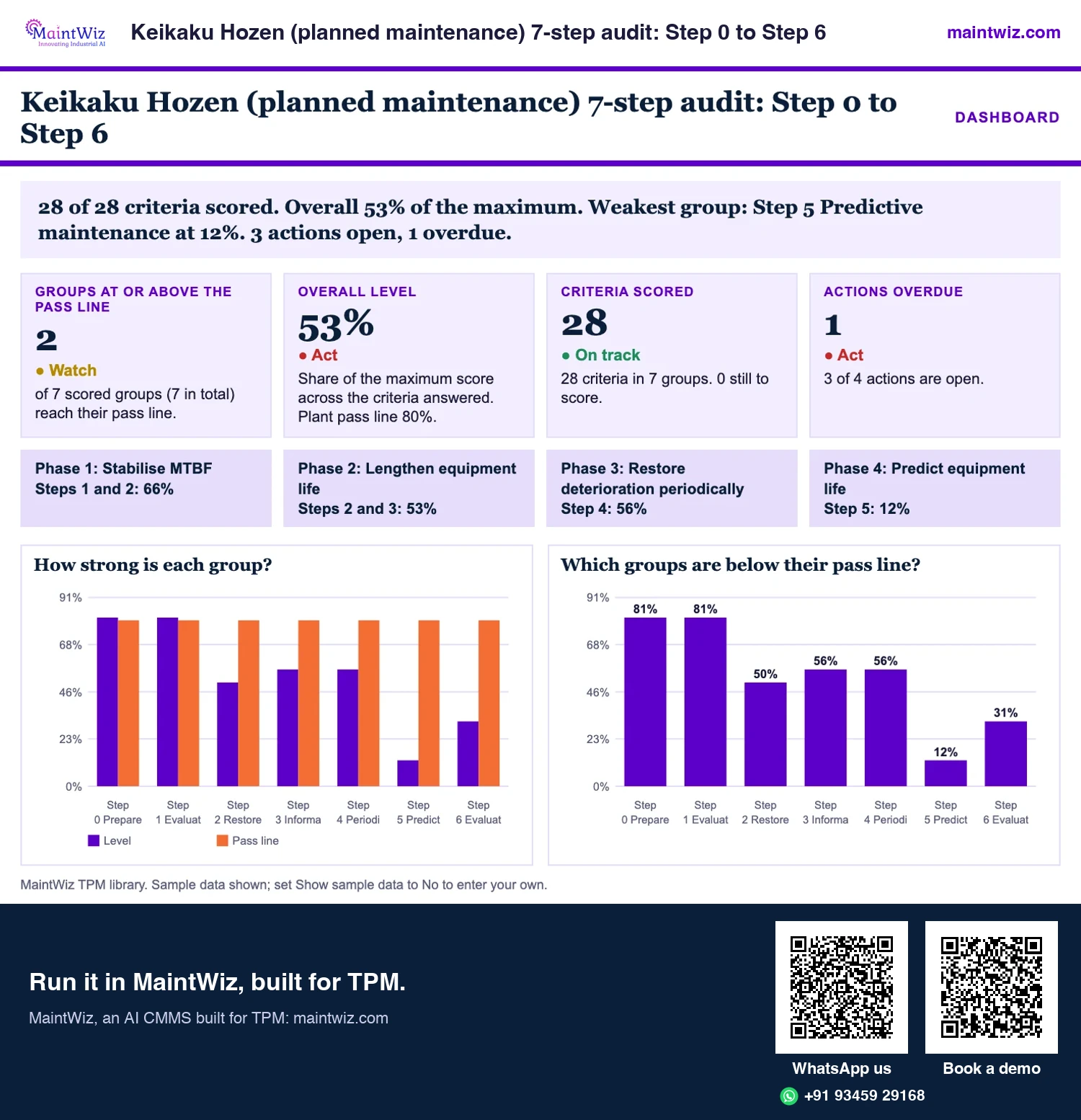
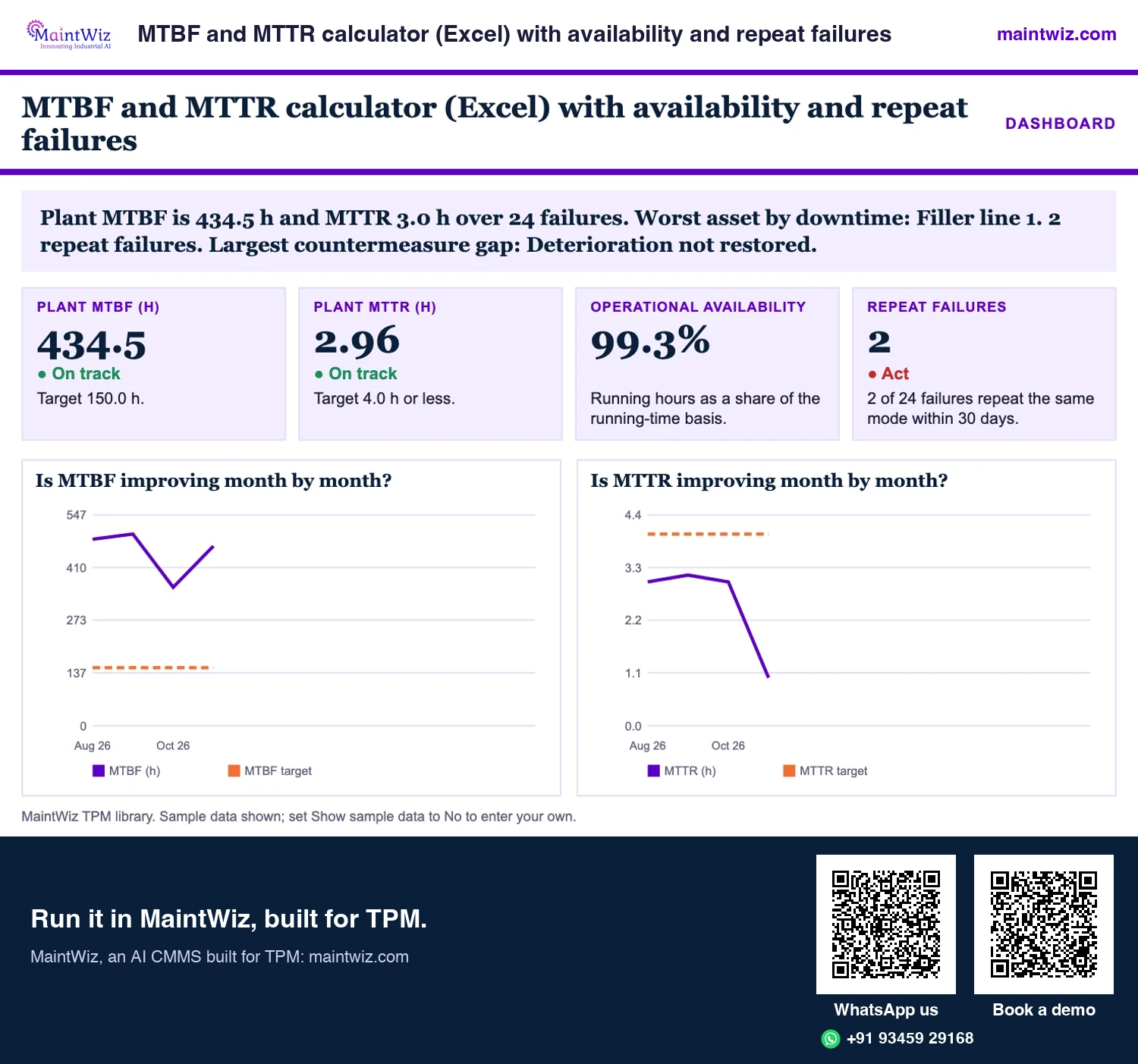
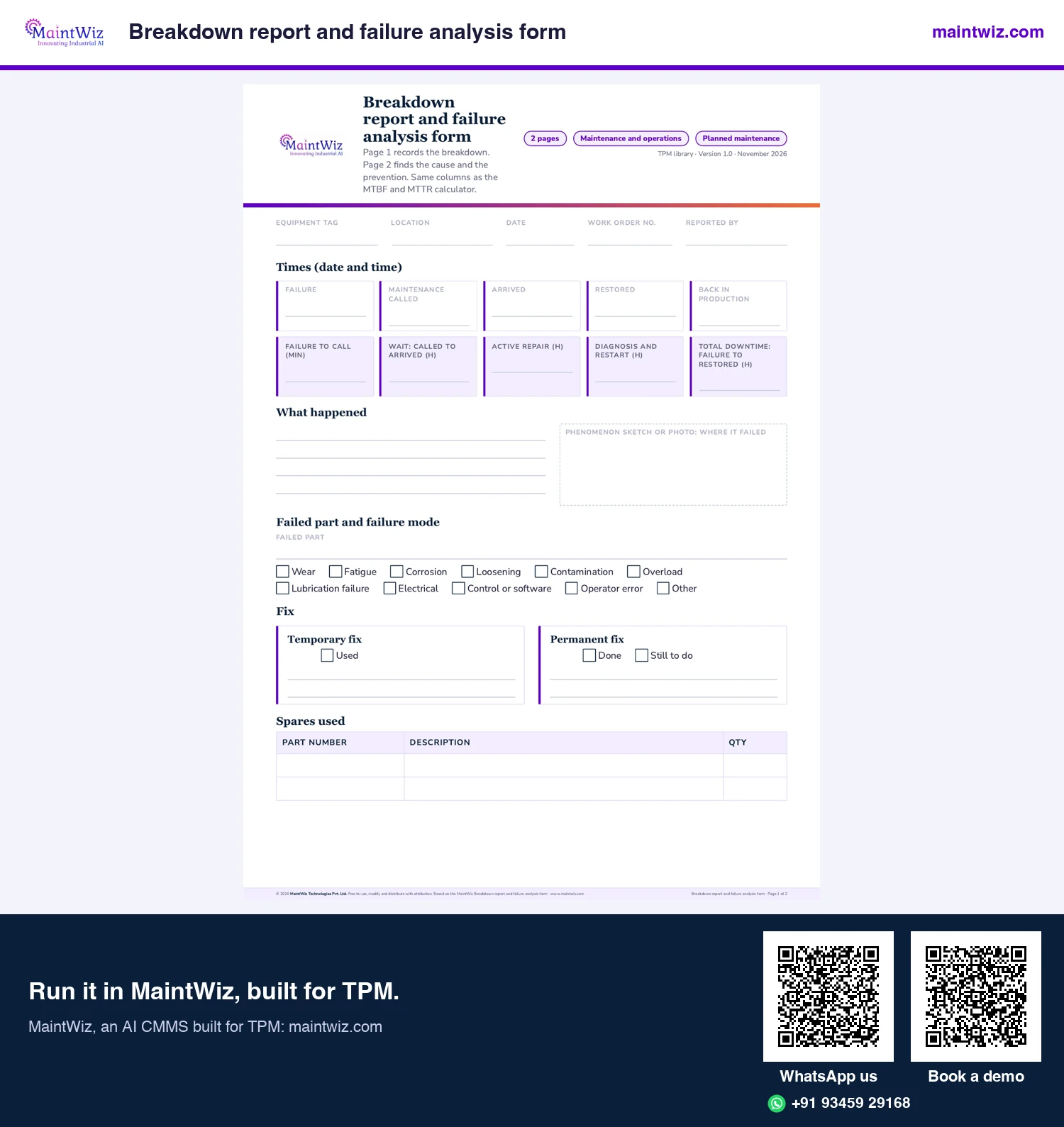
Building the system
How do you build a planned-maintenance system?
- Rank equipment by criticality (effect on safety, quality, output and cost of failure).
- Collect failure history and causes for the critical equipment.
- Define tasks and intervals per equipment, including what operators take over through CIL standards.
- Prepare the schedule, the spare parts and the work-order templates.
- Execute, record findings and times, and feed repeat failures back into the plan.
- Review KPIs on a fixed cadence and adjust tasks and intervals.
Building a planned maintenance system
Six steps from criticality to review
Rank equipment by criticality
Collect failure history and causes
Define tasks and intervals
Prepare schedule, spares and templates
Execute, record and feed back
Review KPIs and adjust
 maintwiz.comAI CMMS built for TPM
 WhatsApp us
 +91 93459 29168
 Book a demo
Start in a spreadsheet with the planned maintenance schedule and compliance workbook.
Work orders, schedules and compliance in MaintWiz
MaintWiz holds the asset register, the task plans, the generated work orders and the history that the plan is reviewed from. The reporting that matters for the pillar is compliance (are scheduled jobs done on time) and backlog (how much planned work is waiting). MaintWiz preventive maintenance software reports PM compliance month by month on the planned maintenance dashboard and lists the open planned work orders that make up the backlog.
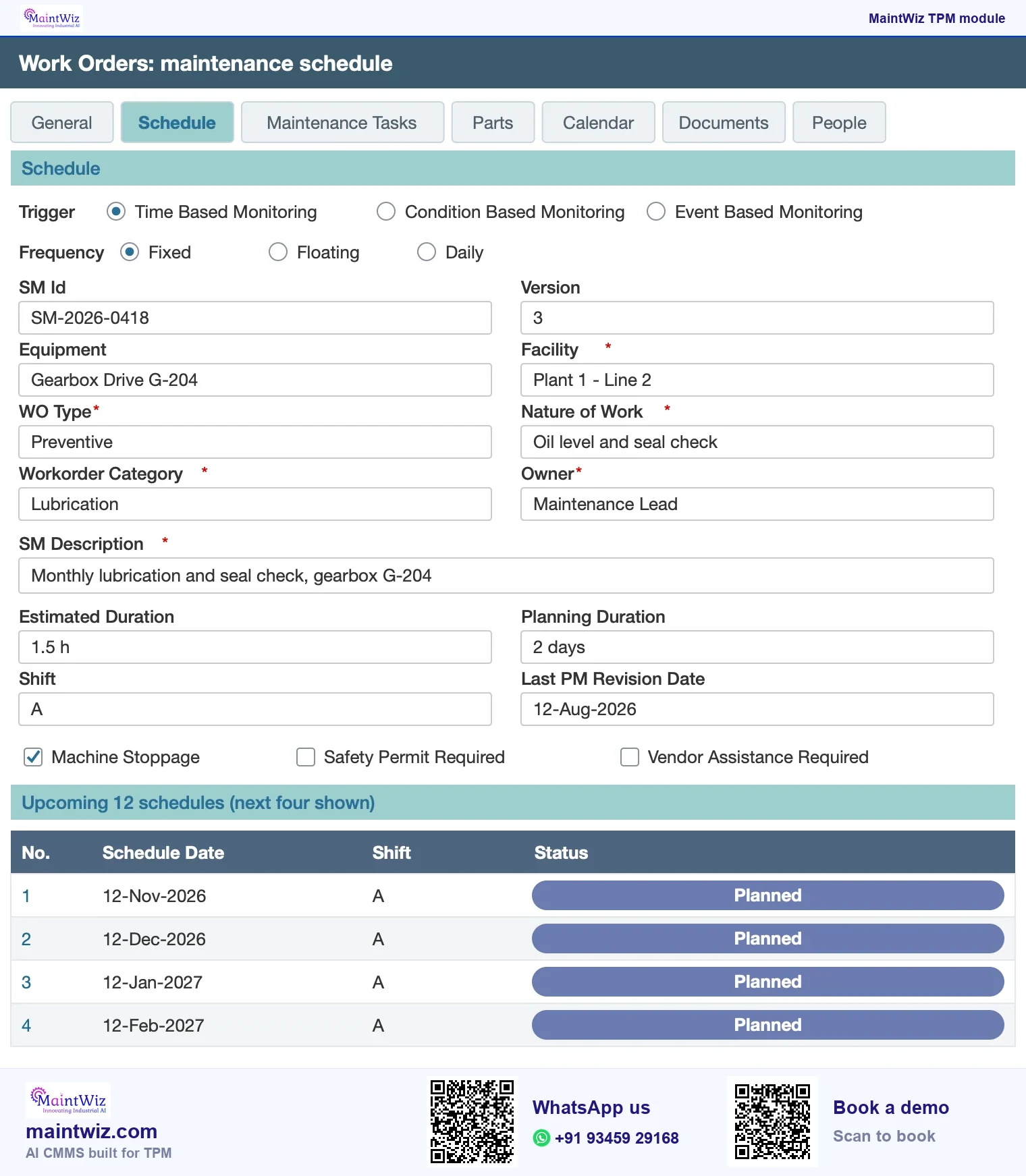
MaintWiz PM schedules run on time, condition and event based triggers at a fixed, floating or daily frequency. Each schedule raises its work orders, operator tags convert to work orders when maintenance work is needed, IoT signals raise work orders automatically and SAP PM and MM connect through web services. Compliance and backlog report from the same records.
See a PM schedule with its triggers and frequency in a demo.
How do you rank equipment by criticality?
Planned maintenance effort follows criticality. Rate each equipment on the effect of its failure and how often it fails, using criteria your plant agrees and writes down.
| Criterion | Example question |
|---|---|
| Safety and environment | Can a failure injure someone or release something? |
| Production | Does the failure stop the line or only one of several machines? |
| Quality | Does it produce defects before it stops? |
| Repair | How long and how costly is the repair; are spares in stock? |
| Failure history | How often has it failed, and in the same way? |
Critical equipment gets a full plan with condition checks; lower-criticality equipment may be run to failure if the failure is cheap and safe.
Rank assets before you plan tasks
Maintenance effort and detail
- A
Critical
stops the line, or carries a safety or quality risk, or has no spare
condition-based and planned tasks at tight intervals
- B
Important
slows output, has a standby or a quick fix
planned tasks at standard intervals
- C
General
low effect, easy to replace
routine checks or run to failure
maintwiz.comAI CMMS built for TPMWhatsApp us+91 93459 29168Book a demoHanding routine tasks to operators
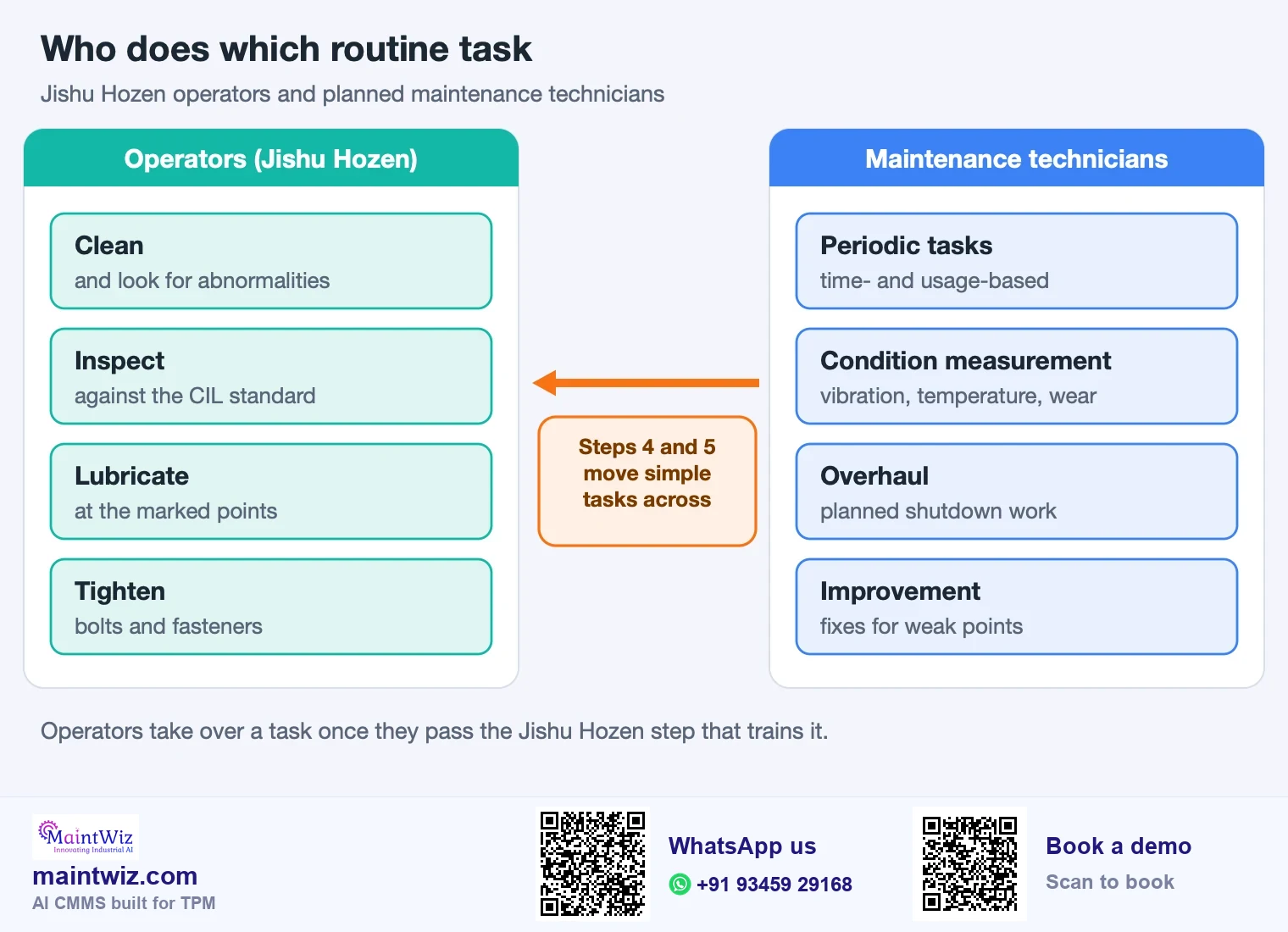
Autonomous maintenance and planned maintenance split the work. Cleaning, inspection, lubrication and tightening move to operators through CIL standards (Jishu Hozen); maintenance keeps periodic work, condition measurement, overhauls and improvements. Review the planned tasks after each Jishu Hozen step: tasks that operators can now do should leave the maintenance plan so that the plan stays short enough to execute.
Operators take over routine inspection in steps 4 and 5; TPM roles and responsibilities defines the roles of planner and pillar owner.
What goes wrong
What goes wrong with a planned maintenance schedule?
- Copying vendor-recommended intervals for every equipment without checking failure history.
- Measuring PM compliance but not whether the PM tasks reduce failures.
- Letting the backlog grow until planned work is only done when equipment stops anyway.
- Not recording findings, so the plan cannot be improved.
- Setting a compliance target before writing down how compliance is counted.
The MaintWiz TPM dashboard reads planned maintenance beside Jishu Hozen and safety, and every pillar has its own clickable dashboard.
Task types
Task types: time-based, usage-based and condition-based
| Task type | Triggered by | Suits | Watch for |
|---|---|---|---|
| Time-based | Calendar interval | Wear that follows time, regulatory inspections | Over-maintenance if the interval is too short |
| Usage-based | Running hours, cycles or output | Wear that follows use | Needs reliable meter readings |
| Condition-based | A measured condition reaching a limit | Failures with a detectable warning period | Needs a measure that signals early enough and a response plan |
| Run to failure | Failure | Low-consequence, cheap items | A deliberate decision, not a default |
The planner's role
A planner turns work requests and schedules into work orders with the right parts, tools, permits and time. Good planning is the difference between a schedule that exists and one that is executed. Planners need a reliable asset register, task lists with times and parts, a view of stores and a link to production for access windows. Work orders should record start, end, cause and findings, which feeds MTBF, MTTR and the loss data.
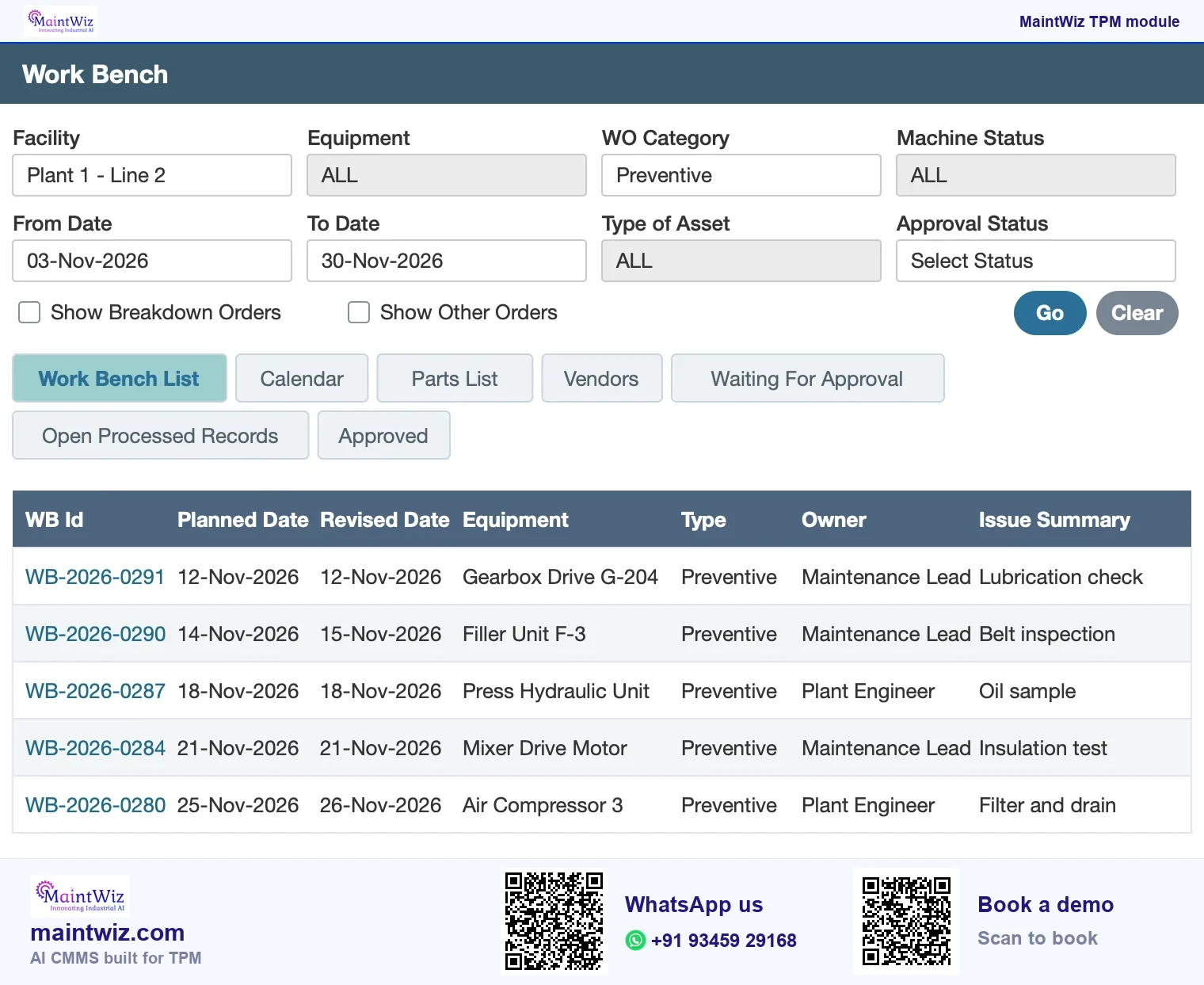
Managing emergency work and backlog
- Define 'emergency' narrowly (safety, environment, major output loss) so it does not become the default priority.
- Review emergency work weekly for patterns that planned tasks could prevent.
- Keep the backlog visible in hours and compare it with weekly capacity.
- Do not let a growing backlog sit: re-prioritise by criticality, or add capacity, or remove tasks of no value.
- Track planned to unplanned work as a sign of control.
Spare parts and shutdown planning
Planned tasks fail when parts are not there. Link task lists to parts lists, reserve parts against work orders and review critical spares by criticality and lead time. For shutdowns, plan scope early, freeze it, sequence tasks and rehearse the critical path. Record what was found, because findings feed the next plan and the task lists.
KPIs
Which KPIs measure planned maintenance?
| KPI | Definition | Why it matters |
|---|---|---|
| Preventive maintenance (PM) compliance | PM jobs completed within the agreed window / PM jobs scheduled | Shows whether the plan is executed |
| Planned backlog (weeks) | Open planned hours / weekly crew capacity in hours | Shows capacity against workload |
| MTBF | Operating time / number of failures | Shows whether failures are becoming less frequent |
| MTTR | Repair time / number of failures | Shows repair effectiveness |
| Planned to unplanned work ratio | Hours on planned work / hours on unplanned work | Shows the shift away from reaction |
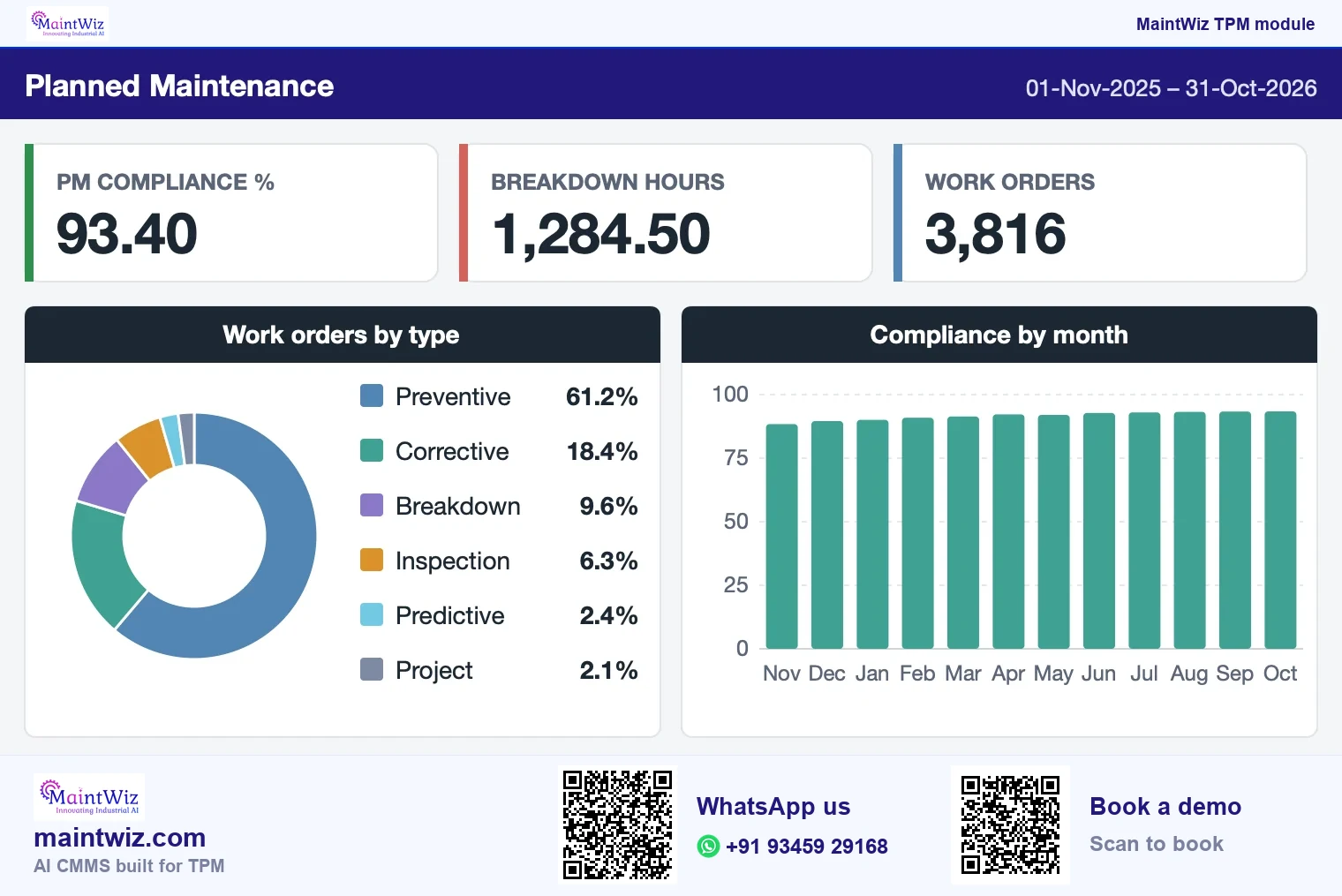
Worked example of the two calculations: a crew of 4 working 40 hours each has 160 hours of capacity a week, so 480 open planned hours is a planned backlog of 3 weeks. If 92 of 100 scheduled jobs are completed within the agreed window, preventive maintenance compliance is 92%. Read the two together: compliance shows whether the plan is executed, backlog shows whether it fits the crew.
Work out MTBF, MTTR and availability for your own equipment with the MTBF and MTTR calculator.
Scored your pillar? Book a demo to see the planned maintenance dashboard with compliance, breakdown hours and work orders by type.
Write your definitions once in a metric dictionary, starting from the TPM KPI definitions, and use them in every report.
Software needs
What should planned maintenance software do?
Software for planned maintenance has to schedule the work, raise it as work orders and keep it beside the operator routines of Jishu Hozen.
| Item | Detail |
|---|---|
| Pillar name | Planned maintenance |
| English meaning | A scheduled, history-based maintenance system. JIPM, the Japan Institute of Plant Maintenance, lists Planned Maintenance among the four core pillars of TPM. |
| What it controls | PM schedules, work orders, breakdown follow-up and the hand-off from operator abnormalities |
| What MaintWiz records | PM schedules, work orders and breakdown records on the same equipment list as the other pillars, with OEE and the pillar dashboards |
- PM schedules with time, condition and event based triggers and fixed, floating or daily frequency.
- Work orders raised from schedules, and from operator tags converted to work orders when maintenance work is needed.
- IoT signals that raise work orders automatically.
- SAP integration through the PM and MM modules using web services.
- Data export to XLS and PDF.
MaintWiz is an AI CMMS built for TPM: load your equipment and PM tasks through Excel uploads, and compliance and backlog report from the same records. See preventive maintenance software, the TPM software buyer's guide, pricing or a demo.
FAQ
Frequently asked questions
What is planned maintenance in TPM?
Planned maintenance is the TPM pillar that builds a scheduled, history-based maintenance system for equipment, while operators handle routine care through autonomous maintenance. It chooses preventive, predictive or corrective approaches by criticality and failure history.
How does the planned maintenance pillar differ from preventive maintenance?
Preventive maintenance is one technique, scheduled by time or usage. The planned maintenance pillar is a wider system that selects preventive, predictive and corrective approaches by equipment criticality and failure history, and feeds findings back into the plan.
What is preventive maintenance (PM) compliance?
Preventive maintenance (PM) compliance is the share of scheduled preventive jobs completed within the agreed window, for example the scheduled week. Write the window once in the metric definition and read compliance beside the failure trend of the same equipment.
How do you prioritise equipment for planned maintenance?
Rate each equipment by the effect of failure on safety, production, quality and cost, and by how often it fails. Critical equipment gets a full plan with condition checks; low-criticality equipment may be run to failure if that is cheap and safe.
What is planned backlog?
Planned backlog is the weeks of planned work waiting: open planned hours divided by weekly crew capacity in hours. A growing backlog means the plan is bigger than the capacity to execute it.
Do operators do planned maintenance in TPM?
Operators carry out routine care (cleaning, inspection, lubrication, tightening) through autonomous maintenance. Planned maintenance, in the narrower sense, is the skilled and periodic work done by the maintenance function.
What is the difference between time-based and condition-based maintenance?
Time-based tasks run at fixed calendar or usage intervals. Condition-based tasks are triggered when a measured condition reaches a limit. Condition-based suits failures with a detectable early warning; time-based suits wear that follows time.
What does a maintenance planner do?
A planner turns requests and schedules into work orders with parts, tools, permits and time, and keeps the schedule and backlog realistic. They depend on reliable asset records and task lists.
What should planned maintenance software do?
It should schedule PM with time, condition or event triggers and fixed, floating or daily frequency, raise work orders and keep them beside the operator routines of Jishu Hozen. MaintWiz also lets IoT signals raise work orders automatically.
Which CMMS runs planned maintenance for TPM?
A CMMS that runs the other pillars on the same equipment list. MaintWiz is an AI CMMS built for TPM; it integrates with SAP through the PM and MM modules using web services and can connect IoT, MES, SCADA, PLC and DCS sources.
Sources
Sources
- JIPM, About TPM https://www.jipmglobal.com/about/tpm/
- JIPM, About TPM (pillars) https://jipmglobal.com/tpm/about_us_en