
Key takeaways
- Plain definitions of the terms used across TPM, with Japanese originals and the page that explains each in depth.
- Main abbreviations: JH, KK, PM, QM, E&T, SHE, EEM, OTPM, OPL, CIL, OEE.
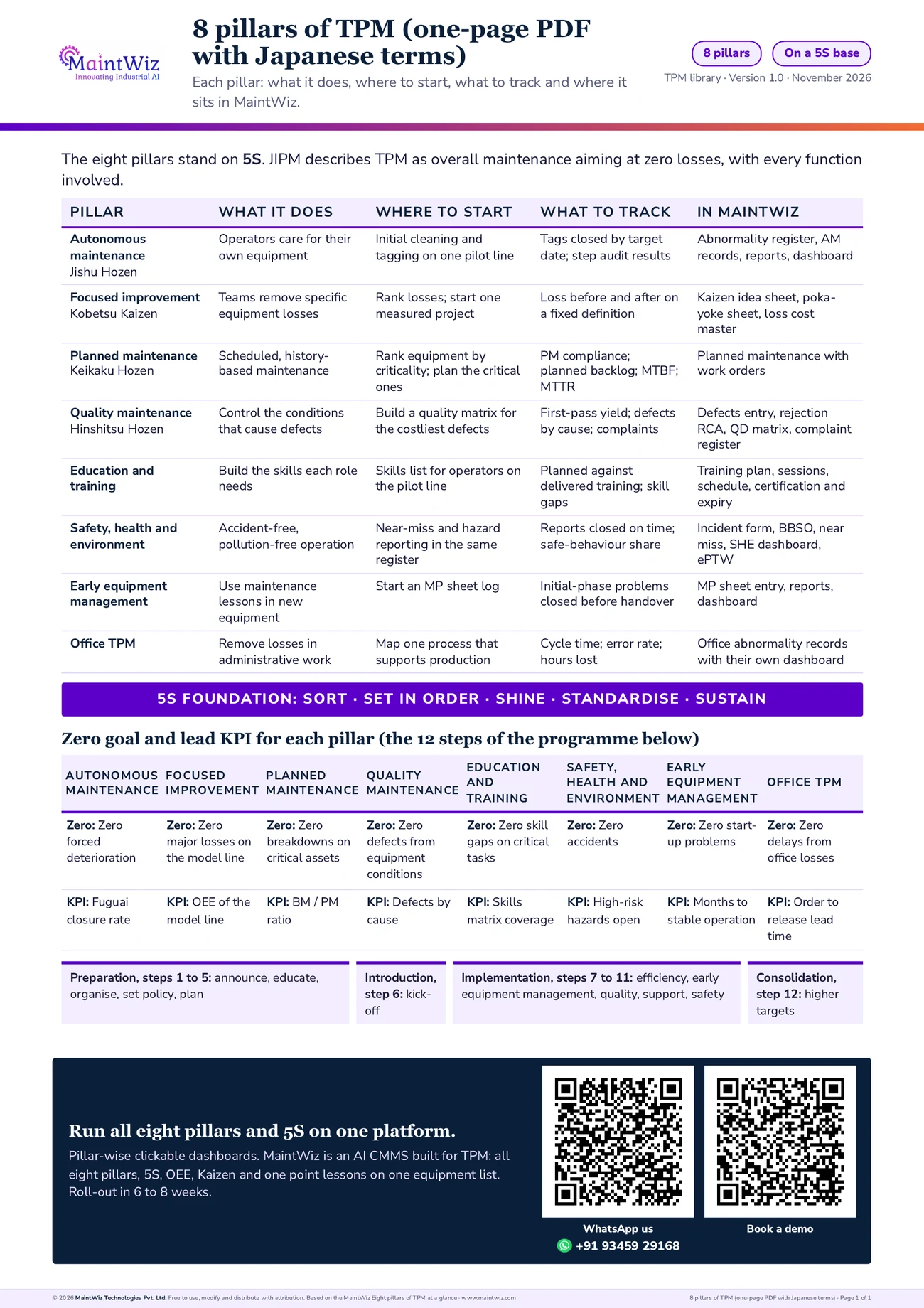
- 'Zero losses' is the aim the pillars work toward; JIPM groups the pillars as four core, two necessary and two optional.
- MaintWiz is an AI CMMS built for TPM: abnormality tags, CIL standards, OEE and its losses, Kaizen sheets and one point lessons are recorded together. All eight pillars, 5S, OEE, Kaizen and one point lessons run in one AI CMMS, operators capture on mobile, tags become work orders, IoT signals raise work orders and ePTW covers safety. The whole roll-out takes 6 to 8 weeks.
How to use it
How do you use this glossary?
The glossary groups terms into methods, the numbers used to judge them and the shop-floor tools (Figure 1).
A map of TPM terms
Methods, measures and tools, by group
Methods
- TPM
- Jishu Hozen
- Kobetsu Kaizen
- Keikaku Hozen
- Hinshitsu Hozen
Measures
- OEE and TEEP
- MTBF and MTTR
- PQCDSM
- Six big losses
Tools
- 5S and red tags
- CIL and OPL
- Poka-yoke
- A3 report
 maintwiz.comAI CMMS built for TPM
 WhatsApp us
 +91 93459 29168
 Book a demo
Downloads
TPM glossary pocket card and pillar reference files
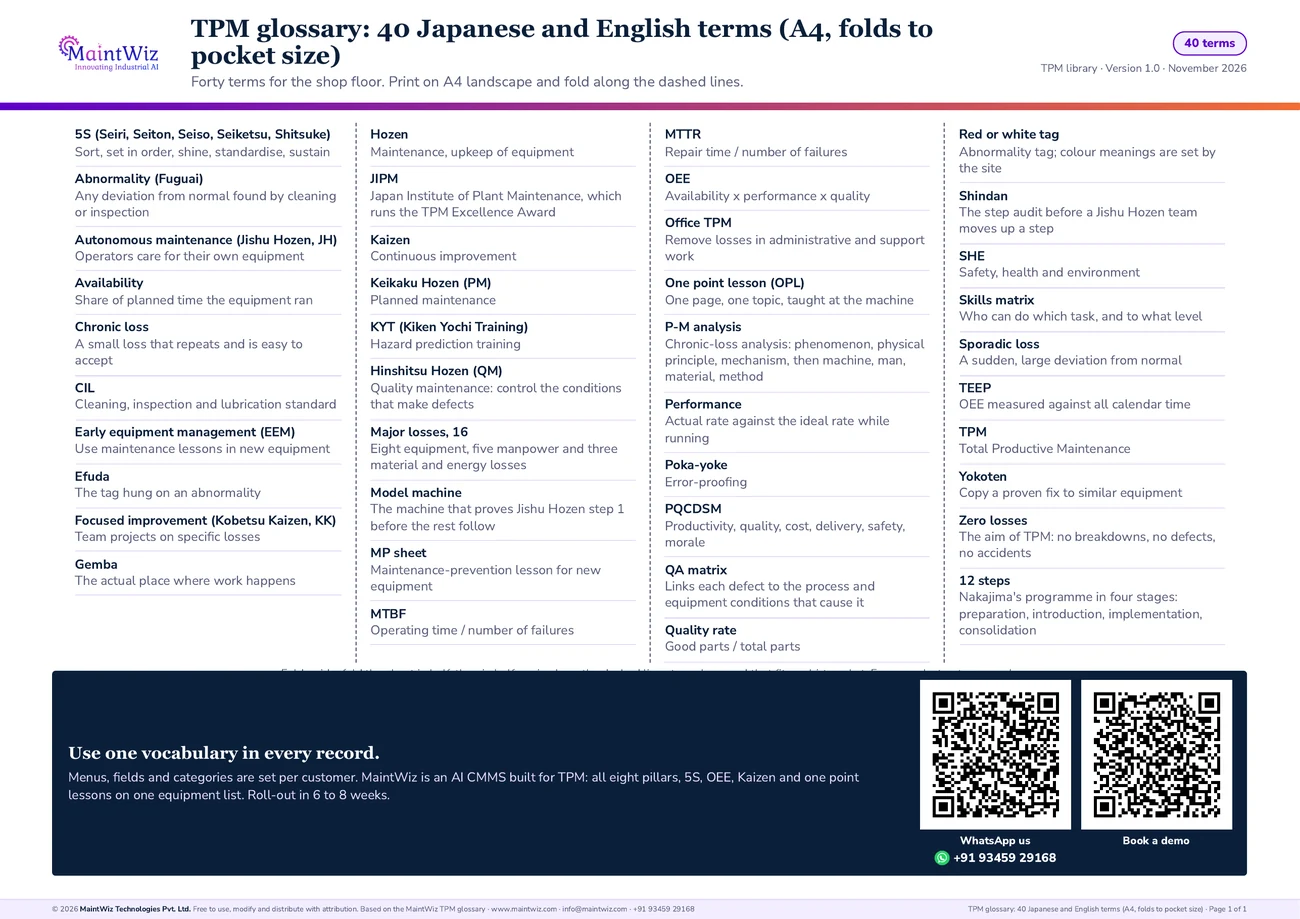
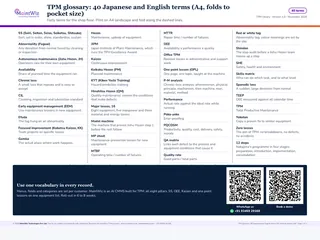 PDFTPM glossary: 40 Japanese and English terms (folds to pocket size)
Forty Japanese and English TPM terms on one A4 sheet that folds to pocket size
- Pages
- 1
- A4 landscape
- Created
- 5 November 2026
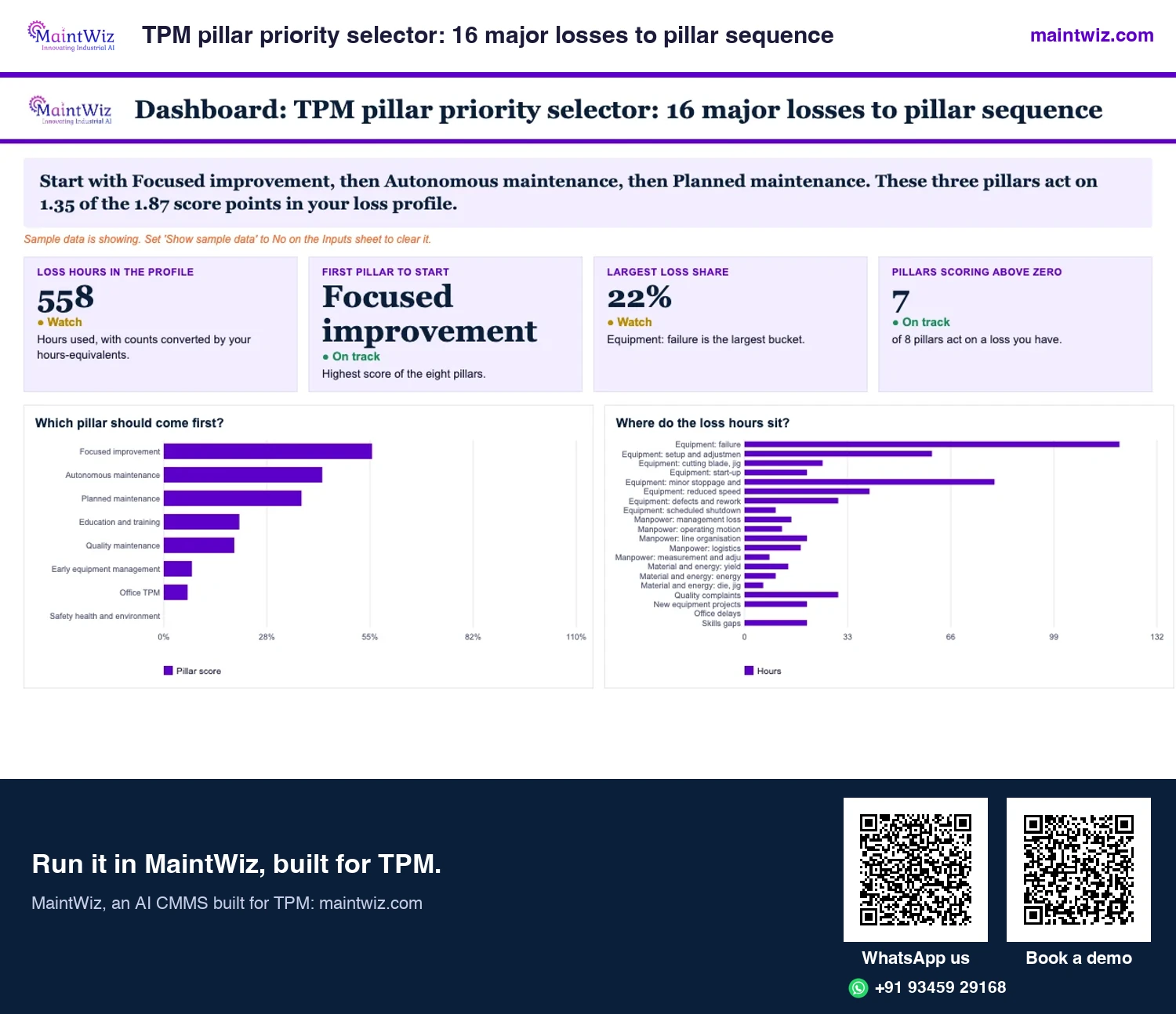
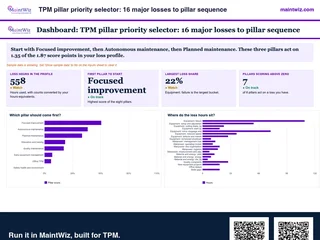 ExcelTPM pillar priority selector: 16 major losses to pillar sequence
Enter your 16 major losses and see which TPM pillar to start first
- Sheets
- Dashboard, Inputs, Mapping, Results, Read me
- A4
- Version
- v1.0, 2 November 2026
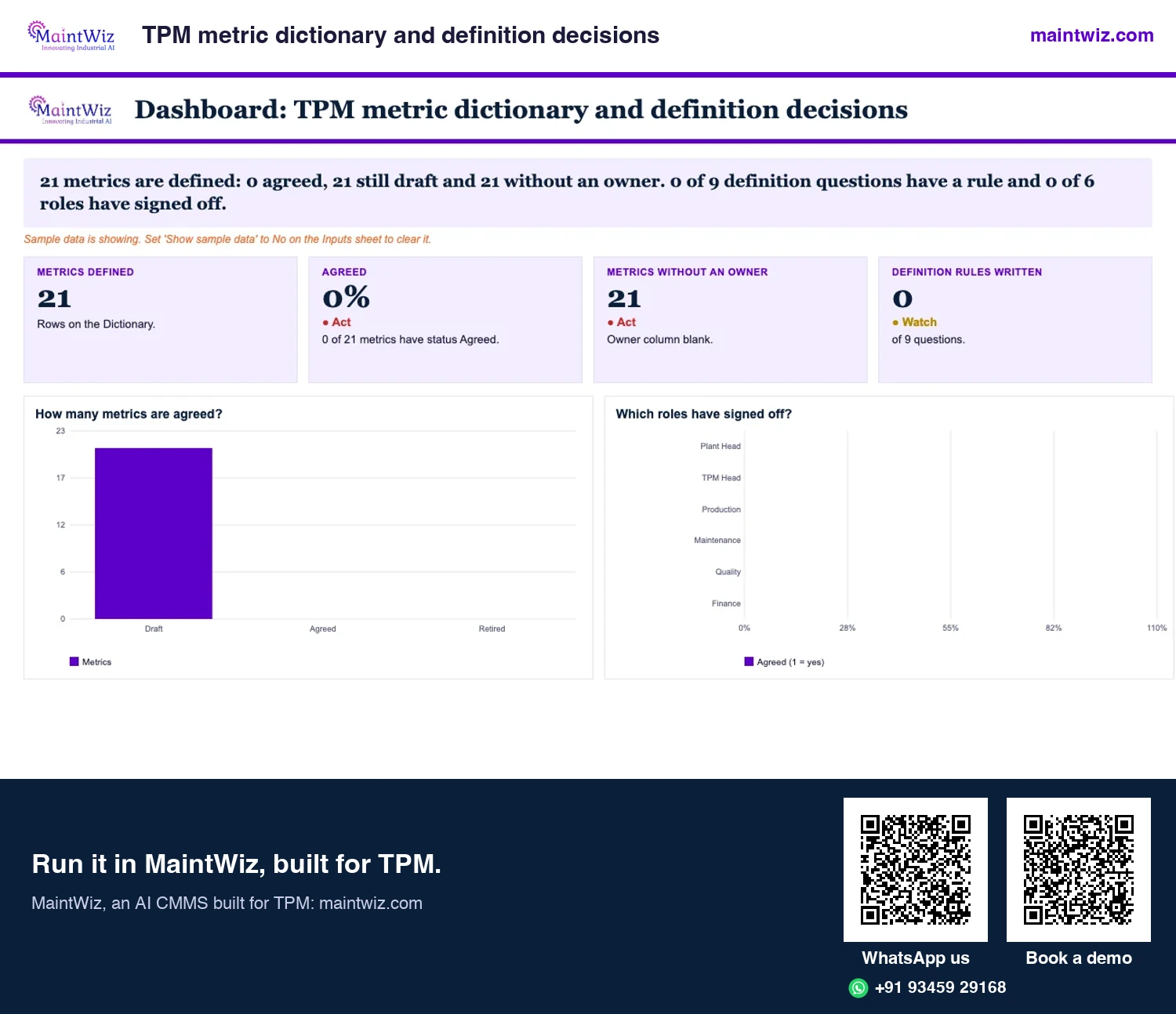
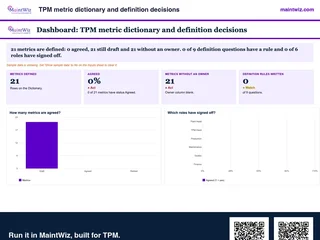 ExcelTPM metric dictionary and definition decisions
Twenty-one TPM metric definitions, including fuguai closure, BM / PM ratio, cost per unit and OTIF
- Sheets
- Dashboard, Inputs, Dictionary, Decisions, Sign-off, Read me
- A4
- Version
- v1.0, 2 November 2026
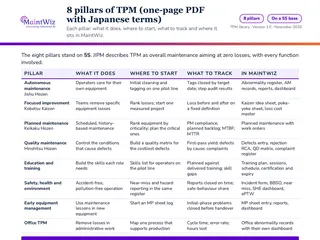 PDF8 pillars of TPM (one-page PDF with Japanese terms)
The eight pillars on one page with Japanese names, zero goal, lead KPI and where each sits in MaintWiz
- Pages
- 1
- A4
- Created
- 5 November 2026
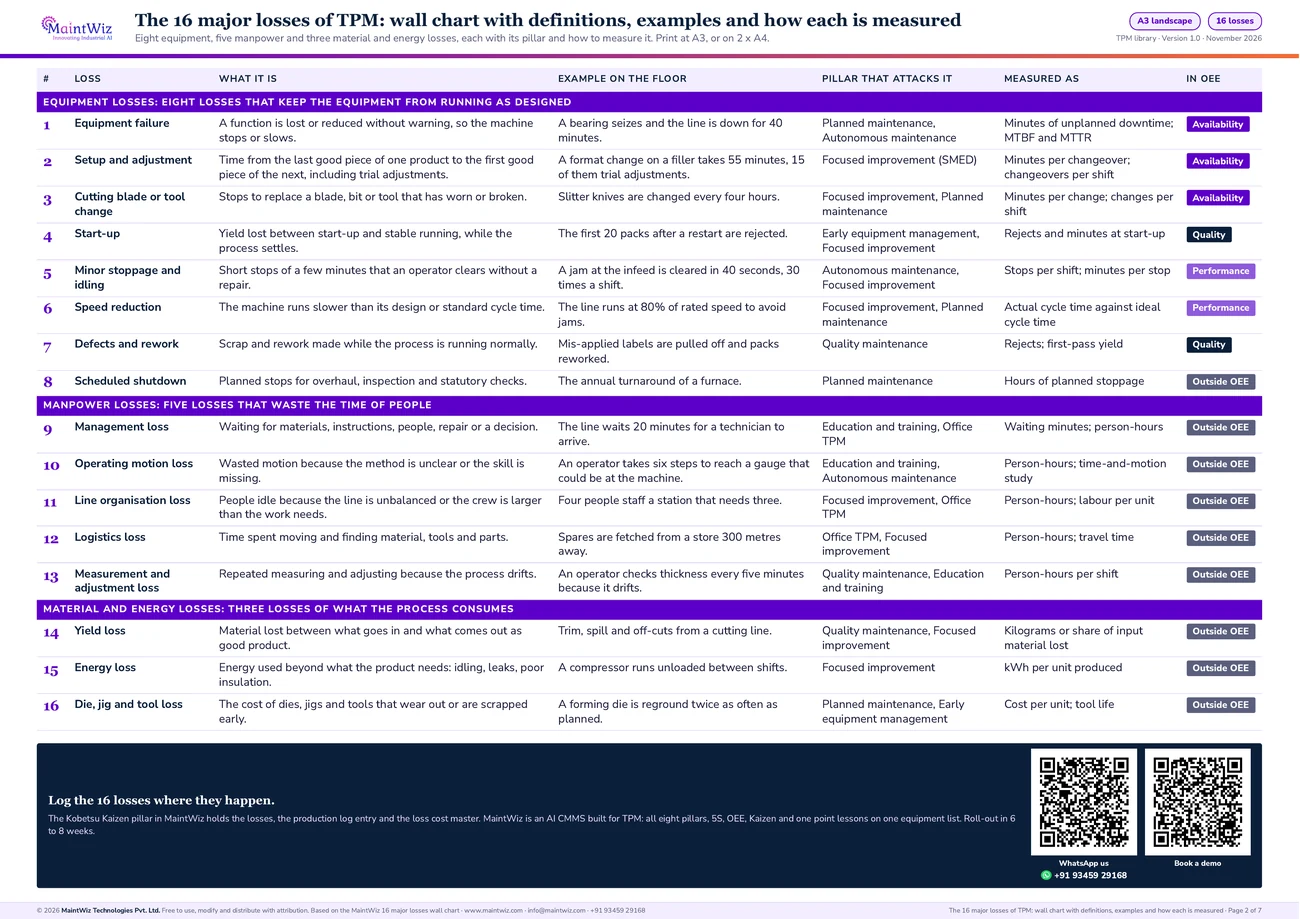
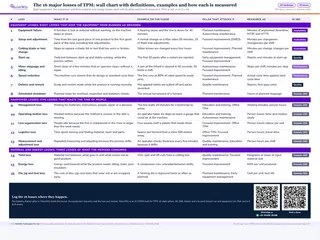 PDFThe 16 major losses of TPM: wall chart with definitions, examples and how each is measured
Keep the 16 major losses of TPM on the wall: eight equipment, five manpower and three material and energy, each with pillar and measure.
Inside: Eight equipment losses from equipment failure to scheduled shutdown · Five manpower and three material and energy losses · Definition, floor example, pillar and measure for each loss · How the losses roll up to OEE and where to start · A3 wall layout or 2 x A4
- Pages
- 7
- A4 landscape
- Created
- 5 November 2026
TPM terms
What do the TPM terms mean?
| Term | Japanese or original | Definition | Read more |
|---|---|---|---|
| 16 major losses | The wider TPM loss list: 8 equipment losses, 5 manpower losses and 3 resource losses. | 16 major losses | |
| 5S | Seiri, Seiton, Seiso, Seiketsu, Shitsuke | Workplace organisation method: sort, set in order, shine, standardise, sustain. The foundation of TPM. | 5S |
| Abnormality | Fuguai (malfunction, defect) | Any deviation from the normal condition of equipment, found by cleaning or inspection and recorded, often with a tag. | Abnormality |
| Andon | Andon (行灯) | A visual signal, such as a light or board, that calls attention to an abnormality at a machine or line so someone responds at once. | |
| Autonomous maintenance | Jishu Hozen | The TPM pillar in which operators take over basic care of their equipment: cleaning, inspection, lubrication. | Autonomous maintenance checklist |
| Availability | Operating time divided by planned production time; one of the three factors of OEE. | Availability | |
| Chronic loss | A loss that recurs because several small causes act together, so fixing one cause lowers it a little and it returns. | Chronic loss | |
| CIL | Cleaning, inspection and lubrication: the operator routine written as a standard for each equipment. | CIL | |
| CMMS | Computerised maintenance management system; software for asset records, work orders, schedules and history. | CMMS | |
| Early equipment management (EEM) | The pillar that applies maintenance experience to the design and commissioning of new equipment. | Early equipment management | |
| Education and training (E&T) | Kyoiku Kunren | The pillar that builds the skills each role needs for TPM. | Education and training |
| Focused improvement | Kobetsu Kaizen | The pillar in which cross-functional teams remove specific equipment losses through measured projects. | Focused improvement |
| Fuguai tag | Fuguai (malfunction, defect) | A tag fixed to equipment at the spot where an operator finds an abnormality, with a register entry that tracks it to closure. | Fuguai tag |
| Gemba | Gemba (the actual place) | The place where the work is done; to 'go to the Gemba' is to observe it directly. | Gemba |
| JIPM | Japan Institute of Plant Maintenance, which proposed TPM in 1971 and runs the TPM award system. | JIPM | |
| Kaizen | Improvement; the practice of continuous, small, team-based improvement. | Kaizen sheet format | |
| Kobetsu Kaizen (KK) | Individual-improvement teams that remove a specific equipment loss with a measured project. | Kobetsu Kaizen | |
| Maintenance prevention (MP) design | Using lessons from existing equipment to design new equipment that is easier to run and maintain; recorded on MP sheets. | Maintenance prevention | |
| MTBF | Mean time between failures: operating time divided by the number of failures. | MTBF | |
| MTTR | Mean time to repair: repair time divided by the number of failures. | MTTR | |
| Muda | Muda (無駄, waste) | Waste: any activity that uses time, material or effort without adding value for the customer. | |
| Mura | Mura (斑, unevenness) | Unevenness in workload, flow or quality that creates waste and overburden elsewhere. | |
| Muri | Muri (無理, overburden) | Overburdening people or equipment beyond what they can sustain, which causes breakdowns and errors. | Muri |
| OEE | Overall equipment effectiveness: availability x performance x quality. | OEE | |
| Office TPM | Kanri Kansetsu Bumon (TPM in administration) | Applying TPM's loss-elimination approach to administrative and support functions. | Office TPM |
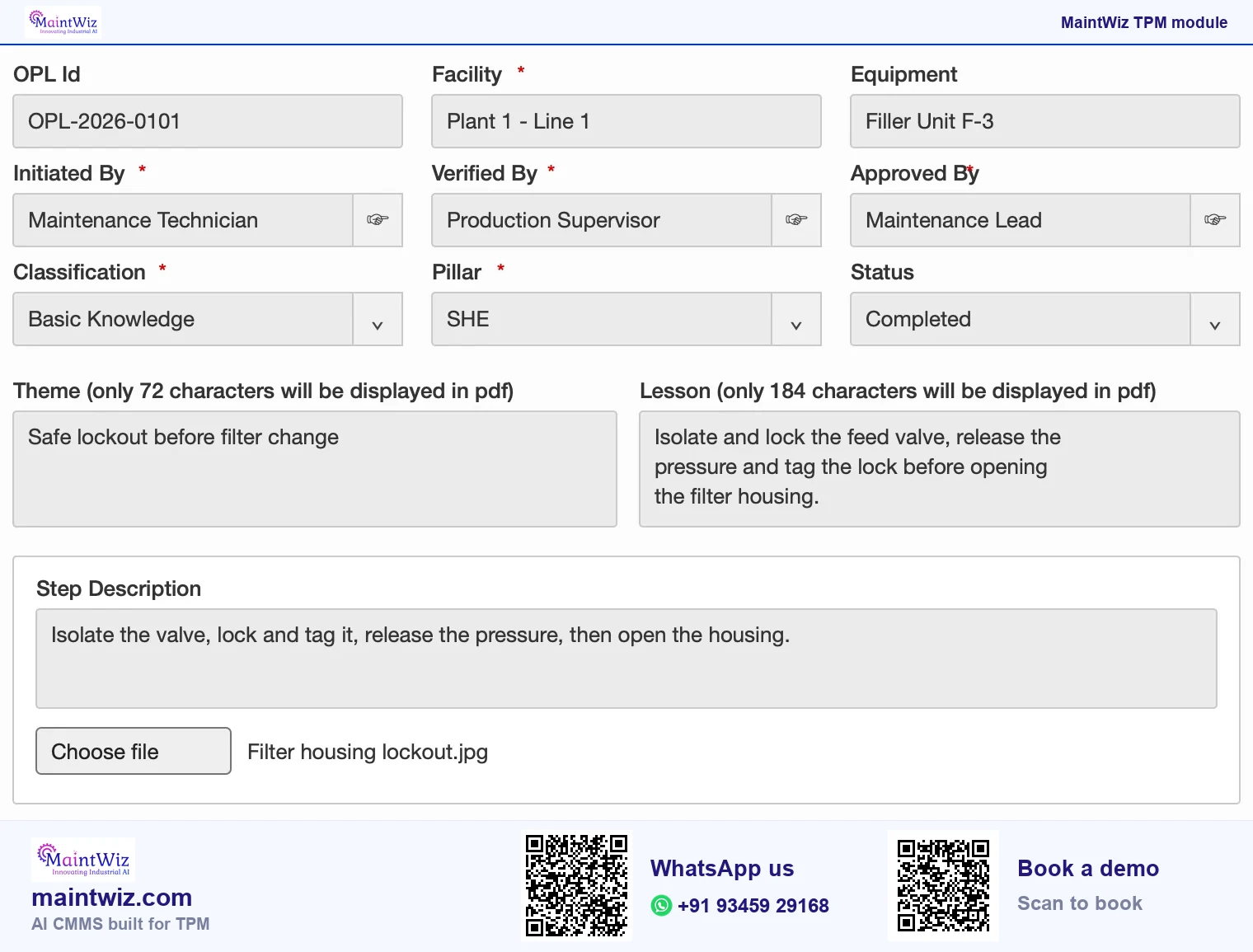
| One point lesson (OPL) | A one-page training sheet on a single topic. | One point lesson | |
| Performance | Ideal cycle time multiplied by total count, divided by operating time; one of the three factors of OEE. | Performance | |
| Planned maintenance | Keikaku Hozen | The pillar that builds a scheduled, history-based maintenance system. | Planned maintenance |
| P-M analysis | A focused-improvement method for chronic losses: describe the phenomenon, explain it physically, list every condition behind it and correct each one that is out of standard. | P-M analysis | |
| Poka-yoke | Error-proofing: a device or method that prevents a mistake or catches it before it passes on. | Poka-yoke | |
| PQCDSM | Productivity, quality, cost, delivery, safety and morale: the six groups of TPM results. | PQCDSM | |
| Quality | Good count divided by total count; one of the three factors of OEE. | Quality | |
| Quality maintenance | Hinshitsu Hozen | The pillar that prevents defects by controlling equipment conditions. | Quality maintenance |
| Red tag / white tag | Tags on equipment marking an abnormality; colour meanings are set by each site. | Red tag / white tag | |
| Safety, health and environment (SHE) | The pillar that works toward accident-free and pollution-free operation. | Safety, health and environment | |
| Seiso | Seiso (shine) | The third S: cleaning the equipment and its surroundings so that leaks, wear and loose parts show up. | Seiso |
| Seven steps of Jishu Hozen | The programme through which operators build autonomous maintenance: initial cleaning, countermeasures at sources, standards, general inspection, autonomous inspection, standardisation and full self-management. | Seven steps of Jishu Hozen | |
| Six big losses | Equipment breakdowns, setup and adjustment, idling and minor stops, reduced speed, process defects and rework, reduced yield at start-up. | Six big losses | |
| TEEP | Total effective equipment performance: like OEE but measured against all calendar time. | TEEP | |
| TPM | Total Productive Maintenance: equipment management in which operators and maintenance work together to remove equipment losses. | TPM | |
| TPM Excellence Award | The award JIPM presents to plants for their TPM results. | TPM Excellence Award | |
| Zero losses | The aim TPM works toward: no breakdowns, no defects and no accidents. Each pillar pursues part of it. | Zero losses |
Japanese terms
What do the Japanese terms mean?
TPM Japanese terms with kanji, romaji and English
Eight pillar names, the five S and the floor words
The eight pillar names
| Romaji | Kanji | English | Code |
|---|---|---|---|
| Kobetsu Kaizen | 個別改善 | Focused improvement | KK |
| Jishu Hozen | 自主保全 | Autonomous maintenance | JH |
| Keikaku Hozen | 計画保全 | Planned maintenance | PM |
| Hinshitsu Hozen | 品質保全 | Quality maintenance | QM |
| Kyoiku Kunren | 教育訓練 | Education and training | E&T |
| Anzen Eisei Kankyo | 安全衛生環境 | Safety, health and environment | SHE |
| Shoki Kanri | 初期管理 | Early equipment management | EEM |
| Kanri Kansetsu Bumon | 管理間接部門 | Office TPM | OT |
The five S
| Romaji | Kanji | English | S |
|---|---|---|---|
| Seiri | 整理 | Sort | 1S |
| Seiton | 整頓 | Set in order | 2S |
| Seiso | 清掃 | Shine | 3S |
| Seiketsu | 清潔 | Standardise | 4S |
| Shitsuke | 躾 | Sustain | 5S |
Words used on the shop floor
| Romaji | Kanji | English | Pillar |
|---|---|---|---|
| Kaizen | 改善 | Continuous improvement | all |
| Fuguai | 不具合 | Abnormality found on equipment | JH |
| Gemba | 現場 | The place where the work is done | all |
| Poka-yoke | ポカヨケ | Error-proofing | KK |
| Efuda | – | Tag hung on equipment at an abnormality | JH |
maintwiz.comAI CMMS built for TPMWhatsApp us+91 93459 29168Book a demo| Term | Meaning | Notes |
|---|---|---|
| Jishu Hozen | Self-maintenance, autonomous maintenance | Abbreviated JH |
| Kobetsu Kaizen | Individual or specific improvement, focused improvement | Abbreviated KK |
| Hinshitsu Hozen | Quality maintenance | Abbreviated QM |
| Fuguai | Malfunction, defect, abnormality | Fuguai tags mark abnormalities |
| Seiri, Seiton, Seiso, Seiketsu, Shitsuke | Sort, set in order, shine, standardise, sustain | The five S |
| Poka-yoke | Error-proofing | Sometimes written poka yoke |
| Gemba | The actual place where work happens | Also genba |
| Andon | Visual signal that calls attention to an abnormality | Light or board at the line |
| Muda | Waste | One of the three M: Muda, Mura, Muri |
| Mura | Unevenness | Spelled 斑 or in katakana |
| Muri | Overburden | Often paired with Muda and Mura |
Keep the terms at the line. Get the TPM glossary pocket card.
More terms
More terms used with TPM
| Term | Meaning |
|---|---|
| SMED | Single-minute exchange of die: a method for cutting changeover time |
| 5 whys | Asking why repeatedly to trace a problem to its root cause |
| Pareto chart | A ranked bar chart of causes or losses with a cumulative line |
| Fishbone diagram | A cause-and-effect diagram grouping possible causes by category |
| A3 report | The Kaizen A3 report: a one-page problem-solving format that sets out the background, current condition, target, root cause, countermeasures and follow-up |
| PDCA | Plan, do, check, act: a cycle for improvement |
| DMAIC | Define, measure, analyse, improve, control: the six sigma project sequence |
| Cycle time | Time to make one unit at a station |
| Ideal cycle time | The design or best demonstrated cycle time used in OEE performance |
| Loading | Planned production time divided by calendar time, used in TEEP |
| CILT | Cleaning, inspection, lubrication and tightening: CIL with the tightening check added |
| SOP | Standard operating procedure |
| Lockout/tagout | Isolating and locking energy sources before work on equipment |
| EAM | Enterprise asset management: software for the whole life of assets across sites, from acquisition to disposal |
| RCM | Reliability-centred maintenance: choosing tasks by failure mode and consequence |
| FMEA | Failure mode and effects analysis |
| PM | Preventive maintenance, or the planned maintenance pillar, depending on context |
Where each term lives in MaintWiz
Each of these terms has a record or report in MaintWiz, an AI CMMS built for TPM.
| Term | Where it lives in MaintWiz | Module page |
|---|---|---|
| Abnormality, red tag, white tag | Abnormality register with tags tracked to closure | Abnormality management software |
| Autonomous maintenance, CIL | Autonomous maintenance standards and reports | Autonomous maintenance software |
| OEE and the six big losses | OEE dashboard with the lost-hours Pareto | OEE software |
| Kobetsu Kaizen, Kaizen idea sheet | Kaizen projects with an owner and a result | Kaizen software |
| Rejection RCA, QD matrix | Quality defects, rejection RCA and complaints | Quality defect management software |
| 5S | 5S audit, reports and dashboard | 5S audit software |
| Planned maintenance | PM schedules, work orders and compliance | Preventive maintenance software |
| One point lesson (OPL) | One point lesson list and form | One point lesson software |
Book a demo to see these records on your own equipment list, or read how pricing is quoted.
PM can mean preventive maintenance or the planned maintenance pillar; autonomous maintenance vs preventive maintenance sets the operator checks against the preventive tasks.
What do the abbreviations stand for?
| Abbreviation | Meaning |
|---|---|
| JH | Jishu Hozen (autonomous maintenance) |
| KK | Kobetsu Kaizen (focused improvement) |
| QM | Quality maintenance |
| E&T | Education and training |
| SHE | Safety, health and environment |
| EEM | Early equipment management |
| OTPM | Office TPM |
| OPL | One point lesson |
| CIL | Cleaning, inspection and lubrication |
| OEE | Overall equipment effectiveness |
| MTBF / MTTR | Mean time between failures / mean time to repair |
| PQCDSM | Productivity, quality, cost, delivery, safety, morale |
FAQ
Frequently asked questions
What is a Fuguai in TPM?
A Fuguai is any abnormality an operator finds on equipment during cleaning or inspection: a leak, a loose bolt, a worn part or dirt at a source. It is tagged at the spot and tracked in the register until the countermeasure closes it.
What do JH, KK, QM and E&T mean in TPM?
JH is Jishu Hozen (autonomous maintenance), KK is Kobetsu Kaizen (focused improvement), QM is quality maintenance and E&T is education and training. They are abbreviations for four of the eight pillars.
What is the difference between OEE and TEEP?
Both measure how well equipment is used. OEE uses planned production time as its base; TEEP uses all calendar time, so it also shows capacity that was never scheduled.
What is the difference between a red tag and a white tag?
Both mark an abnormality on equipment. Colour meanings are set by each site; a common use is red for abnormalities needing maintenance support and white for ones the operating team can fix.
What is poka-yoke?
Poka-yoke is error-proofing: a device or method that prevents a mistake or catches it before it passes on, such as a fixture that accepts a part in only one orientation.
What is Gemba?
Gemba is the Japanese term for the actual place where work happens. Going to the Gemba means observing the process and equipment directly rather than relying on reports.
What is the difference between MTBF and MTTR?
MTBF is mean time between failures: operating time divided by the number of failures. MTTR is mean time to repair: repair time divided by the number of failures. MTBF reflects reliability; MTTR reflects repair speed.
What does SMED stand for?
Single-minute exchange of die. It is a method for cutting changeover time by separating steps done while the machine is stopped from those that can be done while it runs.
What is CIL in TPM?
CIL is the cleaning, inspection and lubrication standard for one piece of equipment: what to check, how, how often and the normal condition. Operators run it in autonomous maintenance, and the step audit checks that it is followed.
What are the Japanese names of the eight TPM pillars?
Jishu Hozen (autonomous maintenance), Kobetsu Kaizen (focused improvement), Keikaku Hozen (planned maintenance), Hinshitsu Hozen (quality maintenance), Kyoiku Kunren (education and training), Anzen Eisei Kankyo (safety, health and environment), Shoki Kanri (early equipment management) and Kanri Kansetsu Bumon (office TPM).
Sources
Sources
- JIPM, About TPM https://www.jipmglobal.com/about/tpm/
- JIPM, About TPM (pillars) https://jipmglobal.com/tpm/about_us_en