
Key takeaways
- TPM implementation follows 12 steps in four stages: preparation, introduction, implementation, consolidation.
- A pilot-first path of six or seven steps is common; start with readiness, definitions and one pilot area.
- Steps 1 to 6 prepare and start the programme; steps 7 to 12 build the pillars and consolidate.
- MaintWiz keeps owners, overdue tags, training records and 5S audits on one equipment list, so a stalling programme shows on the pillar dashboards before it stops.
- MaintWiz, an AI CMMS built for TPM, runs the routines of all eight pillars with 5S, OEE, Kaizen and OPL on one equipment list, with mobile capture, tag-to-work-order, IoT-triggered work orders and ePTW, and rolls out in 6 to 8 weeks.
Before you start
What should you do before you start TPM?
Two decisions come first. Choose a pilot area: one or two lines where losses are visible and operators and managers are willing, with enough data to measure a baseline. And set up the steering group: a sponsor with authority over production and maintenance, pillar owners and a TPM lead who meets the group on a fixed cadence. Management commitment and a promotion organisation are the two conditions every TPM programme needs before step 1, and MaintWiz gives both a record: goals and an event calendar in TPM Central, and a named owner on every tag and work order.
How to choose the pilot area
A weighted pilot area matrix
Scores 1 to 5 against five weighted criteria; safe access and baseline data are pass or fail
ILLUSTRATION
| Candidate | Visible losses 30% | Willing team 25% | Safe access 15% | Baseline data 15% | Fit for other lines 15% | Weighted score | Safe access and data 3+ |
|---|---|---|---|---|---|---|---|
| Filler line | 5 | 5 | 4 | 4 | 4 | 4.55 | Pass |
| Mixer | 3 | 4 | 4 | 3 | 3 | 3.40 | Pass |
| Press | 4 | 3 | 2 | 4 | 3 | 3.30 | Fail |
| Compressor house | 2 | 3 | 5 | 2 | 2 | 2.70 | Fail |
Highest weighted score among the passing candidates: Filler line
 maintwiz.comAI CMMS built for TPM
 WhatsApp us
 +91 93459 29168
 Book a demo
- Visible losses and willing leaders and operators.
- Safe access for cleaning and inspection.
- Baseline data available, or quick to collect.
- Representative of other equipment, so lessons transfer.
- Not so critical that a failed experiment is unaffordable.
A weighted pilot asset selection matrix makes the choice explicit.
Downloads
TPM implementation plan: master plan, 90-day roadmap and RACI matrix
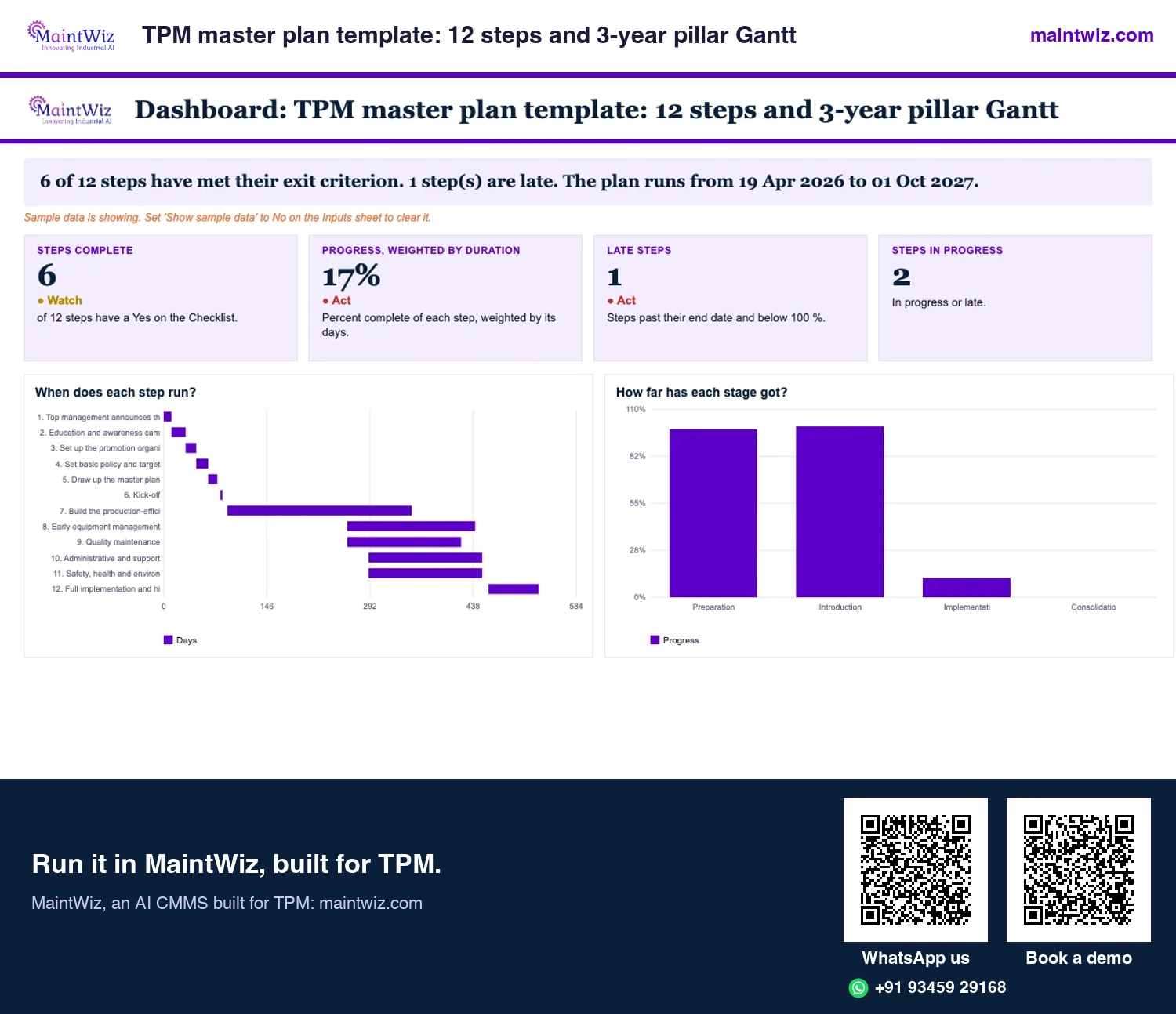
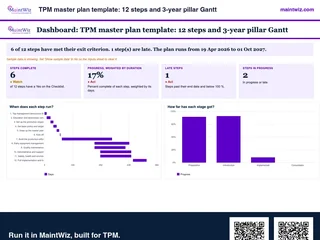 ExcelTPM master plan template: 12 steps and 3-year pillar Gantt
Plan the 12 TPM steps and a three-year Gantt by pillar and quarter
- Sheets
- Dashboard, Inputs, Plan, Pillar Gantt, Checklist, Read me
- A4
- Version
- v1.0, 2 November 2026
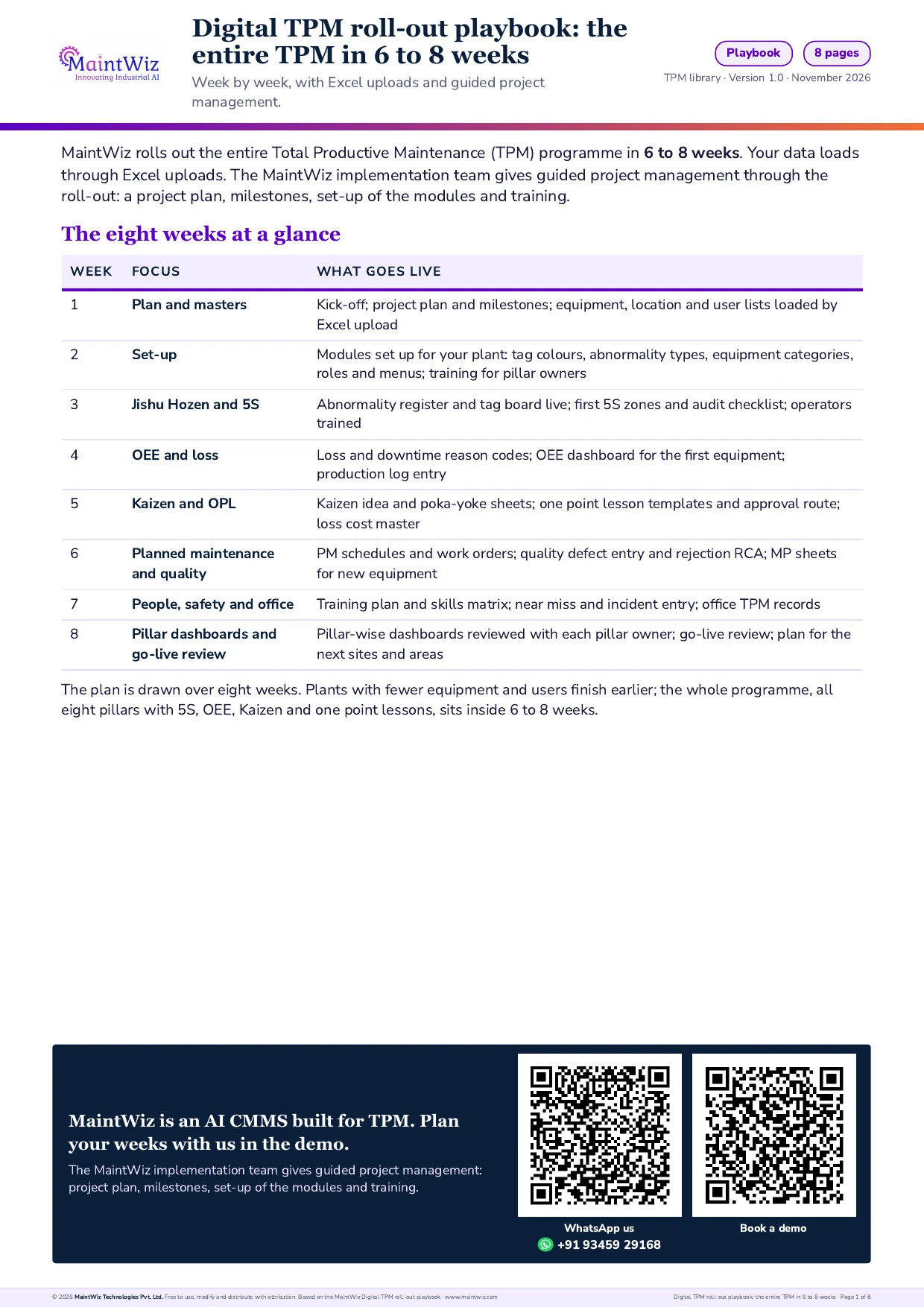
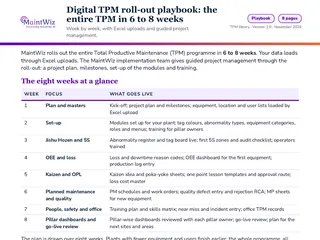 PDFDigital TPM roll-out playbook: the entire TPM in 6 to 8 weeks with Excel uploads
Plan the entire TPM going live in 6 to 8 weeks: week-by-week focus, Excel uploads, guided project management and the roles on both sides.
Inside: Eight weeks at a glance: what goes live each week · Before week 1: equipment list, locations, users and pillar owners · Excel uploads and guided project management · Roles of the plant team and the implementation team · Eight A4 pages
- Pages
- 8
- A4
- Created
- 5 November 2026
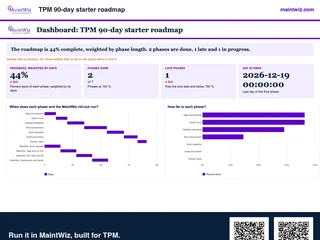 ExcelTPM 90-day starter roadmap
Seven dated phases for the first 90 days, with the 6 to 8 week MaintWiz roll-out running as a second lane
- Sheets
- Dashboard, Inputs, Roadmap, Read me
- A4
- Version
- v1.1, 4 November 2026
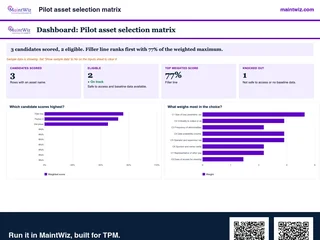 ExcelPilot asset selection matrix
Rank candidate assets on weighted criteria with safety and baseline-data gates
- Sheets
- Dashboard, Inputs, Criteria, Candidates, Read me
- A4
- Version
- v1.1, 4 November 2026
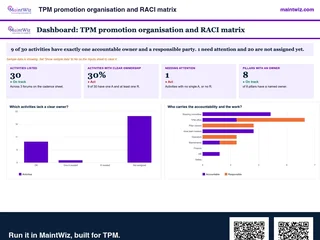 ExcelTPM promotion organisation and RACI matrix
Nine roles across 40 TPM activities with a one-accountable check
- Sheets
- Dashboard, Inputs, Pillars, RACI, Forums, Small groups, Org chart, Read me
- A4
- Version
- v1.0, 2 November 2026
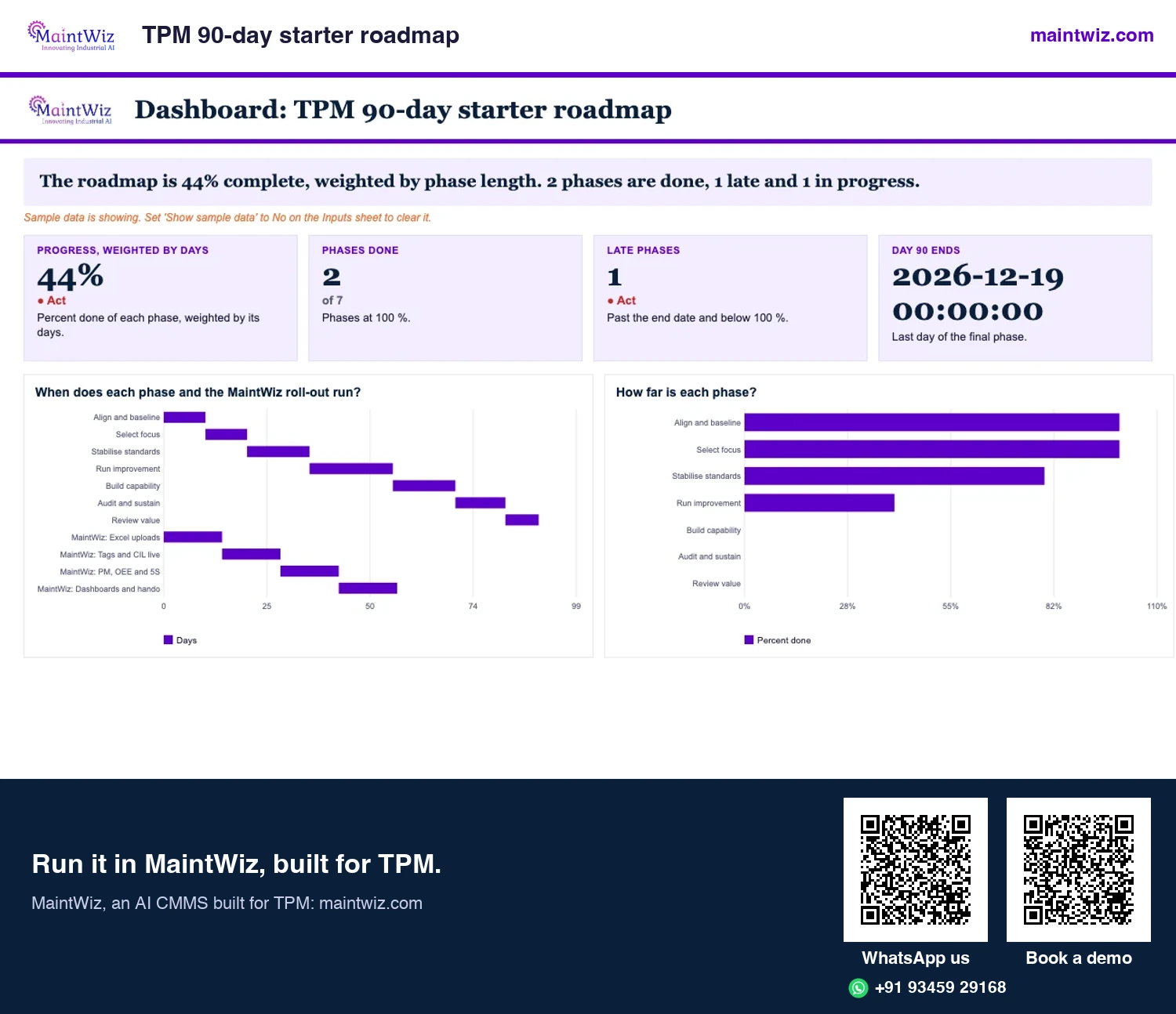
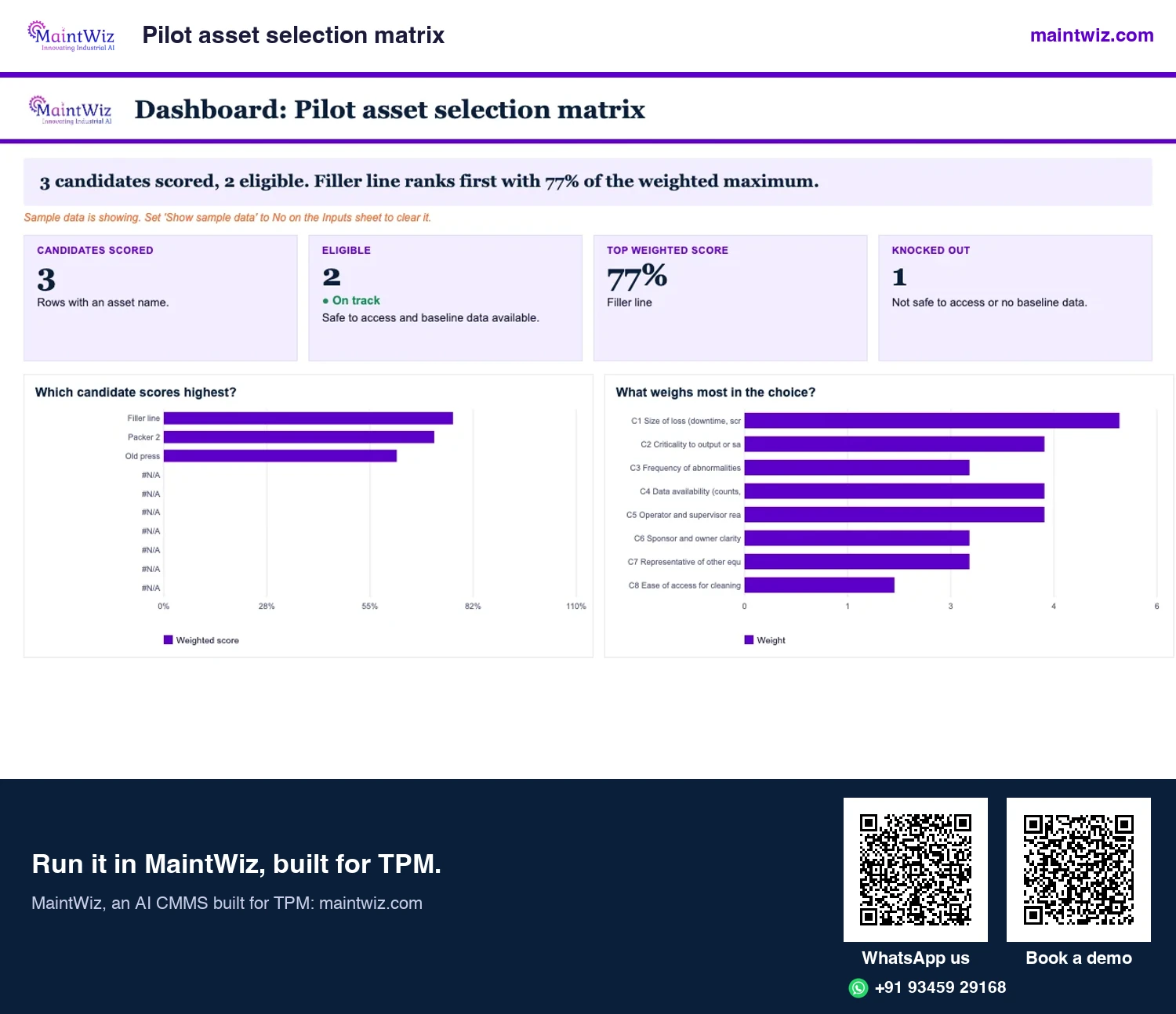
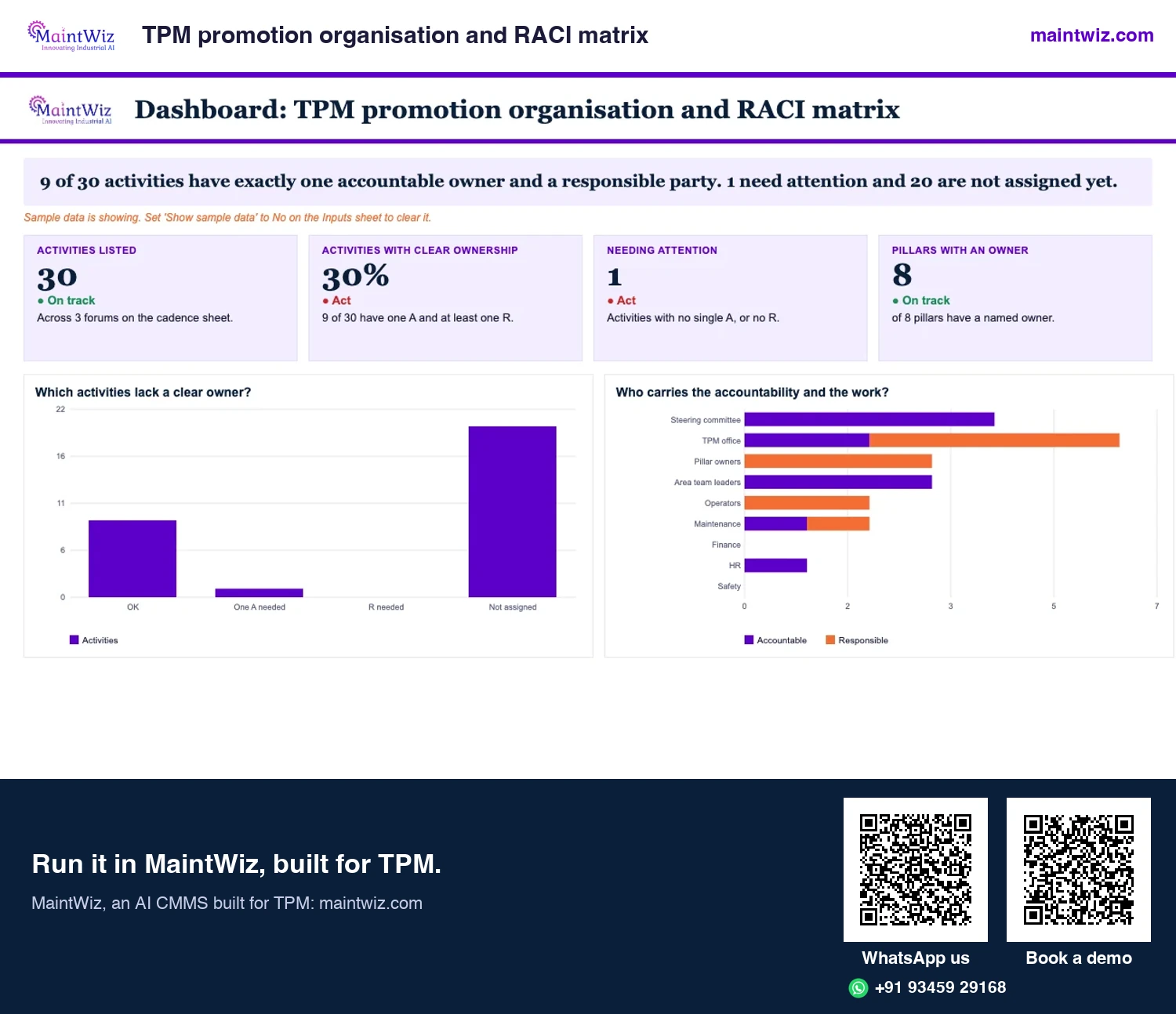
Plan your 6 to 8 weeks with us in the demo: masters by Excel upload, guided project management.
12 steps
What are the 12 steps of TPM?
The JIPM 12-step TPM programme and the MaintWiz record for each step
Four stages; step 7 is split into the four core pillar programmes
- 1
Top management announces the decision
MaintWiz: TPM Central news - 2
Education and awareness campaign
MaintWiz: TPM Central best practices - 3
Set up the promotion organisation
MaintWiz: TPM Central roles - 4
Set basic policy and targets
MaintWiz: TPM Central goals - 5
Draw up the master plan
MaintWiz: TPM Central event plan
- 6
Kick-off
MaintWiz: Kick-off event on the event plan
- 7.1
Focused improvement
Kobetsu Kaizen
MaintWiz: Kaizen idea sheet - 7.2
Autonomous maintenance, seven steps
Jishu Hozen
MaintWiz: Abnormality register - 7.3
Planned maintenance
Keikaku Hozen
MaintWiz: PM schedule - 7.4
Education and training
Kyoiku Kunren
MaintWiz: Training plan - 8
Early equipment management
Shoki Kanri
MaintWiz: MP sheet - 9
Quality maintenance
Hinshitsu Hozen
MaintWiz: QD matrix - 10
Office and support efficiency
Office TPM
MaintWiz: Office tags - 11
Safety, health and environment
Anzen Eisei Kankyo
MaintWiz: Near miss and incident
- 12
Full implementation and higher targets
MaintWiz: Hall of fame
Programme length 2.5 to 3 years (Shen 2015)
maintwiz.comAI CMMS built for TPMWhatsApp us+91 93459 29168Book a demoSeiichi Nakajima set out the 12-step programme, taught in four stages: preparation, introduction, implementation and consolidation.
| Stage | Step | What happens |
|---|---|---|
| Preparation | 1. Top management announces the decision | Leaders state they will introduce TPM and why |
| Preparation | 2. Education and awareness campaign | Everyone learns the basics of TPM |
| Preparation | 3. Set up the promotion organisation | Steering group and pillar owners |
| Preparation | 4. Set basic policy and targets | Written policy and measurable goals |
| Preparation | 5. Draw up the master plan | Sequence, dates and owners by pillar |
| Introduction | 6. Kick-off | Formal start, with customers and suppliers invited in some programmes |
| Implementation | 7. Build the production-efficiency system | Focused improvement, autonomous maintenance, planned maintenance, and education and training |
| Implementation | 8. Early equipment management | Lessons applied to new equipment and products |
| Implementation | 9. Quality maintenance | Conditions that prevent defects held under control |
| Implementation | 10. Administrative and support efficiency | Office TPM: the same loss thinking in support functions |
| Implementation | 11. Safety, health and environment | Safe working conditions and care for the environment built into every routine |
| Consolidation | 12. Full implementation and higher targets | Review results, raise targets, apply for external assessment such as the TPM Award |
What is a seven-step practical path?
The seven steps of Jishu Hozen
Seven steps, each audited before the next
Initial cleaning
Contamination and access
CIL standards
General inspection
Autonomous inspection
Standardisation
Self-management
Before step 1: preparation and training (sometimes called step 0)
maintwiz.comAI CMMS built for TPMWhatsApp us+91 93459 29168Book a demo| Practical step | Covers 12-step items | Output |
|---|---|---|
| 1. Check readiness and agree the goal | 1 to 4 | Readiness scores, policy, targets |
| 2. Define the losses and KPIs | 4, 5 | Metric dictionary, baseline |
| 3. Pick a pilot area and form teams | 3, 5 | Pilot charter, owners |
| 4. Start 5S and autonomous maintenance | 7 | Tag register, CIL standards, step audits |
| 5. Attack the biggest loss | 7 | Improvement projects, PM plan |
| 6. Train and standardise | 7 | Skills matrix, one point lessons |
| 7. Review, spread and sustain | 6, 8 to 12 | Management review, rollout plan |
Not to be confused with the seven steps of Jishu Hozen, the autonomous maintenance programme that runs inside step 7 of the 12-step programme.
Short versions with five, six or seven steps compress the 12-step programme; a five-step version usually reads: readiness and goals, definitions and baseline, a pilot with 5S and autonomous maintenance, an attack on the largest loss, then training, review and spread. The same material is grouped into four phases in the 12-step form: preparation, introduction, implementation and consolidation.
Master plan
What does a TPM implementation plan or master plan contain?
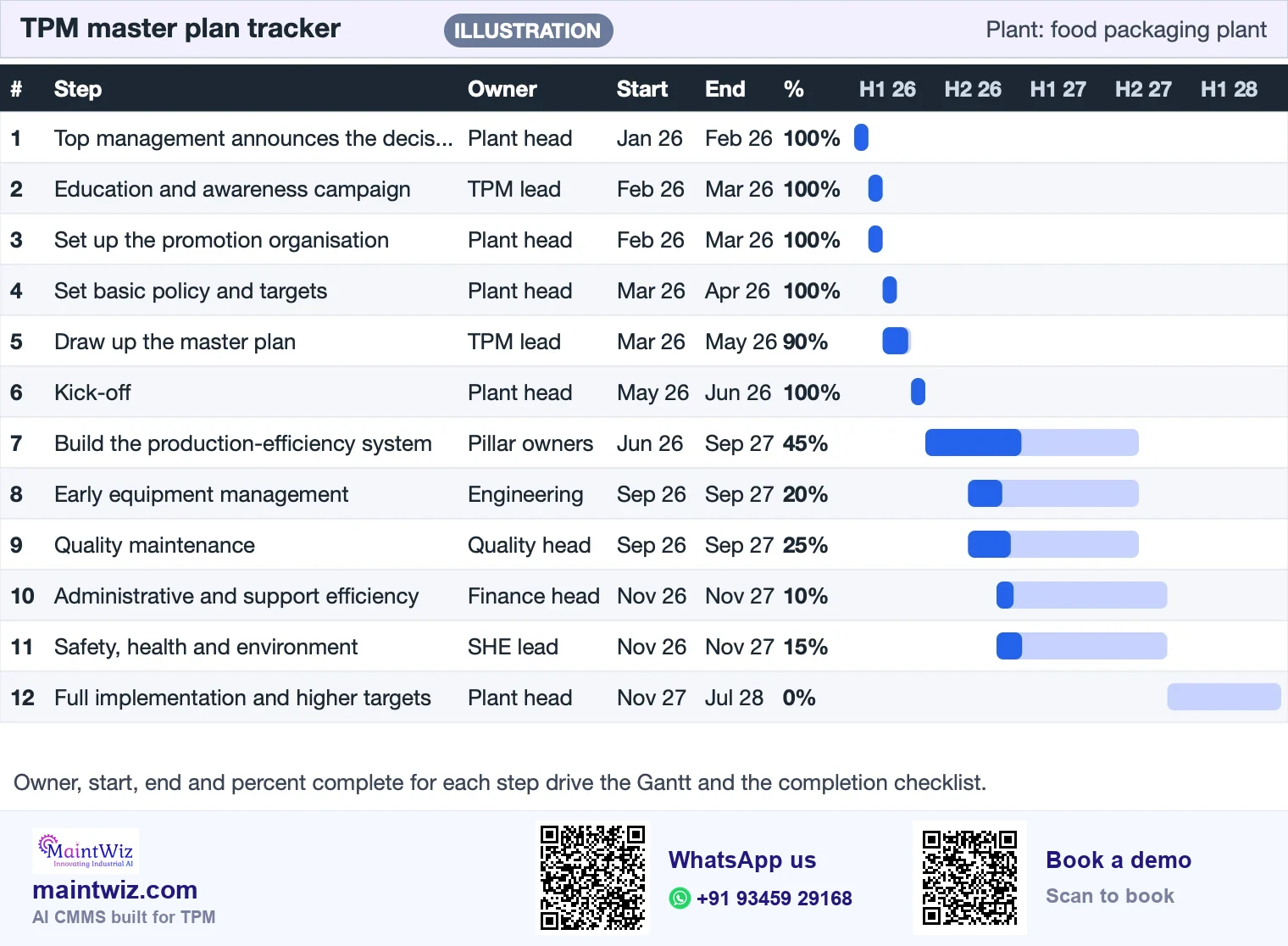
| Element | What it holds |
|---|---|
| Policy and targets | Why the plant is doing TPM and the measures that show progress, on fixed definitions |
| Organisation | Steering group, TPM lead, pillar owners, meeting cadence |
| Scope and sequence | Pilot areas first, then spread; which pillars start when |
| Activities by pillar | What each pillar does, with owners and dates |
| Training plan | Who needs what skill before each step |
| Milestones and reviews | Dated checkpoints and the management review cycle |
| Resources | Time given to operators, budget, tools and systems |
TPM roles and responsibilities defines the steering group and pillar owner roles; autonomous maintenance steps 0 and 1 is the operator routine that most pilots start with.
The first plant cycle: about 100 days
| Days | Focus | Output |
|---|---|---|
| 1 to 20 | Leadership and scope | Policy, targets, pillar owners, pilot areas chosen |
| 21 to 50 | Basics and data | 5S baseline audit, asset criticality, loss definitions, readiness re-score |
| 51 to 80 | First loops | Tag register live, first CIL standards, first loss Pareto, first projects |
| 81 to 100 | Review and plan | First management review, master plan with dates, training plan |
The first plant cycle is your own calendar for policy, pilot and review. The MaintWiz roll-out that runs its routines is a separate clock: 6 to 8 weeks, set out in the roll-out section below.
How long TPM takes
The programme runs for years; the software roll-out takes weeks
Full TPM programme
2.5 to 3 years
Large workforce
3 to 5 years
MaintWiz software roll-out
6 to 8 weeks
012345
Years from the start
Programme length: Shen (2015). Roll-out puts the routines on screen.
maintwiz.comAI CMMS built for TPMWhatsApp us+91 93459 29168Book a demo12 steps, 6 to 8 weeks
How does MaintWiz carry the 12 steps in 6 to 8 weeks?
The entire TPM can be rolled out on MaintWiz in 6 to 8 weeks. Data loads through easy Excel uploads, and the MaintWiz implementation team gives guided project management: project plan, milestones, set-up of the modules and training.
A 6 to 8 week roll-out with MaintWiz
Guided by the MaintWiz implementation team; data loads through easy Excel uploads
Weeks 1 to 2: set-up and Excel upload of the equipment list and master data
Weeks 3 to 4: modules and pillar routines configured with the implementation team
Weeks 5 to 6: operator training and live running in the pilot areas
Weeks 7 to 8: extension across areas and review of the dashboards
maintwiz.comAI CMMS built for TPMWhatsApp us+91 93459 29168Book a demo| Stage | What the MaintWiz team and your team do | What you have |
|---|---|---|
| 1. Excel upload | Equipment list, masters and users load through easy Excel uploads | One equipment list |
| 2. Modules configured | The implementation team sets up the modules, menus, roles and entitlements for your plant | Pillar modules ready |
| 3. Training and live running | Teams are trained and start recording tags, audits and losses | Routines running |
| 4. Extension and review | The roll-out extends to more areas and the team reviews the pillar dashboards | Dashboards in use |
| 12-step item | MaintWiz module that carries it |
|---|---|
| 7. Production-efficiency system | Autonomous maintenance software, abnormality register, OEE software, Kaizen and training management |
| 8. Early equipment management | MP sheet module |
| 9. Quality maintenance | Quality defect software |
| 10. Administrative and support efficiency | An office TPM view with its own dashboard of tag records |
| 11. Safety, health and environment | Near miss and BBSO software and ePTW |
Book a demo and bring your equipment list; we map your 12-step plan to the modules.
Pilot to rollout
How do you run the pilot, rollout and sustaining?
- Pilot: measure the baseline on agreed definitions, run the first loops (tags, CIL, one loss project) and review monthly.
- Rollout: spread area by area, using the pilot's standards and trained people as seed; do not start every area at once.
- Sustaining: layered audits, a visible scoreboard, regular management review, refreshed standards and recognition of the teams. Re-score readiness each quarter.
What does TPM implementation cost and who is needed?
Pricing for MaintWiz is quoted on request and tailored to the modules and users you need; see TPM software pricing. The main resources for the programme are people's time (operators for routines, a TPM lead, pillar owners, steering group meetings), training, materials for tags, boards and labels, any improvement projects' spending, and the TPM software that holds the records. Many plants build the programme with internal leaders and JIPM-affiliated or industry-body training; on the software side, the MaintWiz implementation team gives guided project management. The largest cost is usually time, so plan it explicitly and protect it.
| Role | What they do in implementation |
|---|---|
| Sponsor (plant head) | Announces the decision, sets policy, reviews progress, removes obstacles |
| TPM lead | Runs the programme, the master plan and the cadence |
| Pillar owners | Run each pillar's activities and measures |
| Area owners and operators | Run the routines and findings in the area |
| Maintenance and engineering | Coach operators, run improvement projects and planned maintenance |
| HR and training | Help with the skills matrix and training plan |
| Finance | Help validate benefits on agreed definitions |
TPM implementation checklist
- Leaders have announced the decision and given a reason.
- A steering group and pillar owners are named.
- Policy and measurable targets are written.
- Loss and KPI definitions are agreed and written down.
- A baseline is measured for the pilot area.
- The master plan has dates and owners.
- Training for the first steps is scheduled.
- Time for operator routines is in the shift plan.
- A review cadence is set and the first review is booked.
- A method to close tags and actions is in place.
Choosing a system to run these steps? Score MaintWiz with the TPM software buyer's guide and see pricing. Where you run SAP, read TPM software with SAP integration.
How to measure the baseline before you start
Pick the pilot equipment and collect, for a few weeks, the planned time, the stops with reasons, the count and the rejects. Write the OEE definition and loss codes down before collecting, so later figures are comparable. If records are poor, a simple tally sheet at the machine is enough. The baseline is what makes later improvement visible and defensible; see the OEE guide.
Training in the first plant cycle
Announce the decision and the reason before any training. Then train in the order the work happens: managers on their role and the review cadence, pillar owners on their pillar, pilot-area operators on cleaning and inspection and on how to raise and close a tag. Short sessions on the floor, with the equipment in view, are easier to apply than long classroom ones. Record who has been trained, because the skills matrix is also the evidence the programme is real.
- Week 1 to 2: sponsor briefing, steering group, definitions and baseline.
- Week 3 to 6: pilot-area training, 5S and initial cleaning.
- Week 7 to 12: first standards, first audit, first improvement project.
- Week 12 onward: management review of results and a decision on spreading.
KPIs
Which KPIs should an implementation track?
- Leading measures: tags raised and closed on time, step audits passed, training delivered, 5S scores, projects started and finished.
- Result measures: OEE and its factors, unplanned downtime, MTBF and MTTR, defects, near misses.
- Programme measures: master plan milestones met, review meetings held.
Report leading and result measures together, because results lag behind the routines.
Sustaining TPM after the first year
Programmes most often fade when the launch energy ends and the routines compete with output. Sustaining work is mostly administrative: keep the review cadence with the sponsor, keep step audits independent of the team being audited, keep the skills matrix current as people move, and refresh the standards when equipment or product changes. Recognise progress in public, and retire measures nobody acts on. JIPM's TPM awards add a staged external assessment.
- Quarterly: management review of results and tag ageing.
- Twice a year: re-audit steps already passed.
- Yearly: review targets, definitions and the master plan.
- On any equipment change: update standards and retrain.
Why it fails
Why do TPM implementations fail?
TPM programmes fail for four root causes: weak management commitment, no promotion organisation, too little training and 5S not in place. The practical failures that follow from them: no time for operators' routines, abnormalities found but not closed, projects without a baseline, a campaign with no master plan, and results reported on a changed definition. MaintWiz shows each one early: overdue tags, open 5S audit findings and training records sit on the pillar dashboards.
Why do TPM implementations stall, and how does MaintWiz prevent each cause?
| Cause | What helps | In MaintWiz |
|---|---|---|
| Leadership attention fades after the launch | A fixed review cadence with the sponsor; visible results on the board | The JH dashboard and pillar dashboards show open, closed and completed tags and cumulative closure, so the review starts from current figures. |
| Operators have no time for routines | Reduce the routine through step 2; put it into the shift plan | Operators raise a tag from a phone at the machine and see their own area's open items, so the routine stays short. |
| Tags raised but not closed | Owners and dates; overdue list in the review | Overdue alerts show what has passed its target date, and a tag converts to a work order with an owner. |
| Results cannot be shown | Fix definitions and baseline before starting | The OEE dashboard per equipment shows loss stratification, daily OEE and a lost-hours Pareto on the definitions you fixed. |
| Projects stall | Scope to weeks; one theme at a time; a sponsor who clears obstacles | The Kaizen idea sheet and the loss data sit on the same equipment list, so a project starts from a ranked loss. |
| Spreading too fast | Pass the pilot's step audits before opening new areas | Areas are added on the same equipment list; 5S audit compliance and training records show which areas are ready. |
Which self-assessments and checklists help?
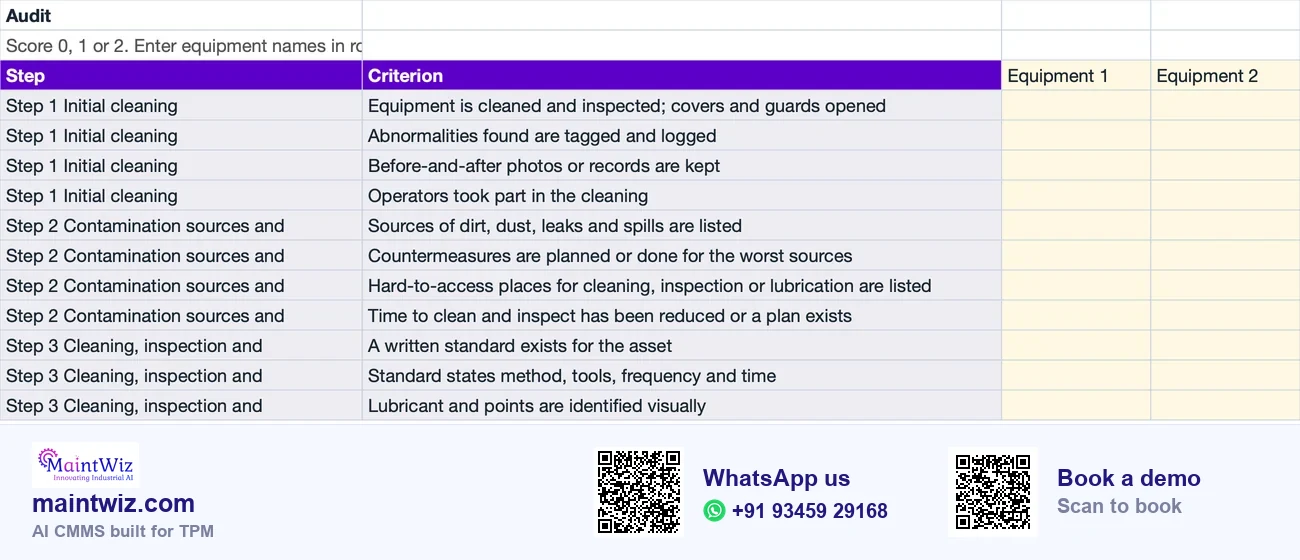
Use the TPM readiness self-assessment before you start and each quarter, the autonomous maintenance checklist and step audit for the operator routine, and the TPM templates and tools library for the rest. Plants in India can also follow CII's certificate path: CII TPM Club certificates and the EOT award.
Reviews of TPM implementation (Ahuja and Khamba 2008; Marin-Garcia and Mateo 2013; Chaurey and colleagues 2023) name the same causes of stalled programmes: weak management commitment, no promotion organisation, too little training and 5S not in place.
Next steps
Next steps
- Book a demo and bring your equipment list; we load it from Excel and map your 12 steps.
- Score readiness in ten minutes and bring the result to the demo: TPM self-assessment.
- See how the pillars run in a system: TPM software.
FAQ
Frequently asked questions
How do you implement TPM step by step?
Check readiness, set policy and targets, choose a pilot area, start 5S and autonomous maintenance, attack the largest loss with focused improvement and planned maintenance, train, then review and spread. The 12-step programme gives the full sequence.
What are the 12 steps of TPM?
Preparation: 1 announce the decision, 2 run an education campaign, 3 set up the promotion organisation, 4 set policy and targets, 5 draw up the master plan. Introduction: 6 kick-off. Implementation: 7 build the production-efficiency system (focused improvement, autonomous maintenance, planned maintenance, education and training), 8 early equipment management, 9 quality maintenance, 10 office and support efficiency, 11 safety, health and environment. Consolidation: 12 sustain and raise targets.
How long does TPM implementation take?
A full TPM programme in the plant runs for years. The entire TPM can be rolled out on MaintWiz in 6 to 8 weeks, with easy Excel uploads and guided project management from the MaintWiz implementation team.
Why do TPM implementations fail?
Four root causes: weak management commitment, no promotion organisation, too little training and 5S not in place. In practice they show as no time for operators' routines and tags found but never closed; MaintWiz puts both on the pillar dashboards.
How do you choose a TPM pilot area?
Choose one or two lines where losses are visible, leaders and operators are willing, safe access is possible and baseline data exists. Score candidates on weighted criteria, with must-have checks for safety and data.
What is a promotion organisation in TPM?
It is the structure that runs the programme: a steering group led by a sponsor, a TPM lead and a leader for each pillar, meeting on a fixed cadence. MaintWiz gives each pillar leader the pillar's dashboard.
What is a TPM master plan?
A master plan sets the sequence, dates and owners of activities by pillar over the programme, with milestones and review points. Keep it visible and revise dates that slip, so it stays a working document.
What does TPM implementation cost?
Pricing for MaintWiz is quoted on request and tailored to the modules and users you need. The largest plant cost is operator time, so plan it in the shift plan, along with training, materials for tags and boards, and any improvement projects.
Do you need a consultant to implement TPM?
No. Many plants build the programme with internal leaders and industry-body training; others use consultants for coaching. On the software side, the MaintWiz implementation team gives guided project management.
Sources
Sources
- JIPM, About TPM https://www.jipmglobal.com/about/tpm/
- Shen, C.C. (2015). Discussion on key successful factors of TPM in enterprises. Journal of Applied Research and Technology 13(3), 425-427. https://elsevier.es/es-revista-journal-applied-research-technology-jart-81-articulo-discussion-on-key-successful-factors-S1665642315000371
- Ahuja, I.P.S. and Khamba, J.S. (2008). Total Productive Maintenance: literature review and directions. International Journal of Quality & Reliability Management 25(7), 709-756. https://www.emerald.com/ijqrm/article/25/7/709/149131/Total-productive-maintenance-literature-review-and
- Marin-Garcia, J.A. and Mateo Martinez, R. (2013). Barriers and facilitators of the TPM implementation. Intangible Capital 9(3). https://www.intangiblecapital.org/index.php/ic/article/view/360
- Chaurey, S., Kalpande, S.D., Gupta, R.C., Toke, L.K. (2023). Journal of Quality in Maintenance Engineering 29(1), 114-135. https://emerald.com/insight/content/doi/10.1108/JQME-11-2020-0118/full/html
- JIPM, TPM Awards https://www.jipmglobal.com/service/tpm-awards/