
Plant shutdown guide
What Is Shutdown Maintenance?
Shutdown maintenance is planned maintenance work carried out while a plant, or part of a plant, is deliberately taken out of service. It covers work that cannot be done safely or practically while equipment runs, such as intrusive inspection, major repair and modification. The work is scoped and scheduled well in advance; large periodic events are commonly called turnarounds.
In this guide, shutdown maintenance means the work, and a shutdown is the stop itself.
How MaintWiz helps: Most shutdowns still run on spreadsheets, calls and paper. The MaintWiz shutdown module moves the plan from spreadsheets into one system with a critical path, readiness gates, permits and spares status. See the module · Get the 40-step checklist
By Jai Balachandran · Published · Last reviewed
What MaintWiz adds:Critical path and floatReadiness gatesPermits and isolationsSpares status with SAP
Terms
How do shutdown, turnaround and outage fit together?
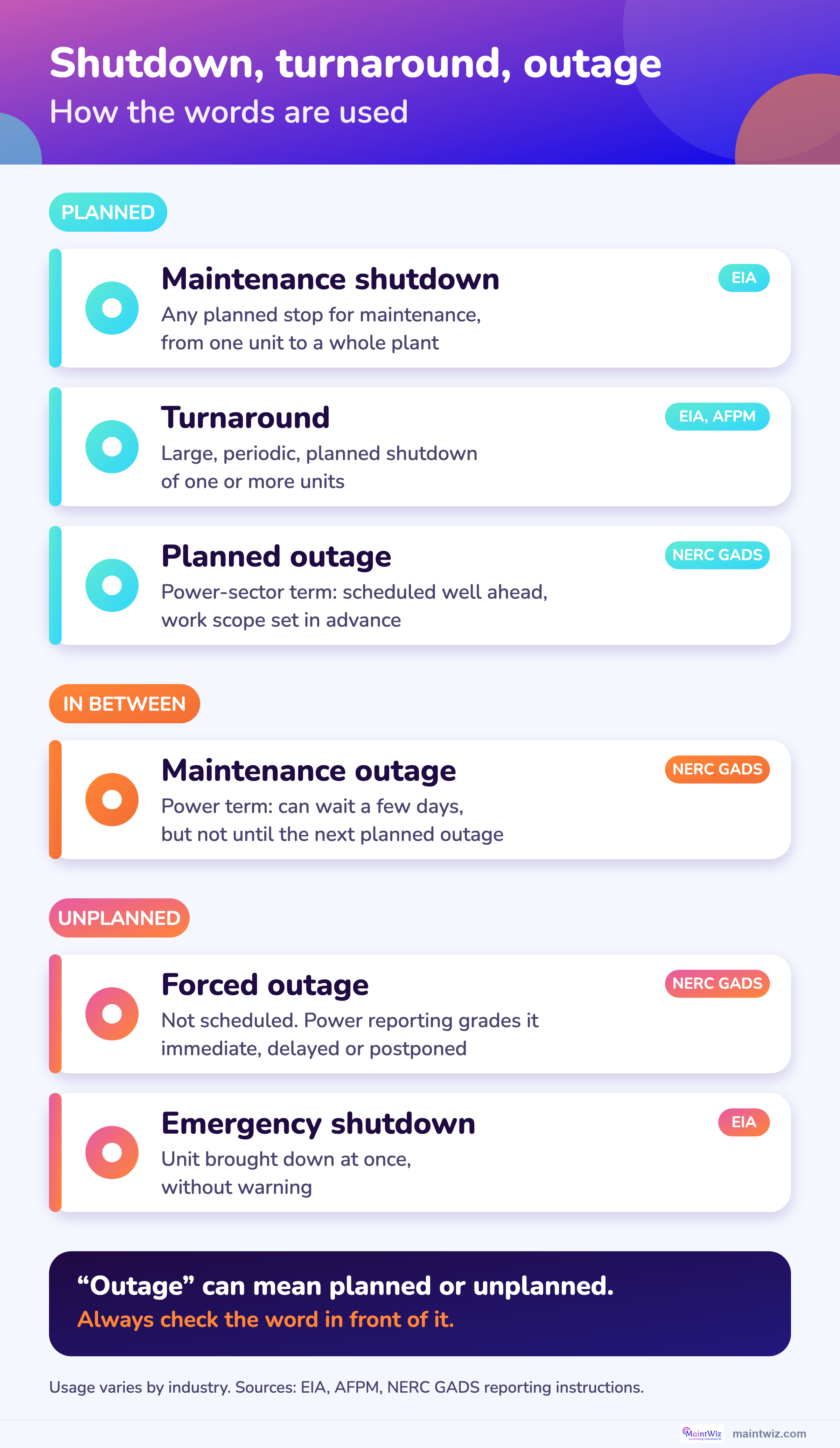
Shutdown, turnaround and outage all describe a plant or unit being out of service, but the words are used differently by industry. A turnaround is usually the large, planned, periodic form of shutdown. “Outage” can mean a planned or an unplanned stop, so check the word in front of it.
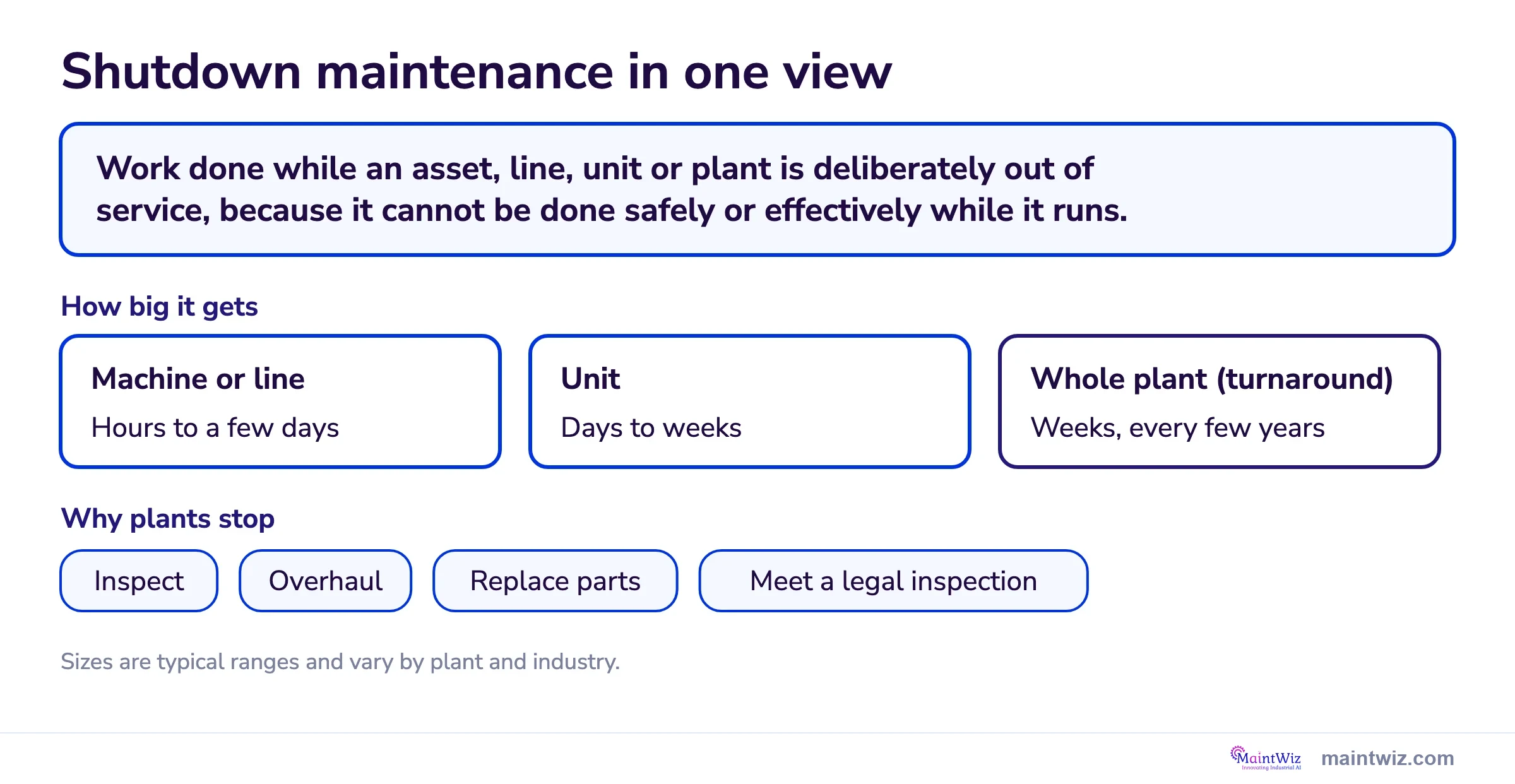
Use the three boxes to place your own stop: hours to a few days for a machine or line, days to weeks for a unit, weeks every few years for a turnaround. The four reasons below them are the usual basis for the scope. Decide which one drives the next stop, then size the plan and lead time to match.
Access
Intrusive work needs equipment emptied and isolated. HSE guidance says to plan intrusive maintenance for shutdown periods to minimize isolation requirements. 7
For the cost difference, see planned vs unplanned shutdown cost.
Purpose
EIA gives the purposes of a turnaround as maintenance, inspection and repair, replacing process materials and equipment that have worn out or broken, and ensuring safe and efficient operation. 1
Statutory inspection
Some stops are driven by law. India’s Boilers Act, 2025 provides that a boiler certificate authorizes use for a period not exceeding twelve months (section 12(6)), and the Factories Act (replaced by the OSH Code, 2020 from 21 November 2025) lets state governments make rules for the examination and testing of pressure plant (section 31(2)). The 2025 Act came into force on 1 May 2025. 15,14
Vs preventive
How is shutdown maintenance different from preventive maintenance?
Preventive maintenance is a type of maintenance task. Shutdown maintenance is a way of scheduling work in a window when equipment is out of service, and it can include preventive tasks, inspection, corrective repair, replacement and modification.
The US Department of Energy’s Federal Energy Management Program defines preventive maintenance as actions performed on a time- or run-time-based schedule that detect, preclude or mitigate degradation, to sustain or extend useful life. Predictive maintenance, by contrast, uses measurements that detect the onset of degradation. Both kinds of work can be placed in a shutdown window. 6
| Aspect | Routine preventive maintenance | Shutdown maintenance |
|---|---|---|
| Equipment state | Usually one asset at a time, often while the rest of the plant runs | Plant or unit out of service |
| Work volume | One or a few work orders | Many work orders at once, some in a set sequence |
| Planning | Standing schedule | Project-style plan with scope, budget, critical path and approvals |
| Types of work | Scheduled preventive tasks | Preventive, inspection, corrective, replacement, modification and statutory work |
The UK Health and Safety Executive advises minimising isolation requirements wherever practicable by planning intrusive maintenance for shutdown periods. 7
Scope
What is shutdown maintenance work, and what goes into it?
A shutdown’s work scope is the planned scope plus any approved work found along the way. Plants that run continuously, such as power plants and refineries, generally have larger and more complex scopes than plants that run in shifts.
- Maintenance backlog set aside for the shutdown window
- Inspections that need equipment out of service, such as boilers and pressure vessels
- Cleaning, inspection and repair of utilities, pipelines and storage tanks
- Corrective work on known defects and performance deterioration
- Planned preventive tasks and improvements identified by predictive maintenance
- Replacement or overhaul of equipment and components
- Modifications, such as pollution-control or energy-saving retrofits
- Safety and reliability improvements
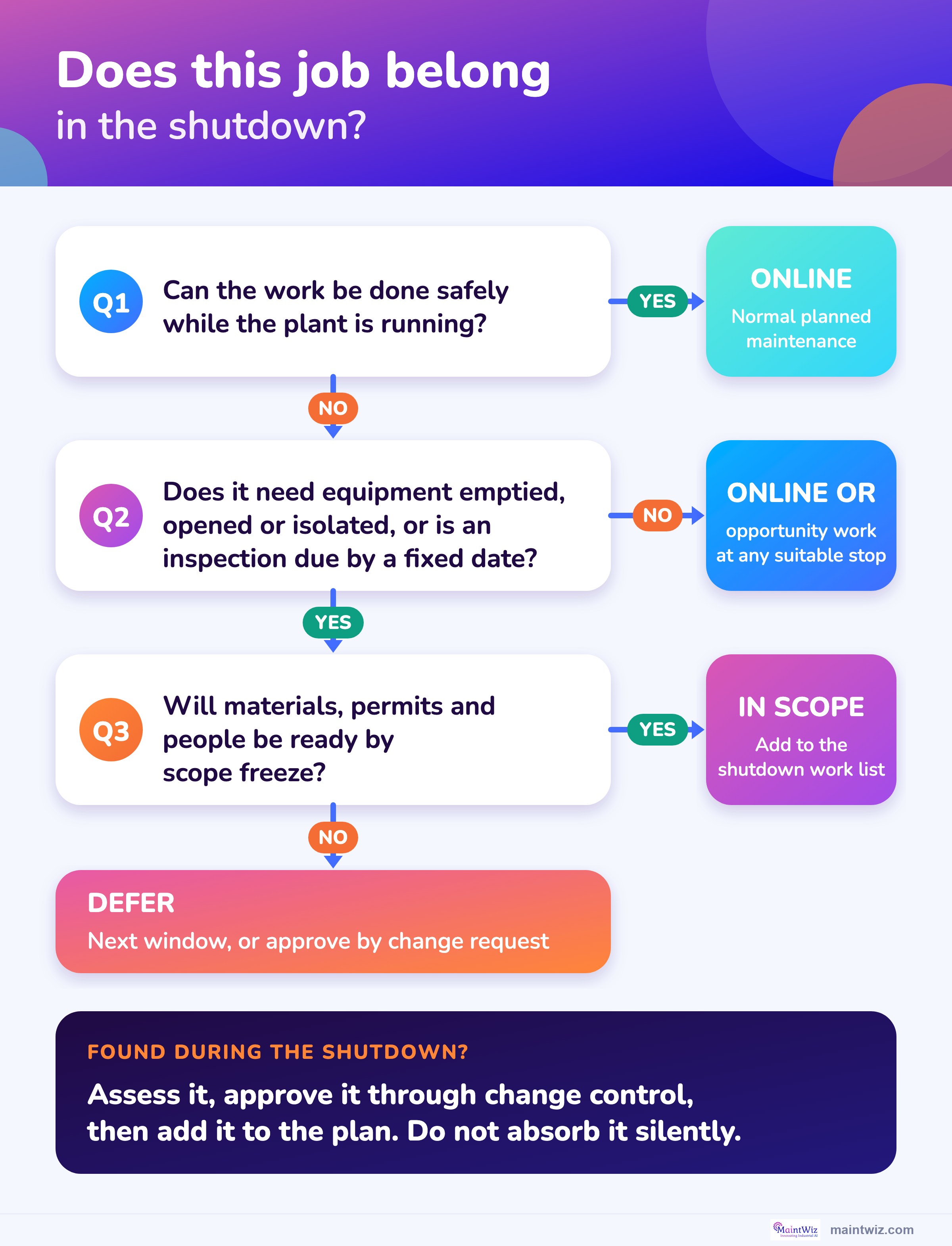
A simple test for whether a job belongs in the shutdown
- Q1Can the work be done safely while the plant is running?YES → ONLINENormal planned maintenanceIf no, go to Q2
- Q2Does it need equipment emptied, opened or isolated, or is an inspection due by a fixed date?NO → ONLINE OR OPPORTUNITY WORKAt any suitable stopIf yes, go to Q3
- Q3Will materials, permits and people be ready by scope freeze?YES → IN SCOPEAdd to the shutdown work listIf no, defer to the next window, or approve by change request
Planned scope and discovered work are different things. NERC’s generator reporting rules require that for a planned outage the individual tasks be determined in advance as the “original scope of work”, and treat discovery work and re-work as outside it. In practice, fix the scope early and assess newly found work through a change process instead of absorbing it silently. 5 Where OSHA’s Process Safety Management standard applies, changes to equipment and procedures other than replacements in kind need written management-of-change procedures. 11
More: Shutdown scope definition · Work packages · Risk assessment.
Types
What are the types of shutdown?
| Classified by | Type | What it is | Source |
|---|---|---|---|
| Trigger | Planned | Scheduled in advance, with scope, budget and resources set before the stop. | EIA, NERC GADS |
| Trigger | Statutory or inspection-driven | Set by a legal inspection or certificate date, for example a boiler certificate or pressure plant examination. | Boilers Act 2025, Factories Act 1948 |
| Trigger | Seasonal or low-demand window | Placed where demand is lowest, for example spring or fall in US refining and generation. | AFPM, EIA |
| Trigger | Emergency or forced | A unit is brought down immediately, or an unplanned outage is taken. | EIA, NERC GADS |
| Extent | Partial or targeted | One or more units, or a smaller scope than a turnaround. | EIA |
| Extent | Full plant | The whole plant or refinery is taken out of service. | EIA |
| Scale | Routine shutdown or turnaround | Turnarounds are the large, periodic form; routine shutdowns are smaller and more frequent. | EIA, AFPM |
Detailed classification: Types of plant shutdowns.
Process
What is the shutdown maintenance process?
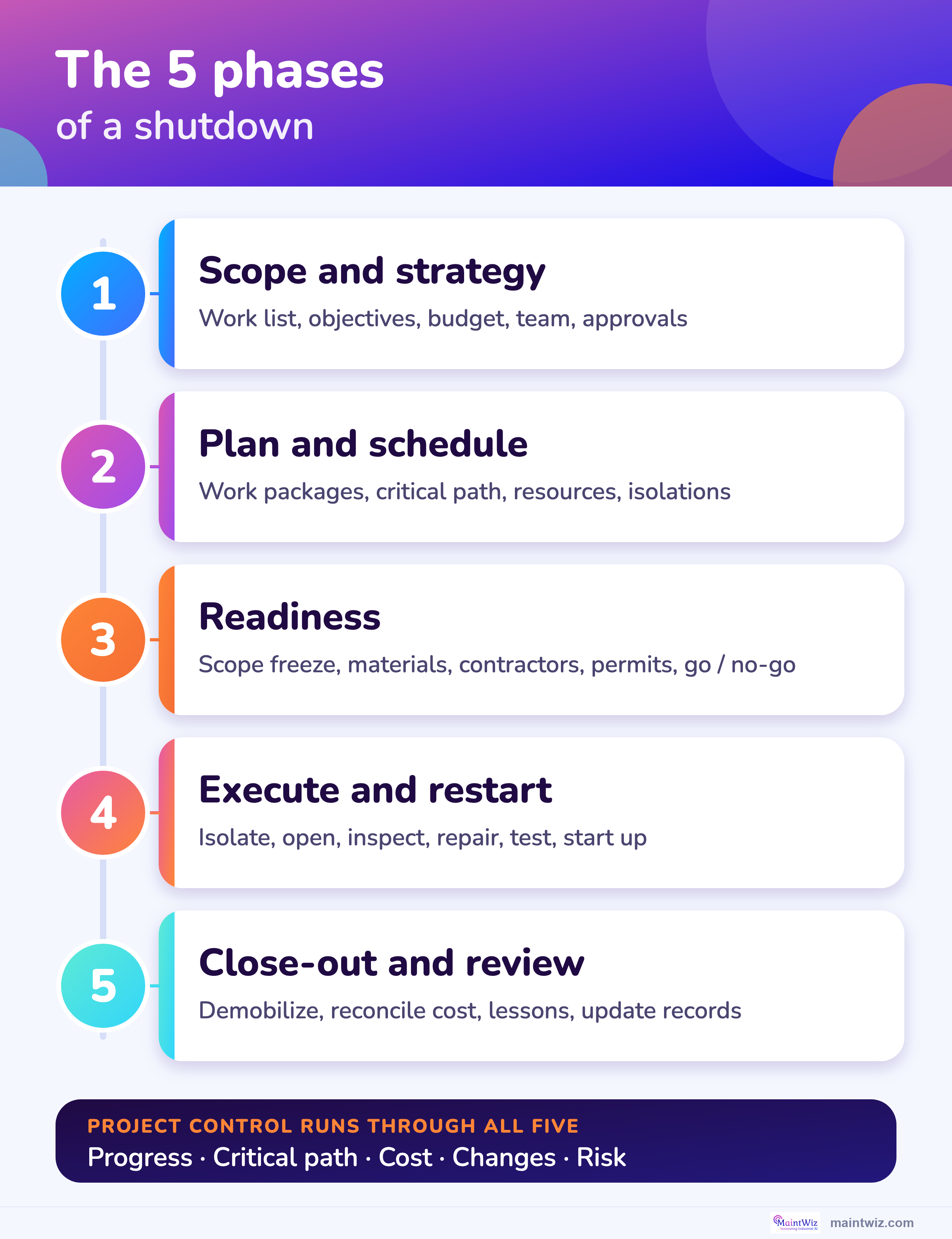
The shutdown maintenance process runs in five phases, with project control running through all of them.
- 1
Scope and strategy
Collect the work list from the backlog, inspection findings and past shutdowns. Set objectives, timing and a cost estimate. Define the team and roles. Obtain approvals.
Outputs: Approved scope, budget, dates, team - 2
Plan and schedule
Break the scope into work packages with job plans. Sequence the work and find the critical path. Plan resources, permits, external approvals, spares, tools, logistics and isolations.
Outputs: Work packages, schedule, resource and material plan, isolation plan - 3
Readiness
Freeze the scope. Confirm materials and contractors. Complete training. Prepare permits and isolations. Hold a go / no-go review.
Outputs: Readiness sign-off - 4
Execute and restart
Mobilize, shut down in the planned sequence, isolate, inspect, clean, repair and replace, calibrate, check quality, assess discovered work, then restart in the planned sequence.
Outputs: Completed work, inspection records, safe restart - 5
Close-out and review
Demobilize, close permits and contracts, reconcile cost and schedule, review performance and lessons, report to management.
Outputs: Close-out report, lessons learned, updated asset records
Detail: Planning process · When to schedule · Scheduling · Execution · 40-step checklist.
Procedure
What is the shutdown maintenance procedure, step by step?
The procedure takes a unit from running to safe for work and back again: shut down, make safe, isolate, permit, hand over, work, box up, hand back and start up.
- 1
Brief and confirm
Confirm the frozen scope, the shutdown sequence and the isolation list. Brief operations, maintenance and contractors on roles, permits and hold points.
- 2
Shut down in sequence
Operations bring the unit down to its written normal-shutdown procedure: reduce rate, stop feeds and cool down in the planned order. Where OSHA's process safety management standard applies, written operating procedures must cover normal shutdown. 11
- 3
Make the equipment safe
Depressurise, drain, flush, vent and purge so the equipment is free of hazardous substances before it is opened. 7
- 4
- 5
- 6
Hand over to maintenance
Operations hand the equipment to maintenance against the signed permit and the isolation record.
- 7
Do the work
Inspect, clean, repair, replace and calibrate to the job plan. Record findings, and assess discovered work against the frozen scope before it is added.
- 8
Box up and test
Reassemble, remove spades and blinds against the isolation register, and leak or pressure test before the equipment returns to service.
- 9
Hand back and close permits
Maintenance hands the equipment back. Permits are closed and locks removed only when the work area is checked and every person and tool is clear. 9
- 10
Detail: Permit to work · Leak and hydrotest · Start-up after a shutdown · Safe isolation (HSG253) · 40-step checklist.
Safety
What safety and compliance controls apply during a shutdown?
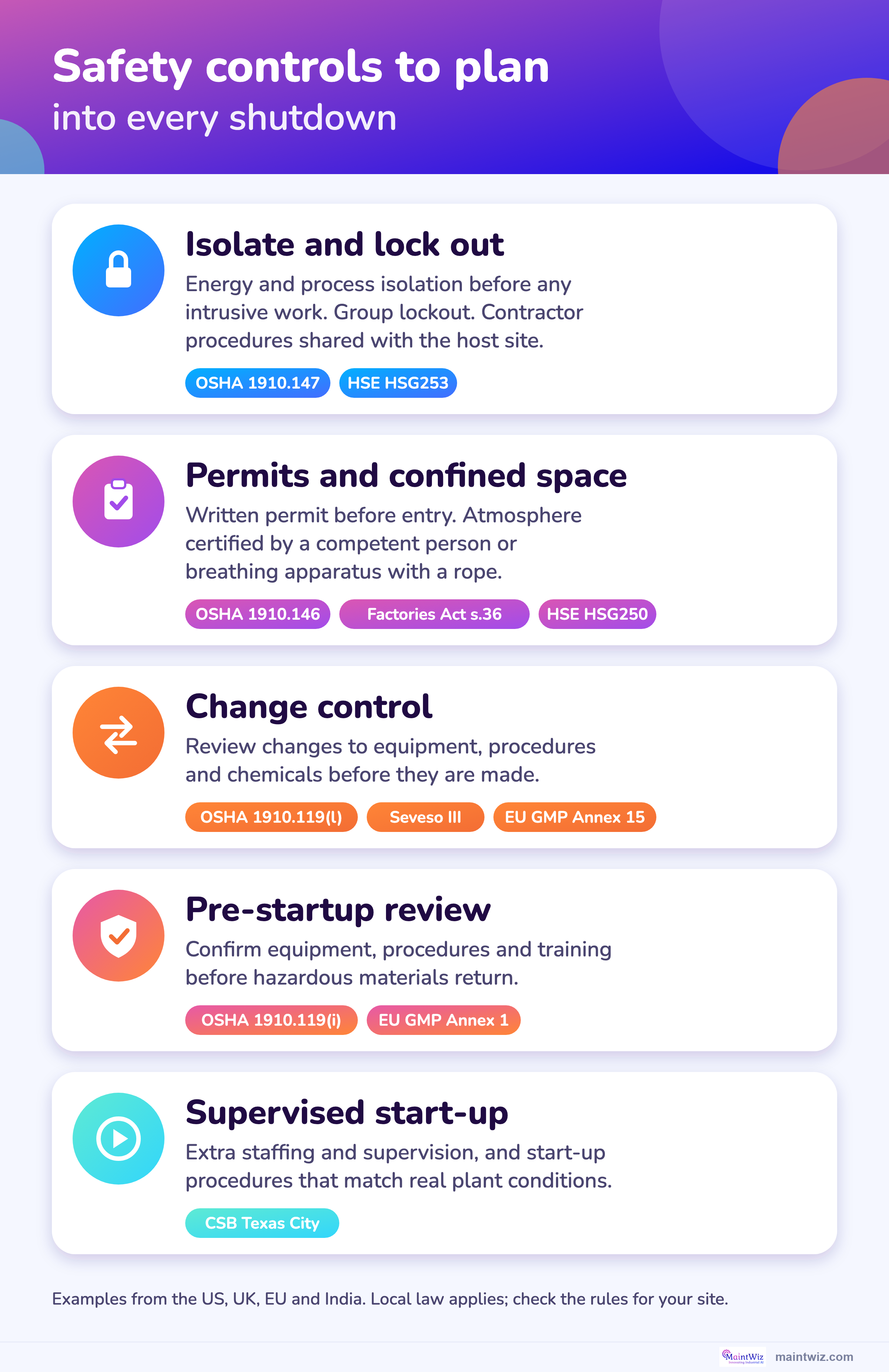
Shutdown safety rests on isolation and lockout, permits and confined space controls, change control, a pre-startup review, and supervised start-up. The rules differ by country, so the table gives examples.
Isolate and lock out
Energy and process isolation before any intrusive work. Group lockout. Contractor procedures shared with the host site.
Permits and confined space
Written permit before entry. Atmosphere tested and certified by a competent person before entry; breathing apparatus with a lifeline is a fallback for a space that cannot be made safe to breathe, not a replacement for testing and rescue planning.
Change control
Review changes to equipment, procedures and chemicals before they are made.
Pre-startup review
Confirm equipment, procedures and training before hazardous materials return.
Supervised start-up
Extra staffing and supervision, and start-up procedures that match real plant conditions.
Examples by jurisdiction
| Jurisdiction | Isolation and lockout | Permits and confined space | Process safety and change control |
|---|---|---|---|
| United States (OSHA) | 1910.147 covers servicing and maintenance where unexpected energization or release of stored energy could injure employees. It has group lockout provisions, requires host and contractor employers to inform each other of their procedures, and requires checks before energy is restored. 9 | 1910.146: a written permit space program, and an entry permit documenting the required measures before entry is authorized. 10 | 1910.119, where the standard applies: written management-of-change procedures (except replacements in kind) and a pre-startup safety review for modified facilities before hazardous chemicals are introduced. 11 |
| United Kingdom (HSE) | HSG253, The safe isolation of plant and equipment. It describes boundary isolation with spades or blinds as typically used on maintenance shutdowns or turnarounds. 7 | HSG250, guidance on permit-to-work systems for the petroleum, chemical and allied industries. 8 | — |
| European Union | — | — | Seveso III Directive: establishments with dangerous substances need a safety management system covering safe operation, including maintenance. Where a change could have significant major-accident consequences, the operator reviews its safety documents and informs the authority before the change. 13 |
| India | Factories Act 1948, s.31: effective measures to keep pressure plant within its safe working pressure, with state rules for examination and testing. 14 | Factories Act 1948, s.36: entry to a confined space only after a competent person certifies it in writing as reasonably free of dangerous gas, fume, vapor or dust, or with breathing apparatus and a lifeline held from outside, in addition to testing, ventilation, an attendant and rescue arrangements. 14 | Boilers Act 2025: boiler certificates for a period not exceeding twelve months. In force from 1 May 2025. 15 |
| Pharmaceutical (GMP) | 21 CFR 211.67 requires written procedures for cleaning and maintenance of equipment. 18 | — | EU GMP Annex 15: use quality risk management to evaluate planned changes and plan any requalification. Annex 1 (sterile products): return to use after maintenance should be approved. 16,17 |
Start-up is a hazard in its own right.
The US Chemical Safety Board found that the March 2005 explosions at the BP Texas City refinery occurred during the restarting of a hydrocarbon isomerization unit. Its recommendations included additional board-operator staffing during start-up, knowledgeable supervisors or technically trained personnel present during especially hazardous phases such as start-up, and start-up procedures updated to reflect actual process conditions. 12
Rules for the Gulf and other regions are not covered here. Always check the law that applies where the plant is located. More: Work permits during shutdowns · Safety incidents during shutdowns.
Industries
Shutdown guides by industry
Every sector uses its own terms and has its own drivers. Pick the guide closest to your plant.
Nuclear refueling outages are covered in nuclear refueling outage planning, and India and Gulf practice in annual shutdown planning in India and T&I turnaround and inspection planning. Sugar mills: sugar mill off-season maintenance.
Tools
How does a CMMS help manage a shutdown?
Software such as a CMMS holds the asset, work order, spares and permit records a shutdown depends on, and can plan, track and close out the work orders in the shutdown scope. MaintWiz adds IoT and predictive maintenance data to that picture. For very large events, planners may also use specialist scheduling tools alongside it.
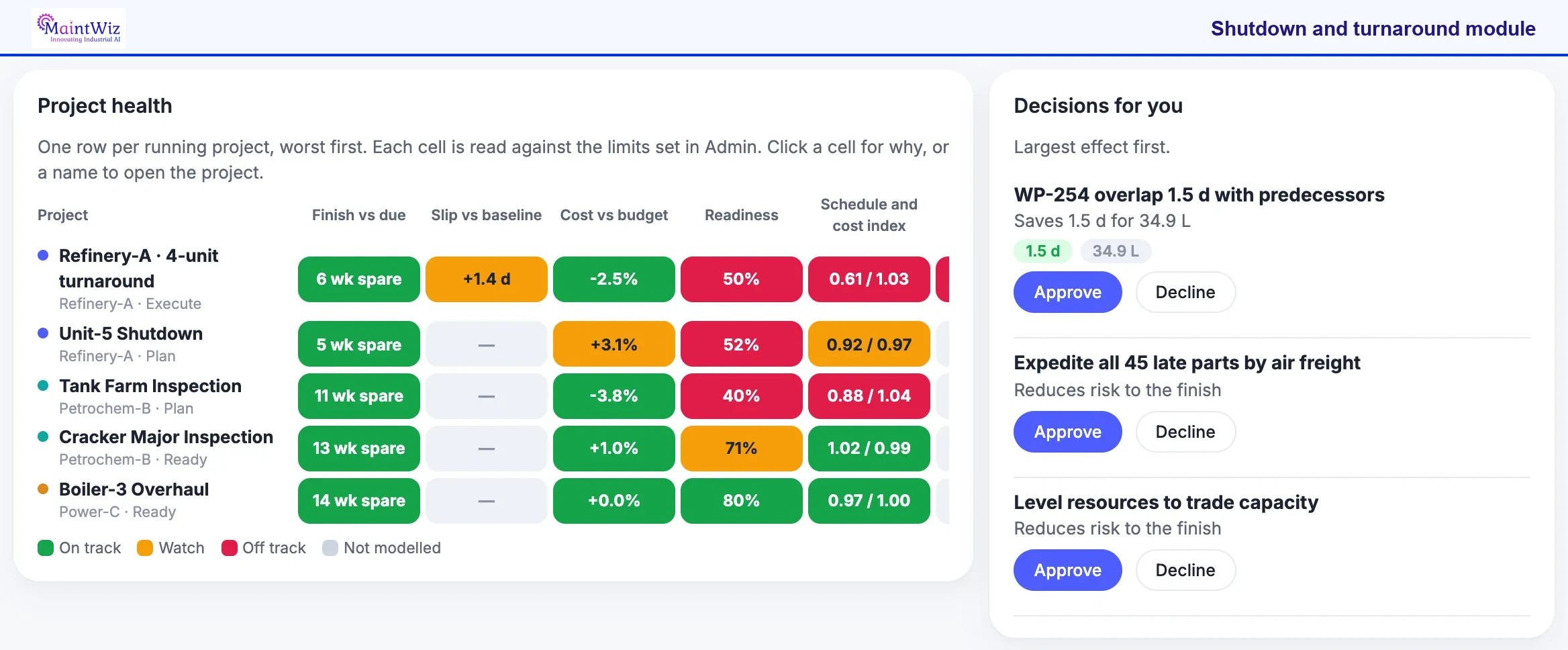
Read down the readiness column first. A red cell, such as 50% for the turnaround at the top, tells the executive which project to ask about. The decisions on the right carry the schedule or risk effect of each proposal, so approving or declining takes one step and leaves a record.
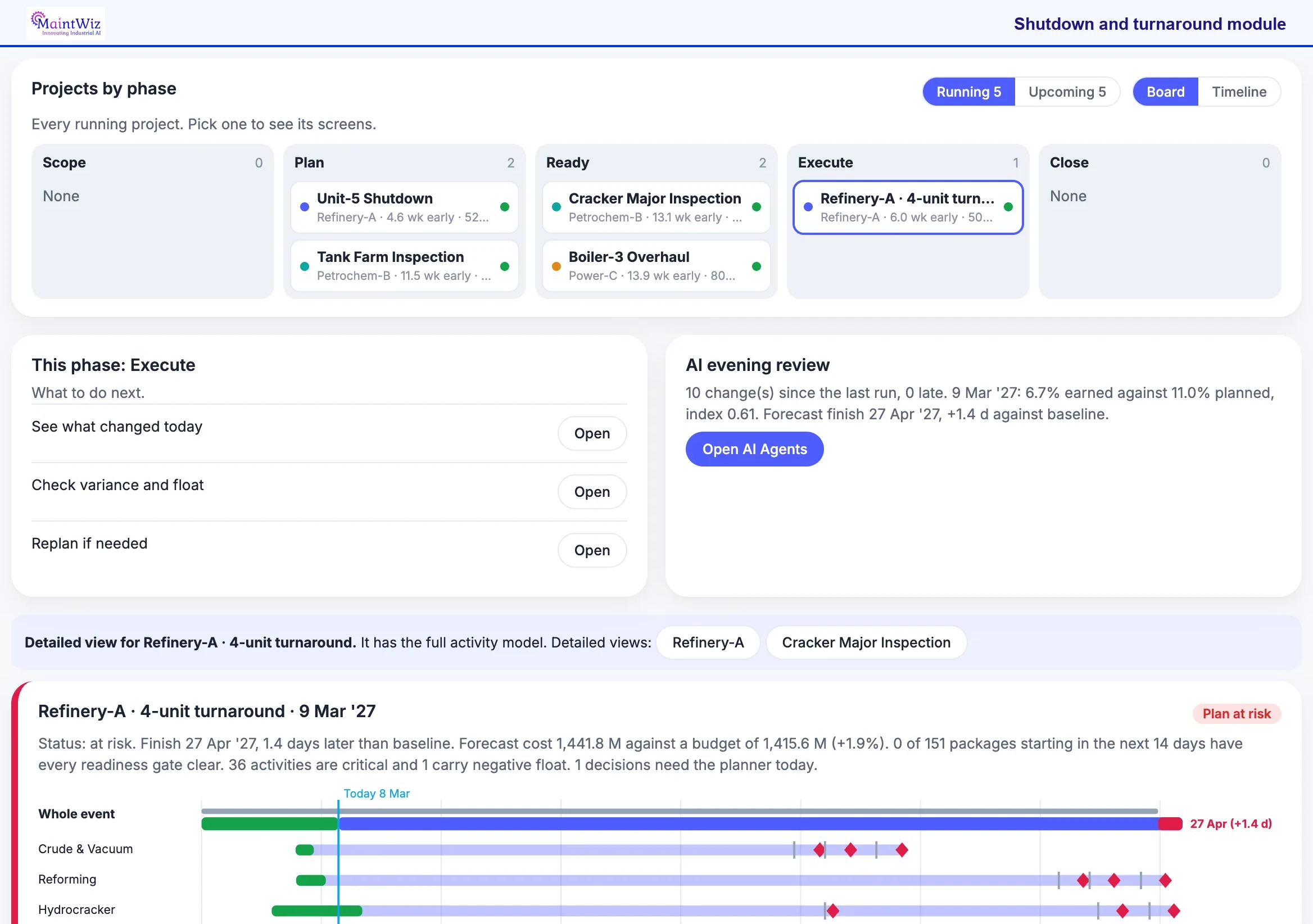
Start with the board to see which project is in which phase, then open the one in Execute. The This phase list gives the next checks: what changed today, variance and float, and replanning. The status line states the forecast finish against baseline, so the central planner knows where to put the day's effort.
For how a shutdown module differs from a CMMS and from Primavera P6, see shutdown software vs spreadsheets vs Primavera P6 and what to digitize first.
Also: product data sheet.
What the shutdown module covers
- Shutdown calendar and critical-path scheduling, with work order sequencing and dependencies
- Asset prioritization, so the most critical equipment is scoped first
- Resource planning for people, spares, heavy equipment such as cranes, and outsourced vendors
- Electronic permits to work, risk management and contingency plans
- Real-time progress monitoring: schedule adherence, cost variance, quality metrics and risk factors
- Step-by-step checklists, pre-restart testing protocols and post-shutdown analysis
Free tools
Free guides, checklists and calculators
Visuals
Every calculator is listed on the shutdown calculator tools page and the files on the shutdown planning templates page.
Save the shutdown maintenance charts
Four one-page charts from this guide. Click any to see it full size.
FAQ
Frequently asked questions
What is the shutdown maintenance procedure?
It is the sequence that takes a unit from running to safe for work and back: shut down to the written procedure, depressurise, drain and purge, isolate and lock out, test and issue permits, hand over to maintenance, do the work, box up and test, hand back and close permits, then review and start up.
How is shutdown maintenance different from preventive maintenance?
Preventive maintenance is a type of task done on a time or run-time schedule. Shutdown maintenance is a window when equipment is out of service, and it can hold preventive tasks, inspection, corrective repair, replacement and modification.
Is shutdown maintenance the same as a turnaround?
Not exactly. A turnaround is usually the large, planned, periodic form of shutdown: EIA defines a refinery turnaround as a planned, periodic shutdown of one or more processing units for maintenance, inspection and repair, and also describes planned, targeted shutdowns of smaller scope. Many plants use the two words interchangeably, so state the scale and duration when you use either. 1
Is a plant outage the same as shutdown maintenance?
No. An outage is any period when a plant or unit is out of service, and it can be planned or unplanned. AFPM describes turnarounds as planned and unplanned outages as shorter stops for specific problems, while NERC's generator reporting rules separate planned, maintenance and unplanned (forced) outages. 2,5
What is an annual shutdown?
An annual shutdown is a planned shutdown scheduled once a year. Plants often place it in a low-demand period, as US refiners and generators do in spring and fall, but its length and scope depend on the equipment, regulation and production calendar. Your own history applies across industries. 2,3
How often should a plant shut down for maintenance?
It depends on the equipment, inspection and legal requirements, and the production calendar. EIA says routine turnarounds on key US refinery fuel-production units are planned every 3 to 5 years, and US reactors typically refuel after about 18 or 24 months. Treat these as published examples, not targets for other industries. 1,4
How long does a shutdown take?
It depends on scope. EIA says a refinery unit can be offline for several weeks to several months, and AFPM gives the same range of weeks to months. EIA reports recent US nuclear refueling outages averaging 34 to 38 days, and one German blast furnace reline was reported at 70 days in 2008. 1,2,4,19
How far in advance should a shutdown be planned?
For large events, years ahead: EIA says refinery turnarounds may involve 1 to 2 years of advance planning, and AFPM says planning teams often begin years ahead. Smaller shutdowns need less lead time, but the scope, materials and contractors still have to be settled before the stop. 1,2
What happens to work that is found during the shutdown?
It is assessed, prioritized and, if approved, added to the plan through change control. NERC's generator reporting rules draw the same line: time spent on in-scope inspection is a planned extension, while repairs to damage found during the inspection are coded as forced outage time, and discovery work is outside the original scope of work. Fixing the planned scope early makes extra work visible. 5
Do shutdowns need work permits and lockout?
Where the work is covered by the relevant rules, yes. In the US, OSHA 1910.147 requires an energy control program for servicing and maintenance and 1910.146 requires an entry permit for permit-required confined spaces; the UK, EU and India have their own rules. Check the requirements where the plant is located. 9,10,8,14
Can a CMMS manage a shutdown?
A CMMS can plan, schedule, track and close out the work orders in the shutdown scope and hold the supporting asset, spares and permit records. Very large, multi-contractor events may also use specialist scheduling software alongside it. See the MaintWiz shutdown and turnaround module.
Product questions: MaintWiz shutdown maintenance FAQ.
Sources
Sources
Figures come from the public sources below.
- U.S. Energy Information Administration, Refinery Outages: Description and Potential Impact on Petroleum Product Prices
- American Fuel & Petrochemical Manufacturers, Refinery turnarounds 101: What are turnarounds and why do we need them? (17 October 2023)
- U.S. Energy Information Administration, Seasonal maintenance helps keep power online during summer and winter peaks (22 April 2011; ISO New England data)
- U.S. Energy Information Administration, Nuclear power plants undergo seasonal scheduled outages (23 May 2011)
- North American Electric Reliability Corporation, Generating Availability Data System (GADS) Data Reporting Instructions, effective 1 January 2026
- U.S. Department of Energy FEMP / Pacific Northwest National Laboratory, O&M Best Practices: Maintenance Approaches
- UK Health and Safety Executive, The safe isolation of plant and equipment (HSG253, 2006)
- UK Health and Safety Executive, Guidance on permit-to-work systems: a guide for the petroleum, chemical and allied industries (HSG250, 2005)
- OSHA, 29 CFR 1910.147, The control of hazardous energy (lockout/tagout)
- OSHA, 29 CFR 1910.146, Permit-required confined spaces
- OSHA, 29 CFR 1910.119, Process safety management of highly hazardous chemicals
- U.S. Chemical Safety and Hazard Investigation Board, BP America (Texas City) refinery explosion
- European Union, Directive 2012/18/EU on the control of major-accident hazards involving dangerous substances (Seveso III), EUR-Lex
- Government of India, Ministry of Labour and Employment, The Factories Act, 1948
- Government of India, The Boilers Act, 2025 (Act No. 12 of 2025), Gazette text as published by PRS India
- European Commission, EU GMP Annex 15: Qualification and Validation (2015)
- European Commission, EU GMP Annex 1: Manufacture of Sterile Medicinal Products (2022)
- eCFR, 21 CFR 211.67, Equipment cleaning and maintenance
- Association for Iron & Steel Technology, ThyssenKrupp Steel to Restart Blast Furnace 1 at Duisburg-Schwelgern (20 March 2008)
- Publications Office of the European Union, An in-depth study into prolonging blast furnace campaign life (2001)
Move your shutdown plan out of spreadsheets
Book a demo and bring the spreadsheet you use today. We will show how the module covers the same ground.