Key takeaways
- The education and training (E&T) pillar builds the skills each role needs for TPM.
- A skills matrix compares each person's level with the level the role requires and drives the training plan.
- One point lessons deliver short, specific training at the equipment.
- MaintWiz, an AI CMMS built for TPM, keeps the training master, plan, sessions, attendance, certification expiry and an E&T dashboard beside the other seven pillars, and the whole of Total Productive Maintenance rolls out in 6 to 8 weeks.
E&T scope
What does the E&T pillar cover?
E&T closes the gap between the skills each role needs and the skills people have. Operators need inspection and basic-maintenance skills for autonomous maintenance; maintenance staff need advanced diagnostic and improvement skills; supervisors need to coach.
What is a skills matrix?
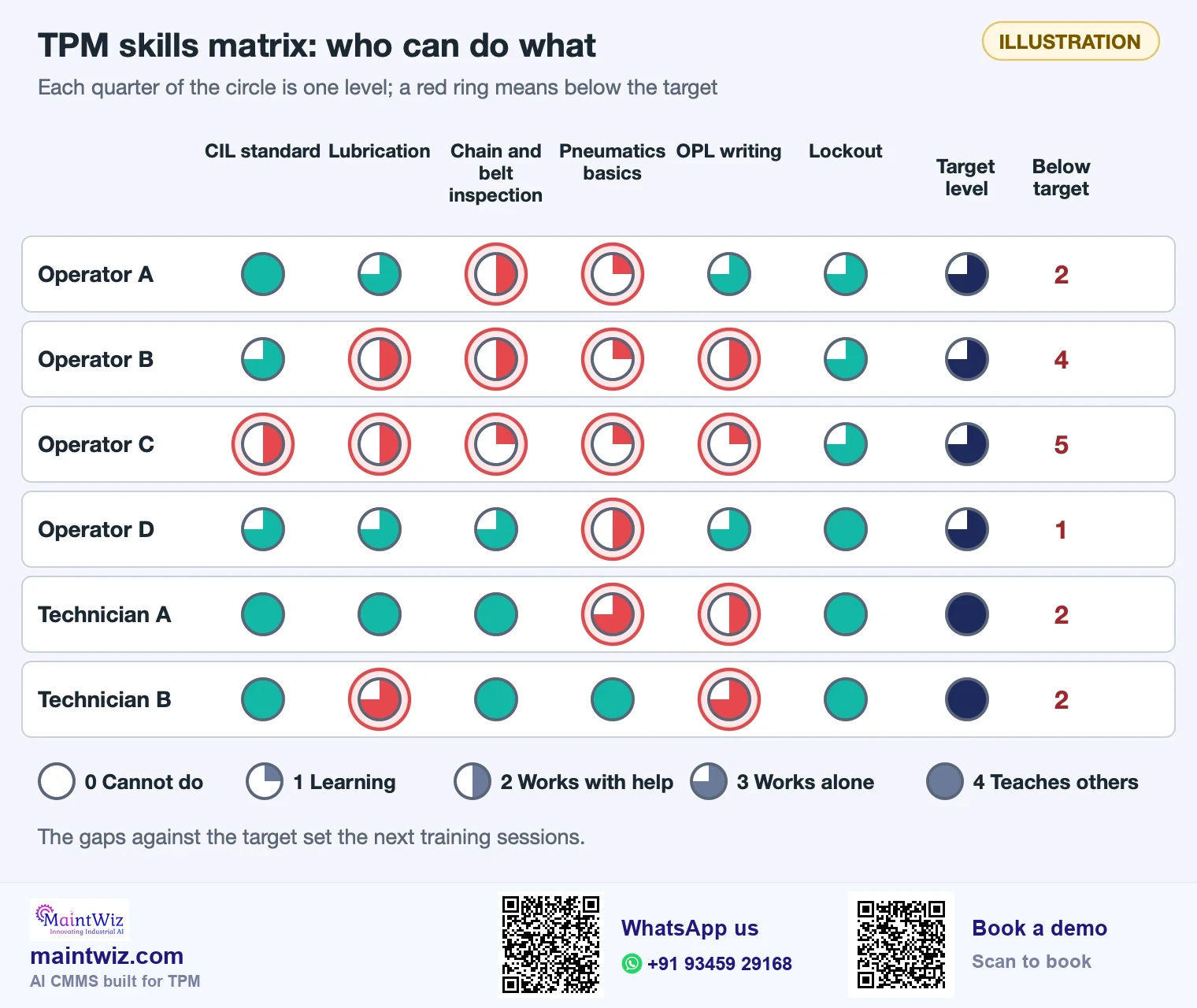
A skills matrix lists skills against people, shows each person's level and compares it with the level the role requires. A common scale runs 0 (cannot do) to 4 (can teach), with each level defined in writing. Gaps drive the training plan: schedule sessions where the gap to the required level is largest.
| Level | Meaning (example scale) |
|---|---|
| 0 | Cannot do the task |
| 1 | Learning; needs close supervision |
| 2 | Does the task with help |
| 3 | Does the task alone to standard |
| 4 | Can teach the task to others |
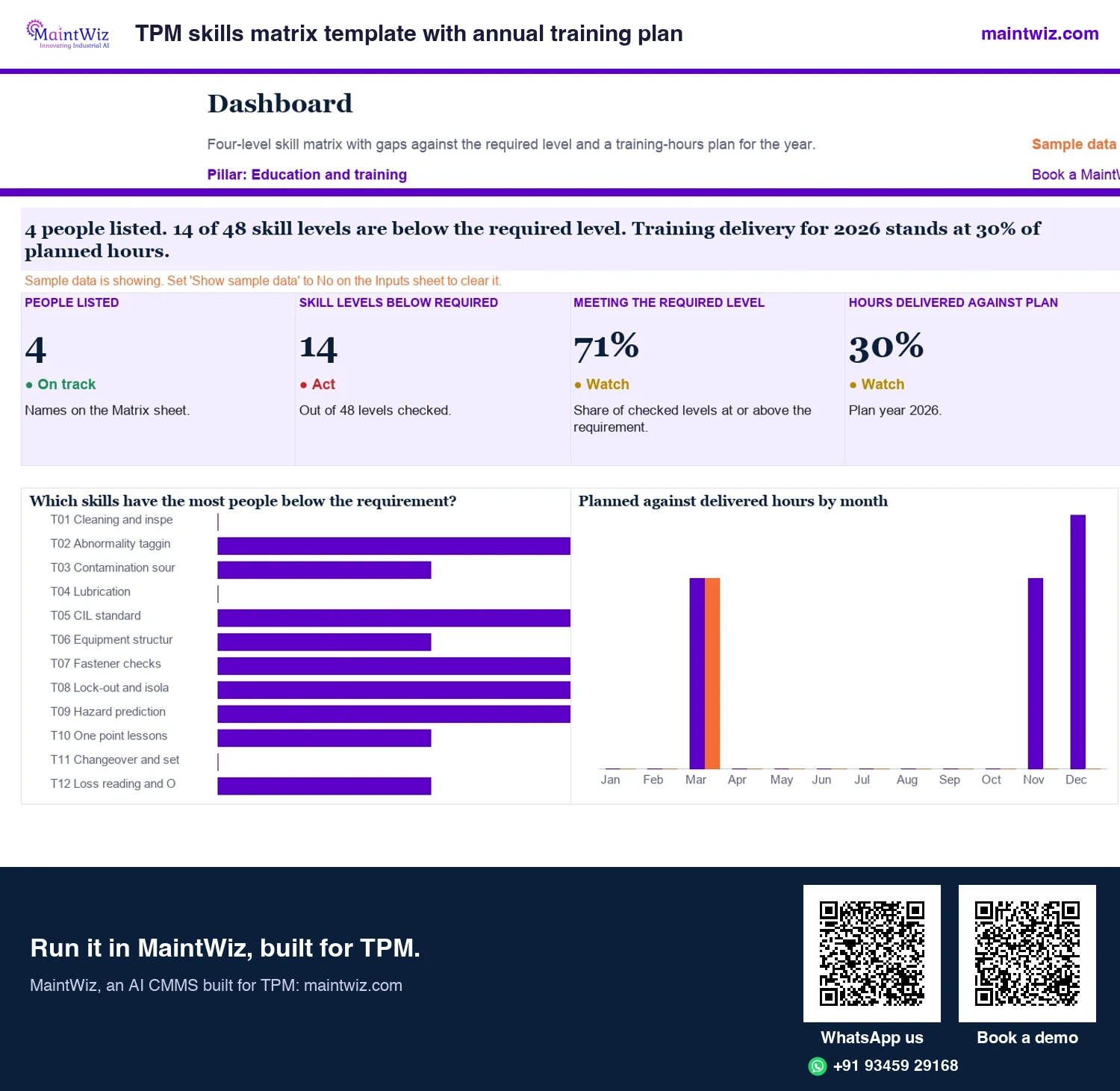
The free skills matrix and annual training plan workbook builds it for you, with quarter-circle levels and the gap to target per person (Figure 1).
Free files
TPM training templates: skills matrix, curriculum and one point lessons
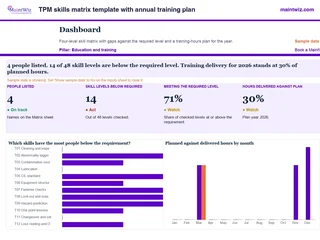 ExcelTPM skills matrix template with annual training plan
Four-level skill matrix with quarter-circle symbols
- Sheets
- Dashboard, Inputs, Matrix, Plan, Read me
- A4
- Version
- v1.0, 2 November 2026
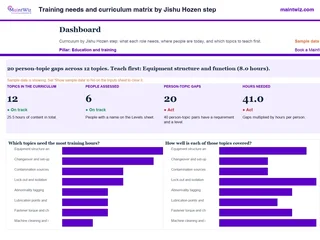 ExcelTraining needs and curriculum matrix by Jishu Hozen step
Set the level each role needs for every training topic by Jishu Hozen step, record where people are
- Sheets
- Dashboard, Inputs, Curriculum, Needs, Levels, Gaps, Schedule, Feed matrix, Read me
- A4
- Version
- v1.0, 2 November 2026
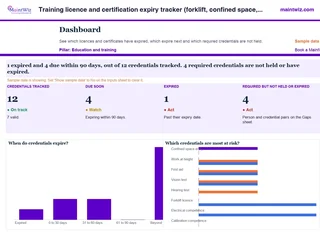 ExcelTraining licence and certification expiry tracker (forklift, confined space, work at height)
See which forklift, confined space and work at height licences have expired, which expire in 30, 60 or 90 days
- Sheets
- Dashboard, Inputs, People, Register, Requirements, Gaps, Read me
- A4
- Version
- v1.0, 2 November 2026
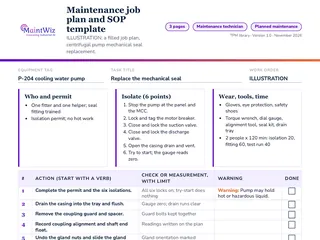 PDFMaintenance job plan and SOP template (PDF)
Print a job plan with isolation, PPE, steps, limits and acceptance
- Pages
- 3
- A4
- Created
- 5 November 2026
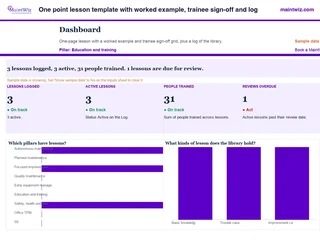 ExcelOne point lesson template with worked example, trainee sign-off and log
Fill a one-page lesson with a worked chain tension example
- Sheets
- Dashboard, OPL, OPL blank, Inputs, Log, Read me
- A4
- Version
- v1.0, 2 November 2026
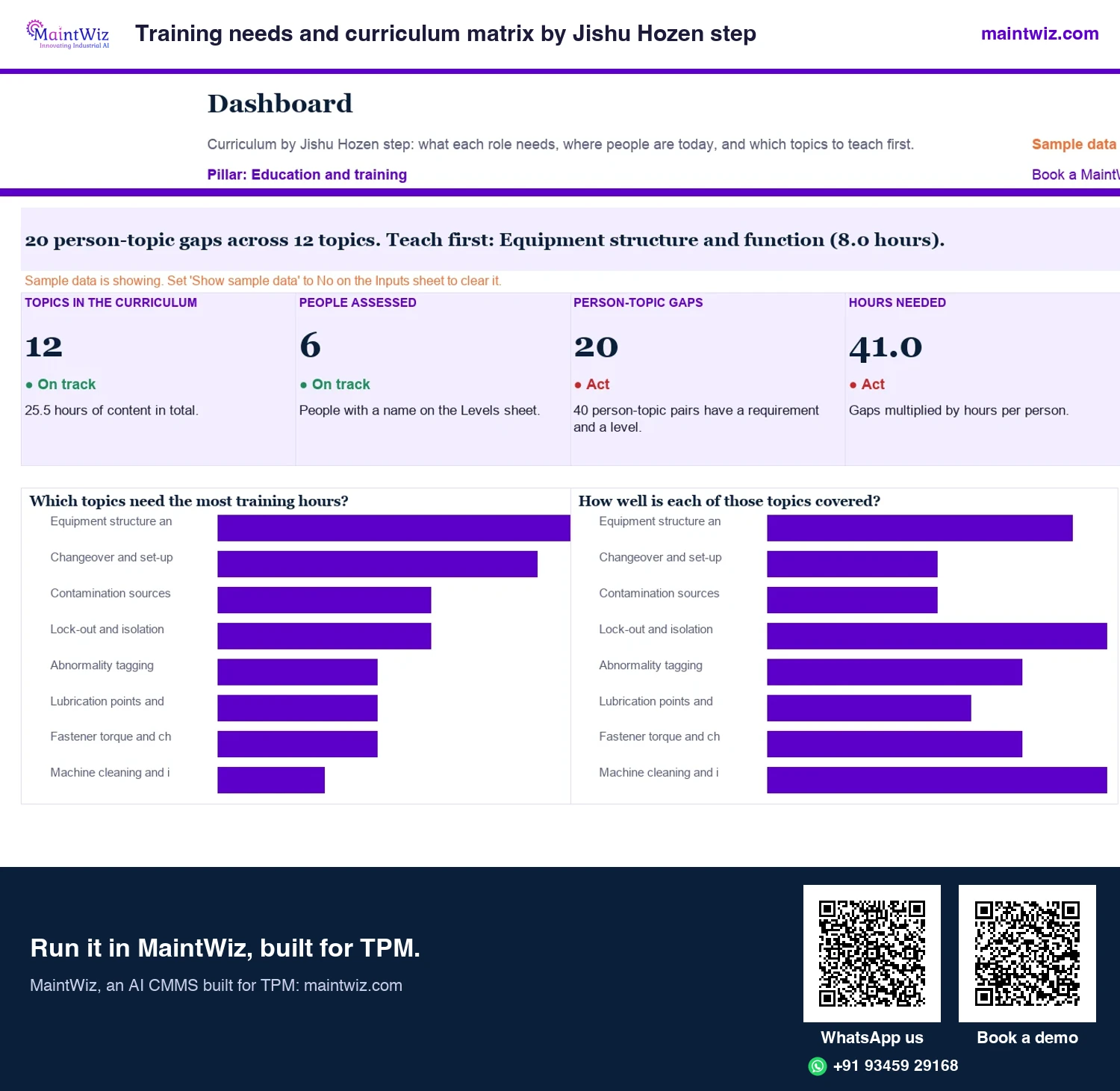
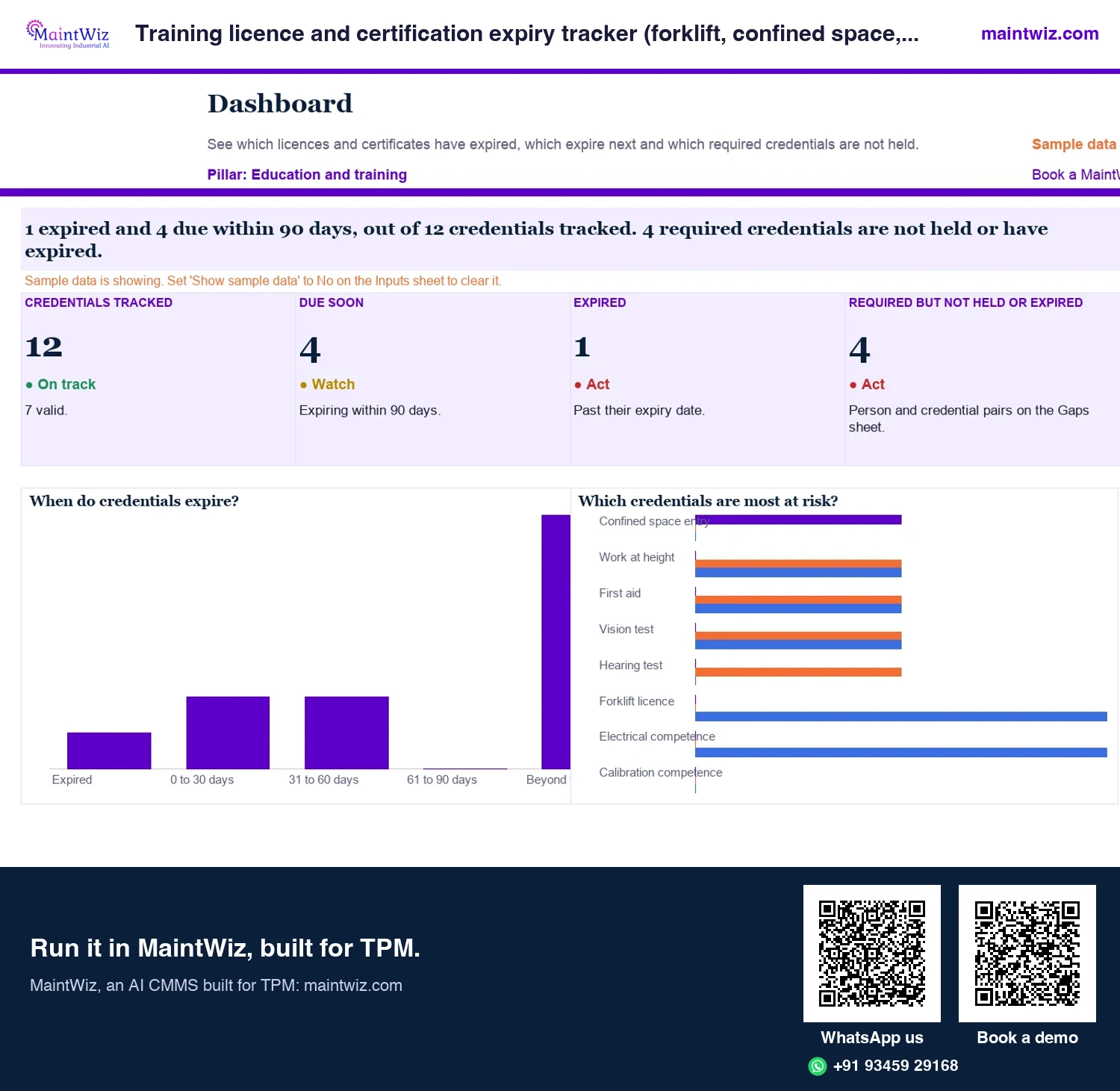
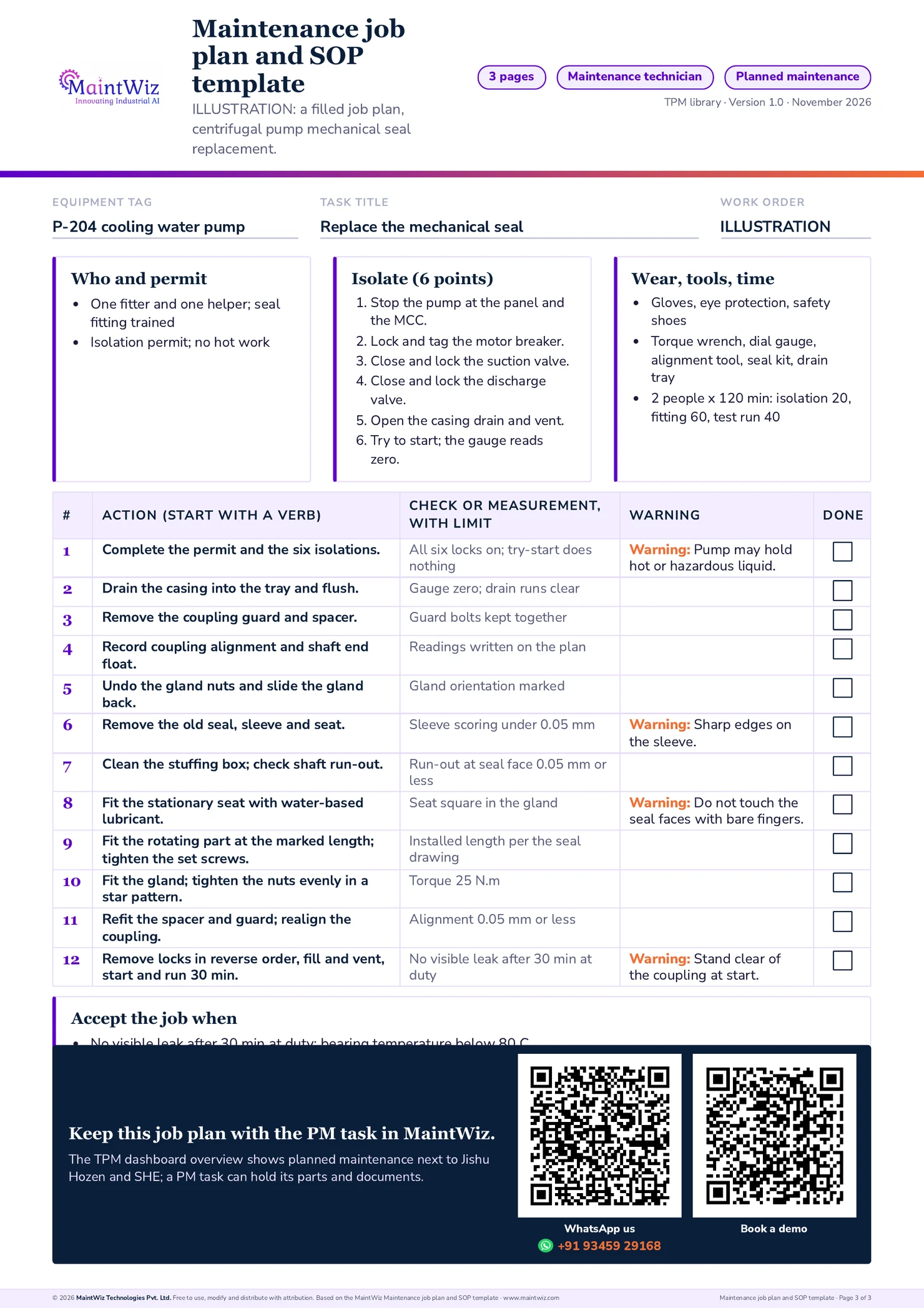
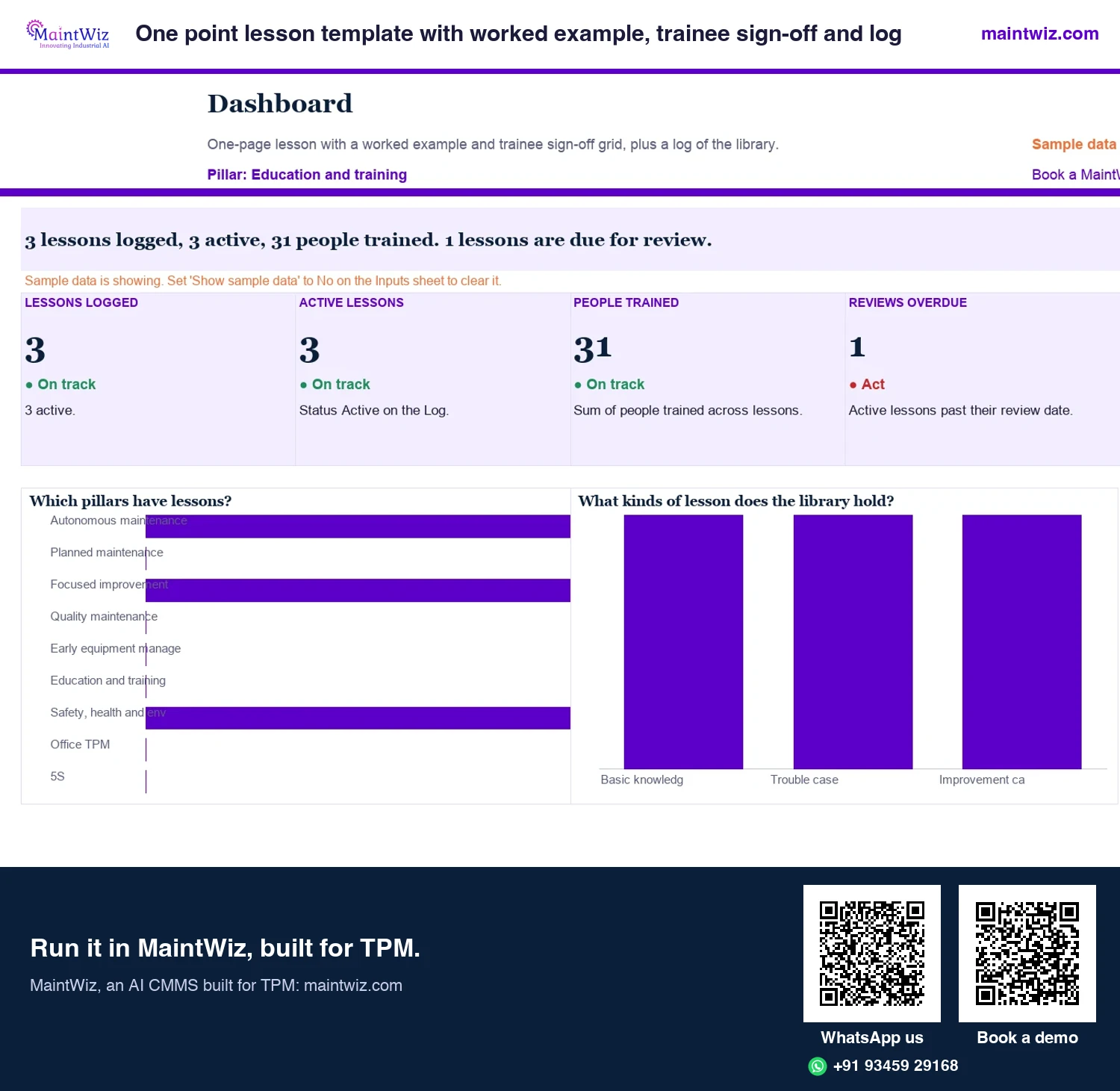
OPLs
How do one point lessons support training?
One point lessons are the short sheets that deliver a single skill or fact at the equipment. They are the main training tool between steps 3 and 5 of autonomous maintenance, and a good one is written in five minutes: one point, one picture, three to five steps.
Training by role
What training does each role need?
| Role | Skills TPM needs | Typical delivery |
|---|---|---|
| Operator | Cleaning and inspection, basic lubrication, abnormality tagging, 5S | One point lessons at the equipment; supervised practice |
| Maintenance technician | Diagnosis, condition monitoring, improvement and root-cause methods, coaching operators | Courses, on-the-job work with specialists, projects |
| Supervisor | Coaching, auditing, loss reading, running the daily routine | Workshops; paired audits |
| Engineer | Loss analysis, early equipment management, standards writing | Projects, reviews |
Training by step
What training does each step of autonomous maintenance need?
Each step of autonomous maintenance (Jishu Hozen) needs specific skills before it is audited: cleaning and tagging for step 1, writing standards for step 3, inspection skills for steps 4 and 5. Plan the training with the step schedule, and record it so the step-gate audit can check it.
Training needed at each Jishu Hozen step
Skills to teach before the step audit, and the lesson that carries them
| Step | Skills to teach | One point lesson topic |
|---|---|---|
| Step 1 Initial cleaning | Spot and tag fuguai; clean safely | OPL: how to raise a tag |
| Step 2 Contamination sources | Find sources; simple containment | OPL: where dirt comes from |
| Step 3 CIL standards | Write a clear standard; lubricants and points | OPL: lubricant and point |
| Step 4 General inspection | By subsystem: lubrication, fasteners, pneumatics, hydraulics, electrical, drives | OPL per subsystem |
| Step 5 Autonomous inspection | Use the checklist; when to stop and call maintenance | OPL: stop and call |
| Step 6 Standardisation | Workplace standards and visual controls | OPL: visual controls |
| Step 7 Autonomous management | Read equipment data; improve own standards | OPL: reading the trend |
 maintwiz.comAI CMMS built for TPM
 WhatsApp us
 +91 93459 29168
 Book a demo
Operators learn inspection subsystem by subsystem at Jishu Hozen steps 4 and 5, and the E&T pillar leader owns the plan that schedules those sessions, with each role's part set in TPM roles and responsibilities (Figure 2).
Measures
How do you measure training?
- Planned against delivered training hours, by month.
- Share of people at or above the required level for their role.
- One point lessons issued and read, with verification recorded.
- Sessions held against sessions planned, by month.
- Attendance by role, to see where participation is thin.
- Skills with fewer than two qualified people.
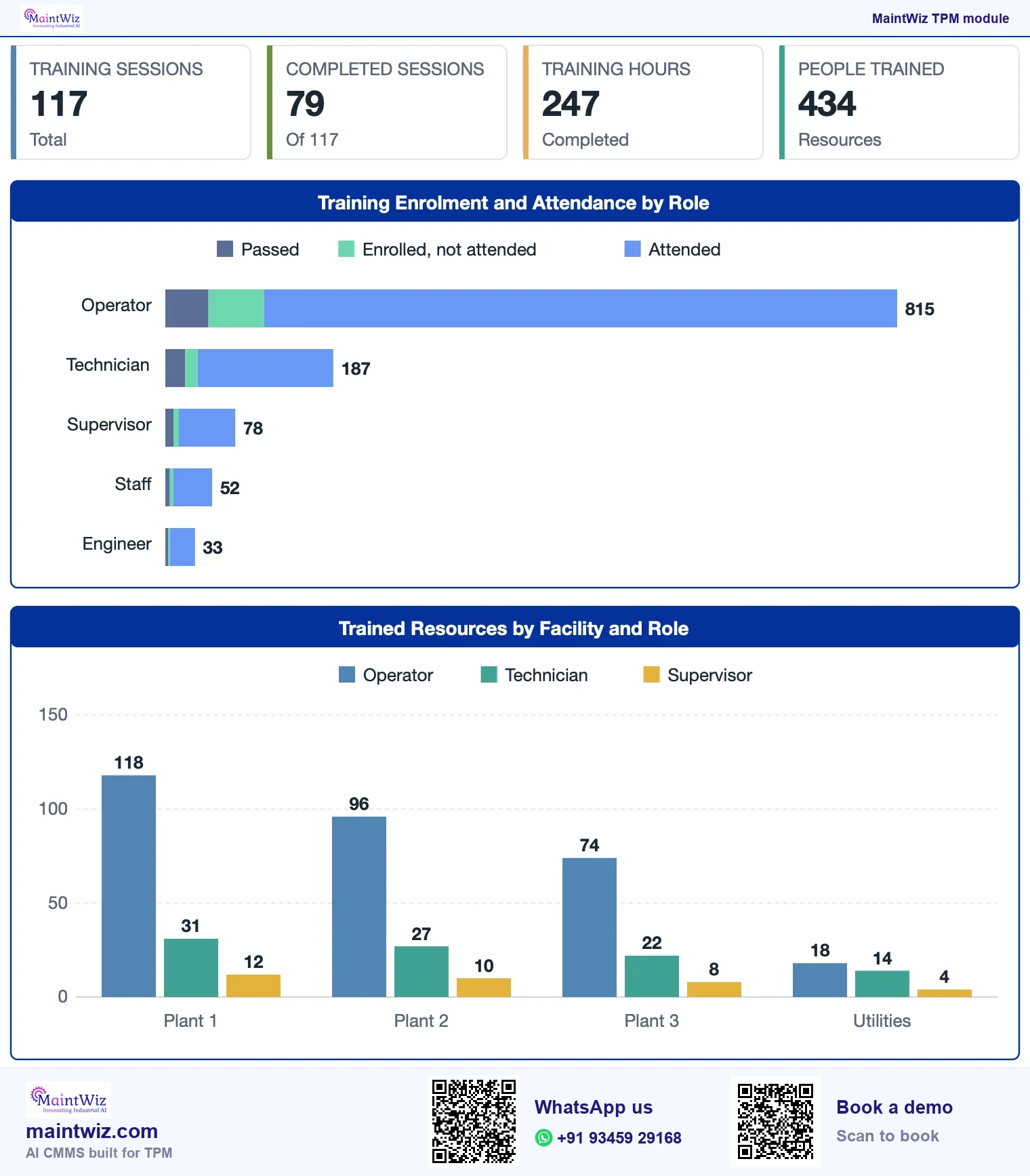
The MaintWiz E&T dashboard shows sessions, completed hours, people trained and attendance by role for the monthly pillar review (Figure 3).
Needs analysis
How do you analyse training needs?
- List what each role must do in the pillars: operators inspect, technicians diagnose, supervisors review.
- Compare with what people can do today, by observation or a skills matrix.
- Look at events: tags, failures and incidents often show a skill gap.
- Rank gaps by risk and by effect on losses.
- Plan training for the highest gaps first and decide how to check it worked.
Training methods
| Method | Good for | Pair it with |
|---|---|---|
| On-the-job coaching | Equipment-specific skills | Record it in a skills matrix so it scales |
| One point lessons | Short, specific tasks and reminders | A five-minute session at the machine with ask-back |
| Classroom or workshop | Concepts, rules, shared language | Practice at the equipment in the same week |
| Simulation or training stations | Hazardous or rare tasks, inspection skills | One shared station for several lines |
| E-learning | Consistent basics for many people | Practice at the equipment afterwards |
One point lessons carry the short tasks in this table, and the MaintWiz training module records each session with its trainer, hours and attendance.
Evaluating training
A common framework (Kirkpatrick) separates four levels: reaction (did people find it useful), learning (did they learn), behaviour (do they do it) and results (did a measure change). For TPM, the second and third levels are the ones that matter: can the operator inspect the point, and do they do it on the shift? Check them by observation and by looking at tags and defects from the area.
Competency levels
Use the 0 to 4 scale above in every matrix: 0 cannot do the task, 4 can teach it. Required levels per role set the gap. Keep the definitions written; review the matrix when equipment or tasks change (Figure 4).
Skill levels 1 to 4 used in a skills matrix
Level 0 means cannot do the task
| Skill group | Level 1 Learning, needs close supervision | Level 2 Works with help | Level 3 Works alone to standard | Level 4 Teaches others |
|---|---|---|---|---|
| Jishu Hozen CIL cleaning, inspection, lubrication | ||||
| General inspection bolts, drives, utilities | ||||
| Planned maintenance periodic tasks, condition checks | ||||
| Kaizen and P-M analysis improvement projects | ||||
| Safety and lockout permits, isolation | ||||
| Quality checks conditions, first-piece check |
maintwiz.comAI CMMS built for TPMWhatsApp us+91 93459 29168Book a demoRoll-out training
How does MaintWiz train your team during roll-out?
Training on the MaintWiz modules is part of the 6 to 8 week roll-out of the whole of Total Productive Maintenance. The MaintWiz implementation team runs the project plan, milestones, module set-up and training, and your existing training plan, topics and session records load through easy Excel uploads. Start with the free skills matrix and annual training plan workbook and bring it to the demo.
In a CMMS
Training records and competency in a CMMS
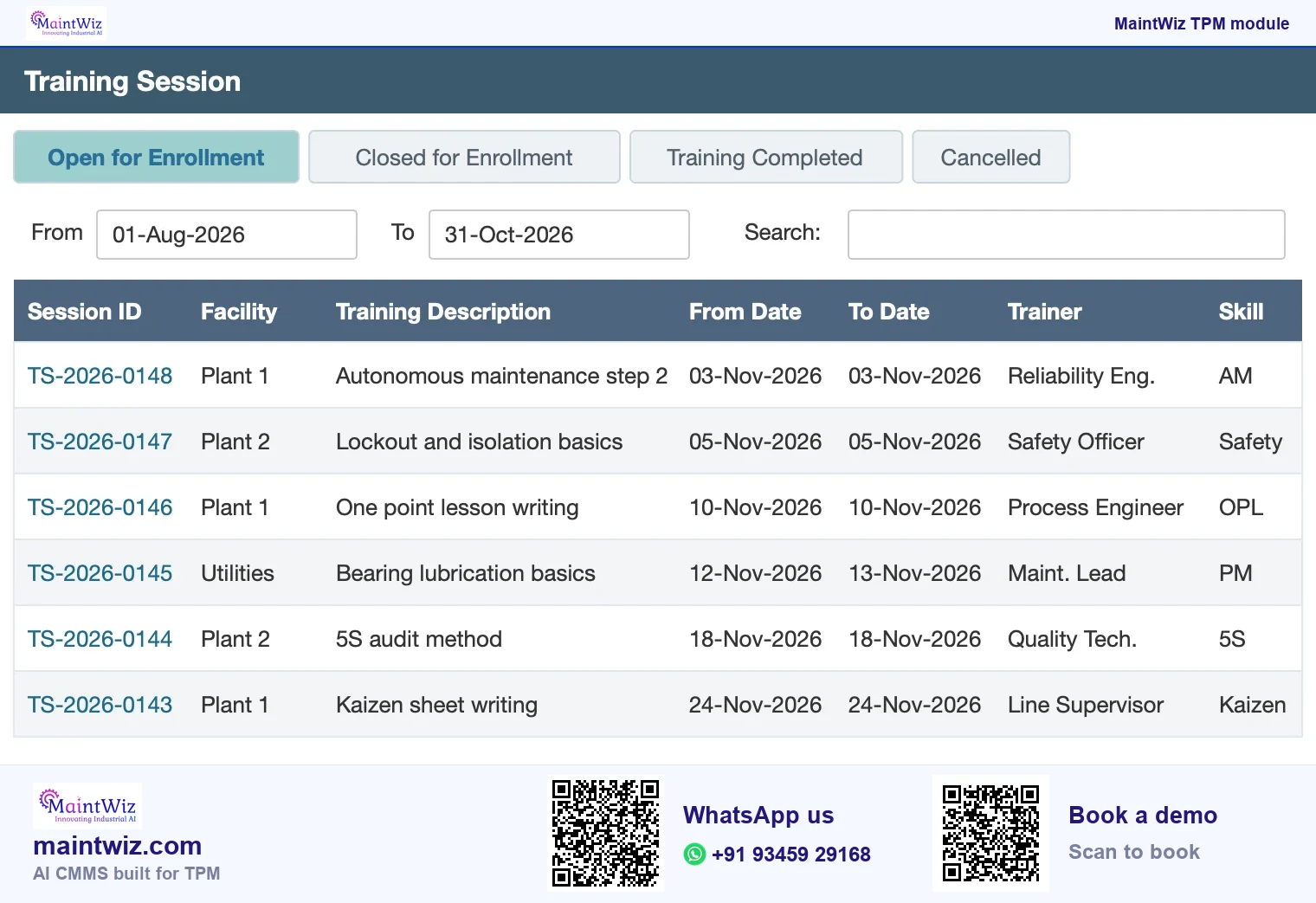
Records show who was trained on what, when and with what attendance. The MaintWiz training module holds the training master, plan, schedule, sessions with attendance and hours, certification and expiry handling, and a dashboard of sessions, completed hours, resources trained and attendance by role (Figure 5).
E&T software
What should software for the education and training pillar do?
Software for the education and training pillar keeps the training plan, the sessions that deliver it and the record of who attended, so a plant can show who has been trained on what. JIPM lists education and training among the two necessary pillars, the ones needed to conduct TPM. In MaintWiz, an AI CMMS built for TPM, the E&T pillar holds the following.
| What the pillar needs | What MaintWiz holds |
|---|---|
| A list of topics and who needs them | A training master of topics and the roles they apply to |
| A plan for the period | A training plan by team or role |
| Dates and trainers | A training schedule and training sessions |
| Proof of attendance | Attendance and hours recorded for each session |
| Qualifications that lapse | Certification and expiry handling, for example licences and vision tests |
| A weekly review | Reports and a dashboard of sessions, completed hours, resources trained and attendance by role |
Keep the plan, sessions and expiry dates in MaintWiz: book a demo with your training plan and see them in the training module. The free skills matrix and annual training plan workbook gives you the matrix layout.
FAQ
Frequently asked questions
What is the E&T pillar in TPM?
E&T is the education and training pillar: it builds the skills operators, maintainers and supervisors need for TPM, so that each pillar has people able to carry it out. It uses methods such as skills matrices, one point lessons and recorded training.
What is a skills matrix?
A skills matrix is a grid of skills and people showing each person's level against the level required for their role. Gaps drive the training plan. A common scale runs from 0 (cannot do) to 4 (can teach), defined by the plant.
How does training support autonomous maintenance?
Operators must be taught inspection skills and how their equipment works before they can take over routine care. One point lessons and recorded training deliver this between steps 3 and 5 of Jishu Hozen.
What is the difference between education and training in TPM?
Education builds understanding of why and how a method works; training builds the ability to carry out a task to standard. TPM needs both: for example the idea behind abnormality tags, and the skill of writing one correctly.
How do you plan TPM training?
List the skills each role needs, score current levels in a skills matrix, rank the gaps by effect on losses and safety, then schedule sessions by month with a trainer, hours and a way to check the result.
What records should training keep?
Who attended, on which topic, on which date, who delivered it and how understanding was checked (ask-back, demonstration or quiz). Keep them in one place so the step-gate audit can check them.
How does the training plan feed the step audit?
Each step of autonomous maintenance needs specific skills before it is audited: cleaning and tagging for step 1, writing standards for step 3, inspection skills for steps 4 and 5. Plan the sessions with the step schedule and record attendance, so the step-gate audit can check them.
How do you evaluate TPM training?
Check learning and behaviour, not only attendance: can the person perform the task and do they do it in the shift? Observe, and look at tags, defects and audit scores from the area.
Which training methods work best for autonomous maintenance?
On-the-job coaching and one point lessons at the equipment, supported by short workshops on the tag rules and inspection skills. Classroom training alone tends to fade without practice.
What is Kyoiku Kunren in TPM?
Kyoiku Kunren is the Japanese name for the education and training pillar of TPM. It builds the skills each role needs to run its part of the other pillars. JIPM lists education and training among the two necessary pillars of TPM.
What should training management software for TPM do?
It should hold a training master, a plan and schedule, sessions with attendance and hours, certification and expiry handling, and a dashboard of sessions, completed hours, resources trained and attendance by role. MaintWiz, an AI CMMS built for TPM, has these in its education and training module.
Can MaintWiz track licence and certification expiry?
Yes. The MaintWiz education and training module records certification and expiry handling, for example licences and vision tests, beside the training plan, sessions and attendance. The E&T dashboard shows sessions, completed hours, people trained and attendance by role for the monthly pillar review.
Sources
Sources
- JIPM, About TPM https://www.jipmglobal.com/about/tpm/
- JIPM, About TPM (pillars) https://jipmglobal.com/tpm/about_us_en