
Key takeaways
- Quality maintenance (Hinshitsu Hozen) prevents defects by controlling the equipment conditions that produce them.
- It complements quality control: control checks the product, quality maintenance checks the conditions.
- A QM matrix links defects to process steps and equipment conditions; limits and checks go into routines.
- MaintWiz is an AI CMMS built for TPM: defects, rejection RCA and the QM dashboard sit in the same AI CMMS as the other pillars. All eight pillars, 5S, OEE, Kaizen and one point lessons run in one AI CMMS, operators capture on mobile, tags become work orders, IoT signals raise work orders and ePTW covers safety. The whole roll-out takes 6 to 8 weeks.
Meaning
What does quality maintenance mean?
Quality maintenance prevents defects at source: quality problems have causes in the equipment and process, and those causes can be kept under control. The Japanese term is Hinshitsu Hozen.
How do equipment conditions cause defects?
| Equipment or process condition | Defect it can produce | What to control |
|---|---|---|
| Tool or die wear | Burrs, dimensional drift | Wear limit and change rule in the standard |
| Temperature or pressure drift | Out-of-tolerance dimensions, poor bonding | Setpoint and tolerance checks, calibrated gauges |
| Misalignment or loose parts | Surface marks, uneven output | Alignment and tightening checks in the CIL routine |
| Contamination | Foreign matter, rejects | Contamination sources removed and cleaning standard kept |
| Wrong settings after changeover | Wrong size or mix | Setup standard, poka-yoke or first-piece check |
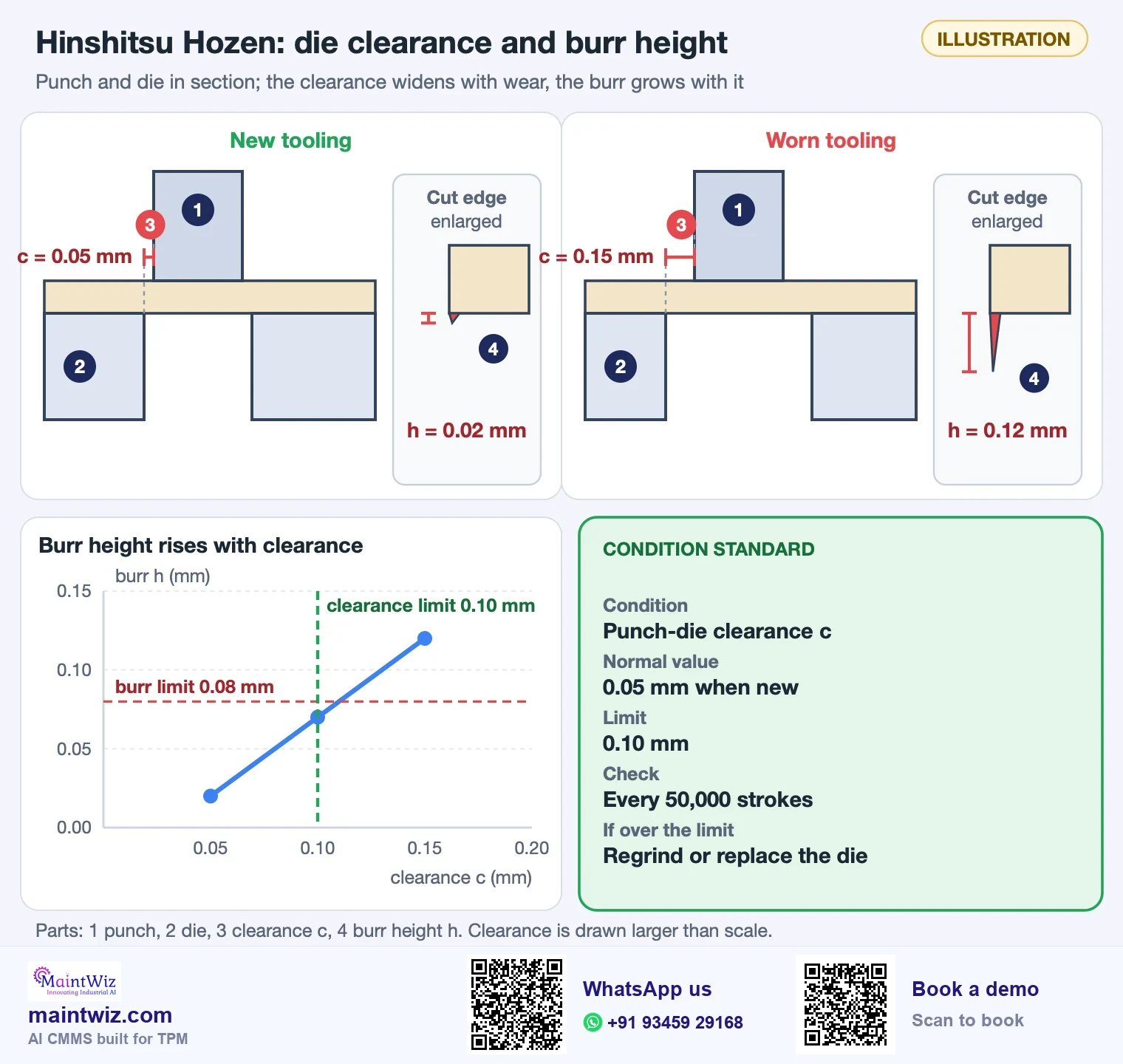
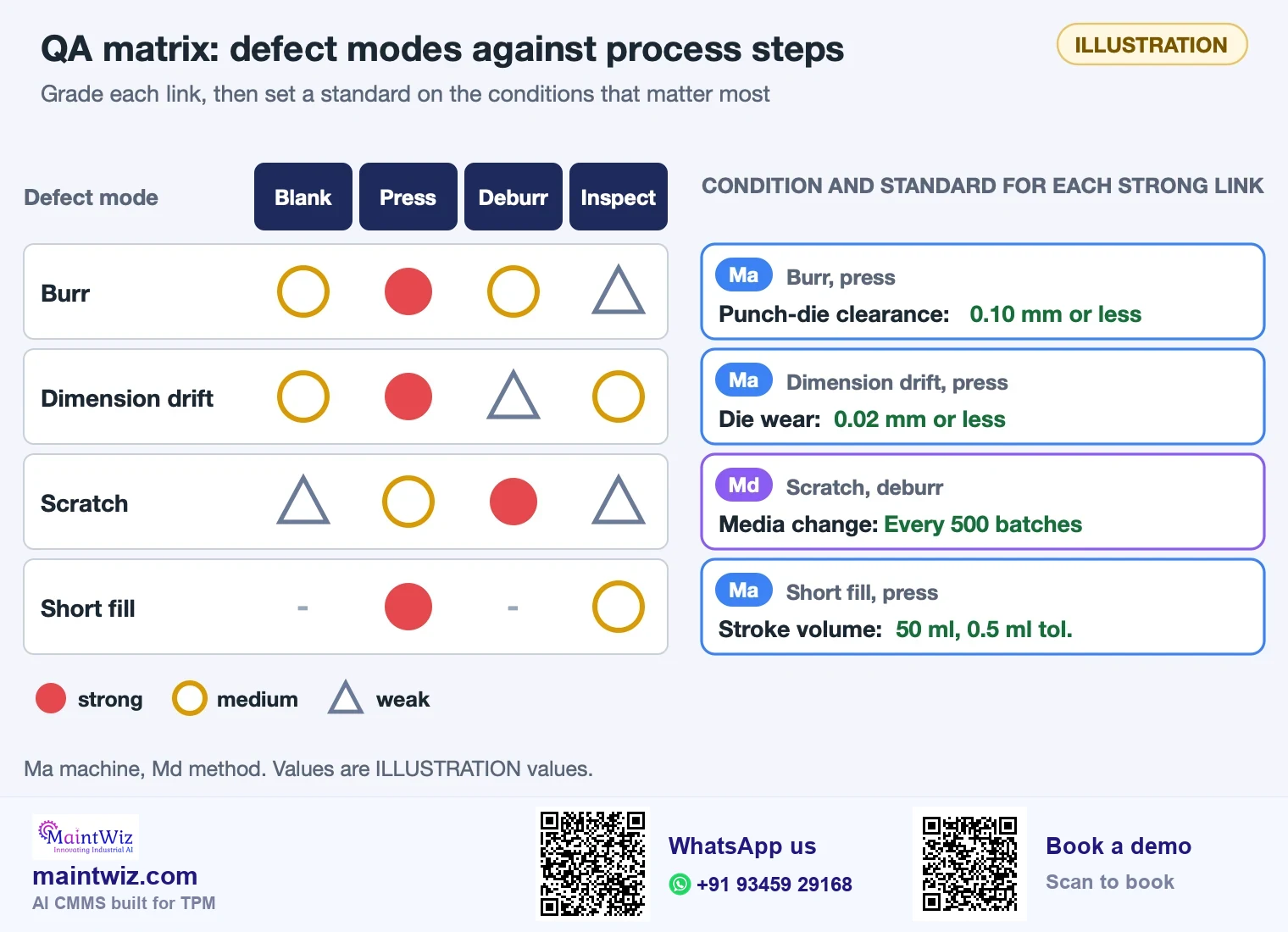
A QM matrix lists defects against process steps and the equipment conditions behind them, and is built from defect and rejection records.
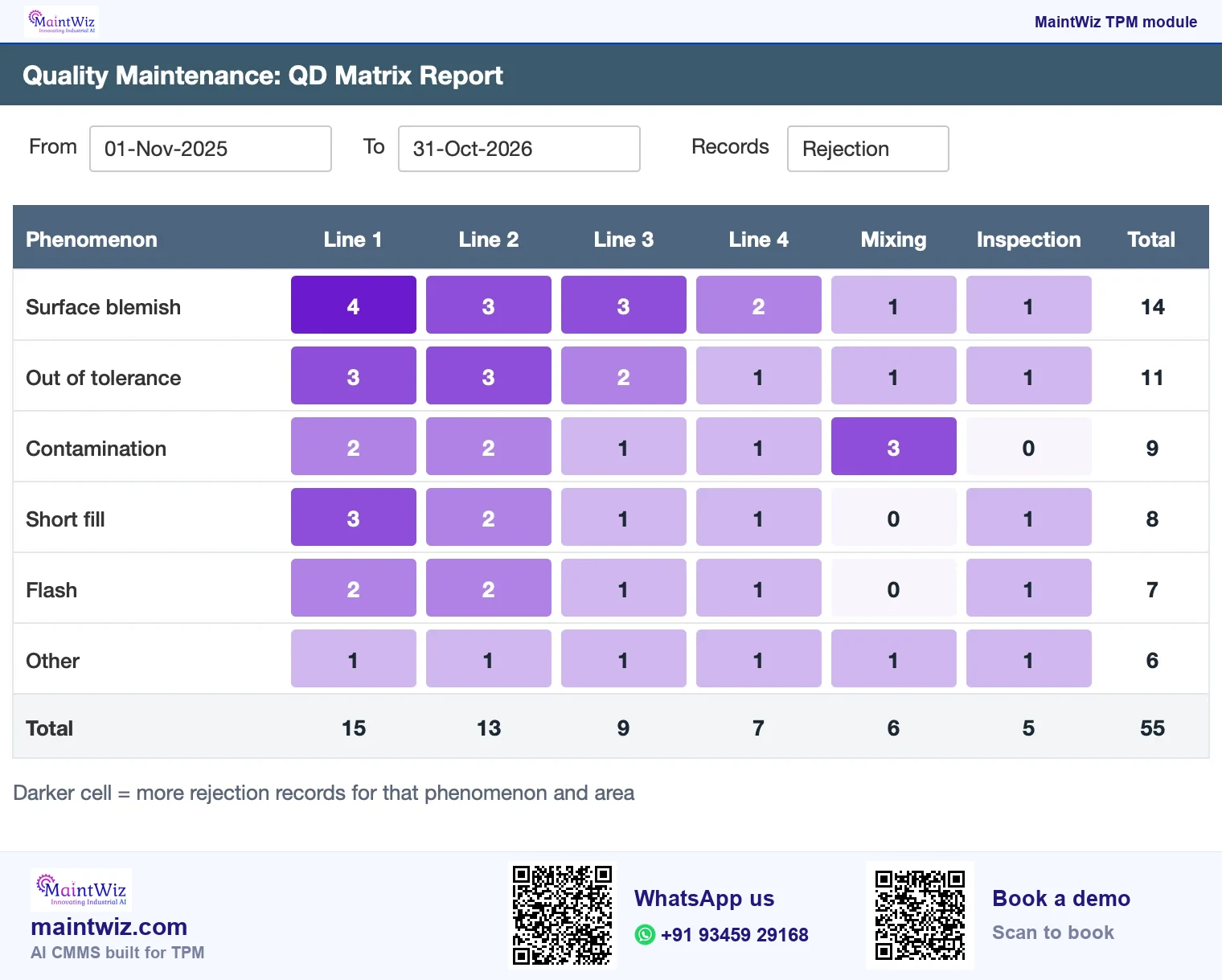
MaintWiz builds this view from the rejection records: the QD matrix report counts them by defect and area, so the repeat defects stand out.
Build your matrix. Get the quality condition matrix (4M) workbook, or see the QD matrix report in a demo.
How does quality maintenance differ from quality control and ISO 9001?
| Quality control | Quality maintenance | ISO 9001 quality management system | |
|---|---|---|---|
| Question | Is this product good? | Are the conditions that make it good in place? | Does the organisation manage quality systematically? |
| When | After or during production | Before and during production | Whole organisation, certified by audit |
| Who | Inspectors, operators | Operators, maintenance, engineering | Management and all functions |
They complement each other: quality maintenance adds equipment-condition checks to the quality control you already run, which moves the plant from result control to condition control.
| Result control | Condition control | |
|---|---|---|
| What is checked | The product, after it is made | The equipment, tooling and process conditions that make it |
| When a problem shows | After the defect exists | Before the defect is made |
| Typical check | Inspection, sampling, final test | Clearance, temperature, pressure or alignment against limits in the CIL and set-up standards |
| Who acts | Quality inspectors | Operators and maintenance in their routines |
Downloads
Quality maintenance templates: pillar audit, defect matrix and 4M matrix
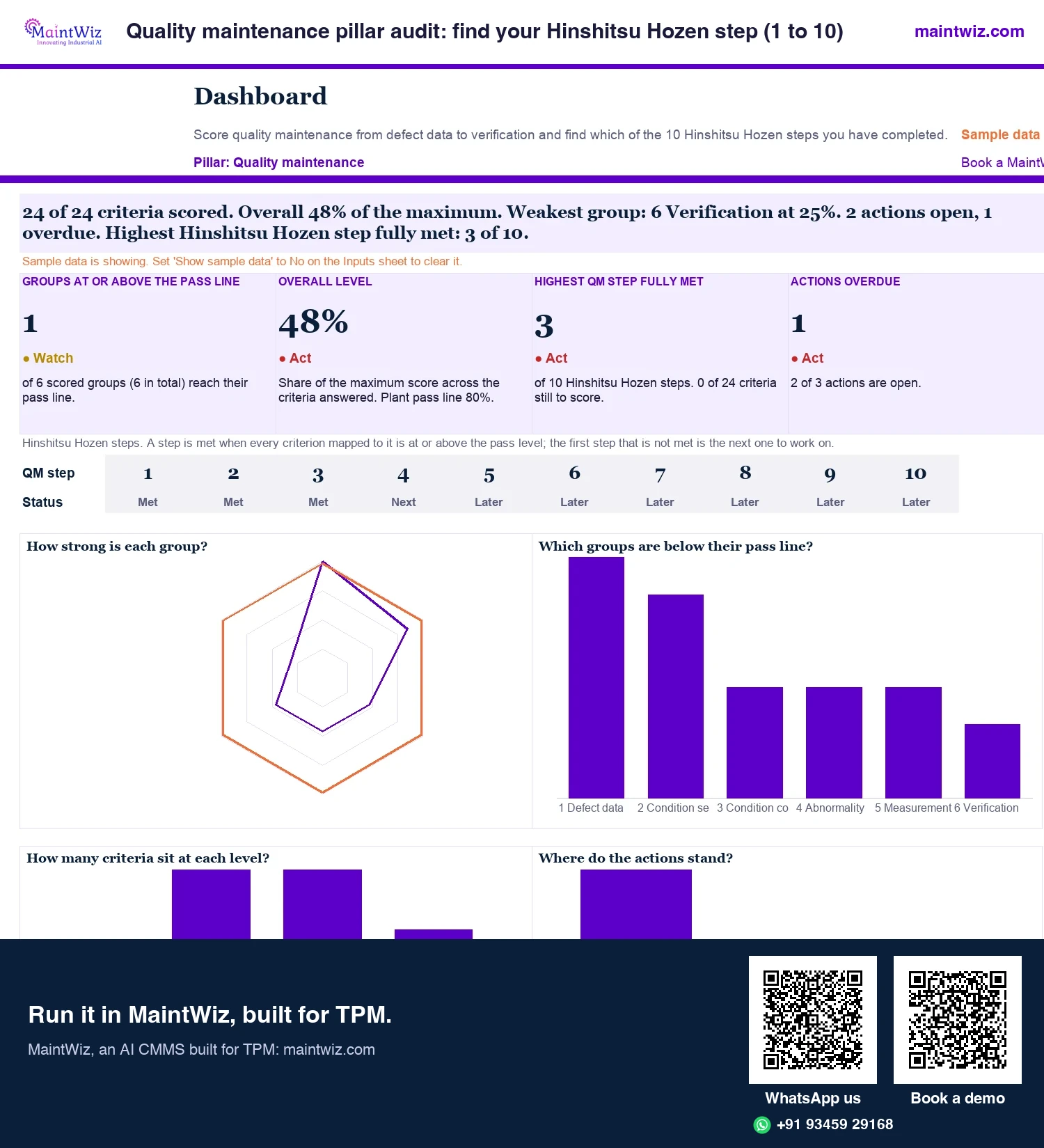
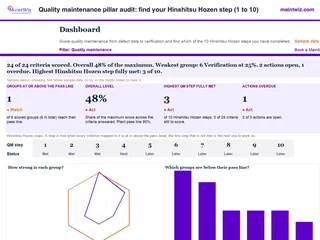 ExcelQuality maintenance pillar audit: find your Hinshitsu Hozen step (1 to 10)
Score your Hinshitsu Hozen step from 1 to 10, with evidence for each of 24 criteria
- Sheets
- Dashboard, Inputs, Audit, Actions, Read me
- A4
- Version
- v1.1, 5 November 2026
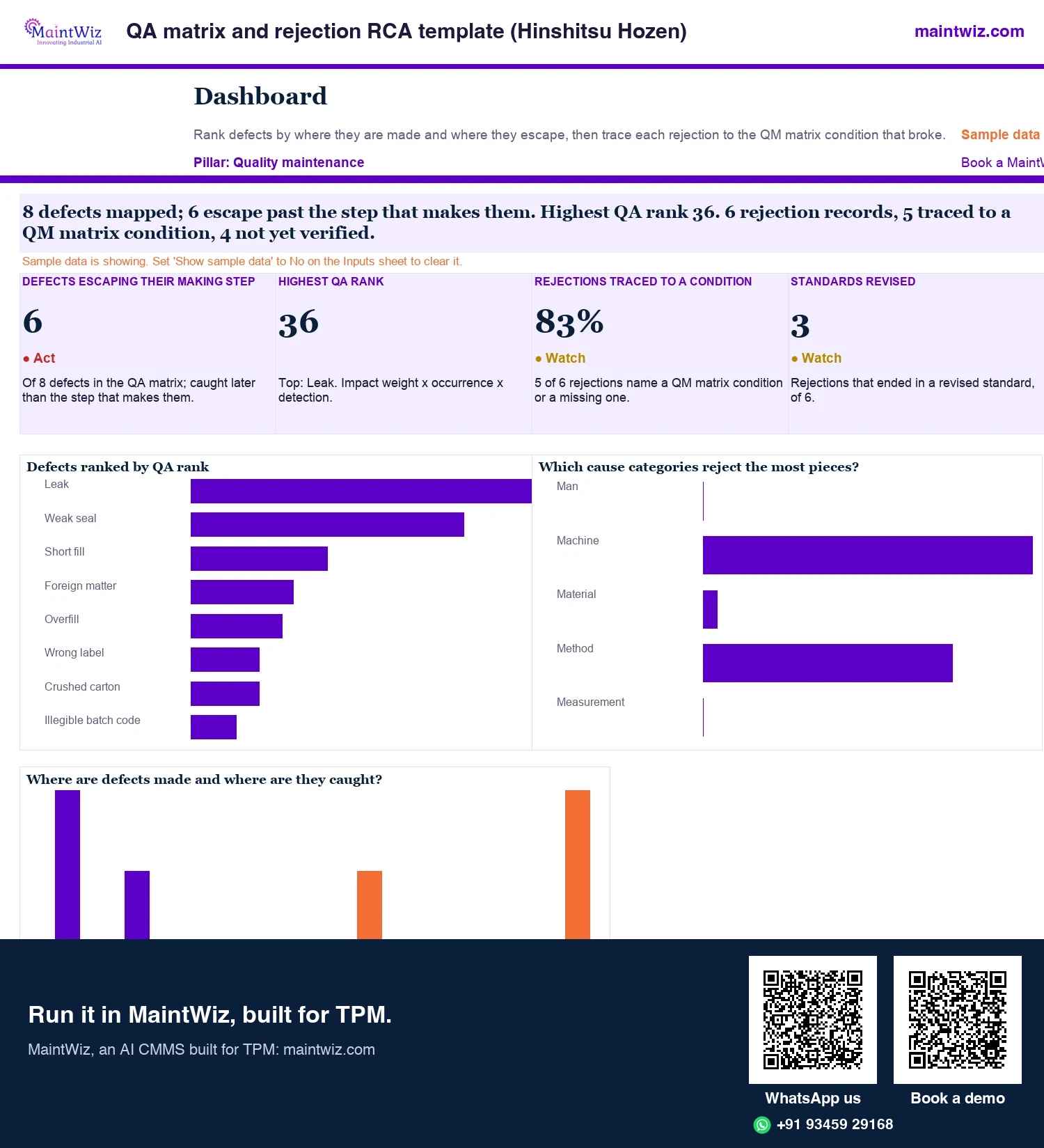
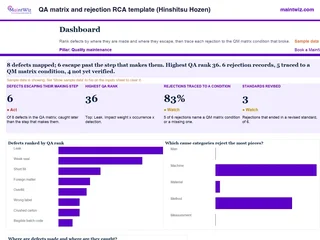 ExcelQA matrix and rejection RCA template (Hinshitsu Hozen)
Rank defects by where they are made and where they escape, then trace every rejection in quality maintenance to the QM matrix condition that broke.
Inside: QA matrix: mark where each defect is made, detected and should be detected · QA rank from customer impact weights A, B and C · Condition IDs pasted from the QM matrix with 4M type · Rejection RCA with five whys and the standard revised
- Sheets
- Dashboard, Inputs, QA matrix, Condition IDs, RCA, Read me
- A4
- Version
- v1.1, 5 November 2026
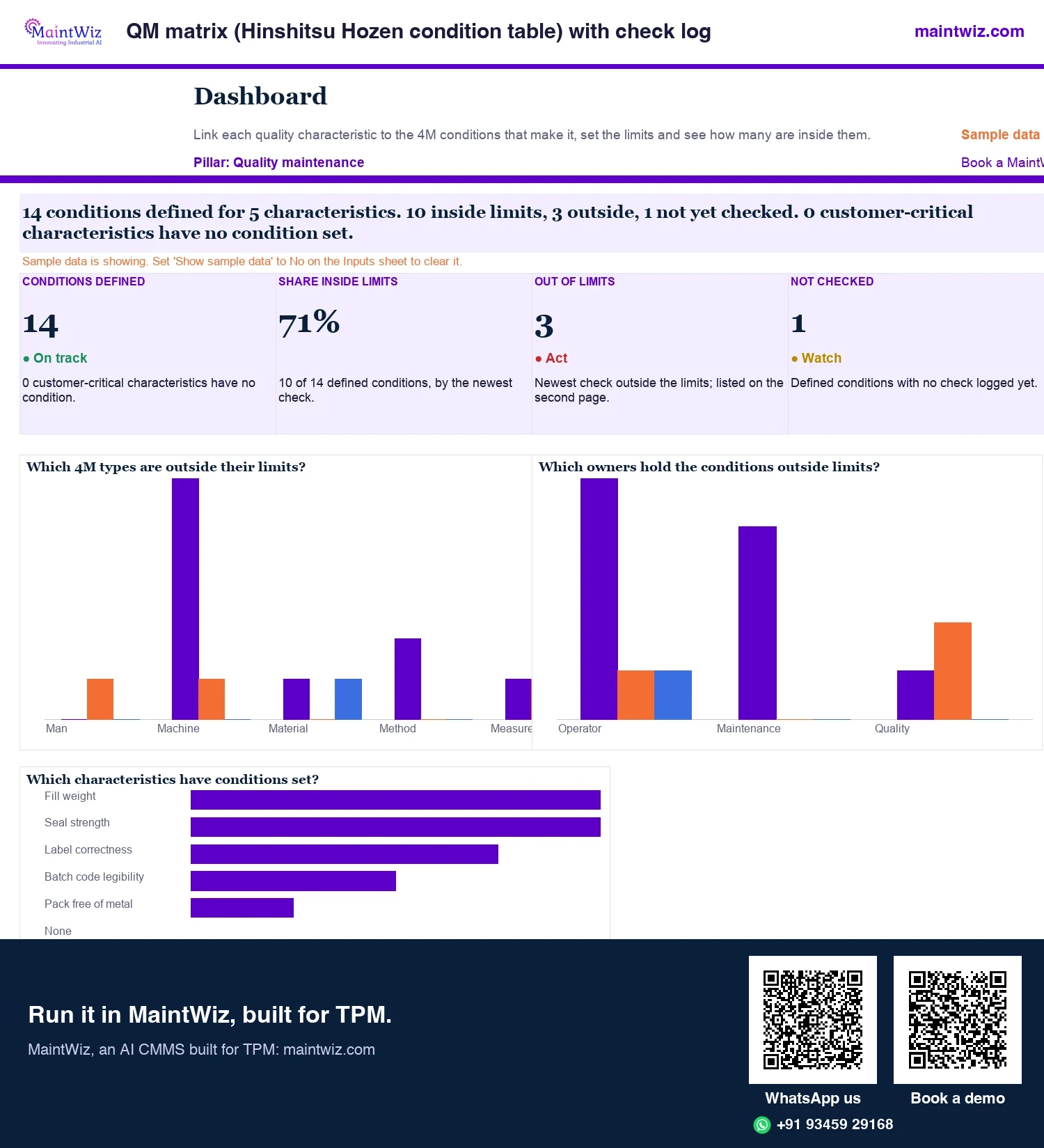
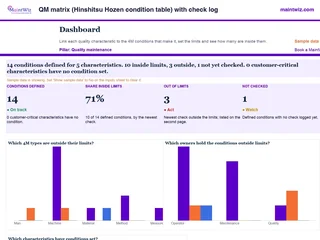 ExcelQM matrix (Hinshitsu Hozen condition table) with check log
Set standard values, limits and check frequency for every 4M condition behind a quality characteristic
- Sheets
- Dashboard, Inputs, Characteristics, Conditions, Checks, Read me
- A4
- Version
- v1.1, 5 November 2026
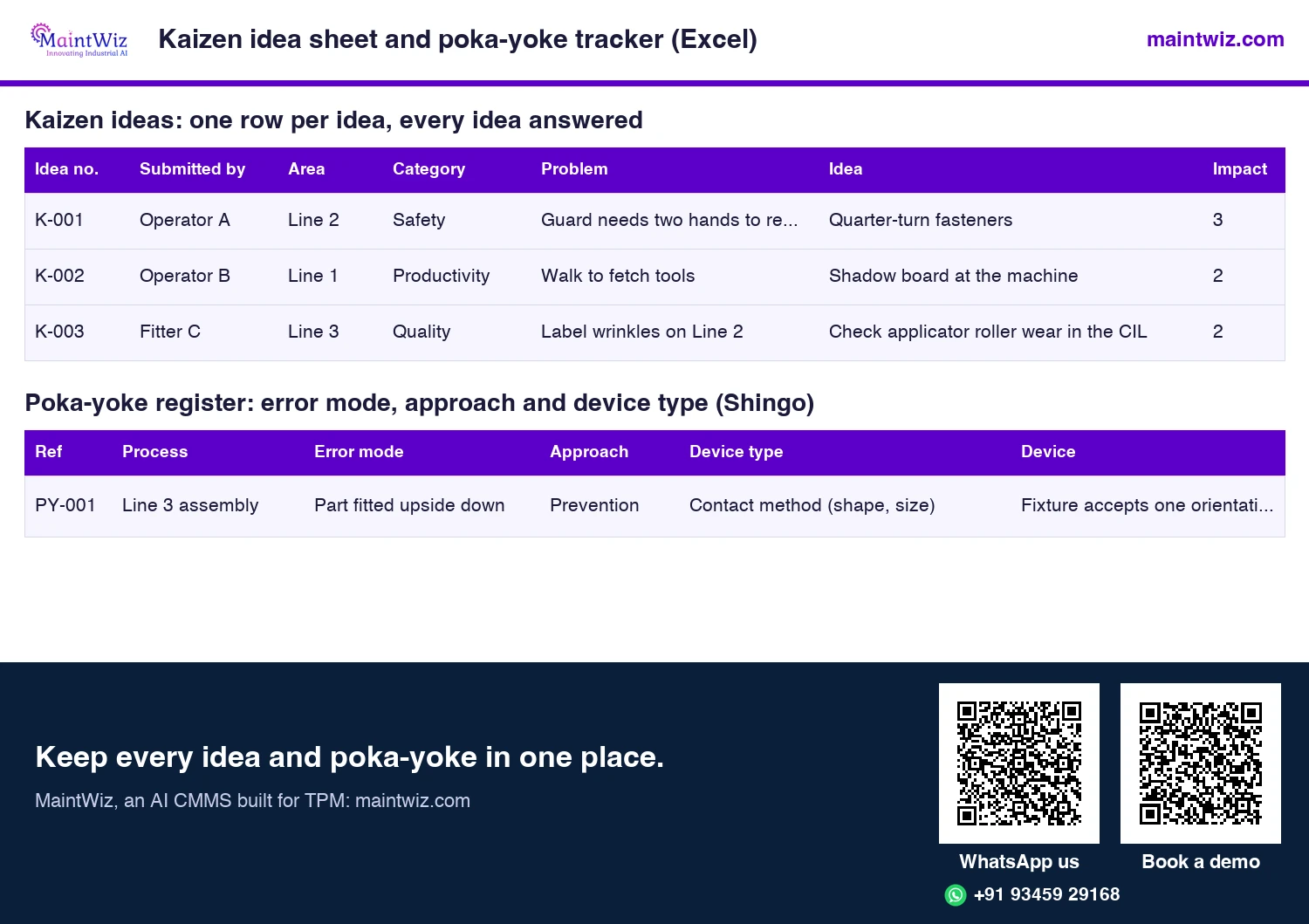
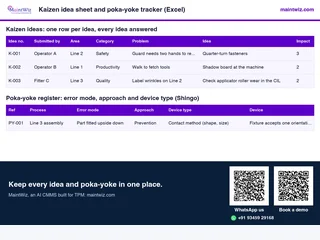 ExcelKaizen idea sheet and poka-yoke tracker
Collect floor ideas by PQCDSM and E category, answer every one
- Sheets
- Dashboard, Inputs, Ideas, Poka-yoke, Summary, Read me
- A4
- Version
- v1.1, 5 November 2026
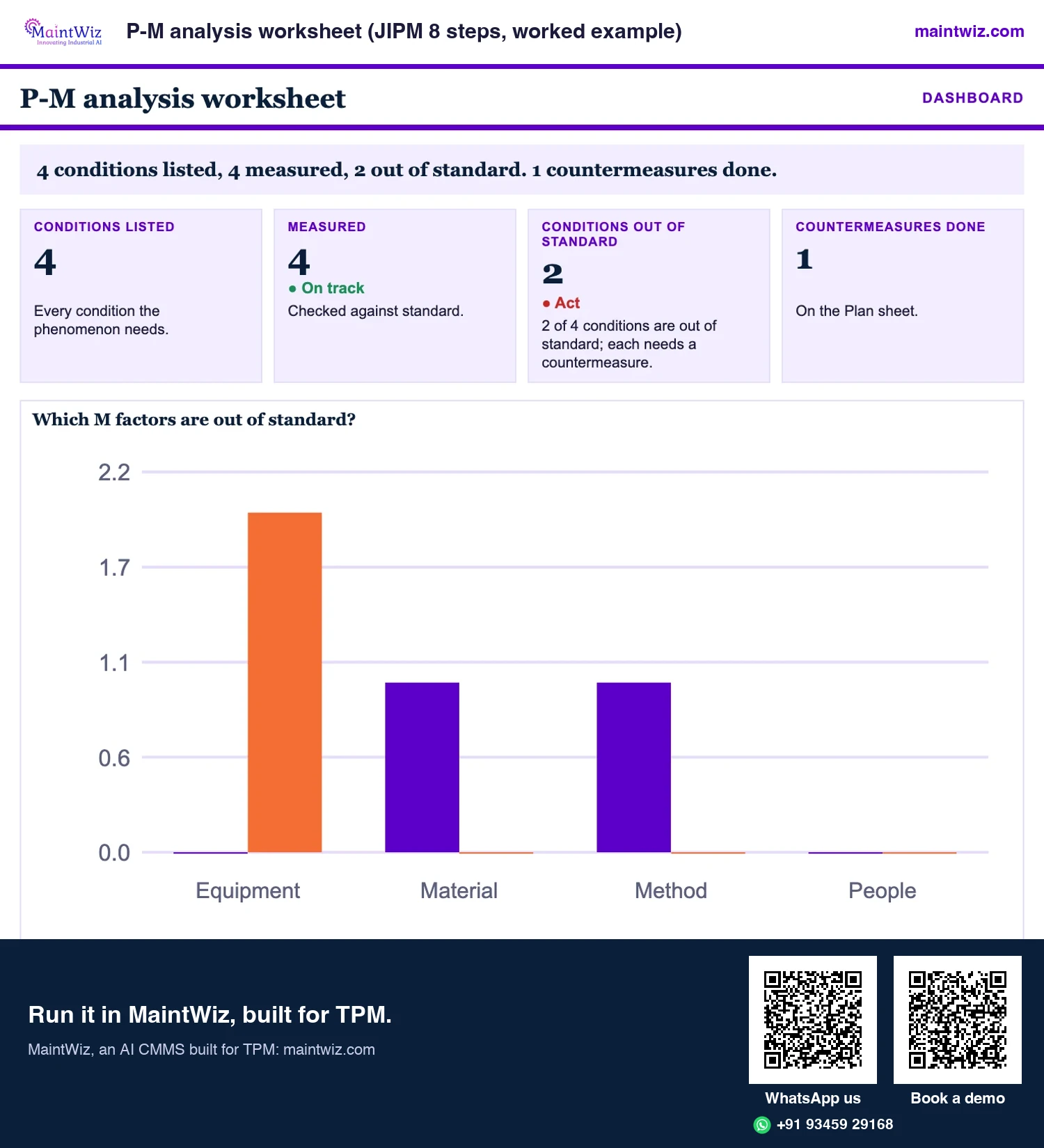
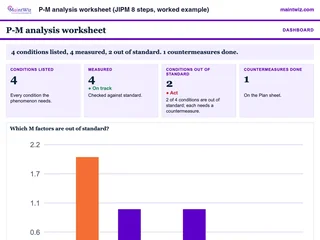 ExcelP-M analysis worksheet (JIPM 8 steps, worked example)
Work a chronic loss through the eight JIPM P-M analysis steps
- Sheets
- Dashboard, Inputs, Phenomenon, Principle, Conditions, Findings, Plan, Read me
- A4
- Version
- v1.1, 5 November 2026
Steps
What are the steps of quality maintenance?
- Define the quality characteristics that matter to the customer and where they are made.
- Link each to the equipment and process conditions that affect it (the QM matrix).
- Set condition limits and standards, and put the checks into operators' and maintenance routines.
- Monitor, and act on deviations before defects appear; run root-cause analysis for rejections that do occur.
- Verify the fix and update the standard and the lesson sheets.
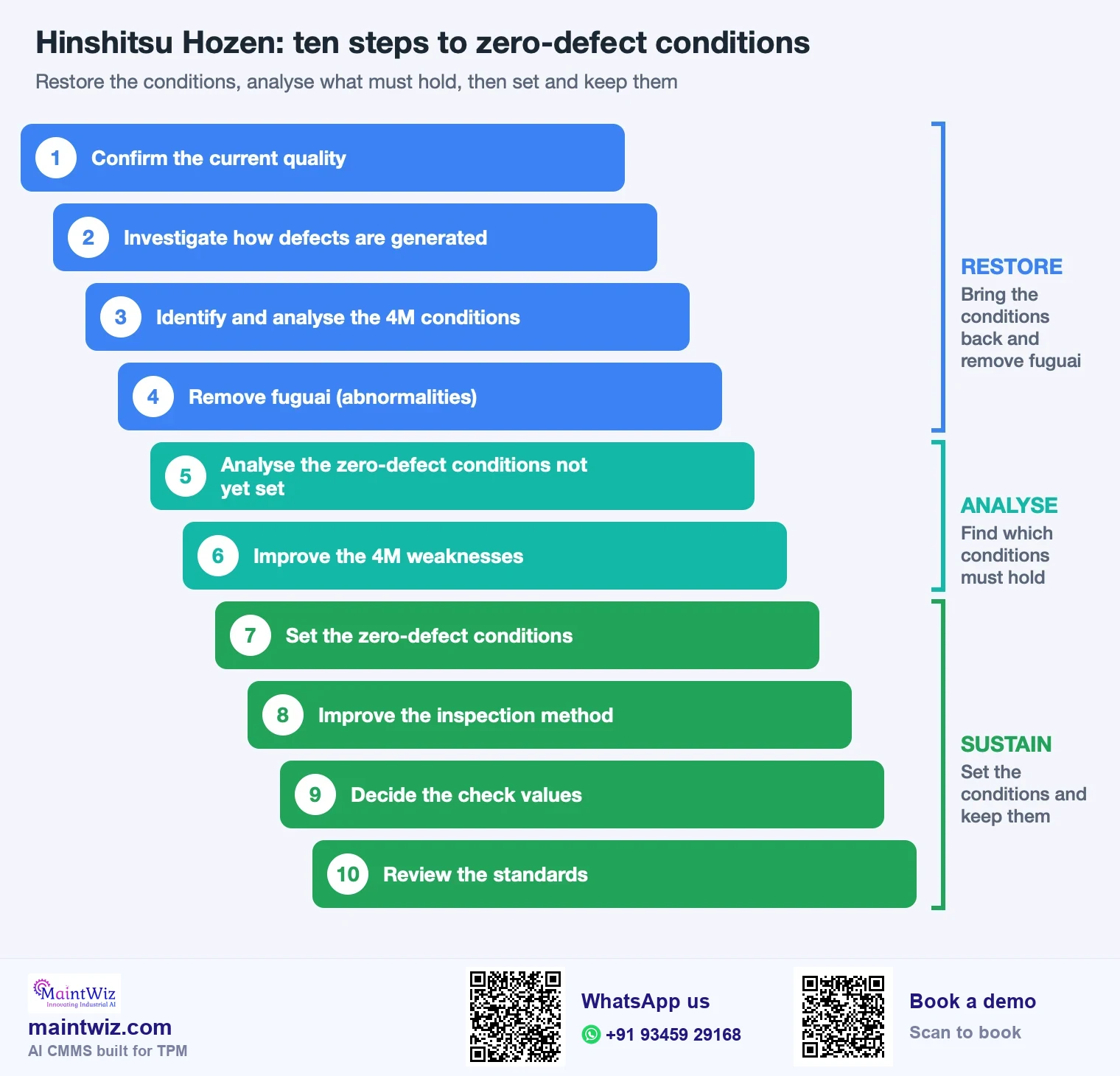
What are the ten steps of Hinshitsu Hozen?
- Confirm the current quality situation.
- Investigate how defects are generated.
- Identify and analyse the 4M conditions.
- Remove fuguai (abnormalities).
- Analyse the zero-defect conditions not yet set.
- Improve the 4M weaknesses.
- Set the zero-defect conditions.
- Improve the inspection method.
- Decide the check values.
- Review the standards.
Steps 1 to 4 restore the conditions, steps 5 and 6 find which conditions must hold, and steps 7 to 10 set and sustain them as standards.
How do you build a quality-maintenance matrix?
A QM matrix is a table with the quality characteristics (or defect types) on one axis and the process steps and equipment conditions on the other. A mark means 'this condition can cause this defect'. Build it from rejection records and from the people who run the process, then use it to decide which conditions to measure, with which limit and how often. Start with the two or three defects that cost most and extend later.
| Step | Output |
|---|---|
| List the defects and customer complaints | Ranked defect list with counts |
| List the process steps and equipment that touch the product | Process map |
| Mark which conditions can cause each defect | QM matrix |
| Set limits and checks for the marked conditions | Condition standards, added to CIL and set-up standards |
| Review after rejections | Matrix and limits updated from root-cause findings |
Poka-yoke and condition checks
Where a condition cannot be left to attention, error-proof it: a fixture that accepts one orientation, a sensor that stops the machine when a limit is crossed, a count that must match before the next step. Poka-yoke devices are logged with the error they prevent and checked after fitting. Log each device in the Kaizen idea sheet and poka-yoke tracker, and in MaintWiz as a poka-yoke sheet.
What goes wrong
What goes wrong in quality maintenance?
- Starting with every defect instead of the costliest few.
- Writing limits that nobody can measure at the machine.
- Treating a rejection as an operator problem before checking the equipment condition.
- Updating the product specification but not the equipment standards.
- Keeping defect data in the quality department only, so maintenance never sees which conditions matter.
Process defects and rework, and reduced yield at start-up, are the two quality losses among the six big losses.
Defect types
What do defect types point to?
| Defect pattern | Equipment or process conditions to check |
|---|---|
| Dimensional drift over a run | Tool wear, thermal growth, fixture condition, measuring equipment |
| Random scratches or marks | Guides, conveyors, handling, contamination |
| Leaks or seal failures | Seal condition, alignment, pressure, surface finish |
| Contamination in product | Cleaning standards, filters, enclosure, material handling |
| Weight or fill variation | Dosing equipment, calibration, feed variation |
| Start-up rejects | Warm-up, set-points reached, stability before release |
Use these pairs as the first rows of the QM matrix, then confirm each condition against the rejection records of that line.
From a defect to a standard: a sequence
- Describe the defect precisely: what, where, when, how often, on which equipment.
- List the conditions of equipment, material, method and people that affect it.
- Check each against its standard: is it in condition today?
- Fix the conditions found out of standard and find why they drifted.
- Put the conditions into checks that operators and maintenance perform, with limits.
- Verify with defect data and update the matrix.
From a defect to condition checks
The quality maintenance path, in the order it is worked
Defect and the process where it arises
QM matrix links the defect to the conditions that cause it
Conditions by 4M: machine, man, material, method
Limit and standard for each condition
Checks added to operator and maintenance routines
Verify with defect data and update the standard
 maintwiz.comAI CMMS built for TPM
 WhatsApp us
 +91 93459 29168
 Book a demo
MaintWiz tracks each corrective action in the abnormality register and each rejection in rejection RCA.
Chronic defects with several interacting causes can be analysed with P-M analysis.
Roles in quality maintenance
| Role | Contribution |
|---|---|
| Operator | Checks conditions in the routine; reports drift and defects |
| Maintenance | Restores and maintains conditions to standard |
| Quality engineer | Owns the matrix and analysis; links to customer requirements |
| Process engineer | Explains how process settings affect the defect |
| Pillar owner | Reviews rejection trends and the matrix |
KPIs
Which KPIs measure quality maintenance?
Useful measures are first-pass yield (the quality factor of OEE), defects by cause and by equipment, customer complaints traced to a process cause, and the share of defined conditions that are inside limits. Use the same definitions between periods.
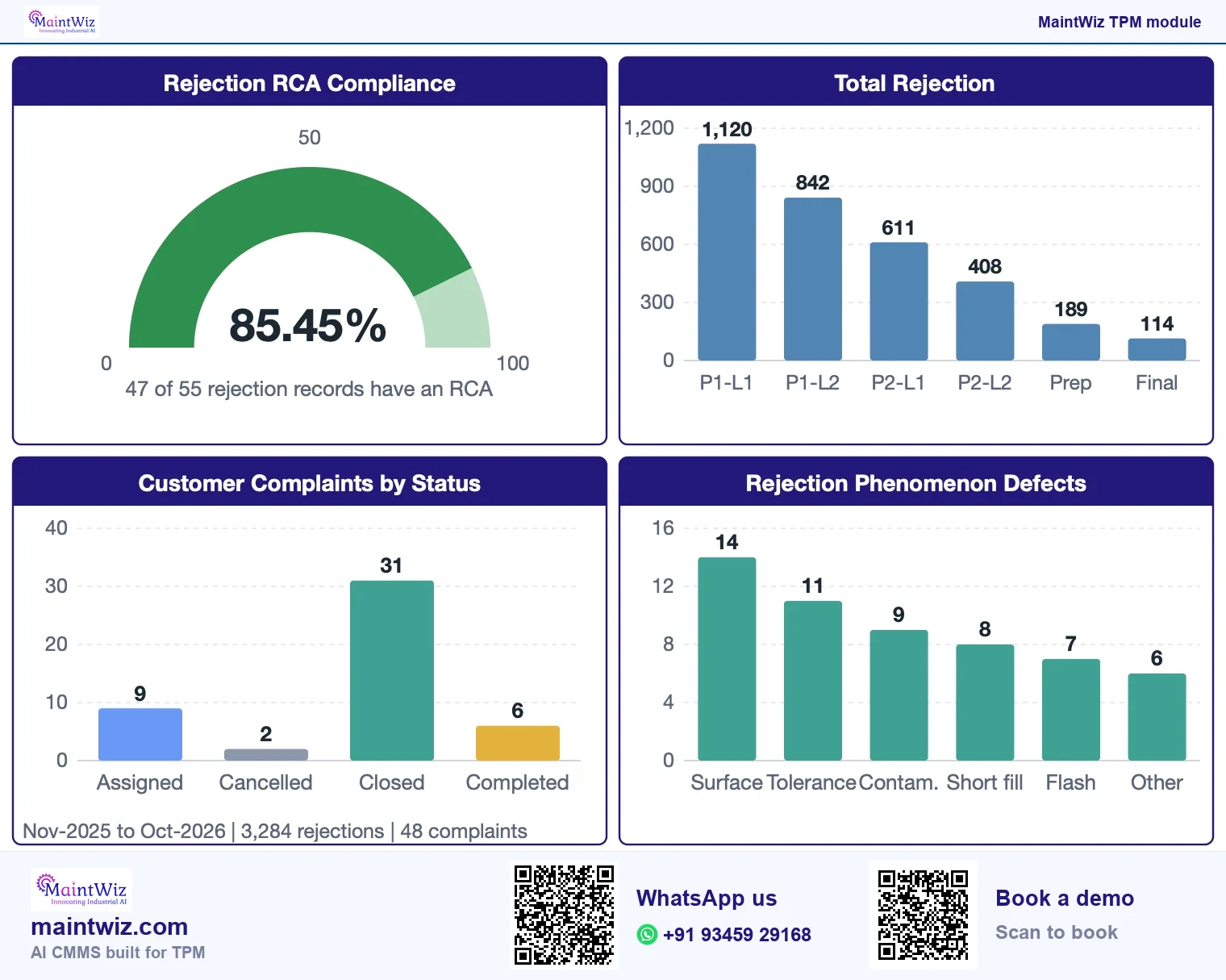
MaintWiz reads these measures from the defect and rejection records held against the same equipment, so quality losses sit beside availability and performance.
Measuring your quality pillar? Book a demo to see the QM dashboard with rejection RCA compliance and complaints by status.
Software needs
What should quality maintenance software do?
Software for Hinshitsu Hozen has to connect a defect to the equipment condition behind it and track the root cause to closure.
| Item | Detail |
|---|---|
| Japanese term | Hinshitsu Hozen |
| English meaning | Quality maintenance. JIPM, the Japan Institute of Plant Maintenance, lists this core pillar as Quality Maintenance. |
| What it controls | The equipment, tooling and process conditions that decide product quality |
| What MaintWiz records | Defects, rejection analysis and complaints against the equipment, with a quality dashboard |
- Quality defects entry against the equipment.
- Rejection RCA with a compliance measure on the dashboard.
- A QD matrix report that counts rejection records by defect phenomenon and area.
- A customer complaint register with complaints by status.
- A quality dashboard with rejections by facility and defect phenomena.
MaintWiz is an AI CMMS built for TPM: load your equipment and defect types through Excel uploads and rejection RCA can start as soon as they are in. See quality defect management software, the TPM software buyer's guide, pricing or a demo.
FAQ
Frequently asked questions
What is quality maintenance in TPM?
Quality maintenance is the TPM pillar that prevents defects by controlling the equipment and process conditions that affect product quality, rather than relying only on inspecting the product after it is made.
What is the QM pillar in TPM?
QM is the quality maintenance pillar (Hinshitsu Hozen), one of the four core loss-reduction pillars that JIPM lists. It controls the equipment conditions that decide product quality and puts limits and checks into routines.
Is quality maintenance the same as quality control?
Quality control checks whether the product is good; quality maintenance controls the conditions that make the product good. They run together, and quality maintenance adds equipment-condition checks to the quality control you already run.
What is Hinshitsu Hozen?
Hinshitsu Hozen is the Japanese term for quality maintenance. Its aim is to build quality into the process by keeping equipment conditions under control so that defects are not made.
What is a QM matrix?
A QM matrix lists defects against the process steps and equipment conditions that can cause them. It is built from defect and rejection records and used to decide which conditions to measure, with which limit and how often.
How does quality maintenance relate to OEE?
The quality factor of OEE is the good count divided by the total count. Quality maintenance works on the conditions behind the process defects and start-up rejects that reduce that factor.
What KPIs track quality maintenance?
Common measures are first-pass yield, defects by cause and equipment, customer complaints traced to a process cause, and the share of defined conditions that are inside limits. Use the same definitions between periods.
How do you start quality maintenance?
Pick the defect with the highest cost or complaint rate on one line, list the equipment and process conditions that affect it, check them against standard and put the key ones into routine checks with limits.
How does quality maintenance work with inspection?
Inspection finds defects after they are made; quality maintenance sets limits and checks on the conditions that cause them, so fewer defects reach the inspector. Both stay in the plan.
What should quality maintenance software do?
It should record quality defects against the equipment, run rejection root-cause analysis, keep a customer complaint register and show a quality dashboard. MaintWiz does all four in its quality menu.