
Key takeaways
- Kobetsu Kaizen (focused improvement) is the TPM pillar for removing specific equipment losses through measured team projects.
- It differs from general Kaizen: a defined loss, a baseline, a cross-functional team and a verified result.
- Pick projects from the loss Pareto, not from the loudest complaint.
- A result counts only if it holds on the same definition and the standard is updated.
- MaintWiz is an AI CMMS built for TPM: the Kaizen idea sheet, poka-yoke sheet, loss cost master and KK report sit beside all eight pillars, 5S, OEE and one point lessons in one AI CMMS; operators capture on mobile, tags become work orders, IoT signals raise work orders and ePTW covers safety. The whole roll-out takes 6 to 8 weeks.
Meaning
What does Kobetsu Kaizen mean?
'Kobetsu' means individual or specific and 'Kaizen' means improvement. In TPM it is the focused improvement (FI) pillar, often shortened to KK. It sits with autonomous maintenance, planned maintenance and quality maintenance among the pillars that attack losses directly. JIPM describes TPM as aiming at zero losses; Kobetsu Kaizen is the method for picking a loss and removing its causes one project at a time.
How is Kobetsu Kaizen different from general Kaizen?
| Kobetsu Kaizen | General Kaizen | |
|---|---|---|
| Trigger | A ranked equipment loss (for example the largest cause of lost time) | Any idea from anyone |
| Team | Cross-functional: operator, maintenance, engineering | Individual or work group |
| Measure | Loss before and after on a fixed definition | Often qualitative or local |
| Output | Verified result, updated standard, rollout to similar equipment | Change made; follow-up varies |
| Typical tool | Loss Pareto, why-why, A3 report | Suggestion scheme, quick fixes |
Both are needed. Ideas from the floor feed the project list; projects are chosen from the loss data. For a plant-wide Kaizen programme, start with how to implement Kaizen in your organization.
The loss structure it targets
Focused improvement works from the loss structure. For equipment, the six big losses (breakdowns, setup and adjustment, idling and minor stops, reduced speed, process defects and rework, reduced yield at start-up) are the usual starting point, measured through OEE; see six big losses and what is OEE. JIPM's loss structure adds manpower and resource losses to these, 16 major losses in all (Figure 1).
JIPM 16 major losses: 8 equipment, 5 manpower, 3 material and energy
Shaded: the six equipment losses that OEE measures and Kobetsu Kaizen projects attack first
- 8
Equipment
- Failure
- Setup and adjustment
- Tool and blade change
- Start-up yield
- Minor stops and idling
- Reduced speed
- Defects and rework
- Planned shutdown
- 5
Manpower
- Management
- Operating motion
- Line organisation
- Logistics
- Measurement and adjustment
- 3
Material, energy
- Yield
- Energy
- Dies, jigs and tools
 maintwiz.comAI CMMS built for TPM
 WhatsApp us
 +91 93459 29168
 Book a demo
Downloads
Kobetsu Kaizen templates: loss tree, A3 report template and pillar audit
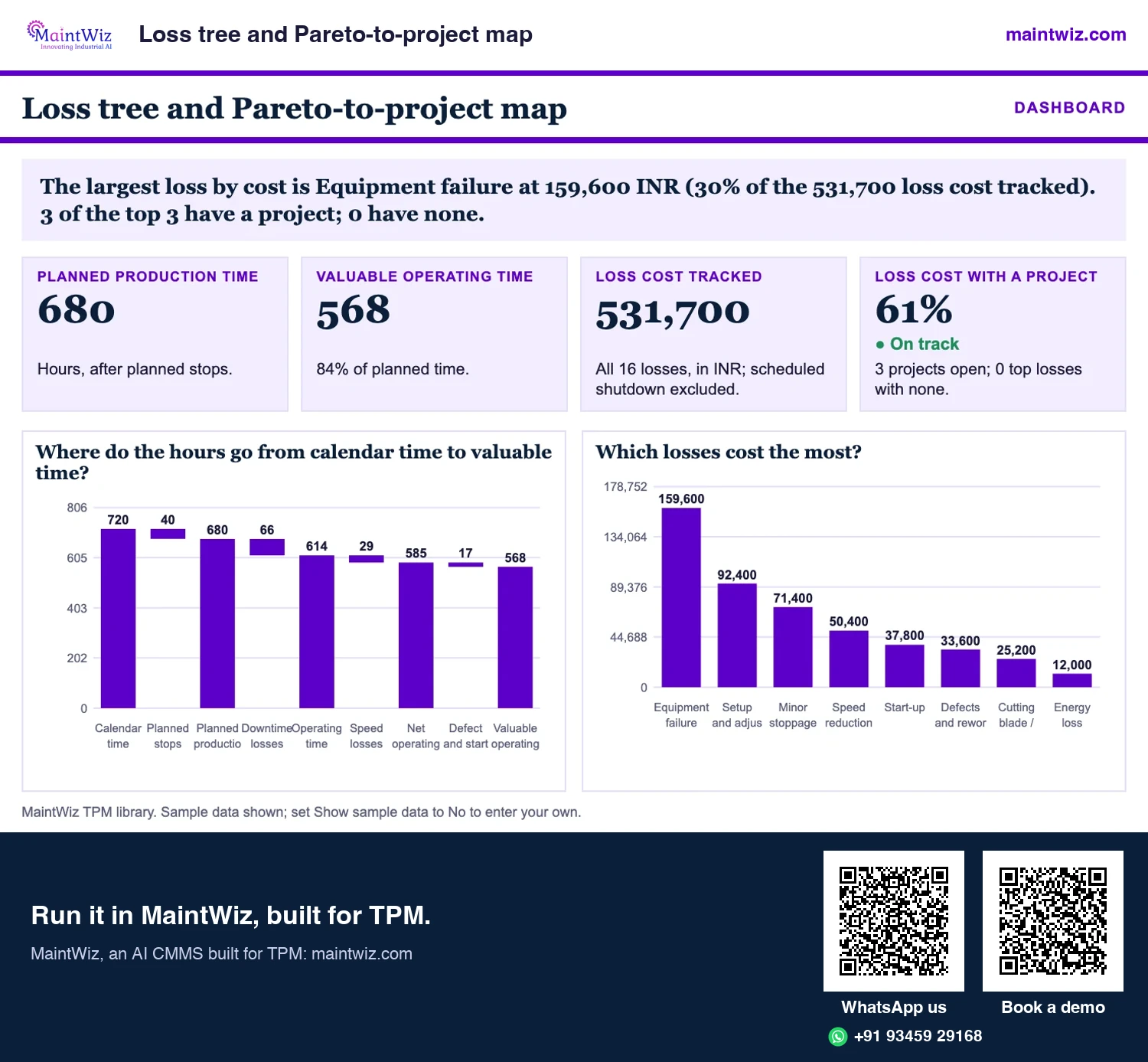
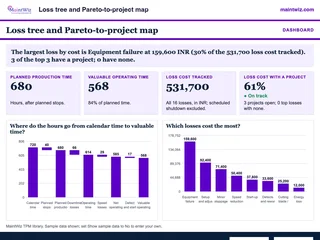 ExcelLoss tree and Pareto-to-project map
Build the loss tree from calendar time to valuable time, rank all 16 losses by cost
- Sheets
- Dashboard, Inputs, Tree, Project map, Pareto, Read me
- A4
- Version
- v1.1, 5 November 2026
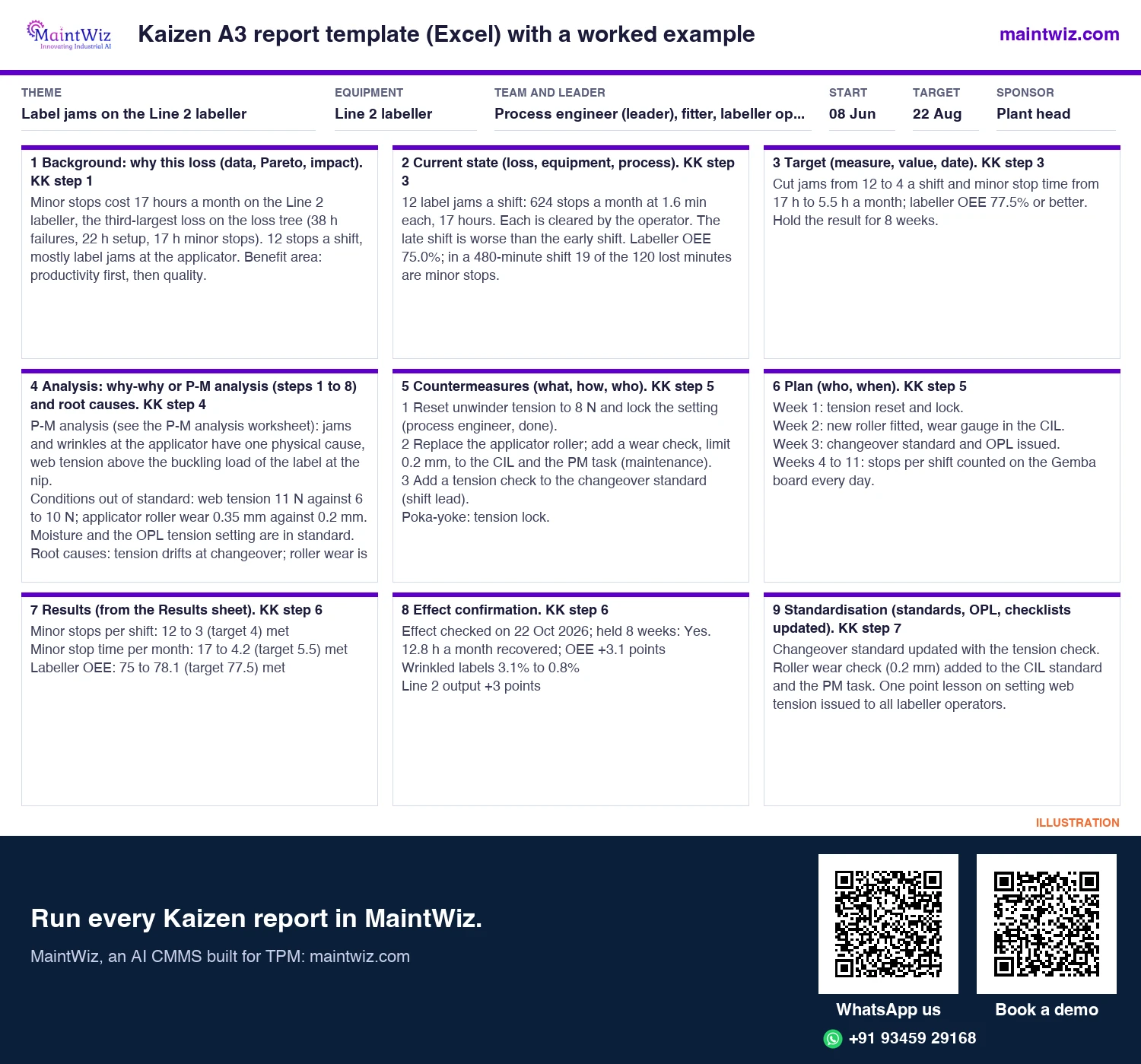
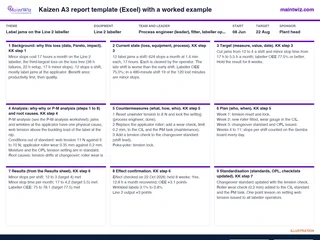 ExcelKaizen A3 report template (Excel) with a worked example
Run a Kobetsu Kaizen project as an A3 report, with the Line 2 labeller project filled in from loss ranking to Yokoten
- Sheets
- Dashboard, Inputs, Results, A3 report, A3 report, 2-page print, Calc, Read me
- One large sheet, or two A4 pages
- Version
- v1.1, 5 November 2026
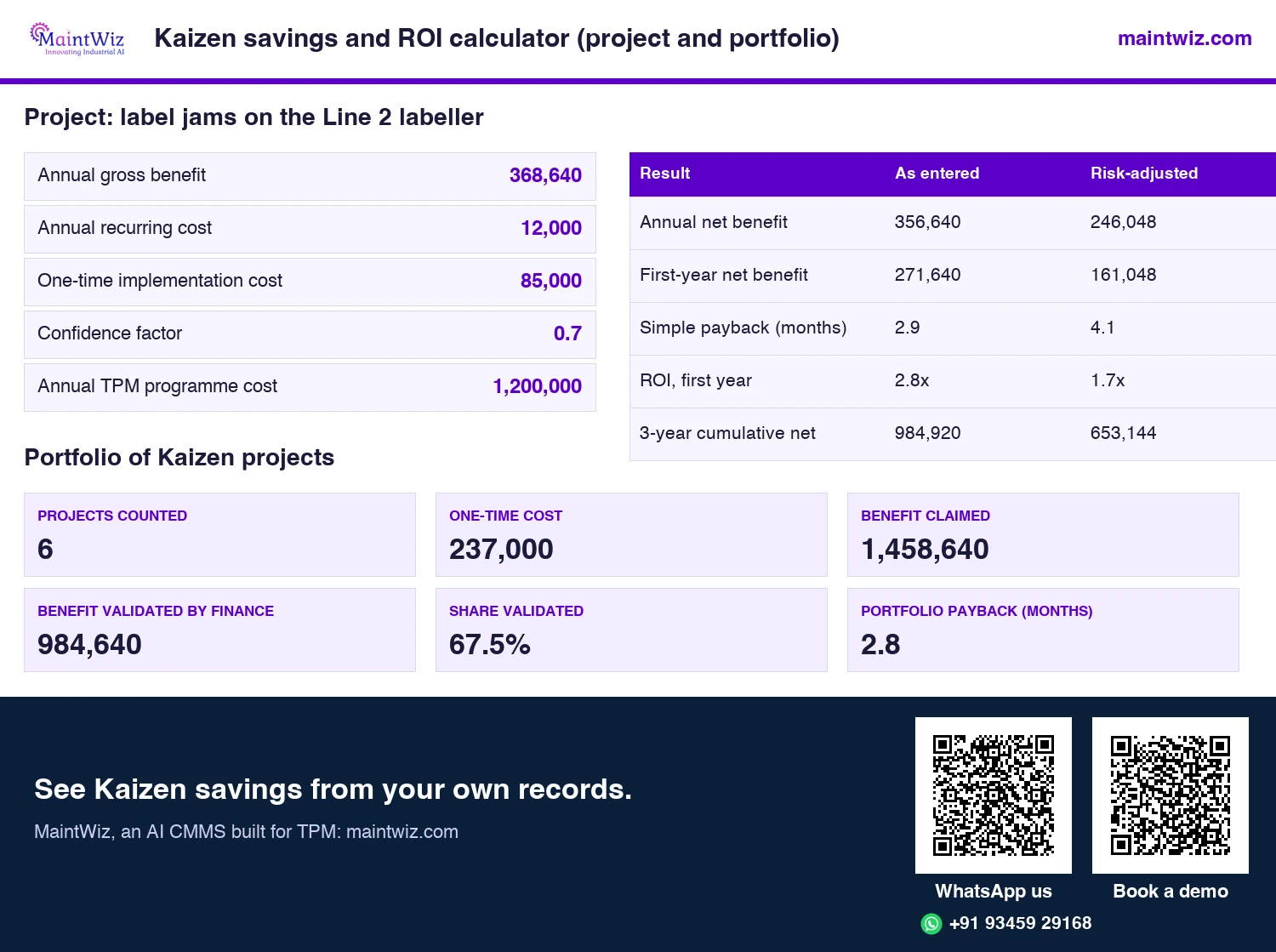
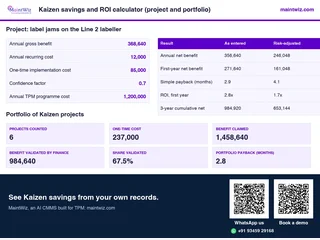 ExcelKaizen savings and ROI calculator (project and portfolio)
Test one Kaizen project for payback and ROI, then list up to 25 projects by loss to see which ones pay for the TPM
- Sheets
- Dashboard, Project, Sensitivity, Portfolio, Read me
- A4
- Version
- v1.1, 5 November 2026
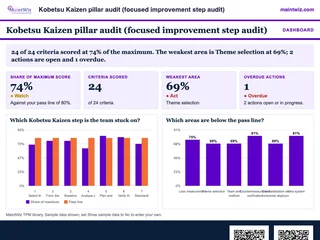 ExcelKobetsu Kaizen pillar audit (focused improvement step audit)
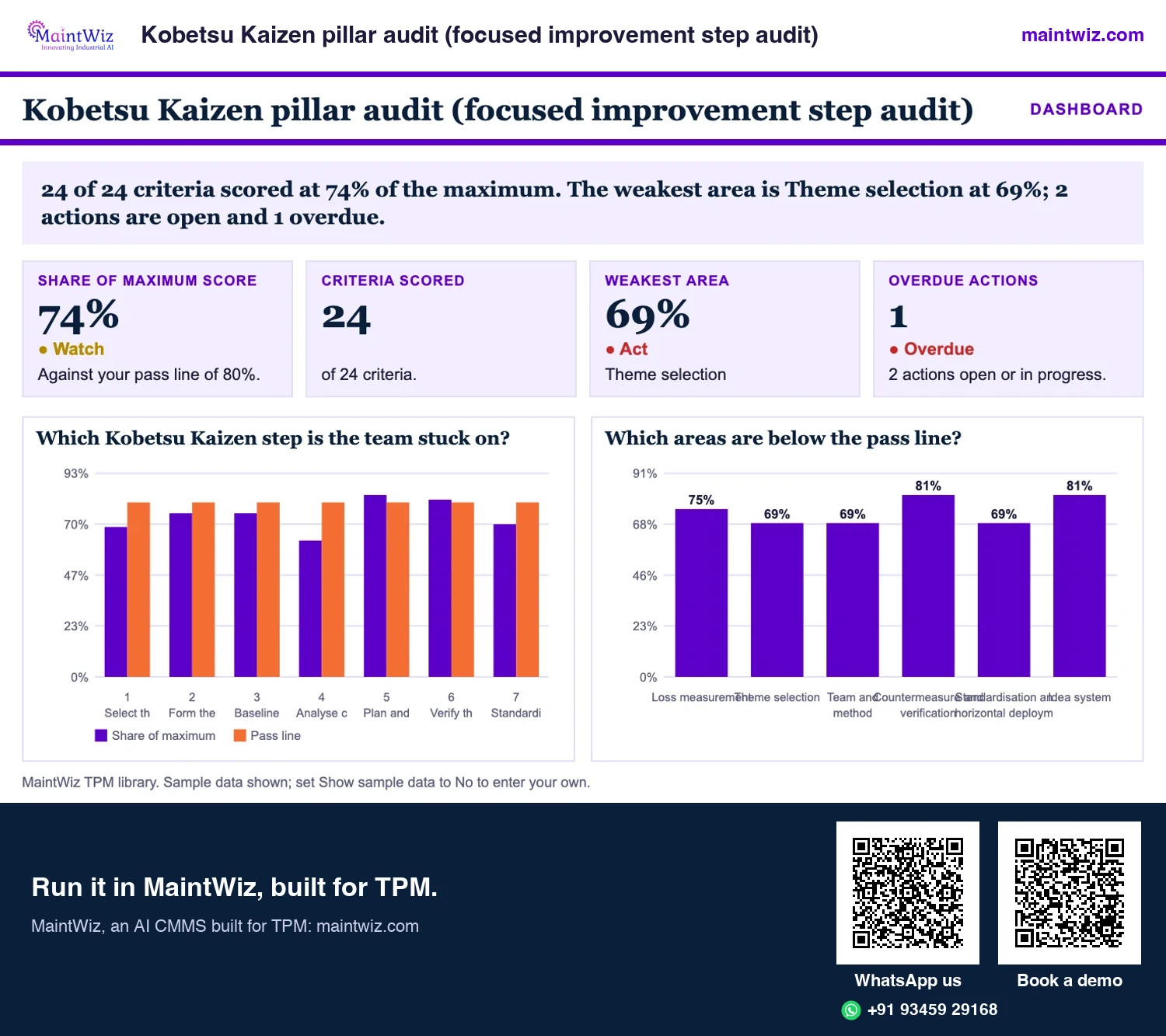
Score 24 criteria across the seven Kobetsu Kaizen steps, see which step a team is stuck on, and track the actions
- Sheets
- Dashboard, Inputs, Audit, Actions, Read me
- A4
- Version
- v1.1, 5 November 2026
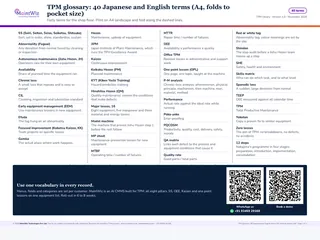 PDFTPM glossary: 40 Japanese and English terms (folds to pocket size)
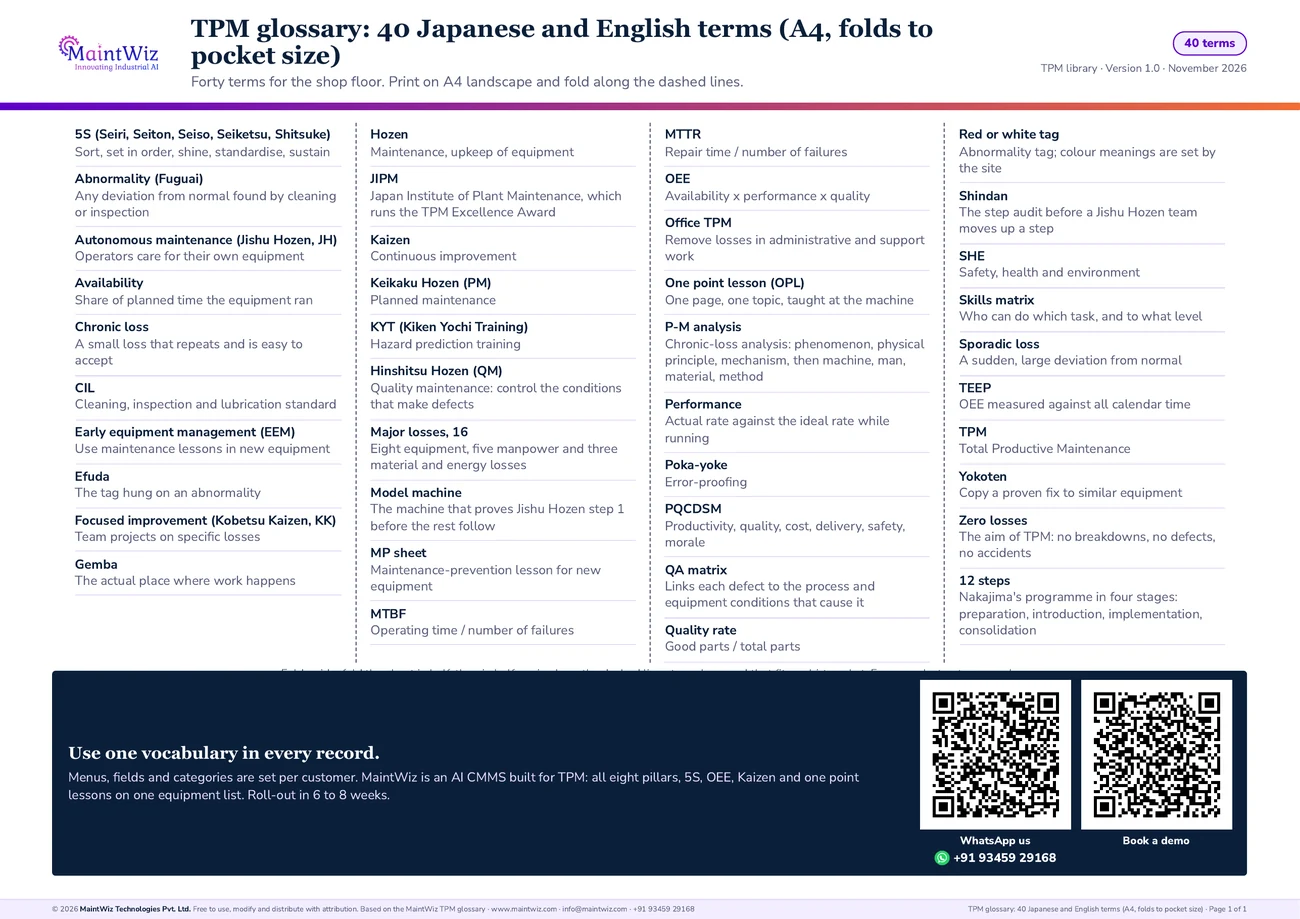
Forty Japanese and English TPM terms on one A4 sheet that folds to pocket size
- Pages
- 1
- A4 landscape
- Created
- 5 November 2026
Project steps
What are the steps of a focused improvement project?
- Pick the loss. Take the largest loss on one equipment from the loss Pareto, not the loudest complaint.
- Form the team. Operator, maintenance and engineering; name a leader and a sponsor.
- Baseline. Measure it on the agreed definition so the later comparison is fair.
- Analyse. Ask why repeatedly and map causes (cause-and-effect or why-why) until you reach a cause you can remove.
- Plan and act. Choose fixes, owners and dates, test small first, make the change and record what was done.
- Verify. Measure again on the same definition and compare with the baseline.
- Standardise and share. Update the CIL standard, the one point lesson and the checklist, and look for the same cause on similar equipment.
A focused improvement project in seven steps
Seven steps from the loss ranking to a new standard
Select theme from the loss ranking
Form the team
Baseline and target
Analyse causes
Plan and act
Verify the result
Standardise and spread
maintwiz.comAI CMMS built for TPMWhatsApp us+91 93459 29168Book a demoReporting the project
The A3 report keeps the whole project on one page, from theme and baseline to the updated standard. Carry the project on the Kaizen A3 report template and test its payback with the Kaizen savings and ROI calculator.
Kobetsu Kaizen example: a worked project
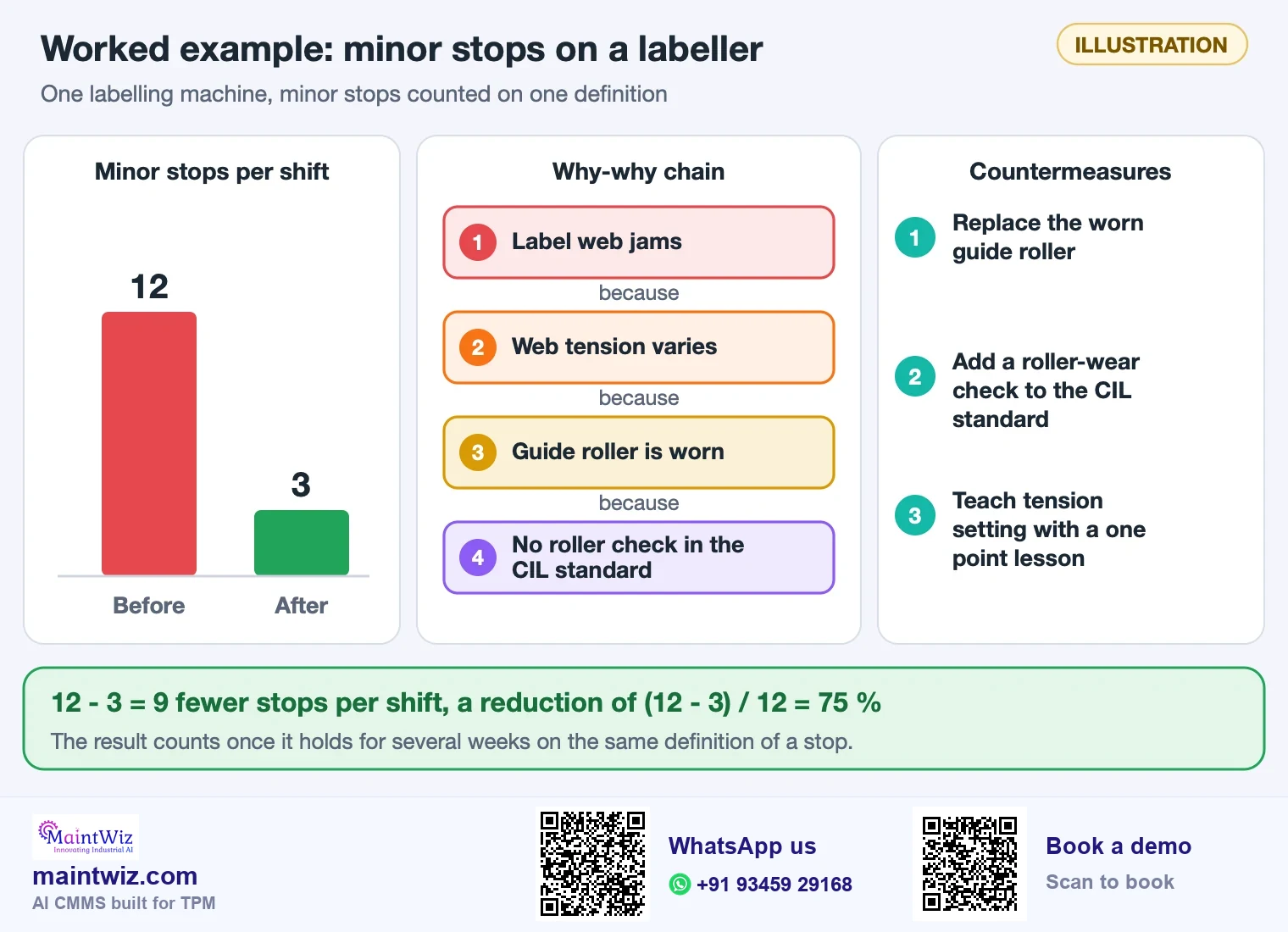
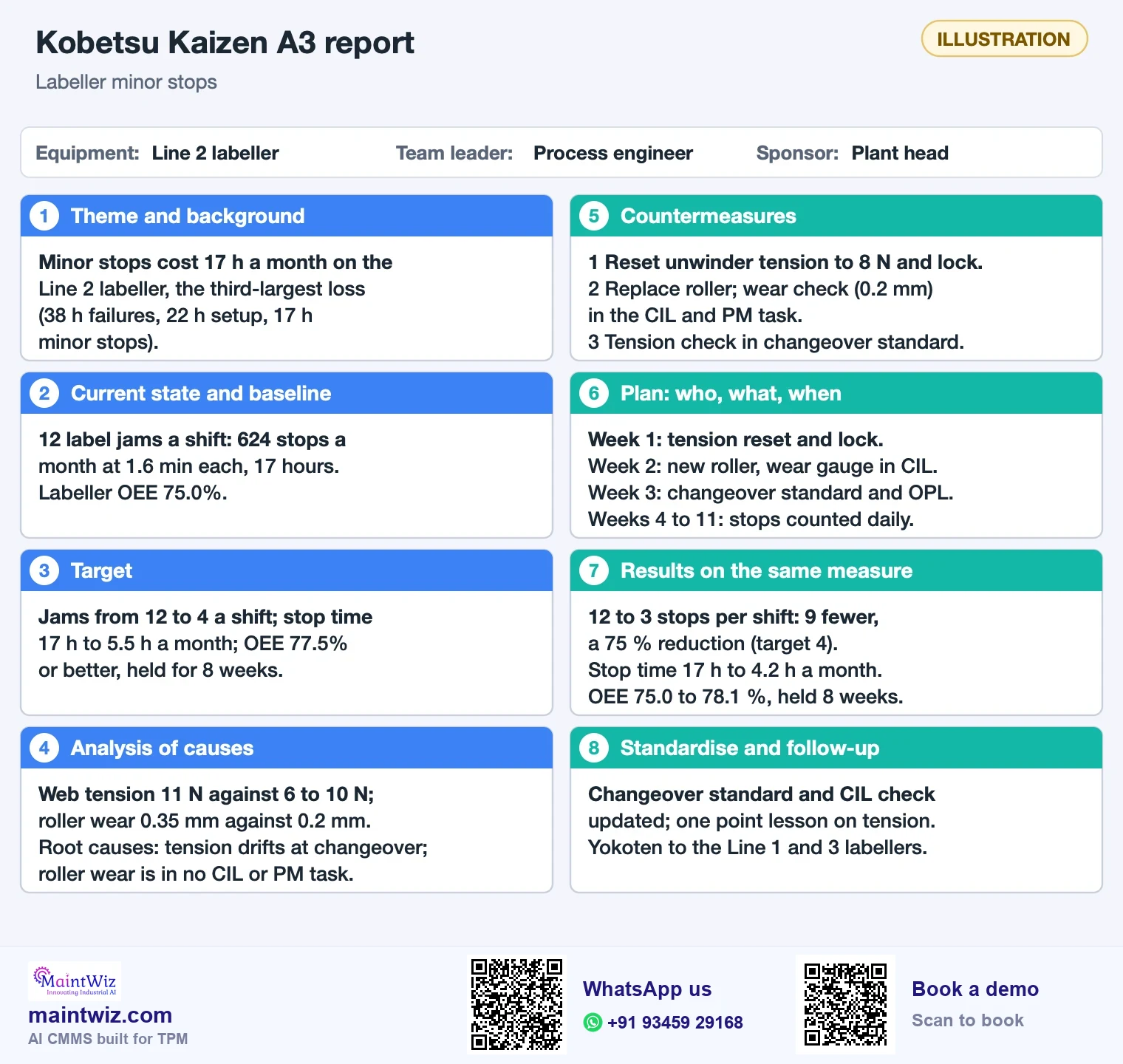
ILLUSTRATION. A labelling machine averages 12 minor stops per shift. The analysis traces most jams to varying web tension, caused by a worn roller that no standard asks anyone to check. After the roller is replaced, a wear check is added to the CIL standard and a one point lesson covers tension setting, the same count shows 3 stops per shift: 12 - 3 = 9 fewer stops per shift, a reduction of (12 - 3) / 12 = 75 %. The result counts only if it holds over several weeks on the same definition of a stop (Figure 3).
Choosing a project
Choosing the project: from loss tree to theme
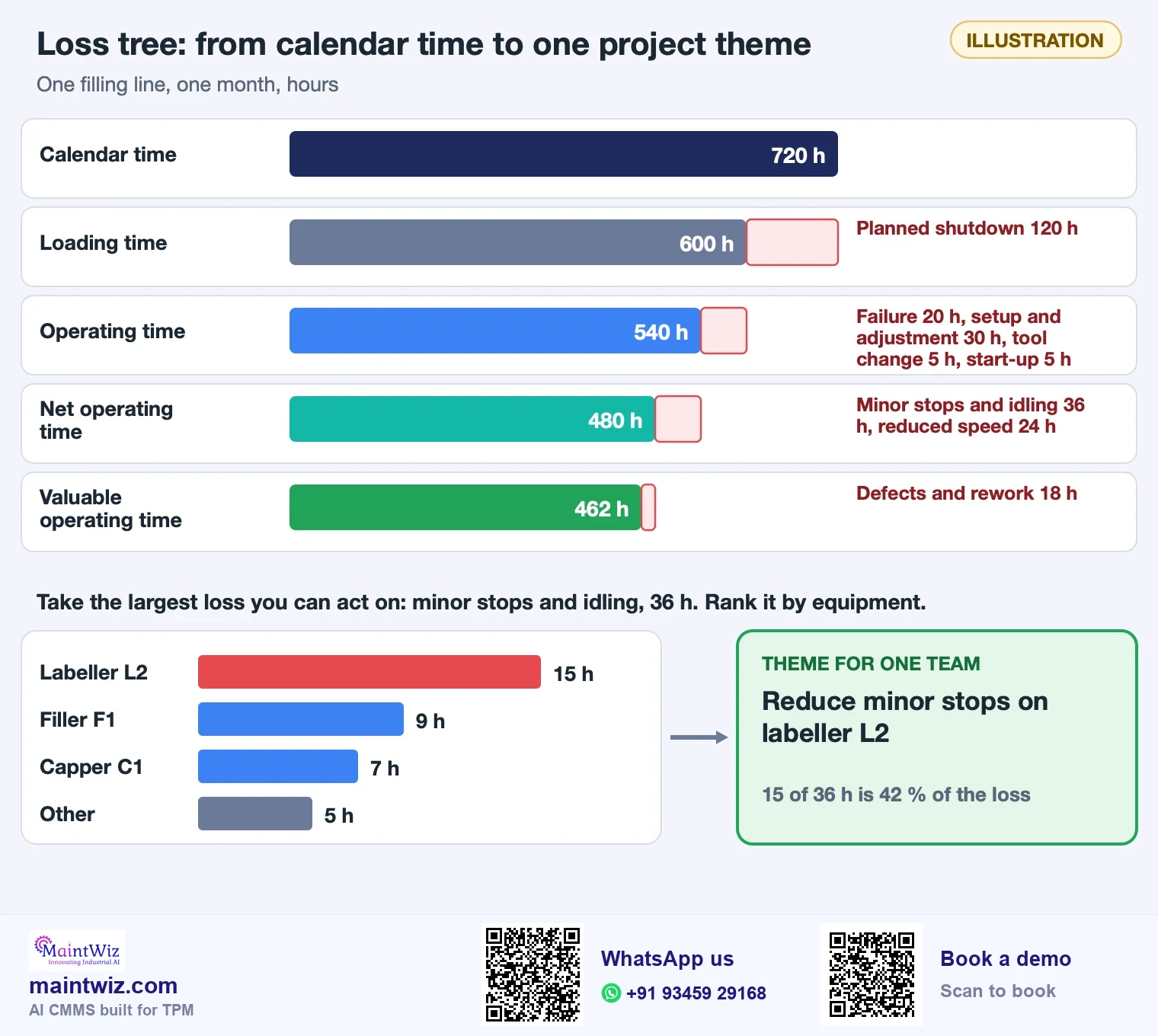
A loss tree breaks the plant's lost output into lines, equipment and loss types until you reach a size where one team can act. Start from the OEE loss breakdown by equipment, take the largest bucket, and ask whether it is big enough to matter, recurring, measurable and owned. A theme such as 'reduce minor stops on the labeller' is workable; 'improve line performance' is not.
| Check | Question |
|---|---|
| Size | Is it among the largest losses on this equipment or line? |
| Recurrence | Does it happen every week, not once? |
| Measurability | Can we measure it now on a fixed definition? |
| Ownership | Is there a named leader and sponsor? |
| Scope | Can one team finish in weeks, not quarters? |
Sources of contamination that operators cannot remove themselves arrive here as projects from step 2; chronic losses with several causes suit P-M analysis.
What goes in the project report
Use the A3 layout from the Kaizen sheet formats to keep the project on one page, from theme and target to results and standardisation.
Write the target as a number with a date and a definition, for example minor stops per shift on the labeller by a named date. The sponsor approves the theme at the start and the result at the end, and the project closes when the standard is updated, not when the fix is installed. Owners and dates for each countermeasure sit on the A3 report, so the weekly review starts from what is open. Keep the review going with the sponsor until the result is verified on the same definition as the baseline, and then record where else the fix applies.
State what else changed in the period (product mix, staffing, a new supplier). Without that, a before-and-after figure overstates what the project achieved (Figure 5).
Why projects fail
Why do focused improvement projects fail?
- The theme is vague or too large, so nobody can say when it is done.
- The loss is not measured before the work starts, so there is no baseline.
- The team stops at the first plausible cause (operator error, wear) and does not ask why again.
- The fix is made but the standard, the one point lesson and the PM task are not updated, so the loss returns.
- Success is reported in a different definition from the baseline.
- Nobody checks similar equipment, so the same loss is found again elsewhere.
Where the loss data comes from
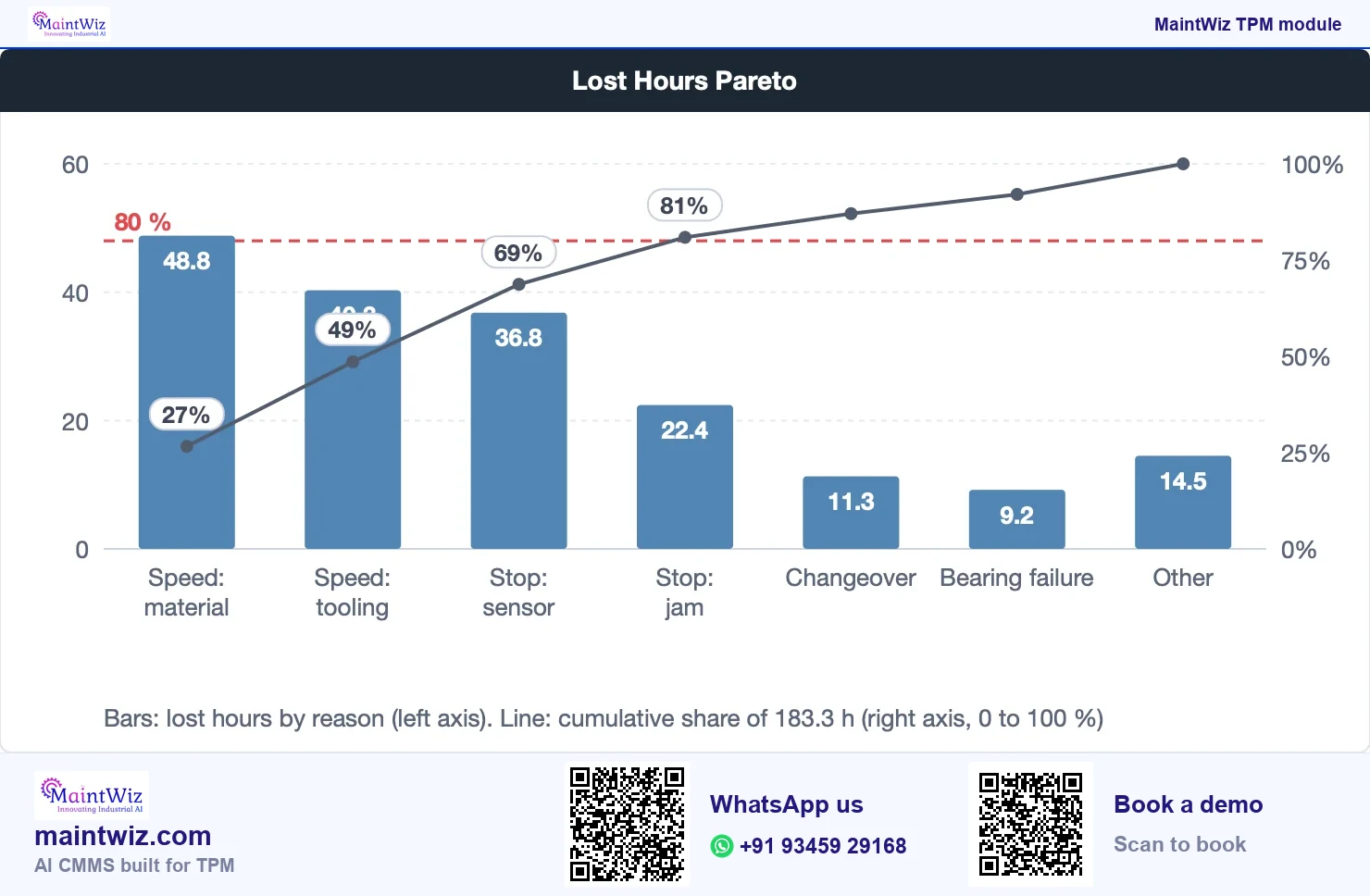
Projects start from a loss Pareto: lost time by loss category and equipment over a period. In the MaintWiz OEE dashboard the lost-hours Pareto shows this for a chosen equipment; the same view rolls up to line and plant. The loss cost master turns each lost hour into money, so the top loss is chosen by cost (Figure 6).
Tools
Tools used in focused improvement
| Tool | What it is used for |
|---|---|
| Loss tree and Pareto | Break total loss into categories and rank them to pick the theme |
| Why-why analysis (5 whys) | Trace a phenomenon back through causes to a root cause |
| Fishbone (cause and effect) diagram | List possible causes by category for a team to test |
| P-M analysis | Analyse a chronic problem by its phenomenon, physical principles and mechanisms to find all contributing conditions |
| A3 report | Summarise problem, analysis, actions and results on one sheet |
| Before-and-after comparison | Verify the change on the same measure and definition |
| Poka-yoke | Design the mistake out so the error cannot recur |
| One point lesson and standard | Teach the change and update the CIL standard |
Tools for one loss project, in order of use
Choose, explain, act, standardise
- 1
Loss tree and Pareto
Break the loss down and rank it to choose the theme
- 2
Why-why analysis
Trace the phenomenon back to a root cause
- 3
Fishbone diagram
List possible causes by category for the team to test
- 4
P-M analysis
Find every condition behind a chronic loss
- 5
A3 report
Carry the project on one page
- 6
Before-and-after check
Verify on the same measure and definition
- 7
Poka-yoke
Design the mistake out
- 8
One point lesson and standard
Teach the change and update the CIL standard
maintwiz.comAI CMMS built for TPMWhatsApp us+91 93459 29168Book a demoChronic losses, those that recur at a modest level, are often harder to fix than sudden failures because several small causes act together. P-M analysis is aimed at them.
Focused improvement compared with DMAIC and general Kaizen
| Kobetsu Kaizen | Six Sigma DMAIC | General Kaizen | |
|---|---|---|---|
| Typical scope | Equipment losses | Process variation | Any improvement, often small |
| Team | Cross-functional, operations and maintenance | Trained belts and process owners | Anyone, individually or in groups |
| Method | Loss structure, step-by-step project, standardise | Define, measure, analyse, improve, control | Plan, do, check, act in small cycles |
| Output | Reduced loss and an updated standard | Reduced variation and a control plan | Many small changes |
The approaches combine: a focused improvement team can use DMAIC steps for a variation problem.
Running the project meetings
- Hold short meetings at the equipment, not only in a room, so the team sees the phenomenon.
- Keep a one-page project board: theme, baseline, target, analysis, actions, status.
- Review weekly with the sponsor; remove obstacles fast.
- Record the baseline before the first action and verify on the same definition.
- Close with a standard, a one point lesson and a list of where else the fix applies.
Tracking improvement projects in a CMMS
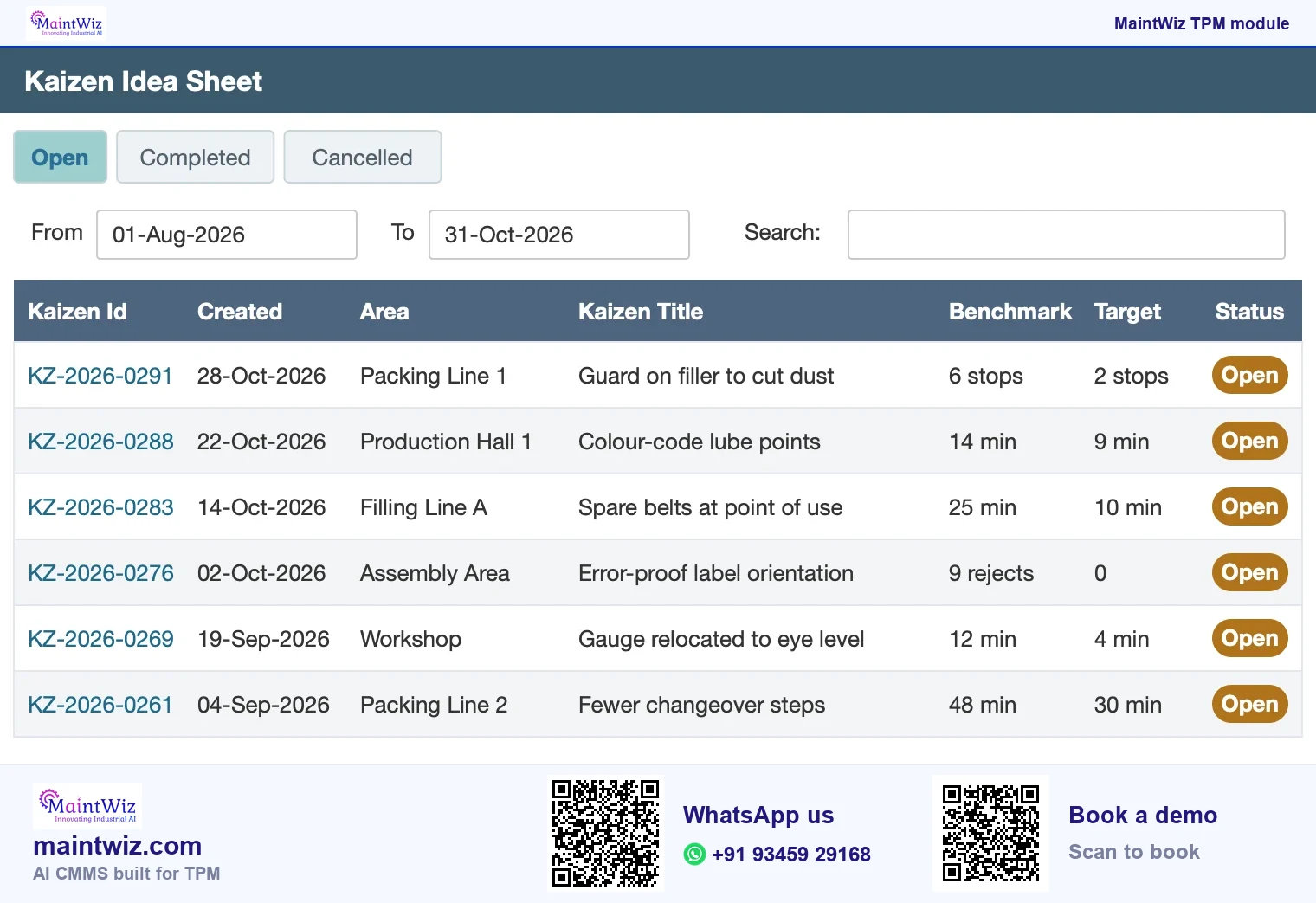
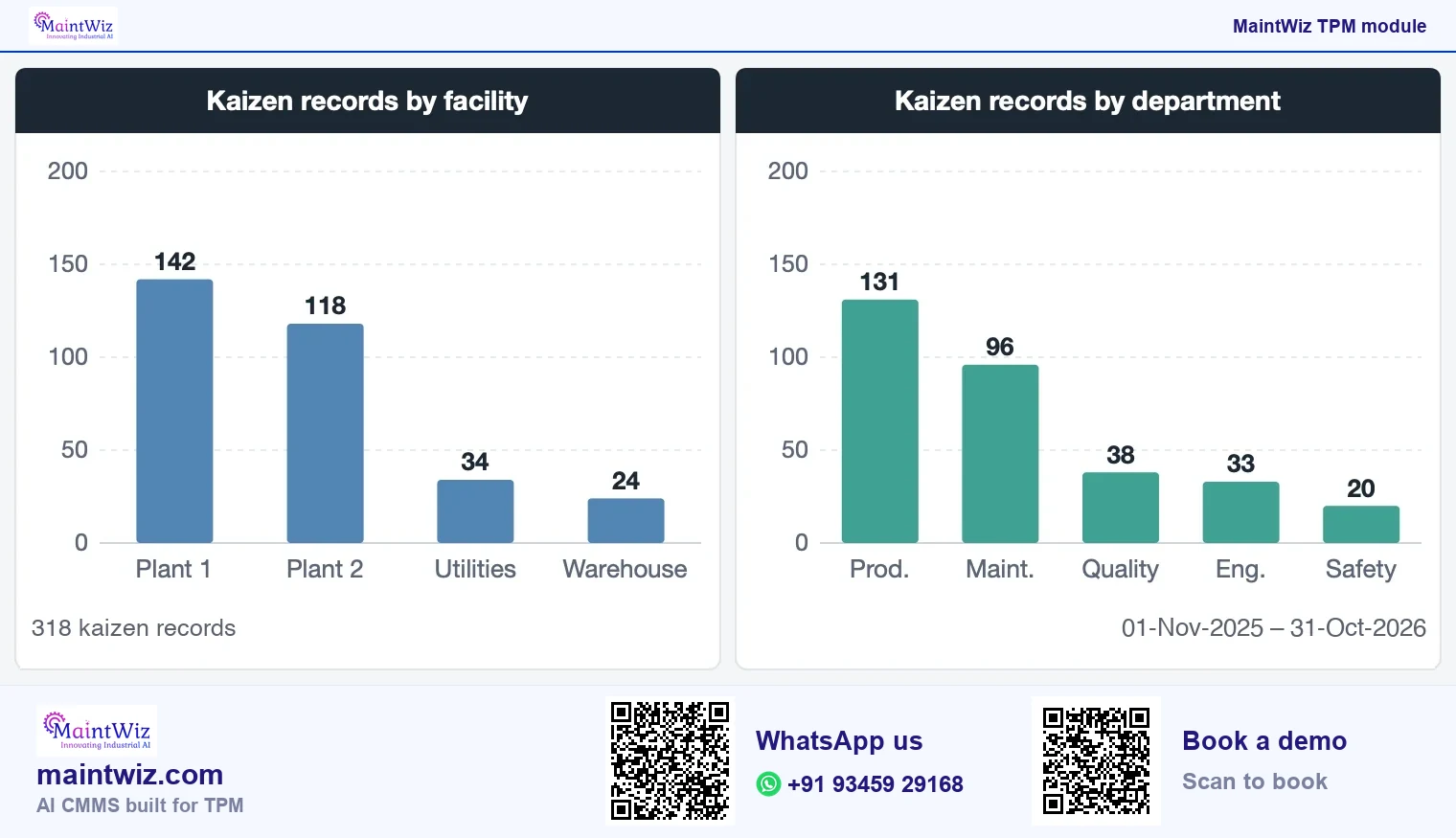
MaintWiz Kaizen software logs each improvement as a Kaizen idea sheet with a benchmark, a target and an area, keeps poka-yoke sheets beside it, and counts Kaizens initiated, completed and cancelled by facility and department (Figures 8 and 9).
Software needs
What should Kobetsu Kaizen software do?
Software for Kobetsu Kaizen has to tie each project to a measured loss and keep the improvement records together. The table sets the pillar out; the list gives the functions to look for.
| Item | Detail |
|---|---|
| Japanese term | Kobetsu Kaizen |
| English meaning | Focused improvement. JIPM, the Japan Institute of Plant Maintenance, lists Focused Improvement among the four core pillars of TPM. |
| What it controls | Chronic equipment losses, improvement projects, error-proofing and the flow of ideas |
| What MaintWiz records | Kaizen idea sheets and poka-yoke sheets; product variants, capacity, losses and production log entries; a loss cost master and a Kobetsu Kaizen report |
- A Kaizen idea sheet and a poka-yoke sheet for each improvement.
- Losses, production log entry and bulk entry, so projects start from recorded losses.
- A loss cost master and a Kobetsu Kaizen report.
- Status counts of Kaizens completed, initiated and cancelled on the dashboard.
- Downtime by category and type from the OEE downtime report, split into unplanned, planned and performance loss.
MaintWiz is an AI CMMS built for TPM. The MaintWiz roll-out takes 6 to 8 weeks, with easy Excel uploads and guided project management by the MaintWiz implementation team. See Kaizen software, the TPM software buyer's guide, pricing or a demo.
FAQ
Frequently asked questions
What is Kobetsu Kaizen?
Kobetsu Kaizen is the TPM focused improvement pillar: cross-functional teams remove a specific equipment loss through projects that start from a measured baseline, find root causes, apply countermeasures and verify the result.
What is the KK pillar in TPM?
KK is the abbreviation for Kobetsu Kaizen, the focused improvement pillar. It is one of the loss-reduction pillars, next to autonomous maintenance, planned maintenance and quality maintenance.
How is Kobetsu Kaizen different from Kaizen?
Kobetsu Kaizen is tied to a defined loss on a defined equipment and run by a cross-functional team with a baseline and a verified result. General Kaizen covers any improvement idea from anyone.
What tools are used in Kobetsu Kaizen?
Typical tools are a loss Pareto to choose the theme, why-why or cause-and-effect analysis, an A3 report to keep the project on one page, poka-yoke for error-proofing, and one point lessons and standards to hold the result.
How long does a Kobetsu Kaizen project take?
Scope a project to a few weeks. If a theme cannot finish in that time, split it. Set the target date when the project is chartered, track it in the Kaizen record, and review weekly with the sponsor.
Who should be on a focused improvement team?
An operator who knows the equipment, a maintenance technician, an engineer or process owner, a named leader and a sponsor who can remove obstacles. Add quality or finance where the loss touches them.
How do you measure a Kobetsu Kaizen result?
Measure the loss before the first action on a fixed definition, for example minor stops per shift, then measure again on the same definition for several weeks after the change. Record what else changed in the period, and close the project only when the standard is updated.
Is Kobetsu Kaizen the same as Six Sigma?
No. Kobetsu Kaizen targets equipment losses through cross-functional teams and a standard project sequence. Six Sigma's DMAIC targets process variation. They can be combined within one project.
What should Kobetsu Kaizen software do?
It should keep Kaizen idea sheets and poka-yoke sheets, record production, capacity and losses, report through a loss cost master and a Kobetsu Kaizen report, and show Kaizens completed, initiated and cancelled. MaintWiz holds these in its Kobetsu Kaizen menu and Kaizen module.
What is the difference between TPM and Kaizen?
Kaizen is continuous improvement: small changes made by everyone, every day. Kobetsu Kaizen is the TPM pillar that applies it to one ranked equipment loss as a team project. TPM is the eight-pillar system around it, with autonomous maintenance, planned maintenance and quality maintenance working on the same losses.