
Key takeaways
- Jishu Hozen (JH) means autonomous maintenance: operators take over cleaning, inspection and lubrication of their own equipment.
- It runs in seven steps, from initial cleaning to full self-management; do not move to the next step until the current one is audited.
- Every finding needs a tag, an owner, a date and a closure, otherwise operators stop reporting.
- Programmes stall on missing operator time, open tags and unaudited steps; in MaintWiz each tag has an owner and a target date, so overdue items are visible.
Meaning
What does Jishu Hozen mean?
Jishu Hozen is Japanese for self-maintenance. In TPM it is the JH pillar, one of the loss-reduction pillars shown below. JIPM describes TPM as overall maintenance that aims at zero losses and involves every function, not only maintenance; Jishu Hozen is where that principle reaches the operator.
The reasoning is practical. Operators are with the equipment every shift, so they are the people most likely to notice a leak, a noise or a loose bolt first. Maintenance staff keep their time for work that needs their skills. The pillar changes who does what: operators own basic care. See planned maintenance in TPM for the other side of that split.
Autonomous maintenance definition and Jishu Hozen full form (JH)
Jishu Hozen is Japanese: 'jishu' means autonomous or self-directed and 'hozen' means maintenance or preservation, so the term is usually rendered as autonomous maintenance or self-maintenance. It is abbreviated JH, and in English-language material AM. The JH pillar, the autonomous maintenance pillar and Jishu Hozen all refer to the same TPM pillar. Its primary goal is for the people who operate the equipment to keep its basic conditions (clean, lubricated, tight) and to find abnormalities early.
Autonomous maintenance compared with preventive maintenance and with TPM
| Autonomous maintenance | Preventive maintenance | TPM | |
|---|---|---|---|
| Who does it | Operators | Maintenance technicians | Everyone, in eight pillars |
| What it covers | Basic care: clean, inspect, lubricate, tighten; reporting abnormalities | Scheduled tasks and inspections by time or usage | All equipment losses |
| Relation | One pillar of TPM | One part of the planned maintenance pillar | The whole system |
Operators own basic care and maintenance owns scheduled work; autonomous maintenance vs preventive maintenance sets out who does what and how often.
Downloads
Jishu Hozen templates: 7-step wall chart, CIL sheets and step audit
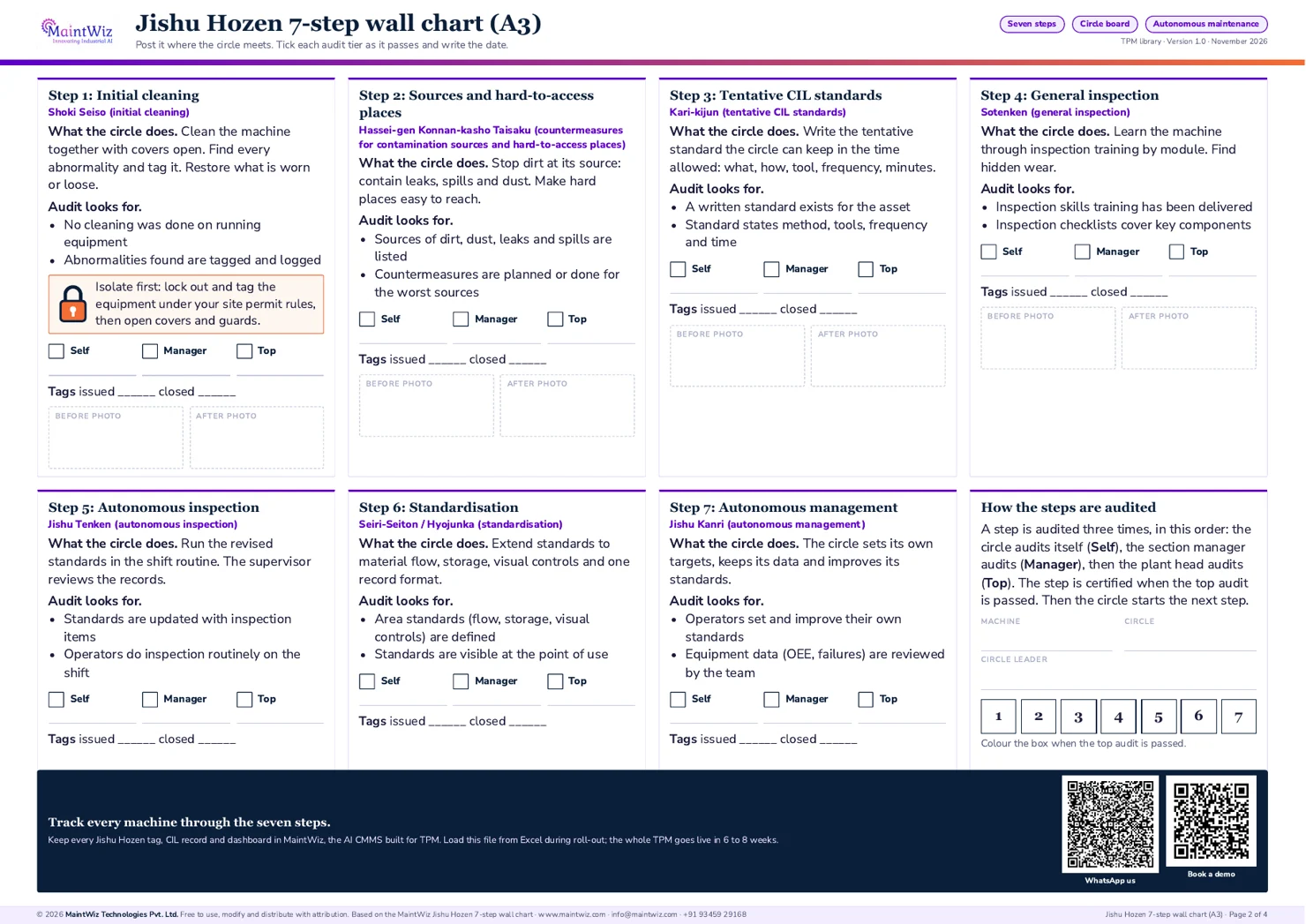
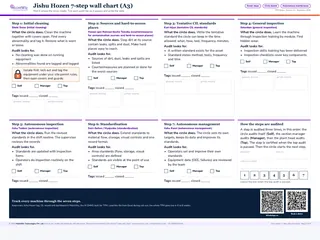 PDFJishu Hozen 7-step wall chart (with Japanese step names and three-tier audit)
Post the seven Jishu Hozen steps at the machine with Self, Manager and Top audit boxes
- Pages
- 4
- A3 landscape (2 x A4 version inside)
- Created
- 5 November 2026
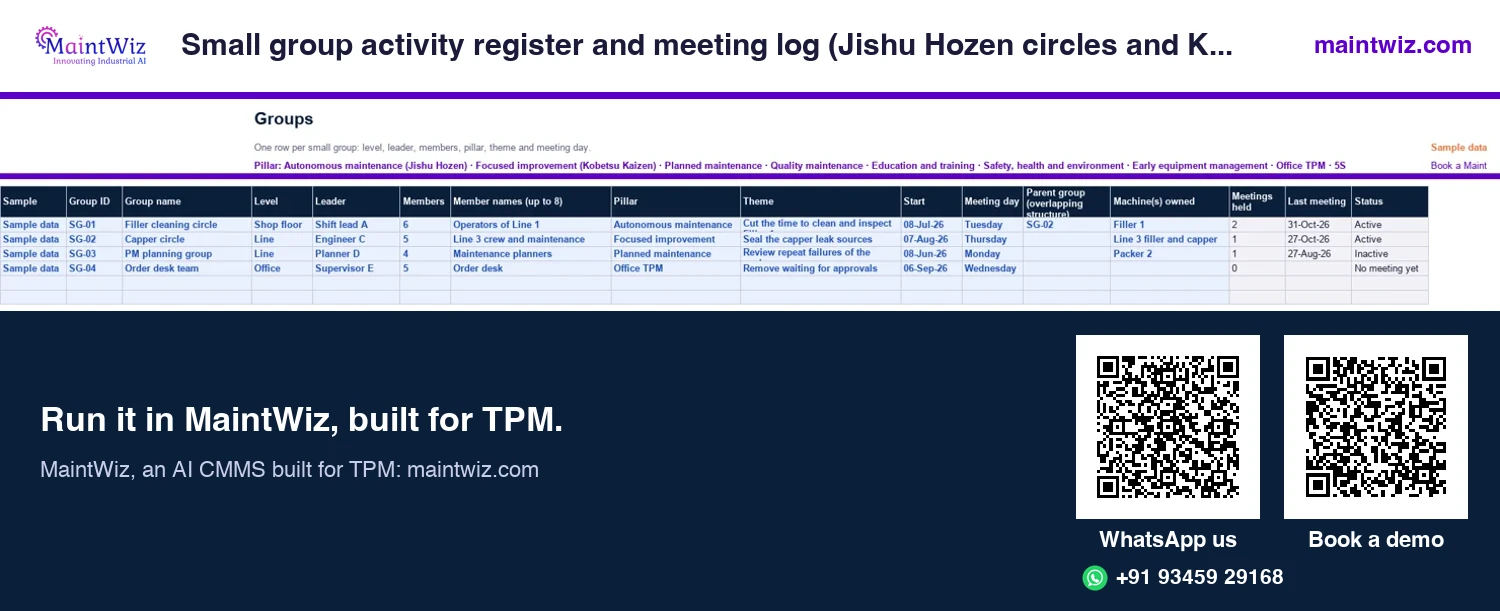
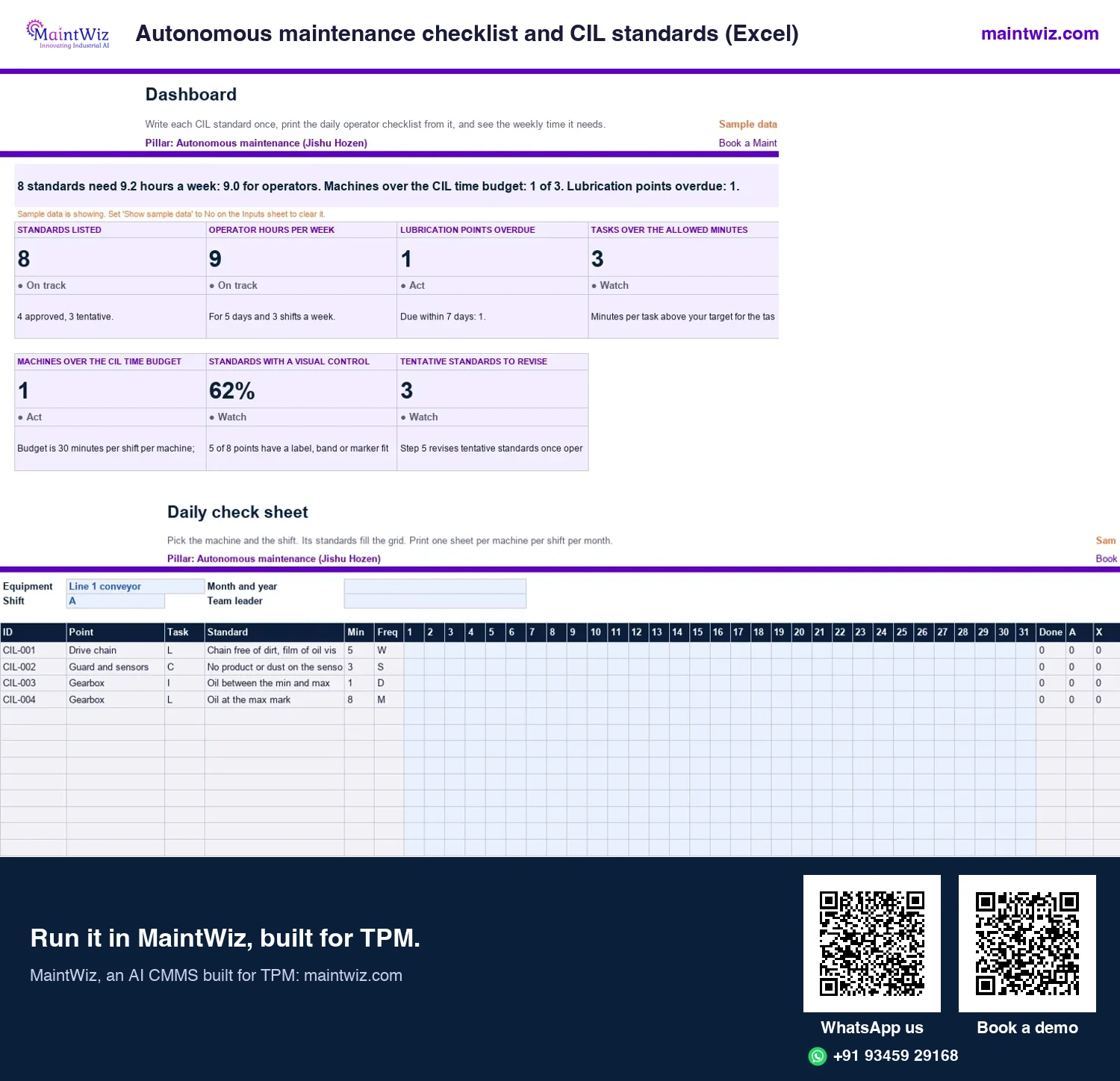
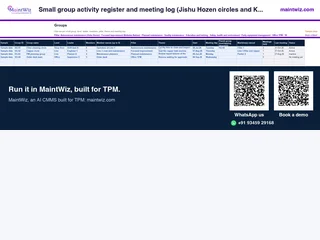 ExcelSmall group activity register and meeting log (Jishu Hozen circles and Kaizen themes)
Register every small group, log its meetings and track Jishu Hozen circles up the seven steps or Kaizen themes up
- Sheets
- Dashboard, Inputs, Groups, Meetings, Activities, Board, Read me
- A4
- Version
- v1.1, 5 November 2026
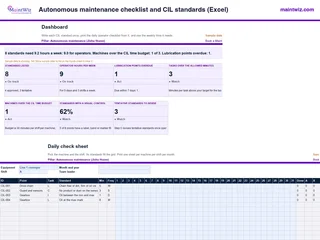 ExcelAutonomous maintenance checklist and CIL standards (Excel)
Write each cleaning, inspection and lubrication standard once, print the daily operator checklist for any machine
- Sheets
- Dashboard, Inputs, Frequencies, Lubricants, Machines, Standards, Daily check sheet, Lube schedule, Lube route, Read me
- A4
- Version
- v1.0, 2 November 2026
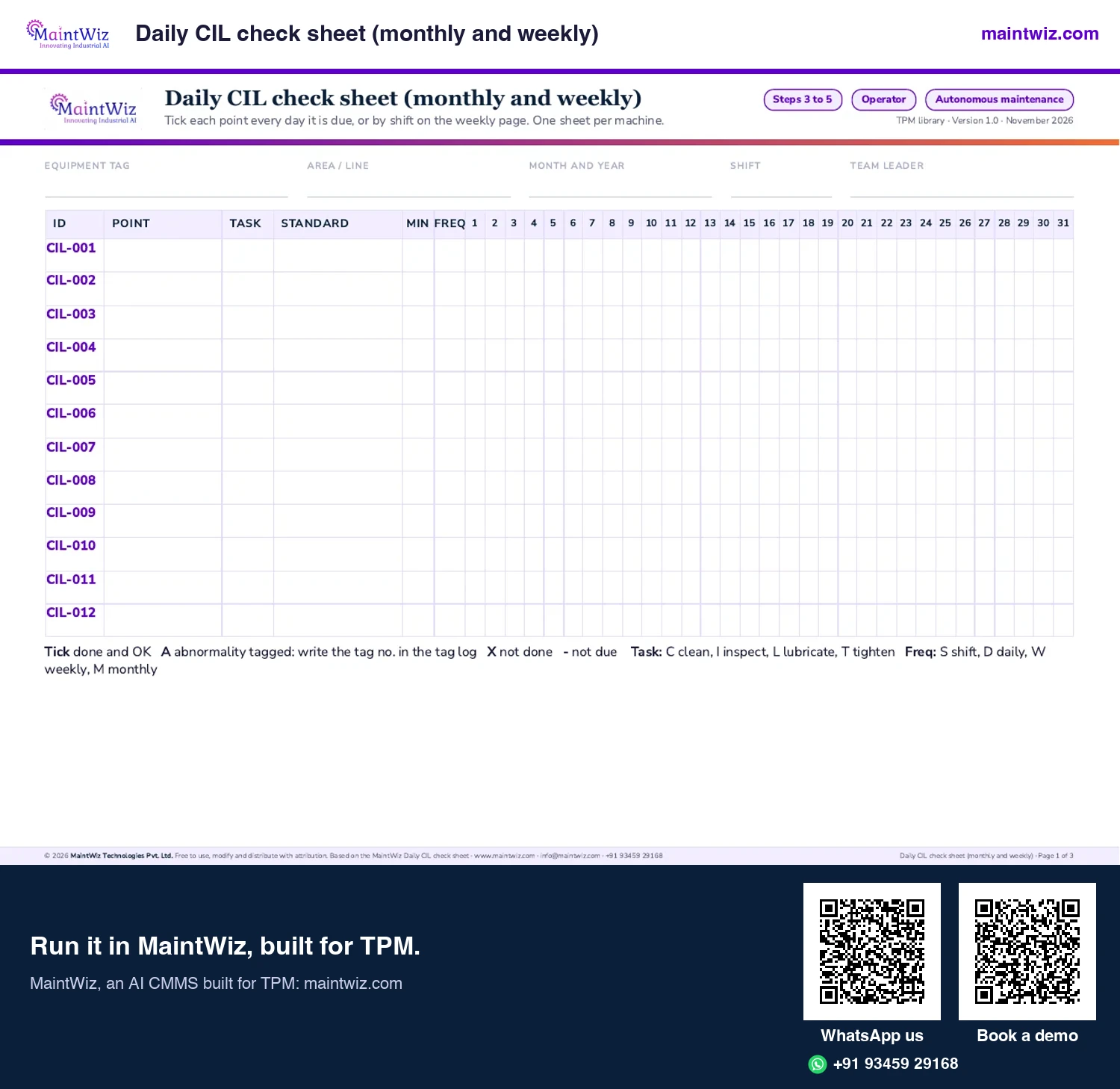
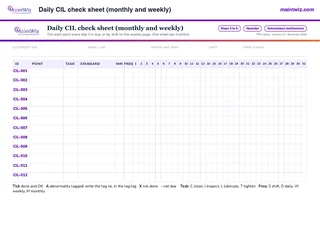 PDFDaily CIL check sheet (monthly and weekly)
Print a daily operator checklist for one machine, monthly or weekly with A, B and C shift boxes
- Pages
- 3
- A4 landscape
- Created
- 5 November 2026
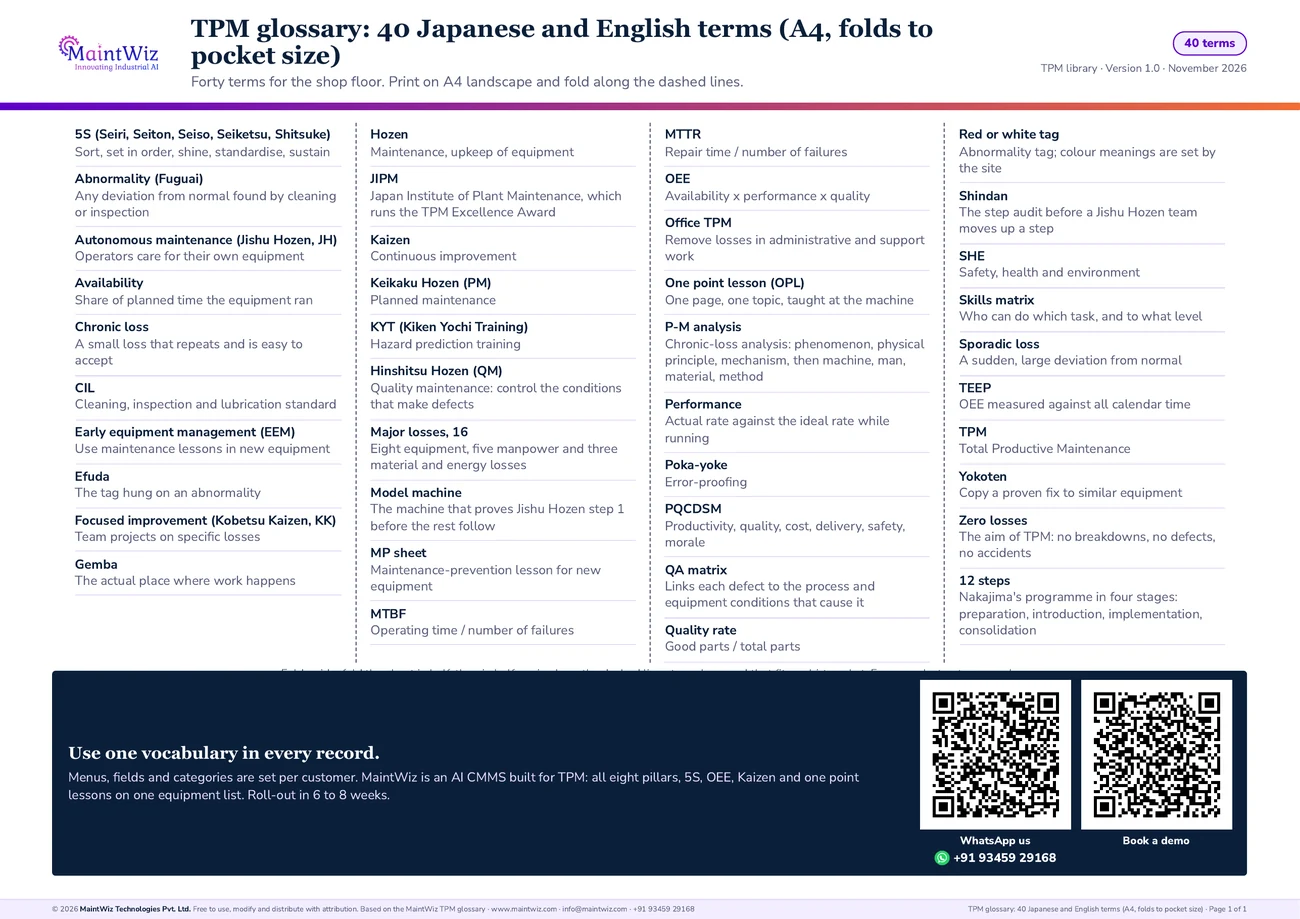
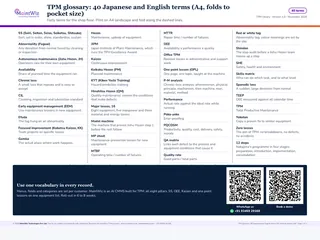 PDFTPM glossary: 40 Japanese and English terms (folds to pocket size)
Forty Japanese and English TPM terms on one A4 sheet that folds to pocket size
- Pages
- 1
- A4 landscape
- Created
- 5 November 2026
Seven steps
What are the 7 steps of Jishu Hozen?
The seven steps of Jishu Hozen are: 1. Initial cleaning. 2. Contamination sources and hard-to-access places. 3. Cleaning, inspection and lubrication (CIL) standards. 4. General inspection. 5. Autonomous inspection. 6. Standardisation. 7. Full self-management. Each step ends with a step audit; the right-hand column is the evidence to ask for before declaring a step complete (Figure 2).
| Step | What operators do | Evidence of completion |
|---|---|---|
| 1. Initial cleaning | Clean the equipment fully, treating cleaning as inspection; find and tag abnormalities (leaks, wear, loose parts). | Tags raised and logged; before and after photos |
| 2. Contamination sources and hard-to-access places | Find where dirt, dust and leaks originate; contain or remove them; fix places that are hard to clean, inspect or lubricate. | List of sources with countermeasures; reduced cleaning time |
| 3. Cleaning, inspection and lubrication standards | Write short standards for the routine: what, how, with which tool, how often, how long. | Approved CIL standards at the point of use |
| 4. General inspection | Learn how the equipment works and what to check (bolts, drives, lubrication, utilities), usually through one point lessons. | Inspection training records; checklists extended |
| 5. Autonomous inspection | Carry out the inspection routine as part of the shift; supervisors review results. | Completed checklists; findings reviewed and closed |
| 6. Standardisation | Standardise the area: flows, storage, visual controls, records, in line with 5S. | Area standards, audit scores |
| 7. Full self-management | Teams set and improve their own standards and use equipment data. | Team-owned targets and improvement records |
The Jishu Hozen staircase
Seven steps, each closed by a step audit before the team climbs to the next
- 0PreparationPurpose, safety training, model area, baseline, tag rules
- 1Initial cleaningShoki seisoStep audit
- 2Sources and hard-to-access placesHasseigen konnan-kasho taisakuStep audit
- 3CIL standardsJishu hozen kari-kijunStep audit
Steps 1 to 3 Restore basic conditions
- 4General inspectionSotenkenStep audit
- 5Autonomous inspectionJishu tenkenStep audit
Steps 4 to 5 Inspection skills
- 6StandardisationHyojunkaStep audit
- 7Full self-managementJishu kanri tetteiStep audit
Steps 6 to 7 Autonomous management
Japanese names as taught by JIPM; each tread ends at a step audit gate
 maintwiz.comAI CMMS built for TPM
 WhatsApp us
 +91 93459 29168
 Book a demo
Each step has a working guide with the checks and evidence to close it: autonomous maintenance steps 0 and 1, step 2, the CIL standard of step 3, steps 4 and 5 and steps 6 and 7. Figure 3 shows the same seven steps on paper and in MaintWiz.
Paper and digital Jishu Hozen
The same seven steps, different records
| On paper | In MaintWiz |
|---|---|
| Tags written by hand and hung on the machine | Tag raised on a phone with a photo |
| Register kept in a spreadsheet | Register with owner, date and colour |
| Status chased by phone and in meetings | Overdue alerts to the owner |
| Monthly report assembled by hand | Dashboard by colour, area and month |
maintwiz.comAI CMMS built for TPMWhatsApp us+91 93459 29168Book a demo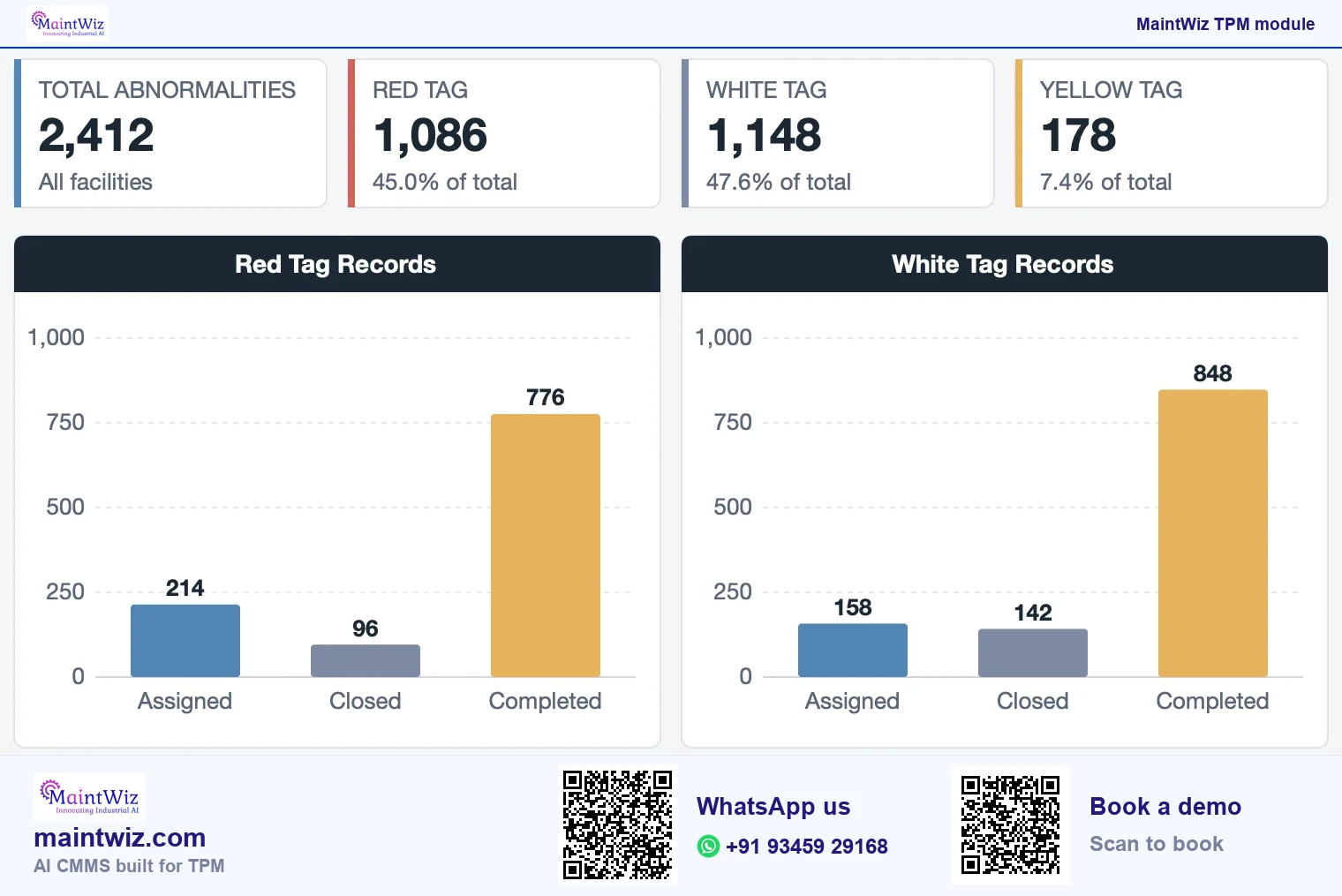
Is there a step 0 in autonomous maintenance?
Step 0 is preparation before step 1: the purpose, safety training, a model area, baseline photographs and the tag rules. Skipping it is a common reason programmes begin badly; score the model area on the readiness self-assessment before the briefing.
Worked example
A worked example: steps 1 to 3 on a conveyor drive
| Step | What the team does | Result |
|---|---|---|
| 1 Initial cleaning | Cleans the gearbox, chain guard and motor; finds oil seeping at the gearbox seal, a missing guard bolt and a dry chain | Three tags raised with owners and dates |
| 2 Contamination and access | Finds the seep contaminates the floor under the drive; fits a drip tray; moves a grease nipple that is behind the guard to a remote point | Source and access countermeasures logged |
| 3 CIL standard | Writes the standard: wipe the gearbox and check for seepage; check chain tension against the gauge mark; lubricate the chain with the listed oil. Frequency and time for each come from the manual and failure history | One-page standard posted at the drive |
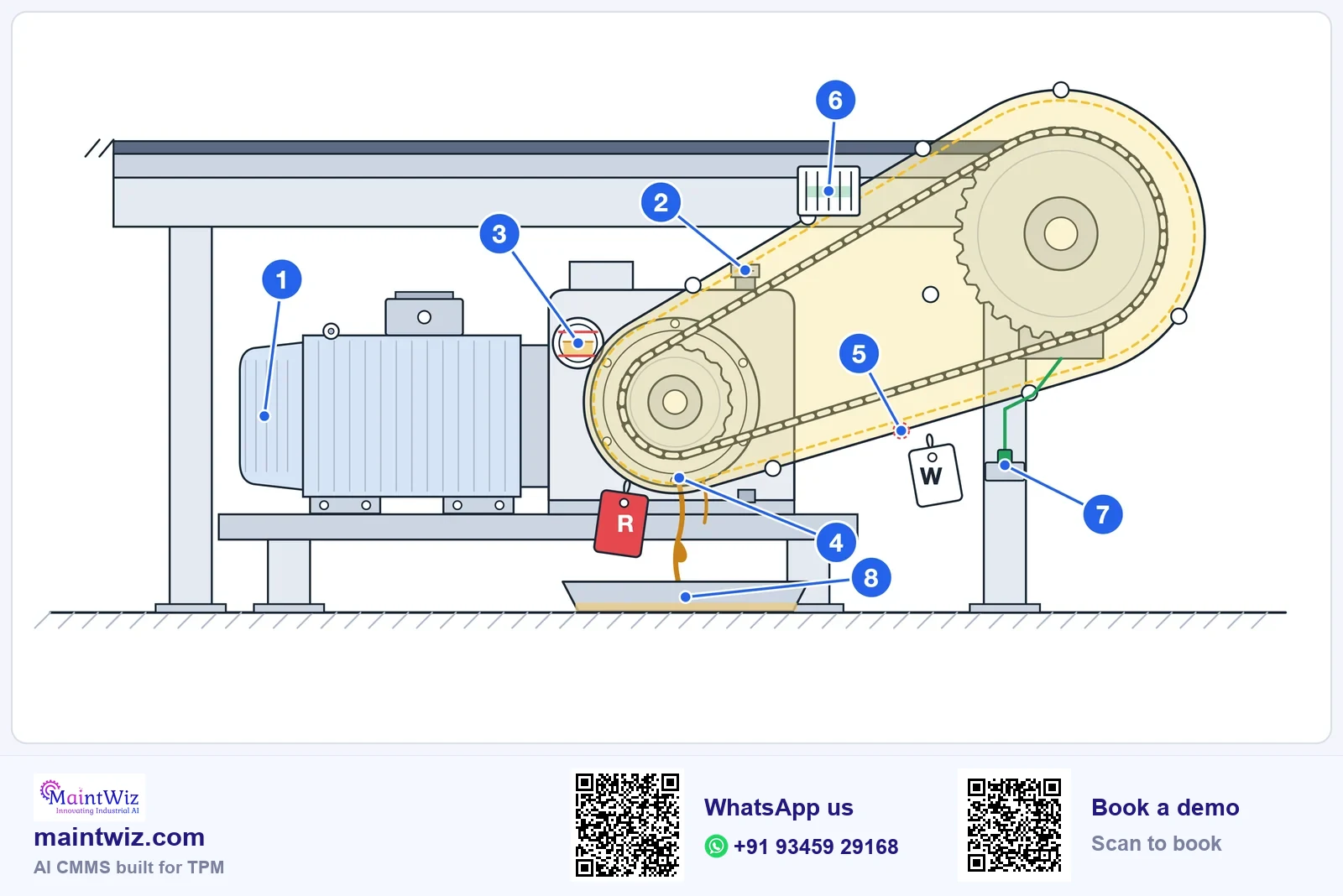
| No. | Point on the conveyor drive | Step 1 to 3 result |
|---|---|---|
| 1 | Motor fan cover | Cleaned at step 1 |
| 2 | Gearbox breather | Cleaned and checked open |
| 3 | Oil sight glass | Level read against the minimum and maximum band |
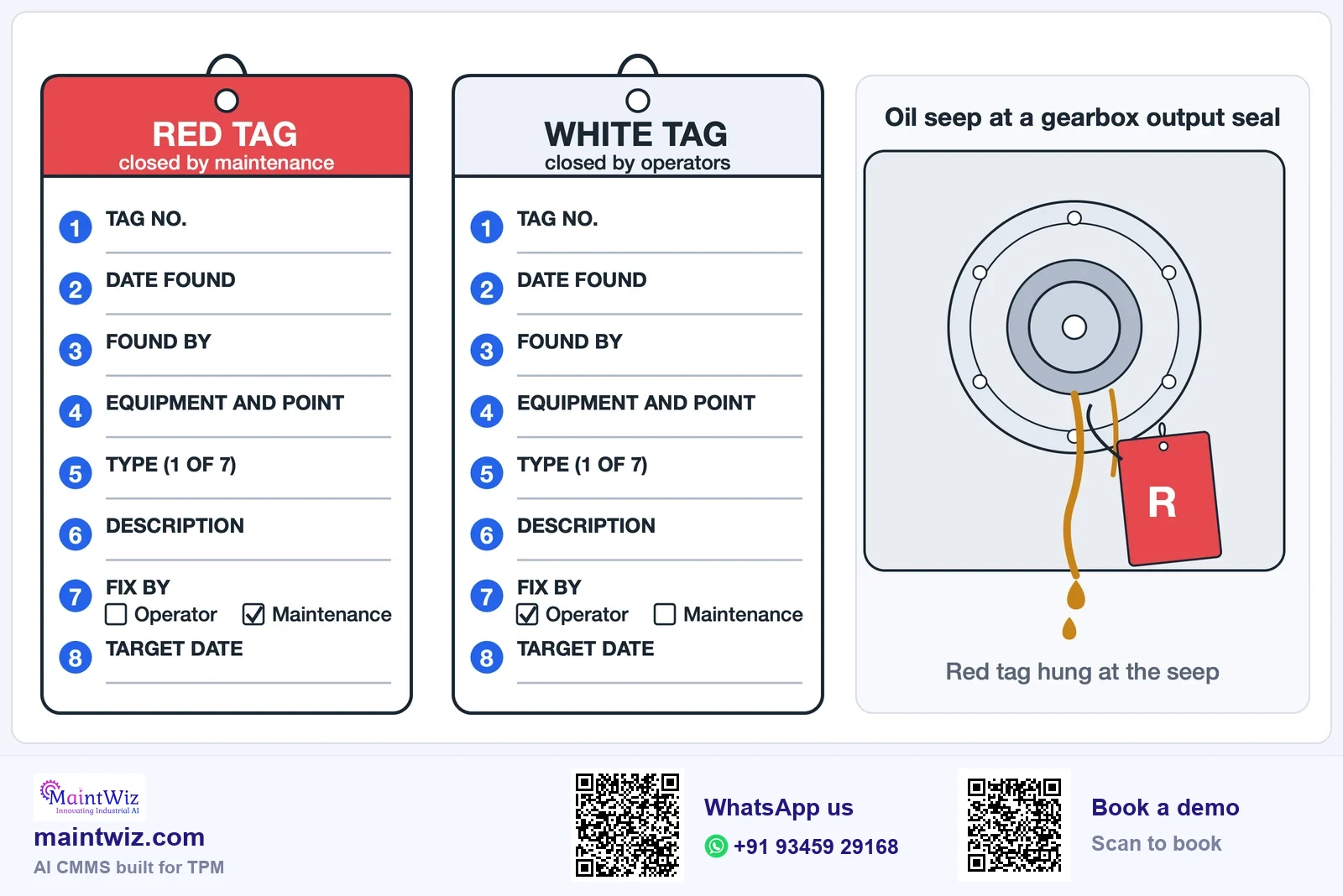
| 4 | Output shaft seal | Oil seep found at step 1: red tag |
| 5 | Chain guard | One missing bolt found at step 1: white tag, bolt refitted |
| 6 | Chain tension gauge mark | Slack read against the mark in the step 3 standard |
| 7 | Grease nipple | Moved from behind the guard to a remote point at step 2 |
| 8 | Drip tray | Fitted under the drive at step 2 to catch seep |
Cleaning, inspection and lubrication (CIL) standards
A CIL standard turns steps 1 to 3 into a routine anyone can follow. Each line states the point on the equipment, the task (clean, inspect, lubricate or tighten), what good looks like, the method and tool, the lubricant, the time it takes and the frequency. Keep it to one page per equipment and post it where the work happens.
Add up the minutes on every standard. If the routine does not fit the operators' shift, it will not be done: change the routine (for example by removing contamination sources in step 2) rather than the expectation. Write each standard once in the free CIL standards workbook and print the daily operator checklist for any machine; the autonomous maintenance checklist adds the 7-step audit.
What should an autonomous maintenance checklist or check sheet contain?
Each row names the point, the task (clean, inspect, lubricate or tighten), the standard, the method, the frequency and time, and what to do when something is abnormal.
Tags and OPLs
How do abnormality tags and one point lessons work together?
Cleaning is only useful if what it finds is recorded and followed up. The common method is a tag on the equipment (red for abnormalities that need maintenance support, white for ones the operating team can fix and yellow for a case your site defines, written on the legend at the area) and an entry in a register with an owner, a target date and a closure. Red tag systems in TPM and 5S explains the method and gives a register layout. Operators call an abnormality fuguai and its tag an efuda; the seven types they look for are in Figure 6.
The seven types of fuguai
What operators look for while cleaning: fuguai means abnormality
- 1
Minor flaws
Dirt, wear, play, looseness
- 2
Unfulfilled basic conditions
Missing lubrication, slack bolts
- 3
Inaccessible places
Grease nipple behind a guard
- 4
Contamination sources
Seal leak, product spill
- 5
Quality defect sources
Worn nozzle, loose guide
- 6
Unnecessary and non-urgent items
Idle tools, spare fittings
- 7
Unsafe places
Exposed shaft, oily floor
Each find gets an efuda (tag) and a register entry with its type
maintwiz.comAI CMMS built for TPMWhatsApp us+91 93459 29168Book a demoOne point lessons
As operators move from step 4 to step 5 they need short, specific training. One point lessons are single-page sheets on one topic (how to check a chain, what a normal sound is) that fit this need.
Auditing steps
How do you audit each step before moving on?
Plants often declare a step finished because the activity happened, not because it held. Each step passes a step-gate audit: four criteria scored 0 to 2, a pass at 7 of 8 points, with the team, the section manager and the plant head auditing the same items. The scored step audit lists the criteria for all seven steps.
Jishu Hozen step audit sheet
Four criteria per step, scored 0 to 2 each; the pass mark is 80%
| Step | What the auditor checks | Evidence | Pass mark |
|---|---|---|---|
| 1 Initial cleaning | Cleaned and inspected with guards open; abnormalities tagged and logged; operators took part | Tag register, before and after photos | 7 of 8; never 0 on tagged and logged |
| 2 Sources and hard-to-access places | Sources and hard places listed; countermeasures for the worst; time to clean reduced or planned | Source list with countermeasures, timed routine | 7 of 8 |
| 3 CIL standards | Written standard with method, tool, frequency and time; lubricant points marked; operators follow it | Standard posted at the equipment, records | 7 of 8 |
| 4 General inspection | Inspection training delivered; checklists cover key components; operators explain how the equipment works | Training records, extended checklists | 7 of 8 |
| 5 Autonomous inspection | Standards carry inspection items; operators inspect on the shift; supervisor reviews the results | Completed checklists, closed findings | 7 of 8 |
| 6 Standardisation | Area standards defined and visible; one record format; audits of the standards scheduled | Area standards, audit scores | 7 of 8 |
| 7 Full self-management | Team sets and improves its own standards, reviews its own data, holds results across audits | Team targets, improvement records | 7 of 8 |
Auditors: the team leader audits first, then the section manager and the plant head audit the same items
maintwiz.comAI CMMS built for TPMWhatsApp us+91 93459 29168Book a demoWho does what: operators and maintenance
| Task | Operator | Maintenance |
|---|---|---|
| Clean equipment and find abnormalities | Yes, every shift or on the standard's frequency | Trains operators; helps with hard-to-reach points |
| Routine lubrication and tightening to standard | Yes, once trained | Sets the standard and checks it |
| Basic inspection against the checklist | Yes, from step 4 and 5 | Reviews findings; adds to the plan |
| Repairs needing skill or tools | Reports and tags | Yes |
| Condition measurement and overhauls | Supports | Yes |
| Improving the standards | Proposes; owns from step 7 | Helps with analysis |
The split moves in stages. At step 1 operators mostly find and tag; by step 5 they inspect routinely; at step 7 they improve their own standards. Maintenance should hand tasks over deliberately and remove them from its own plan.
How long
How long does autonomous maintenance take to implement?
Each step ends when its audit is passed, not on a date, and areas move at different speeds. A full TPM programme generally takes 2.5 to 3 years (Shen 2015). Take one model area through steps 1 to 3 first, review what was learned, then spread. Skipping steps to hit a date brings the programme back to firefighting, because the standards written at step 3 depend on what was found at steps 1 and 2. The MaintWiz roll-out of the records takes 6 to 8 weeks; each area then moves through the seven steps at its own pace.
How do you measure autonomous maintenance?
- Step status per equipment: which step each has passed and when.
- Tags raised and closed on time; average age of open tags.
- Share of CIL routines completed on the shift.
- Contamination sources removed against listed.
- Time taken for the routine, to check it fits the shift.
- Step audit scores.
What are the benefits of autonomous maintenance?
- Abnormalities are found earlier, while they are small.
- Operators understand their equipment better and report what they see.
- Maintenance time is freed for work that needs skill.
- Contamination sources and hard-to-reach places are fixed instead of tolerated.
- Standards, tags and audits give the area a shared record.
Why programmes stall
Why do autonomous maintenance programmes stall?
Five failure points stop autonomous maintenance programmes:
- No time given to operators for the routine, so it competes with output.
- Abnormalities found but not closed, which teaches operators that tagging is pointless.
- Steps declared complete without an audit.
- Standards written by engineers and not tested by the operators who must follow them.
- 5S not in place first, so cleaning keeps re-creating the same mess (5S in TPM).
In MaintWiz, open tags and overdue alerts are visible to the whole team, so a stall shows before the next review.
Tracking Jishu Hozen in a CMMS
In MaintWiz each tag has an owner and a target date, an overdue tag raises an alert, and the Jishu Hozen dashboard shows tag records by colour, cumulative and day-wise closure and sources of contamination.
The register runs in abnormality management software. Book a demo to see your own tags on the dashboard.
Software needs
What should Jishu Hozen software do?
MaintWiz keeps the operator loop moving in one AI CMMS: find, tag, register, assign, close and review.
| Item | Detail |
|---|---|
| Japanese term | Jishu Hozen |
| English meaning | Autonomous maintenance. JIPM, the Japan Institute of Plant Maintenance, lists Autonomous Maintenance among the four loss-reduction pillars of TPM: focused improvement, autonomous maintenance, planned maintenance and quality maintenance. |
| What it controls | Operator cleaning, inspection and lubrication, abnormality tags and the seven steps with an audit at each |
| What MaintWiz records | Abnormality register entries with equipment, tag colour, owner, target date, countermeasure and closure; autonomous maintenance records; a dashboard of tag counts by colour, closure and contamination sources |
- Tags in red, white and yellow, with the meaning of each colour set by your plant.
- An abnormality register with owner and target date, and tabs for open, closed, completed, auditee work completed, cancelled and non-conformance records.
- Operators see their own area's open items, and overdue alerts show what has passed its target date.
- A tag can be converted to a work order when maintenance work is needed.
- A dashboard of tag counts by colour, assigned, closed and completed records, cumulative and day-wise closure, contamination sources and hard-to-access places.
- Mobile capture: operators raise tags and records on a phone at the equipment, with a photo.
- Records in any script: MaintWiz supports Unicode, so operators write tags and notes in Hindi, Tamil or any other script; the menus are in English.
MaintWiz is an AI CMMS built for TPM. The MaintWiz roll-out takes 6 to 8 weeks, with easy Excel uploads and guided project management by the MaintWiz implementation team. See autonomous maintenance software, the TPM software buyer's guide, pricing or a demo.
FAQ
Frequently asked questions
What is Jishu Hozen?
Jishu Hozen is the TPM pillar usually translated as autonomous maintenance: operators take over basic care of their equipment (cleaning, inspection, lubrication) and report abnormalities early, so maintenance staff can focus on work that needs their skills.
What are the 7 steps of autonomous maintenance?
The seven steps are initial cleaning; eliminating contamination sources and hard-to-access places; cleaning, inspection and lubrication standards; general inspection; autonomous inspection; standardisation; and full self-management.
What is the JH pillar in TPM?
JH is the abbreviation for Jishu Hozen, the autonomous maintenance pillar. In the eight-pillar structure it is one of the four loss-reduction pillars, alongside focused improvement, planned maintenance and quality maintenance.
How do operators and maintenance share the work?
Operators clean, inspect, lubricate and tighten their own equipment to written standards and tag abnormalities. Maintenance handles repairs, planned work, condition measurement and anything needing specialist skills, and helps operators improve their standards as the steps progress.
How long does each step take?
Each step ends when its audit passes, not on a date. Step 1 on one small machine takes about three days of cleaning and tagging, and larger equipment runs the same plan section by section. A full TPM programme generally takes 2.5 to 3 years (Shen 2015).
What is the primary goal of autonomous maintenance?
To have the people who operate equipment keep its basic conditions and find abnormalities early, so that failures are prevented and maintenance time is spent on work needing specialist skill.
How do you implement autonomous maintenance?
Prepare and train, pick a model area, run steps 1 to 3, pass the step audits, extend to inspection skills and standards, and spread area by area. Track tags and step status, and give operators time for the routine.
How long does a Jishu Hozen software roll-out take?
The MaintWiz roll-out takes 6 to 8 weeks, with easy Excel uploads for your equipment and people and guided project management by the MaintWiz implementation team. Moving each area through the seven steps follows your own plant programme.
Sources
Sources
- JIPM, About TPM https://www.jipmglobal.com/about/tpm/
- Shen, C.C. (2015). Discussion on key successful factors of TPM in enterprises. Journal of Applied Research and Technology 13(3), 425-427. https://elsevier.es/es-revista-journal-applied-research-technology-jart-81-articulo-discussion-on-key-successful-factors-S1665642315000371