
Key takeaways
- 5S is sort, set in order, shine, standardise and sustain: the workplace-organisation base for TPM.
- 5S is the foundation under the eight pillars of Total Productive Maintenance, not one of them.
- Seiso (shine) is where 5S meets Jishu Hozen: cleaning that finds abnormalities.
- MaintWiz is an AI CMMS built for TPM: it scores 5S by zone, shows the radar and the top and low 10, and raises audit findings in the abnormality register with an owner and a date, beside all eight pillars, OEE, Kaizen and one point lessons; operators capture on mobile, tags become work orders, IoT signals raise work orders and ePTW covers safety. The whole roll-out takes 6 to 8 weeks.
- Scores only mean something if you audit on a schedule with one checklist and close the actions.
5S and TPM
Is 5S a pillar of TPM?
No. 5S is the foundation under the eight pillars of Total Productive Maintenance that JIPM sets out, not a pillar itself. Without a clean, organised workplace, abnormalities stay hidden and the other pillars have nothing stable to work on (Figure 1).
MaintWiz runs 5S audits, OEE, Kaizen and all eight pillars on one equipment list. Book a demo to see 5S audits on your own zones.
What are the five S?
| Japanese | Kanji | English | On the shop floor |
|---|---|---|---|
| Seiri | 整理 | Sort | Remove what is not needed; red-tag items of unclear use and decide on them |
| Seiton | 整頓 | Set in order | A place for everything, labelled, so anyone can find and return it |
| Seiso | 清掃 | Shine | Clean the area and the equipment, and use the cleaning to find abnormalities |
| Seiketsu | 清潔 | Standardise | Write and display the standard for the first three S so it is the same on every shift |
| Shitsuke | 躾 | Sustain | Make it habit: audits on schedule, leaders on the floor, actions closed |
The five S: sort, set in order, shine, standardise, sustain
In Japanese: Seiri, Seiton, Seiso, Seiketsu, Shitsuke
- 1S
Sort
Seiri
Remove what is not needed
- 2S
Set in order
Seiton
A place for everything
- 3S
Shine
Seiso
Clean and inspect
- 4S
Standardise
Seiketsu
Make it the rule
- 5S
Sustain
Shitsuke
Audit and keep it up
 maintwiz.comAI CMMS built for TPM
 WhatsApp us
 +91 93459 29168
 Book a demo
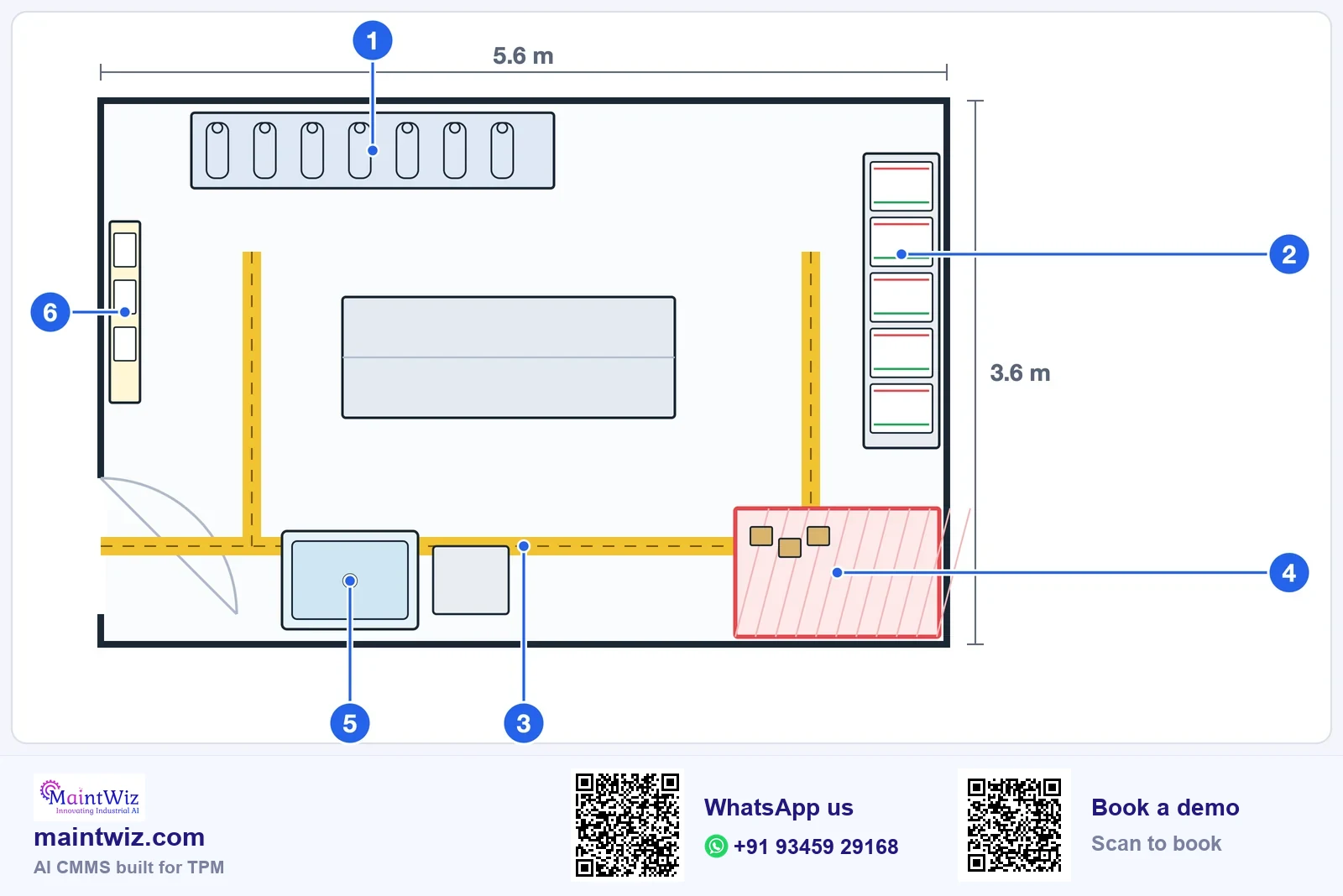
| No. | Seiton element | What it does |
|---|---|---|
| 1 | Shadow board | Every tool has an outline; a missing tool shows at once |
| 2 | Bins with minimum and maximum marks | Reorder and overstock are visible |
| 3 | Yellow walkway lanes | Keep aisles clear and mark where to stand |
| 4 | Red-tag holding area | Tagged items wait here for a keep, move or discard decision |
| 5 | Cleaning station | Cleaning tools return to one place |
| 6 | 5S notice board | Audit scores and the next action are posted |
Downloads
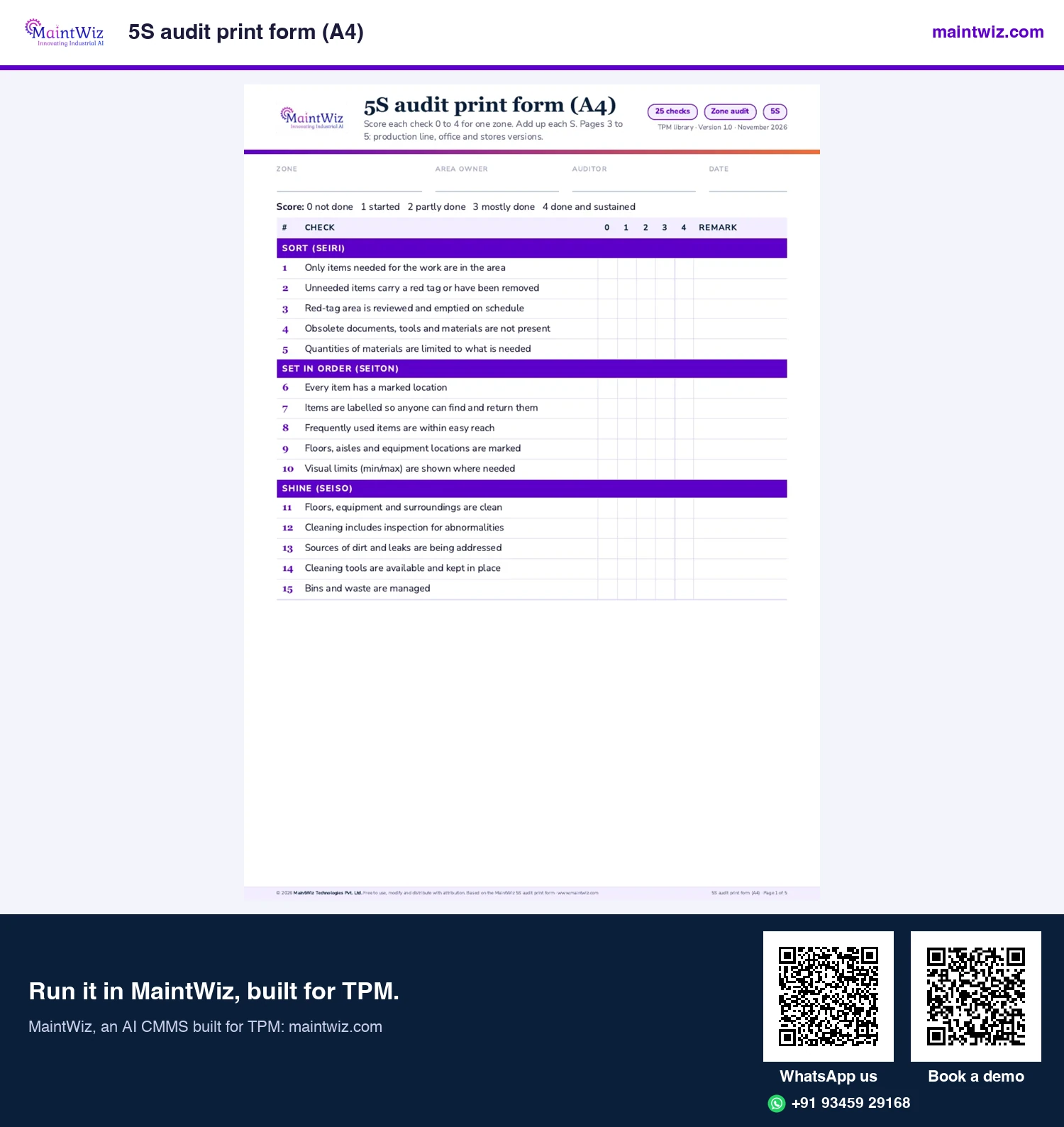
5S audit checklist (Excel and print), zone plan and daily check
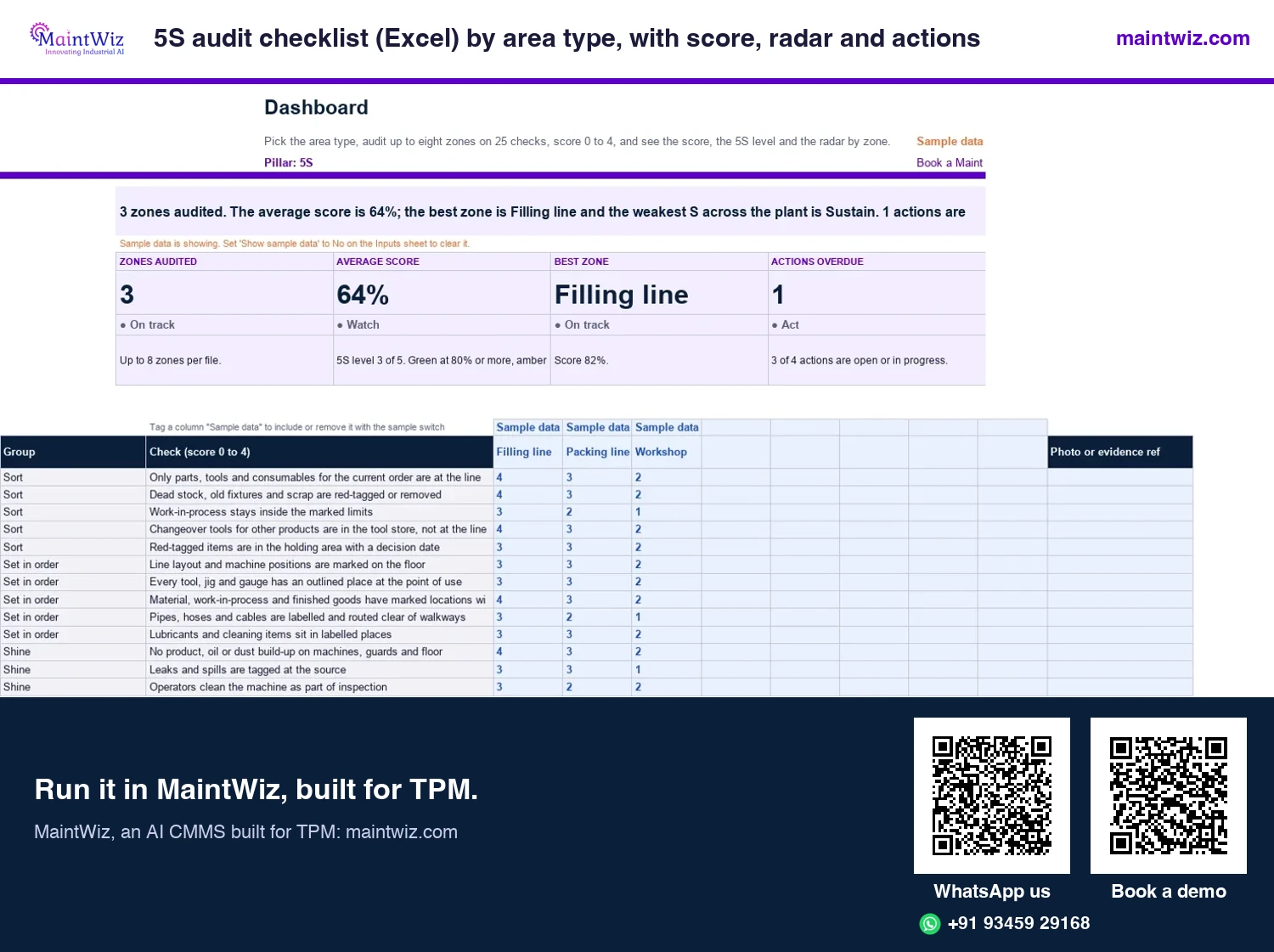
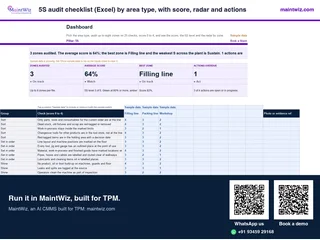 Excel5S audit checklist (Excel) by area type, with score, radar and actions
Run the 5S audit checklist for a production line, workshop, stores, office or utility area: 25 checks, score, 5S level, radar and actions.
Inside: 25 checks, five for each S, scored 0 to 4 · Check wording for five area types: production line, maintenance workshop, stores, office and utility · Up to eight zones per audit with score, 5S level and radar · Action log with owner and due date
- Sheets
- Dashboard, Inputs, Audit, Area checks, Actions, Read me
- A4
- Version
- v1.0, 2 November 2026
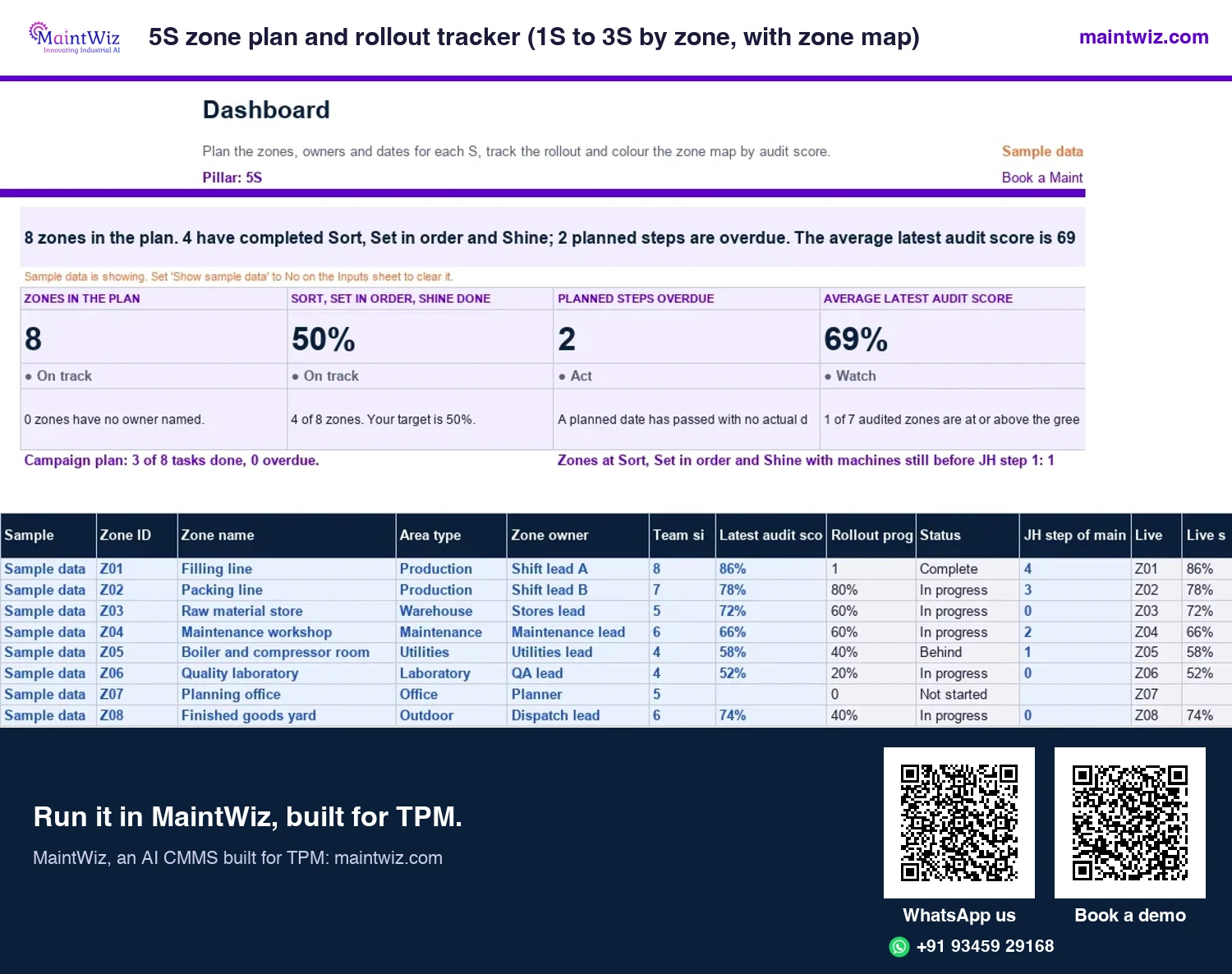
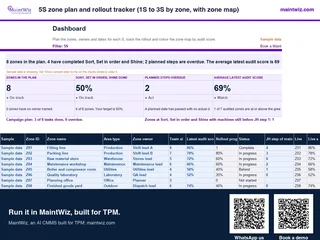 Excel5S zone plan and rollout tracker (1S to 3S by zone, with zone map)
Plan zones, owners and dates for the five S, colour a zone map by audit score
- Sheets
- Dashboard, Inputs, Zones, Schedule, Campaign plan, Zone map, Audit trend, Read me
- A4
- Version
- v1.0, 2 November 2026
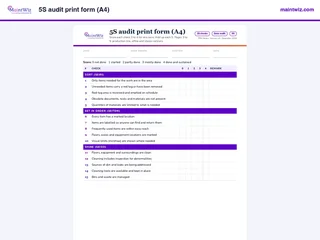 PDF5S audit print form
Score 25 checks on paper for any zone, with ready versions for a production line, an office and a store
- Pages
- 5
- A4
- Created
- 5 November 2026
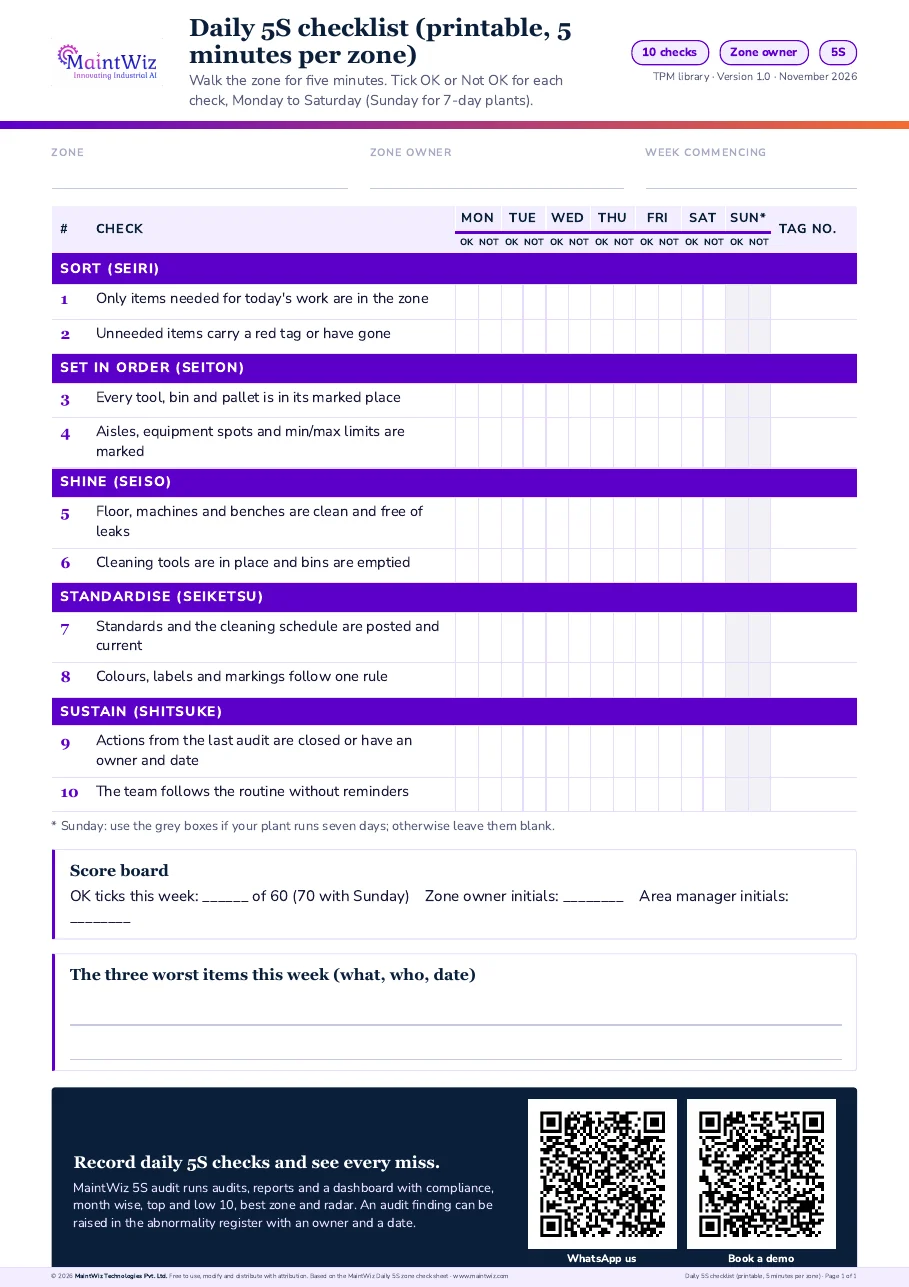
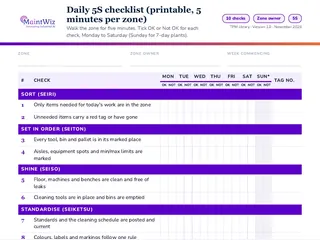 PDFDaily 5S checklist (printable, 5 minutes per zone)
Walk a zone in five minutes with a ten-check tick grid for Monday to Sunday, a score board and the three worst items
- Pages
- 1
- A4
- Created
- 5 November 2026
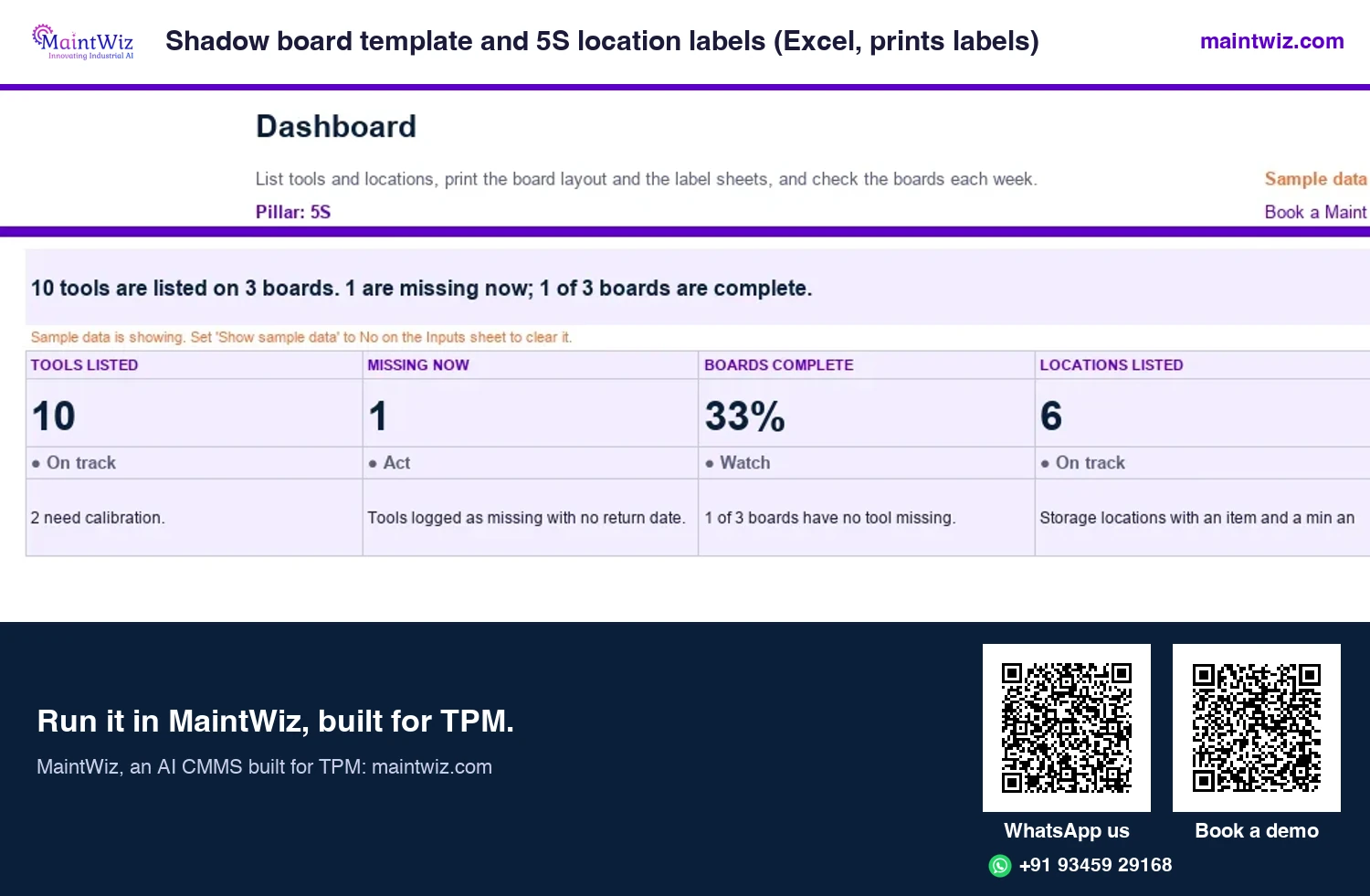
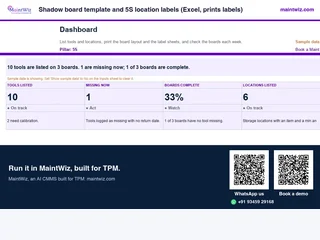 ExcelShadow board template and 5S location labels (Excel, prints labels)
List tools and locations, print the shadow board layout and label sheets
- Sheets
- Dashboard, Inputs, Tool list, Locations, Missing tools, Boards, Weekly check, Board layout, Labels, Read me
- A4
- Version
- v1.0, 2 November 2026
Seiso and step 1
How Seiso connects to Jishu Hozen step 1
Initial cleaning, the first step of Jishu Hozen, is Seiso with a purpose: clean the equipment so thoroughly that every leak, crack, loose bolt and worn part becomes visible, then tag what you find. This is why 5S usually comes first. A plant that has not done Seiri and Seiton will spend its first Jishu Hozen weeks clearing clutter instead of finding abnormalities.
Where 5S meets Jishu Hozen
Each S prepares the step it leads into
Seiri and Seitonsort and set in order
Step 0, preparation
Clear and arrange the area before the first clean
Seisoshine
Steps 1 and 2
Initial cleaning that finds fuguai, then the sources and hard-to-access places
Seiketsustandardise
Steps 3 and 6
CIL standards, then area standards, flows and visual controls
Shitsukesustain
Step 7
Full self-management: the team audits and keeps its own standards
5S is the foundation under the staircase, not a step on it
maintwiz.comAI CMMS built for TPMWhatsApp us+91 93459 29168Book a demoThe discipline carries on into steps 6 and 7, where area standards, storage and visual controls are standardised.
What should a 5S audit check?
An audit gives the sustaining step its teeth. Score each point from 0 (not done) to 4 (done and sustained), by zone, on a schedule, and compare a zone only with its own earlier scores.
| S | What to check | Evidence |
|---|---|---|
| Sort | Only needed items in the area; red-tagged items have an owner and a decision | Red-tag log, area photos |
| Set in order | Marked locations, labels, shadow boards, aisles and equipment positions | Walk-through, labels in place |
| Shine | Equipment and floor clean; cleaning includes inspection; contamination sources addressed | Tags raised from cleaning, source list |
| Standardise | Visual standards at the point of use; responsibilities and schedules posted | Standards displayed, owner named |
| Sustain | Audits on schedule; repeat findings trigger root-cause action; actions closed with evidence | Audit history, action register |
Score a zone on the one-page 5S audit sheet, or in the 5S audit checklist that draws the radar by S. Worked example: a zone checklist of 25 checks, five for each S, scored 0 to 4 has a maximum of 100. A first audit of 55 is 55 %; once the actions close, 80 is 80 %. The MaintWiz 5S dashboard trends that percentage month by month.
Sustaining 5S with visual management
Visual management is what lets someone who did not set the standard see at a glance whether it is being met: floor markings for locations, min and max marks on stock, outline boards for tools, colour codes used the same way across areas. The test of a visual standard is that a new starter can tell what is wrong without being told (Figure 4).
Paper and digital 5S audit
The same audit sheet, different follow-up
| On paper | In MaintWiz |
|---|---|
| Audit sheet filled on a clipboard | Audit scored on a phone zone by zone |
| Scores typed into a spreadsheet later | Scores roll up as the audit is saved |
| Findings listed in a meeting | Findings raised in the abnormality register |
| Radar charts made by hand | Radar and zone ranking update by themselves |
maintwiz.comAI CMMS built for TPMWhatsApp us+91 93459 29168Book a demo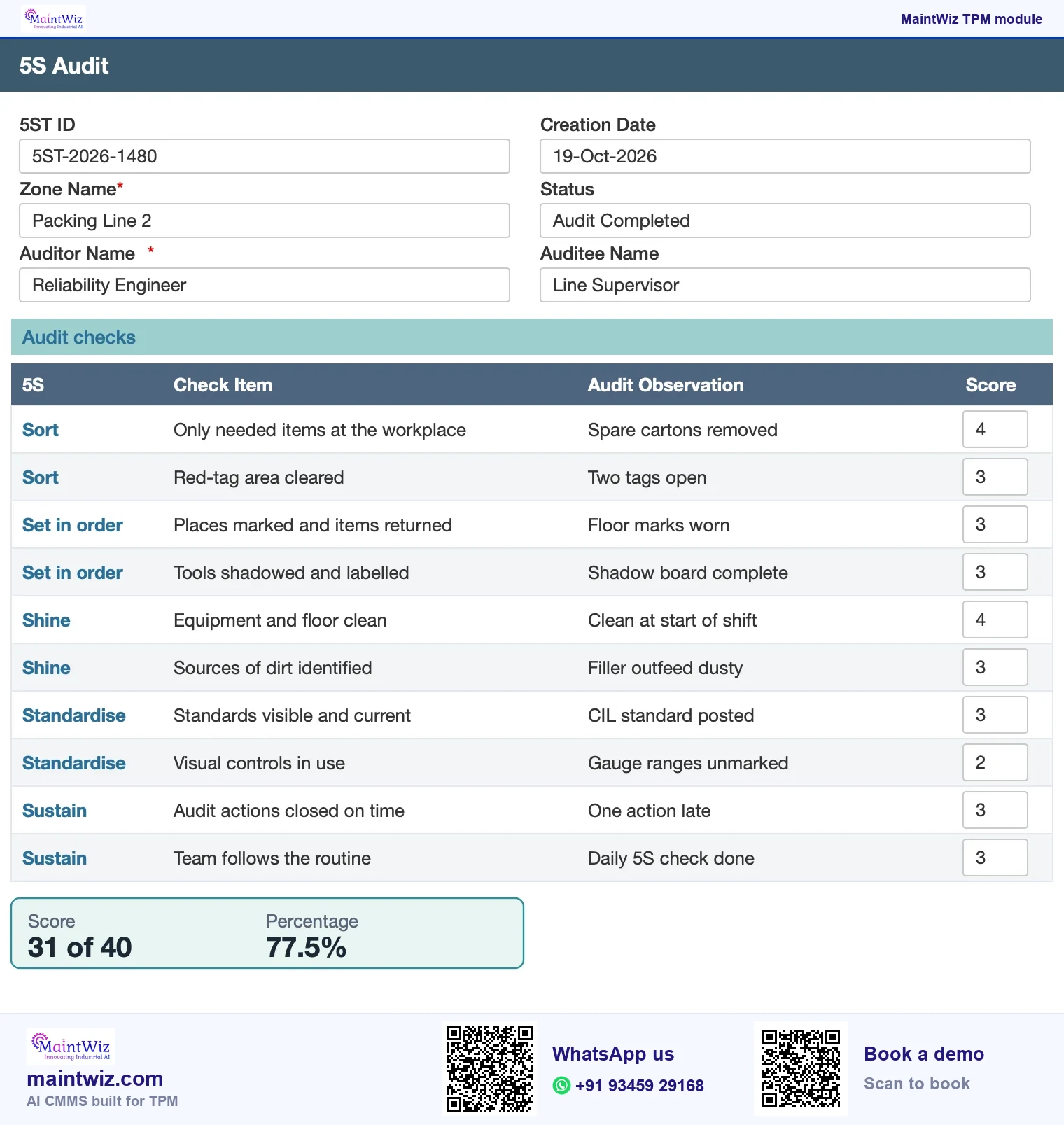
Mistakes
What are common 5S mistakes?
- Treating 5S as a one-off clean-up before a visit instead of a routine with an owner per zone.
- Sorting without a decision rule, so red-tagged items pile up in a holding area for months.
- Labelling everything in the first week and standardising nothing, so labels drift.
- Auditing with a different checklist or scale each time, which makes scores impossible to compare.
- Scoring the area but not closing the actions the audit raised.
- Starting autonomous maintenance in areas that have not done the first three S.
The second and fifth points are why every audit needs an action register as well as a score. Keep a red tag register with the item, owner, decision and decision date so the holding area clears on time; in MaintWiz each audit finding is raised in the abnormality register with an owner and a date.
5S in TPM compared with 5S in lean
The five steps are the same. In TPM the purpose is more specific: the clean, ordered area exists so that abnormalities on the equipment can be found and tagged, and so that operators have the time and the space to carry out cleaning, inspection and lubrication routines. A lean-led 5S programme may stop at tidiness and flow; a TPM-led programme continues into autonomous maintenance.
First 30 days
How to start 5S in a TPM pilot area: the first 30 days
| Week | Do | Output |
|---|---|---|
| 1 | Walk the area with the team; photograph the current state; agree zones and owners | Zone map, baseline photos, owners |
| 2 | Sort: red-tag what is not needed; set the decision rule and the holding area | Red-tag log with decisions |
| 3 | Set in order: mark locations, label, create shadow boards for frequently used items | Marked and labelled area |
| 4 | Shine and standardise: clean with inspection; write the first standard; run the first audit | First audit scores and action list |
The first 30 days of 5S in a pilot area
Four weeks from the red-tag campaign to the first scored audit
Week 1: Red-tag campaign
Seiri: tag what is not needed, set the holding area
Week 2: Set in order
Seiton: mark locations, label, shadow boards
Week 3: Shine and tag
Seiso: clean with inspection, tag what is found
Week 4: Standards and first audit
Seiketsu: first standard, first scored audit
Keep the first scope small: one zone done well teaches more than five done half-way
maintwiz.comAI CMMS built for TPMWhatsApp us+91 93459 29168Book a demoRun the first audit before the end of month one so the sustaining habit starts early.
The red tag campaign in the sort step
The sort step is usually run as a red tag campaign. A team agrees what 'necessary' means for the area, walks it and tags items that look unnecessary. Tagged items go to a holding area where their owners decide to keep, relocate, store or dispose within an agreed time. The record shows what was tagged, why and what was decided. The same colours are also used on equipment, where they mean something different.
5S audit checklists by area type
| Area | What an audit looks for under the five S |
|---|---|
| Production floor | Only needed items at the line; marked locations; clean machines and floor; visual standards for tools and materials; routines followed |
| Maintenance workshop | Tools on shadow boards; labelled spares; clean benches; lubricant storage and labelling; standard for returning tools |
| Stores | Items located and labelled; first-in, first-out; no obsolete stock mixed with live stock; counts matched to records |
| Office | Documents and files sorted and labelled; clear desks; shared areas to standard; digital files named and located by rule |
A free 5S audit checklist scores zones and shows a radar by S. The 5S audit module keeps zone scores and trends in a system.
5S and safety
5S and safety
Clean, organised areas are safer: clear aisles, labelled hazards and tidy cables reduce trips and make hazards visible. 5S also brings people into contact with hazards: cleaning moving machinery, handling chemicals and working at height. Cleaning and inspection standards should state the safety step and who may open guards. MaintWiz runs the safety pillar beside 5S, with ePTW for work on moving machinery.
How do you measure 5S?
- Audit score by zone and by S, trended over time on the same checklist.
- Share of zones above the plant's threshold.
- Time to find a tool or document, timed for a few items.
- Open 5S actions and their age.
- Number of red-tagged items and how long they stay in the holding area.
Calibrate by having two auditors score the same zone, then compare and discuss the differences so every auditor reads the checklist the same way.
Linking 5S audits to a CMMS
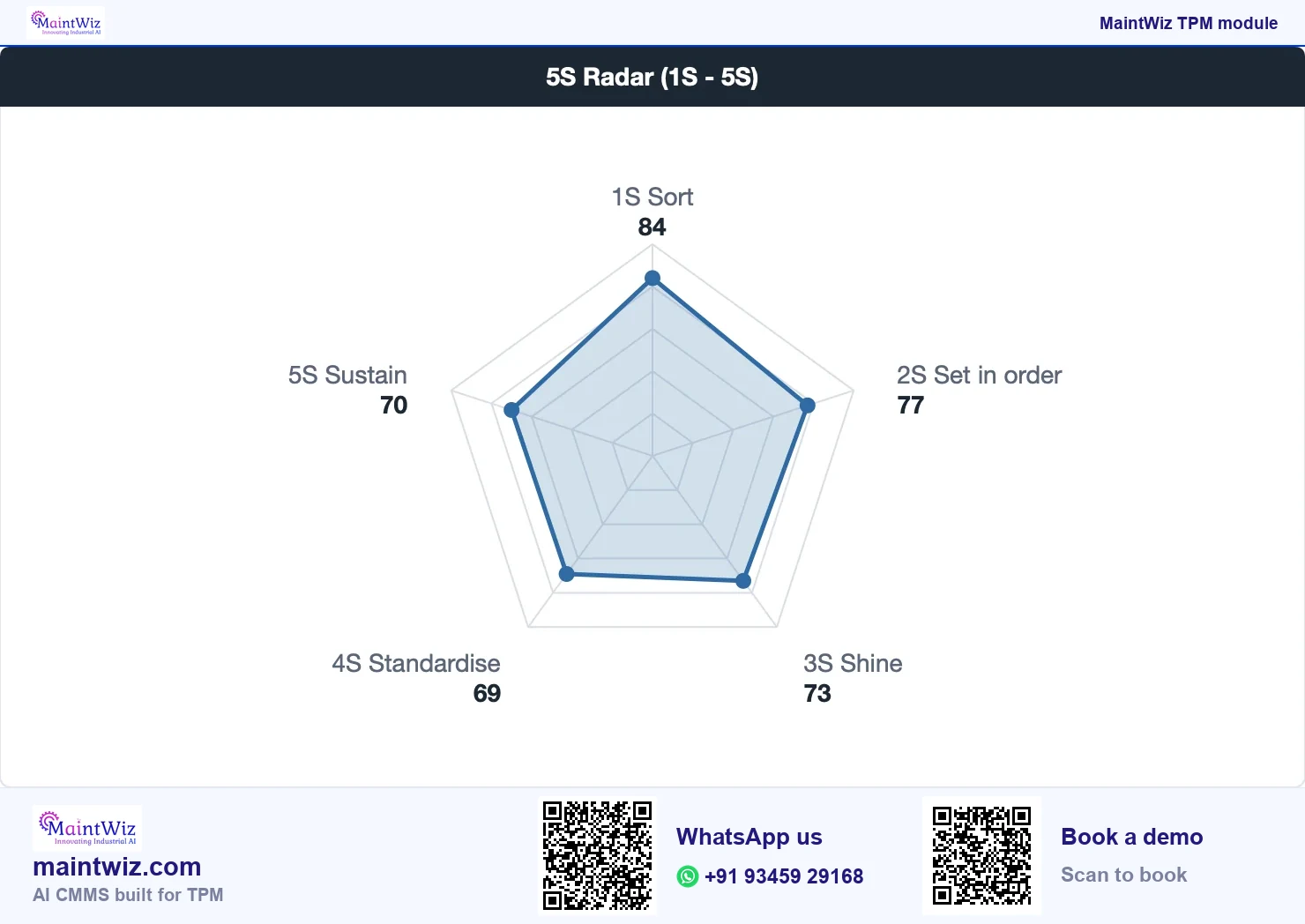
Audits produce actions, and actions need owners and dates. When audit results sit in a spreadsheet, the same findings reappear; when findings become tracked actions linked to the equipment or zone, repeats become visible. The MaintWiz 5S dashboard shows compliance by month, the best zone, top and low scoring zones and a radar by S (Figure 7). Auditors can write findings in Hindi, Tamil or any other script, because MaintWiz supports Unicode; the menus and labels are in English.
Software needs
What should 5S software do in a TPM plant?
5S audits only drive change when scores are comparable and findings are followed up. Software for 5S should run the audit by zone and send findings to the abnormality register.
- Zone audits against your own checklist and scoring.
- A dashboard with compliance, a month-wise view, the top and low 10, the best zone and a radar.
- A finding raised in the abnormality register with an owner and a date.
- Offices audited like production zones.
Book a demo and bring your own 5S checklist: the 5S audit module scores it by zone and raises each finding in the abnormality register with an owner and a date.
FAQ
Frequently asked questions
Is 5S a pillar of TPM?
No. 5S is the foundation under the eight pillars of Total Productive Maintenance, not a ninth pillar. A clean, organised workplace is what lets the other pillars work. MaintWiz runs 5S audits, OEE, Kaizen and all eight pillars on one equipment list.
What is the role of 5S in TPM?
5S gives TPM a clean, organised workplace in which abnormalities become visible and routines can be followed. Seiso (shine) overlaps the initial cleaning step of autonomous maintenance, so plants normally start 5S before Jishu Hozen.
What are the 5S in Japanese?
Seiri (sort), Seiton (set in order), Seiso (shine), Seiketsu (standardise) and Shitsuke (sustain). The five-step form is the one used in TPM, and it is the form MaintWiz scores by zone.
What is 5S?
5S is a method for organising and sustaining a clean, orderly workplace through five steps: sort, set in order, shine, standardise and sustain. It originated in Japanese manufacturing and is used in TPM, lean and quality programmes.
How often should a 5S audit be done?
On a fixed schedule agreed in advance, for example monthly per zone, with the same checklist and scale each time. Frequency matters less than consistency and closing the actions the audit raises.
How is a 5S audit scored?
A common scale scores each point from 0 (not done) to 4 (done and sustained), then reports the score as a percentage of the maximum for the points answered. Compare a zone only with its own earlier scores.
What is the difference between 5S and TPM?
5S organises the workplace; TPM is a wider system for removing equipment losses through eight pillars. 5S is the base on which TPM builds, and the two share the habit of standards and audits.
What is a red tag in 5S?
A red tag marks an item in the work area that may not be needed. Tagged items go to a holding area where the owner decides to keep, relocate, store or dispose of them within an agreed time.
What is the sequence of 5S steps?
Sort, set in order, shine, standardise and sustain. In Japanese they are Seiri, Seiton, Seiso, Seiketsu and Shitsuke. The first three create the condition; the last two keep it.
What should 5S software do in a TPM plant?
It should run zone audits against your checklist, score each S, show compliance by month, the top and low 10 zones, the best zone and a radar, and raise a finding in the abnormality register with an owner and a date. MaintWiz does this in its 5S module.