
Key takeaways
- Rank lost time by the six big losses and assign the largest to the TPM pillar that owns it.
- Check the data first: one definition, a true ideal rate, coded stops; a factor above 100% means an error.
- Run each fix as a measured project and update the standard so the gain holds.
- Set the target from your own baseline: MaintWiz shows OEE per equipment, line and plant, so the baseline is the first dashboard.
Where to start
Where should you start to improve OEE?
Before choosing actions, check that the data can be trusted: one written definition of OEE, an ideal cycle time that is the design or best demonstrated rate, stop reasons coded at the time, and counts that match. A performance figure above 100% means one of them is wrong. Then rank the lost time by the six big losses. JIPM, the Japan Institute of Plant Maintenance, lists autonomous maintenance, focused improvement, planned maintenance and quality maintenance as the four core pillars of TPM, the pillars that remove these losses.
Write down your own definitions of planned time, stops and rework before comparing figures, because OEE only compares across periods when each term means the same every time. OEE measures the loss; TPM removes it. See OEE vs TPM (Figure 1).
From OEE loss to action
Work the largest loss first, one at a time
A Availability
Prevent breakdowns: operator care and planned maintenance
Jishu Hozen + Keikaku Hozen
Cut changeover time (SMED)
Kobetsu Kaizen (SMED)
P Performance
Find and remove the top minor stop
Kobetsu Kaizen
Restore the ideal rate by fixing conditions
Kobetsu Kaizen
Q Quality
Control the conditions that cause defects
Hinshitsu Hozen
Cut start-up scrap
Hinshitsu Hozen
 maintwiz.comAI CMMS built for TPM
 WhatsApp us
 +91 93459 29168
 Book a demo
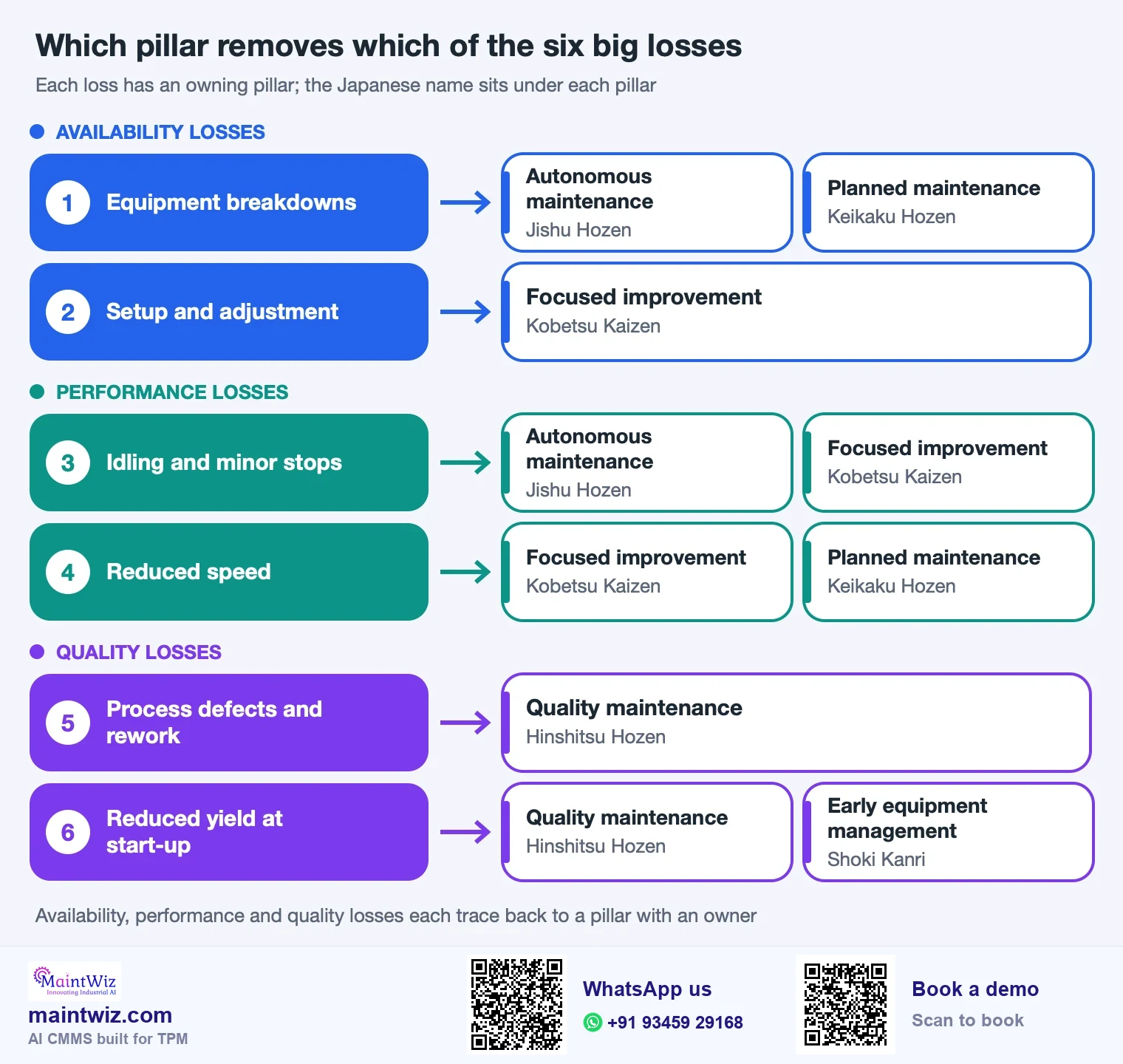
Which action fits which loss?
| Loss | OEE factor | Typical causes | Pillar that owns the action | First action |
|---|---|---|---|---|
| Equipment breakdowns | Availability | Wear, contamination, loose parts, missing lubrication | Autonomous and planned maintenance | Find and fix the basic conditions (CIL); plan work from failure history |
| Setup and adjustment | Availability | Many adjustments, searching for tools, unclear sequence | Focused improvement | Standardise the changeover; separate internal and external work |
| Idling and minor stops | Performance | Jams, sensor trips, blocked chutes, small faults | Autonomous maintenance, focused improvement | Log each stop type; remove the top cause; clean sensors in the routine |
| Reduced speed | Performance | Wear, tuning, ideal rate not respected, material issues | Focused improvement, planned maintenance | Check the ideal rate is right; restore the condition that limits speed |
| Process defects and rework | Quality | Equipment conditions out of limits, setup errors | Quality maintenance | Link defects to conditions; set and check limits; error-proof |
| Reduced yield at start-up | Quality | Unstable process after changeover or restart | Quality maintenance, early equipment management | Standardise start-up; record start-up rejects separately |
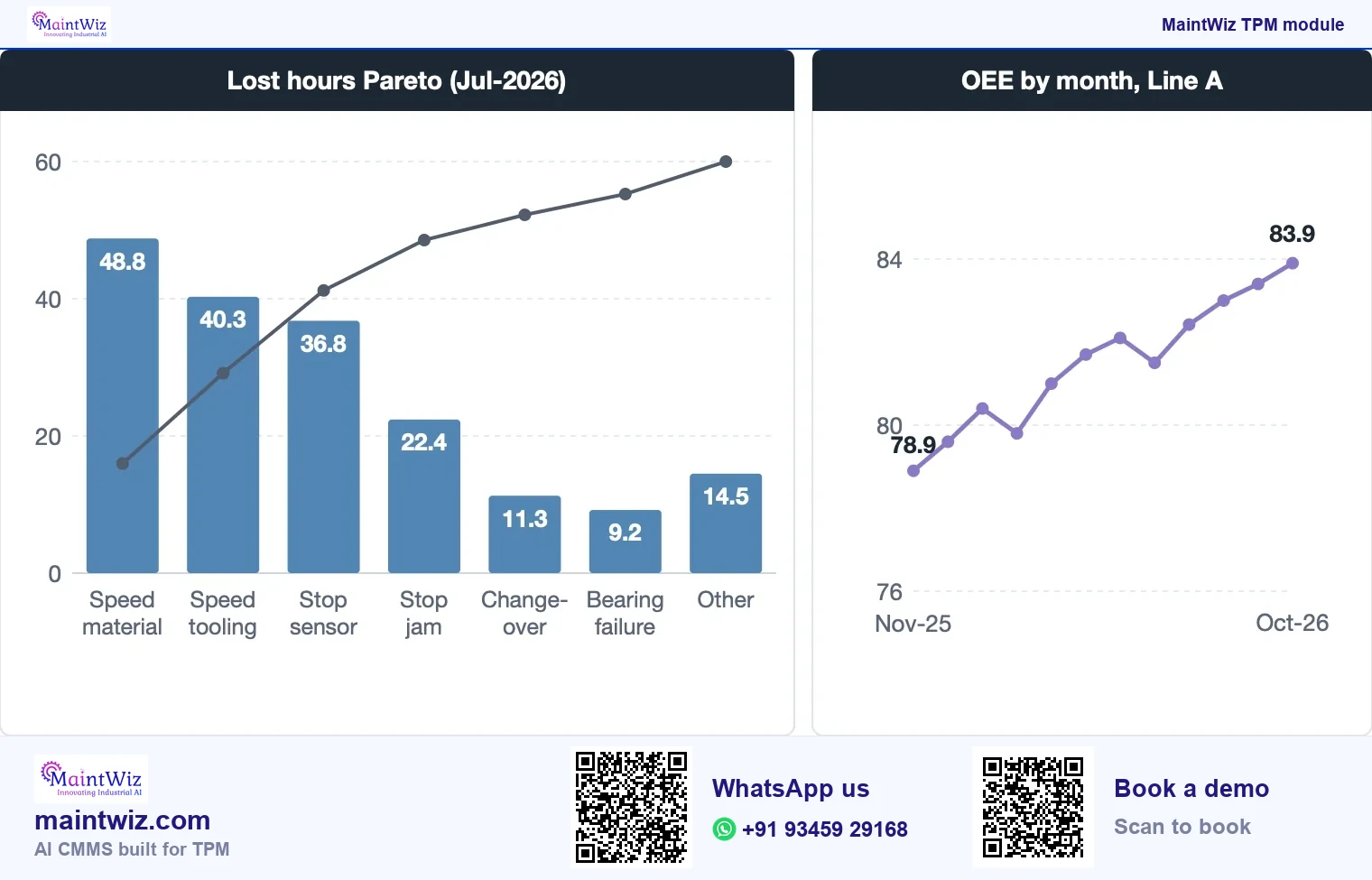
Loss cost: put a money value on each row with the Downtime and loss cost calculator, then work the costliest row first. Ranking every row by lost hours, week after week, is part of what OEE software is: the ranking stays current without re-keying shift sheets. In MaintWiz the OEE software ranks lost hours per equipment on a Pareto, and its downtime report splits them into unplanned, planned and performance loss. See your losses in MaintWiz.
Downloads
OEE improvement templates: loss cost, calculator and loss-to-project map
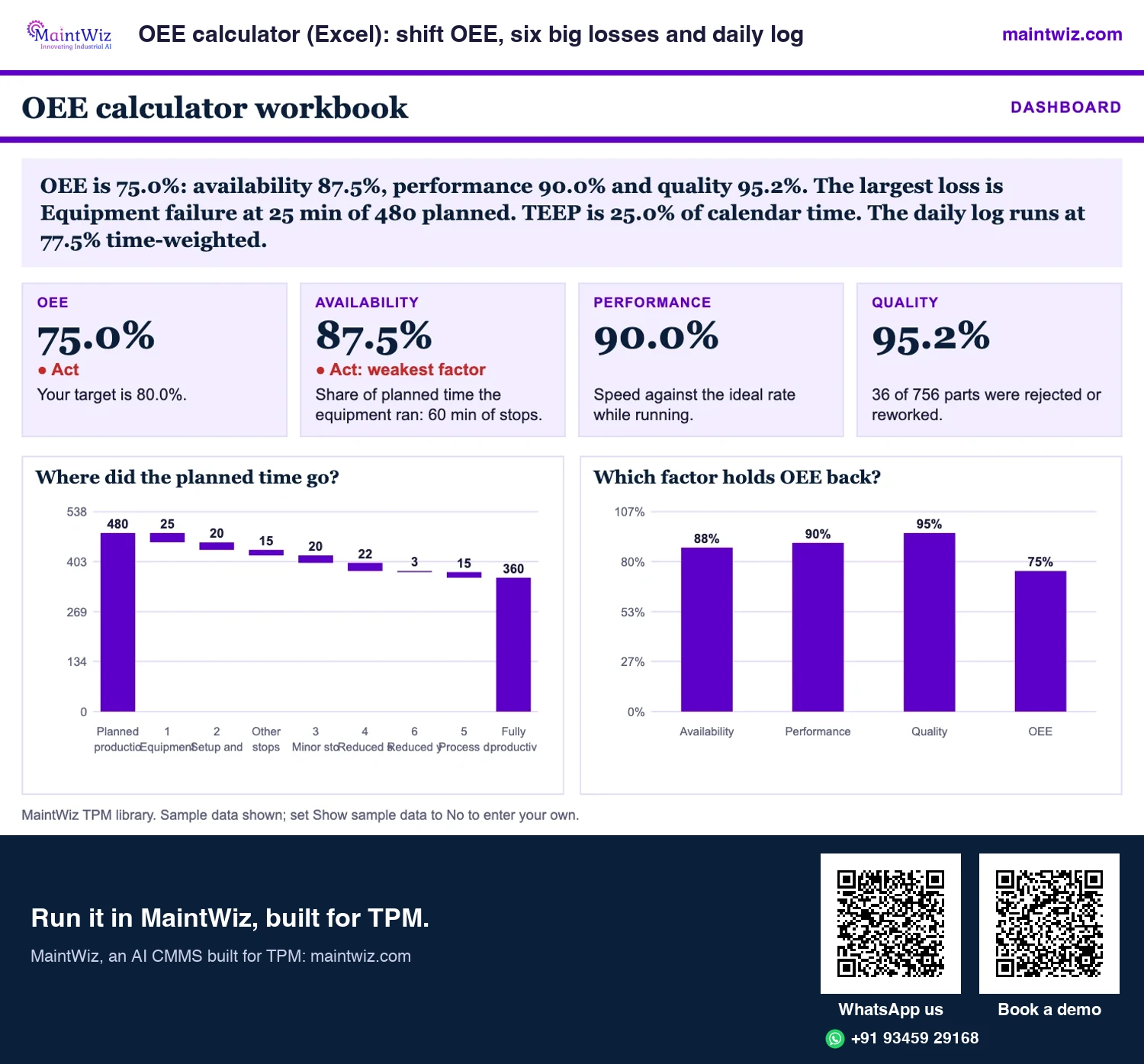
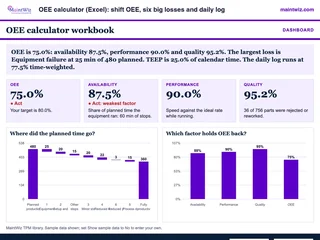 ExcelOEE calculator (Excel): shift OEE, six big losses and daily log
Type one shift and see OEE, the three factors and where every planned minute went
- Sheets
- Dashboard, Shift calculator, Daily log, 480 min shift, Two products in one shift, Read me
- A4
- Version
- v1.1, 5 November 2026
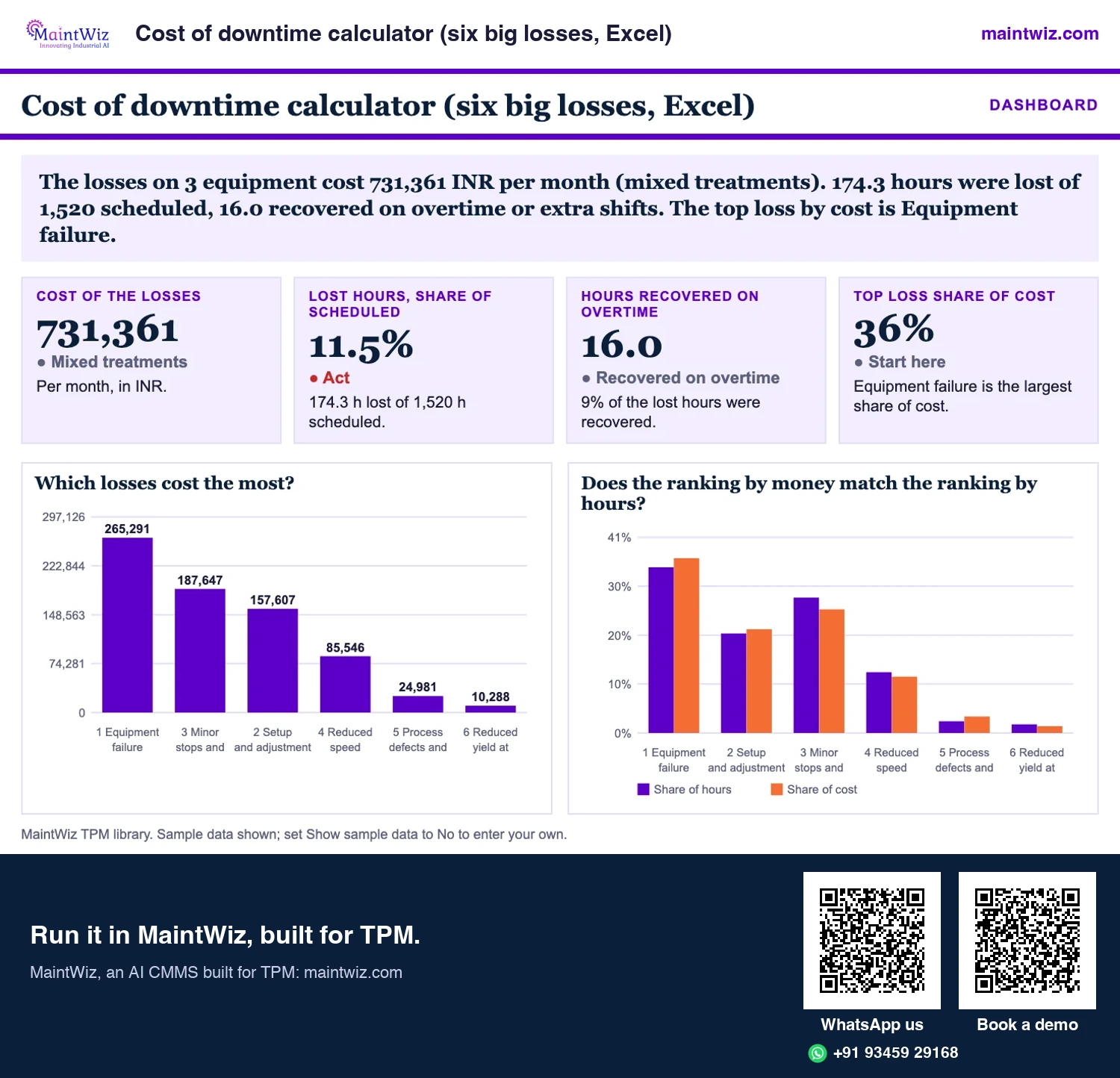
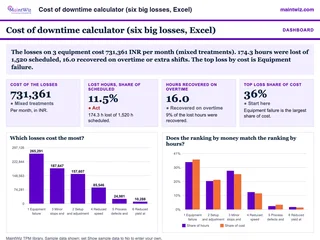 ExcelCost of downtime calculator (six big losses, Excel)
Turn hours lost to each of the six big losses into cost per line, with overtime recovery
- Sheets
- Dashboard, Inputs, Equipment, Results, Read me
- A4
- Version
- v1.2, 5 November 2026
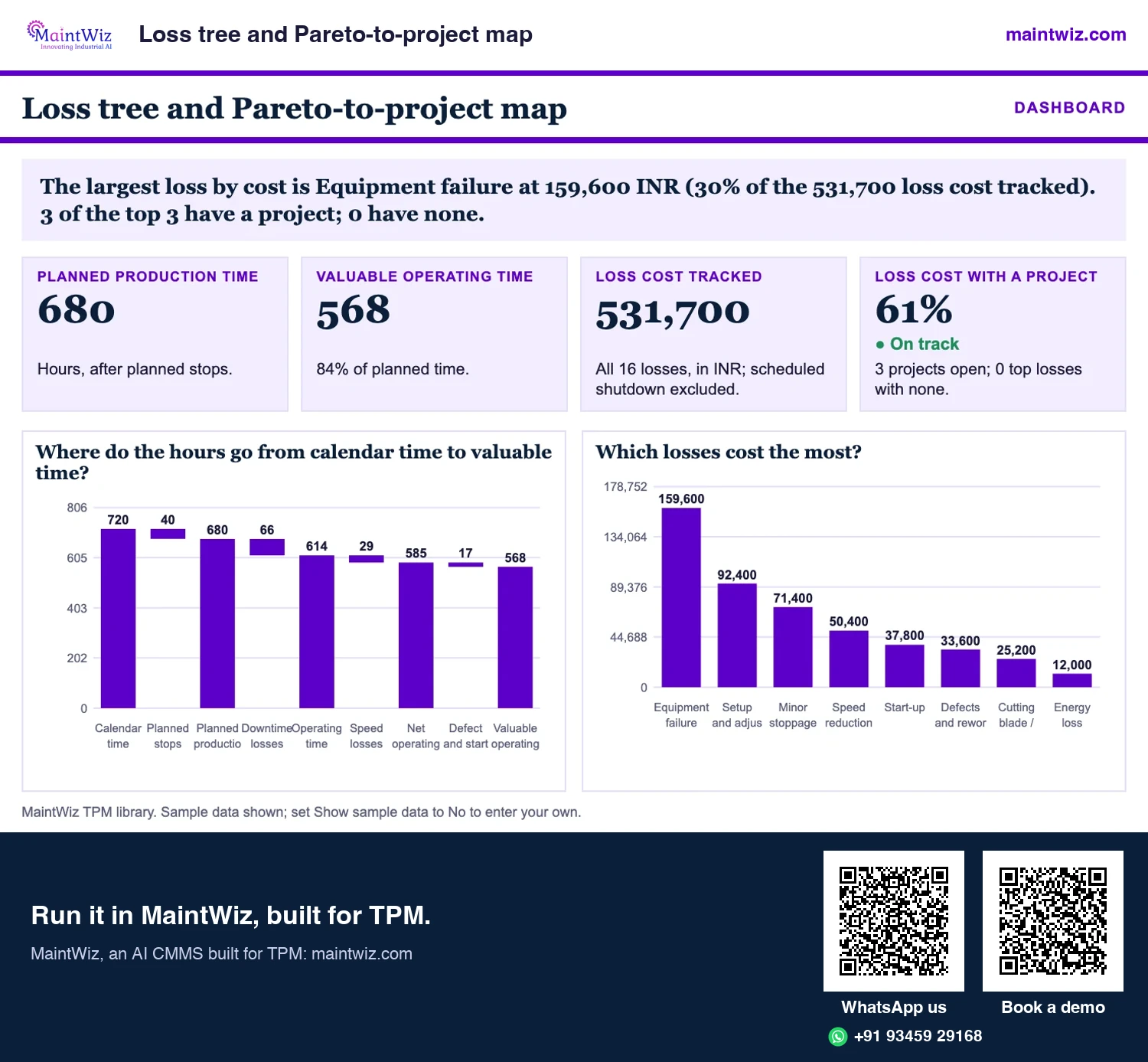
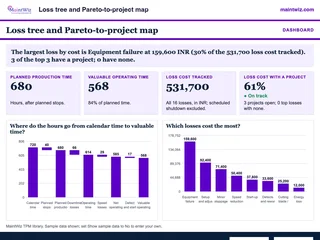 ExcelLoss tree and Pareto-to-project map
Build the loss tree from calendar time to valuable time, rank all 16 losses by cost
- Sheets
- Dashboard, Inputs, Tree, Project map, Pareto, Read me
- A4
- Version
- v1.1, 5 November 2026
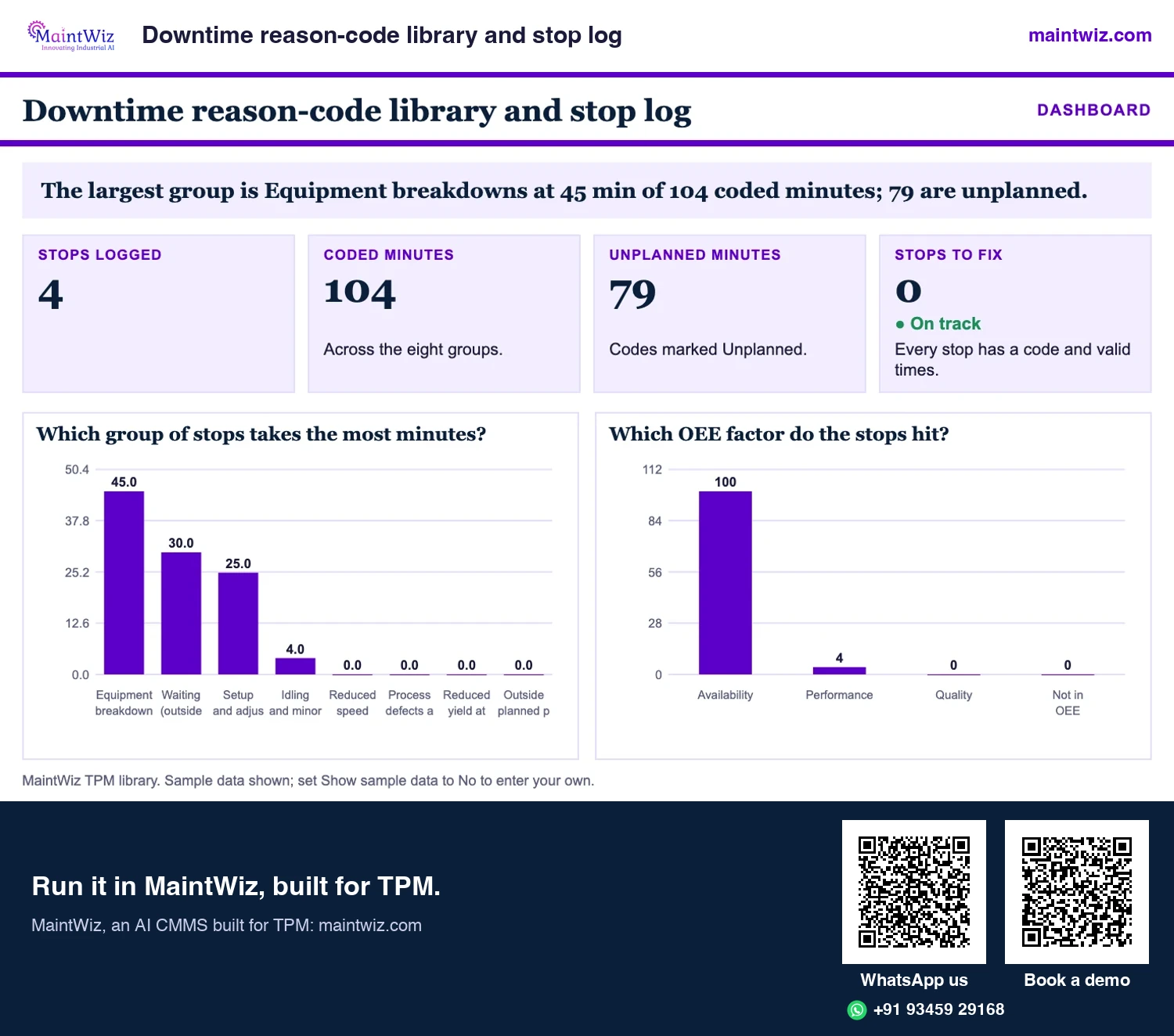
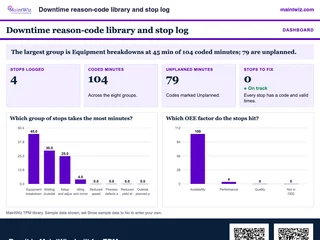 ExcelDowntime reason-code library and stop log
Start from 38 coded stop reasons with definitions, set a minor stop threshold
- Sheets
- Dashboard, Inputs, Codes, Stop log, Summary, Read me
- A4
- Version
- v1.1, 5 November 2026
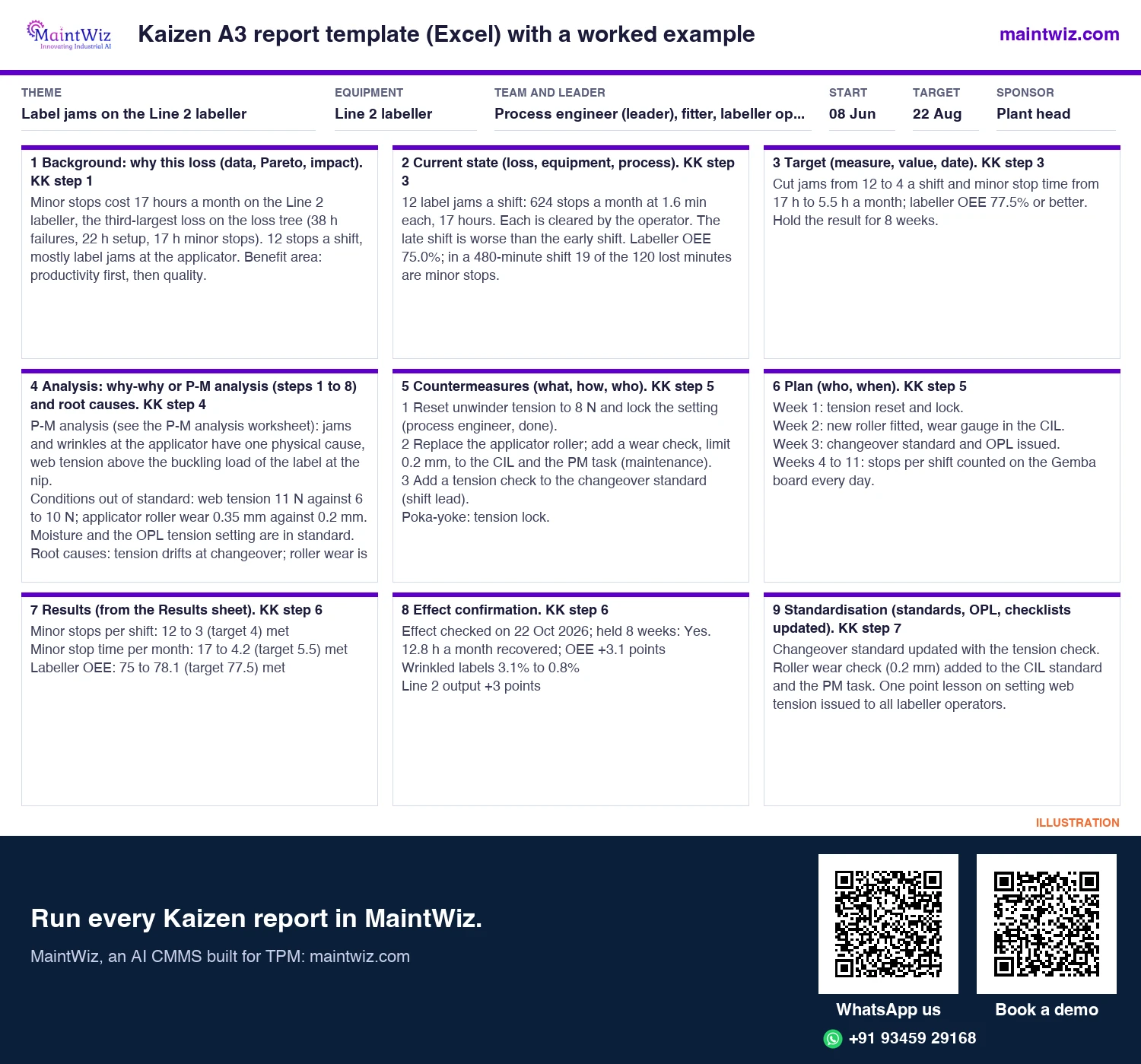
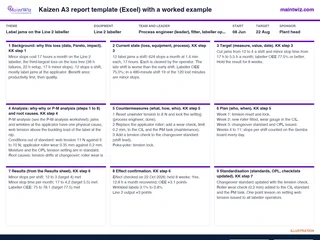 ExcelKaizen A3 report template (Excel) with a worked example
Run a Kobetsu Kaizen project as an A3 report, with the Line 2 labeller project filled in from loss ranking to Yokoten
- Sheets
- Dashboard, Inputs, Results, A3 report, A3 report, 2-page print, Calc, Read me
- One large sheet, or two A4 pages
- Version
- v1.1, 5 November 2026
Availability
How do you improve availability?
Most breakdown losses have a long history of small signs: a leak, a noise, a loose guard. Jishu Hozen puts operators in position to find those early, and planned maintenance schedules the work that needs skill. Setup losses respond to standard work: write the sequence, prepare tools and parts before the stop, and measure the changeover on the same definition each time.
Worked example: what a shorter changeover does to OEE
A line runs at availability 80%, performance 85% and quality 97%, so OEE is 0.80 x 0.85 x 0.97 = 66%. A changeover that is 20 minutes shorter lifts availability to 84%. With performance and quality unchanged, OEE becomes 0.84 x 0.85 x 0.97 = 69%. Read the gain on the same definition before and after, and the result is the share of the loss you removed.
How do you improve performance?
Minor stops are often not recorded, so they hide inside performance. Record them by type for a few weeks, find the one or two types that dominate, and fix the cause rather than clearing the jam faster. For reduced speed, first confirm the ideal rate; many plants find the ideal rate in the system is an old average. Then look at the conditions that limit speed.
How do you improve quality?
Defects that come from equipment conditions respond to quality maintenance: identify the conditions, set limits and check them. Start-up rejects point to the stability of the process after a stop, and sometimes to the design of the equipment (early equipment management).
Pillar ownership
Which pillar owns which loss?
| Pillar | Losses it mainly addresses |
|---|---|
| Autonomous maintenance | Breakdowns, minor stops |
| Planned maintenance | Breakdowns, reduced speed from wear |
| Focused improvement | Setup and adjustment, minor stops, reduced speed, chronic losses of any kind |
| Quality maintenance | Process defects and rework, reduced yield at start-up |
| Early equipment management | Reduced yield at start-up and losses designed in |
| Education and training | Losses caused by skill gaps |
Reducing changeover time: the SMED approach
Single-minute exchange of die (SMED), associated with Shigeo Shingo, separates changeover steps into those done while the machine is stopped (internal) and those that can be done while it runs (external), then moves what can be moved, simplifies the rest and standardises the sequence. The practical steps are to time a real changeover, list the steps, mark internal and external, convert what you can, remove adjustments by design and write the standard. Setup and adjustment is one of the six big losses; see the six big losses.
SMED: moving changeover work outside the stopA 40-minute changeover on one equipment
ILLUSTRATION15 + 15 + 10 = 40 minutes of work; only 15 stay inside the stop
maintwiz.comAI CMMS built for TPMWhatsApp us+91 93459 29168Book a demoReducing minor stops
- Log them for a few weeks with a defined minimum length and reason codes.
- Rank by total lost time, not event count.
- Observe the top stop at the equipment: what exactly happens, how is it cleared?
- Look for conditions: dirt, wear, misalignment, material variation.
- Fix the condition, add a check to the routine, and measure again.
Log them against the downtime reason-code library, and for chronic stops with several interacting causes use P-M analysis.
Minor stops are the loss most often missed: set a realistic ideal cycle time and have operators log each short stop by type, and the MaintWiz downtime report shows them as performance loss beside unplanned and planned loss.
Quick wins
Quick wins and projects
| Type | Examples | Owner |
|---|---|---|
| Quick win | Clean and re-tighten a sensor; fix a recurring jam point; correct an ideal rate | Operators and supervisor |
| Team project | Changeover reduction; chronic minor stop; a recurring defect | Focused improvement team |
| Engineering change | Redesign a feeder; replace a worn assembly with a better design | Engineering, with early equipment management |
How do you keep the gain?
Measure the targeted loss on the same definition before and after, then keep measuring. Gains fade when the standard is not updated or the routine is dropped. Add the change to the CIL standard, write a one point lesson, and review the loss again after a month and a quarter. In MaintWiz the OEE dashboard keeps the targeted loss on one definition, so each review reads from the same screen.
- Run each improvement as a project with a baseline, an owner and a check on the same definition (Kobetsu Kaizen).
- Update CIL standards, PM tasks and one point lessons so the change is standard work.
- Review OEE and the loss Pareto weekly at the line and monthly at plant level.
- Test the effect of a target with the what-if calculator: it shows what a given gain in each factor means in OEE and productive hours.
What halving minor stops does to OEE
The same 480-minute shift before and after
ILLUSTRATION
Before
Minor stops and speed loss42 min
Time at ideal rate378 min
Fully productive time360 min
OEE 75.0%
After a Kobetsu Kaizen project
Minor stops and speed loss21 min
Time at ideal rate399 min
Fully productive time380 min
OEE 79.2%
Working: 399 × 720 / 756 = 380 fully productive minutes; 380 / 480 = 79.2%. The extra 20 minutes at 0.5 minute each is 40 more good parts a shift.
maintwiz.comAI CMMS built for TPMWhatsApp us+91 93459 29168Book a demoFAQ
Frequently asked questions
How can OEE be improved?
Rank lost time by the six big losses, take the largest, assign it to the TPM pillar that owns it, run it as a measured project with a baseline, and standardise the fix so the gain holds.
Which loss should I tackle first?
The one that costs the most lost time on your own data. MaintWiz ranks it first on the lost-hours Pareto for each equipment, line and plant, so the first project is chosen from the data, not from the loudest complaint.
What if my performance figure is above 100%?
The ideal cycle time or the counts are wrong. Correct the ideal rate to the design or best demonstrated rate and check counters before reporting the figure or setting targets from it.
How does autonomous maintenance improve OEE?
By finding abnormalities early through cleaning and inspection, so small faults are fixed before they cause breakdowns, and by removing contamination sources that cause minor stops. It acts mainly on availability and performance.
How do you reduce minor stops?
Record them by type for a few weeks, find the one or two types that dominate, and remove the cause rather than clearing the jam faster. Clean sensors and guides as part of the operator routine.
How do you reduce changeover time?
Write the sequence as standard work, prepare tools and parts before the stop, separate work done while stopped from work that can be done while running, and measure each changeover on the same definition.
How long does it take to improve OEE?
MaintWiz goes live with OEE and the rest of TPM in 6 to 8 weeks. Corrected ideal rates and stop codes sharpen the figure from the first weeks, and each loss project is read on the same dashboard after a month and again after a quarter.
What is SMED?
Single-minute exchange of die is an approach to cutting changeover time by separating internal steps, done with the machine stopped, from external steps that can be done while it runs, then converting, simplifying and standardising.
How do you check that an OEE gain has held?
Measure the targeted loss on the same definition before, after and again after a month and a quarter, and make sure the standard, routine and one point lesson reflect the change.