Key takeaways
- The SHE pillar works toward accident-free and pollution-free operation by finding and removing hazards at equipment level.
- Cleaning and inspection routines expose hazard sources; abnormality tags can record hazards as well as defects.
- In MaintWiz, hazards, near misses and BBSO observations sit beside maintenance, quality and OEE records in one AI CMMS.
- The MaintWiz SHE menu holds the incident reporting form, BBSO, near miss observations and the SHE dashboard.
SHE scope
What does the SHE pillar cover?
SHE extends TPM's loss thinking to people and the environment: accidents, near misses, unsafe conditions and environmental releases are treated as losses with causes that can be removed. It works with the other pillars rather than beside them.
How does SHE connect to autonomous maintenance?
Cleaning and inspection in Jishu Hozen expose hazard sources: leaks, exposed moving parts, damaged guards, spills, poor access. An abnormality tag can record a hazard as readily as a defect, and hard-to-reach places found in step 2 are often safety issues as well as inspection issues. Safety content belongs in the standards that operators follow.
Permits, incidents and observations in a system
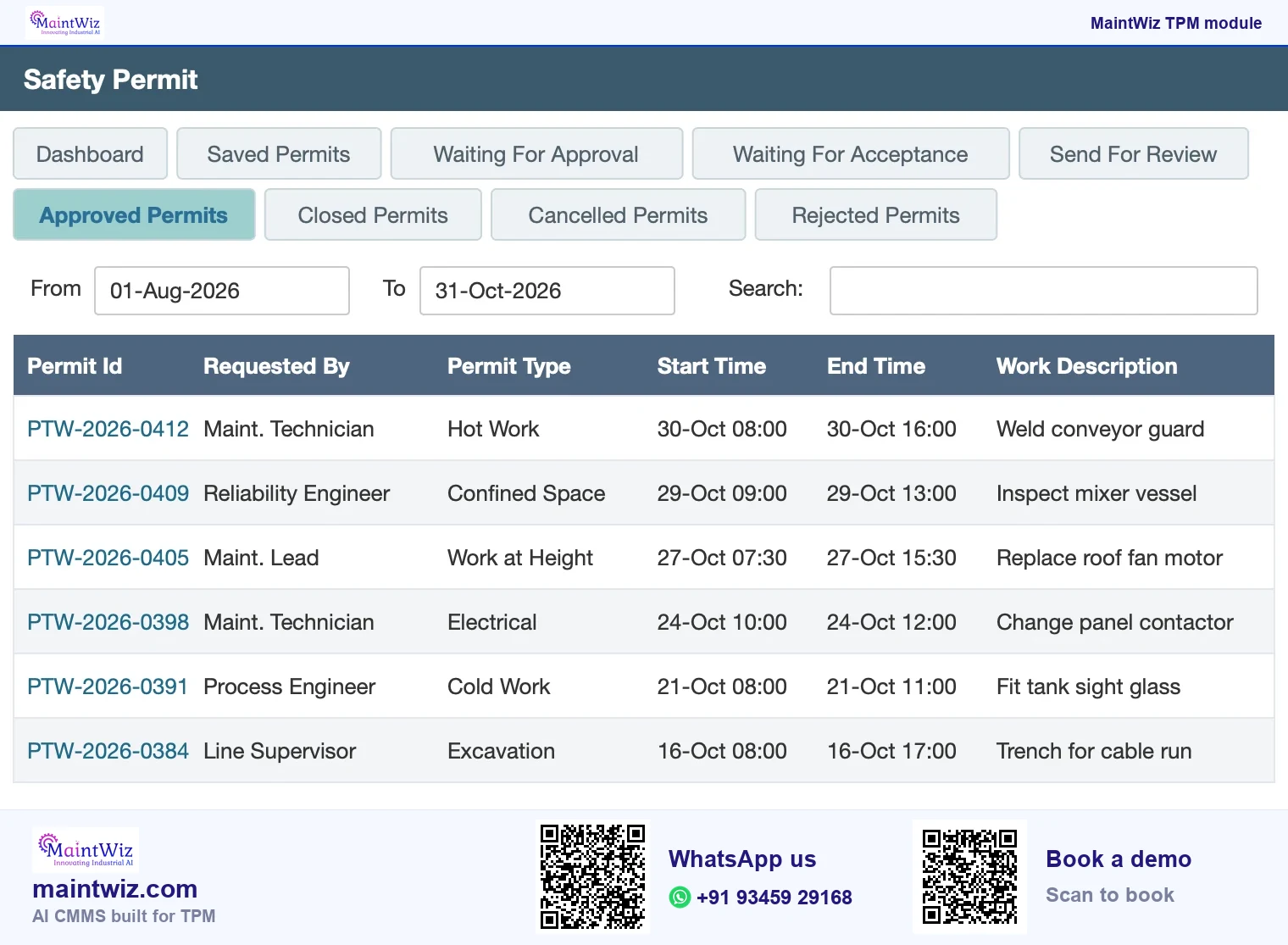
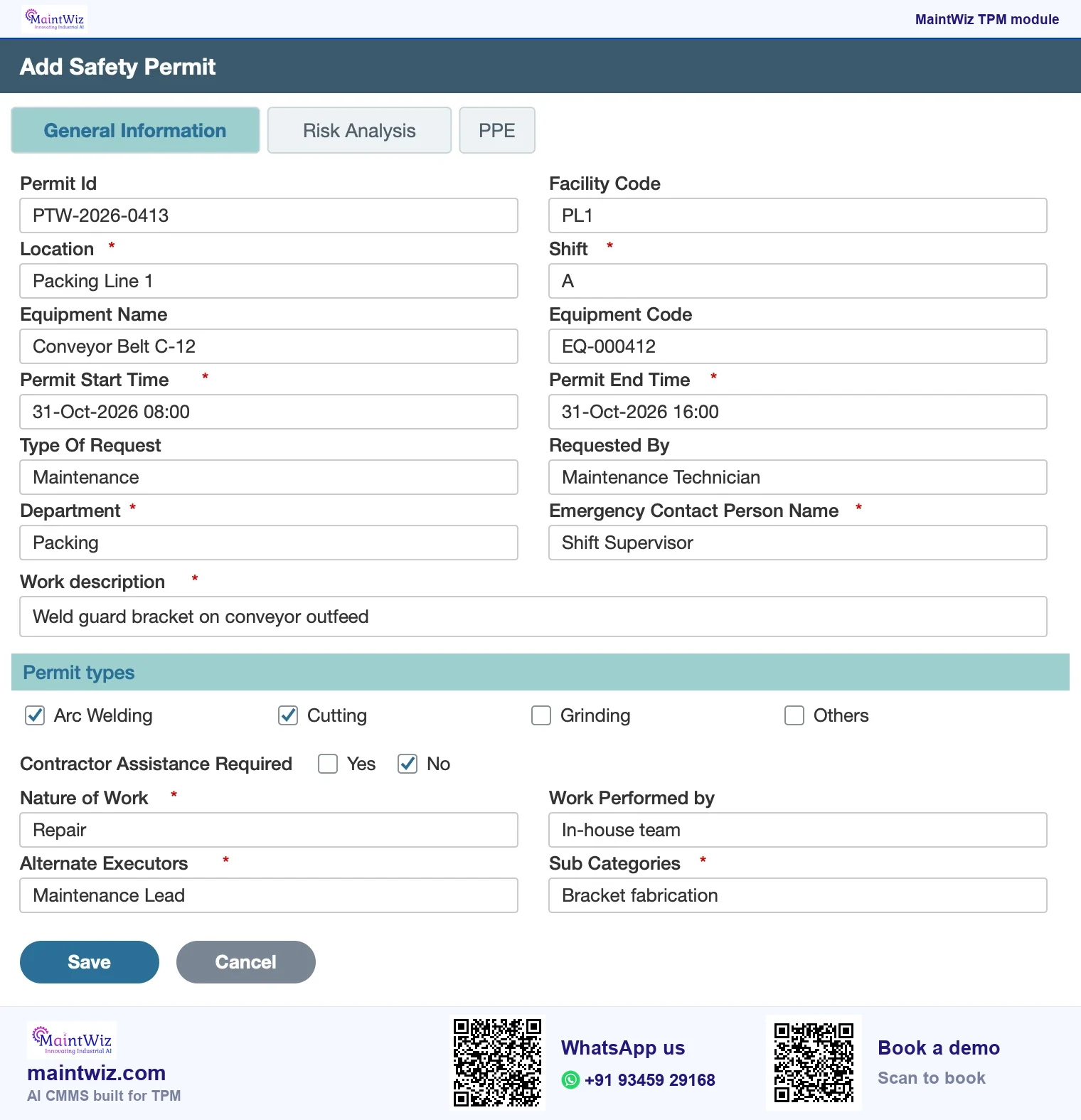
A system records what happened and what was done: incident and near-miss reports, behaviour observations, permits to work with their approvals and closures. In MaintWiz the SHE pillar includes an incident reporting form, BBSO, near-miss observations and a SHE dashboard, and MaintWiz electronic permit to work carries each permit from request and approval to close-out, with risk analysis and PPE on their own tabs of the form (Figures 1 to 5).
Control the hazard before you protect the person
Most effective
- 1
Eliminate
remove the hazard
- 2
Substitute
replace it with something safer
- 3
Engineering controls
guards, interlocks, isolation
- 4
Administrative controls
permits, procedures, training, signage
permit to work
- 5
PPE
protect the person
Least effective
 maintwiz.comAI CMMS built for TPM
 WhatsApp us
 +91 93459 29168
 Book a demo
Electronic permit to work for the SHE pillar
From request to close-out, every step recorded
Request the permit
Review and approve
Work under the permit
Close the permit
Close-out recorded against the equipment
maintwiz.comAI CMMS built for TPMWhatsApp us+91 93459 29168Book a demo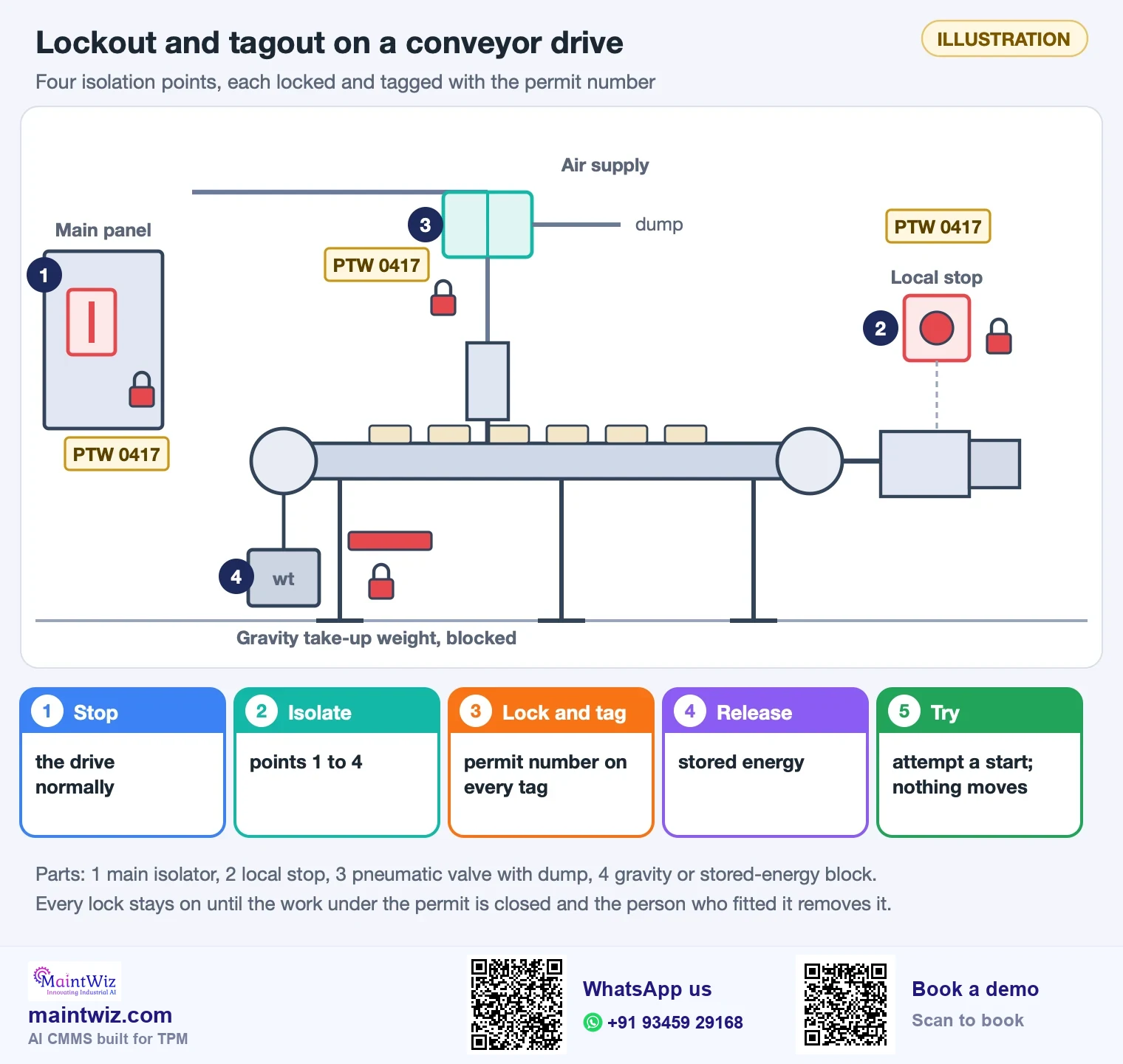
Free files
SHE pillar templates: KYT sheet, safety walk register and pillar audit
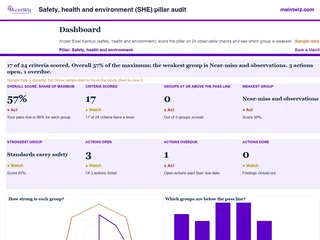 ExcelSafety, health and environment (SHE) pillar audit
Score the safety, health and environment pillar on 24 evidence checks in 7 groups and see the weakest group
- Sheets
- Dashboard, Inputs, Audit, Actions, Read me
- A4
- Version
- v1.0, 2 November 2026
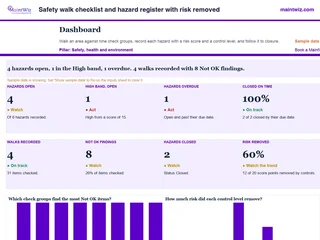 ExcelSafety walk checklist and hazard register with risk removed
Walk an area on nine check groups, score every hazard before and after its control
- Sheets
- Dashboard, Inputs, Walk, Hazards, Read me
- A4
- Version
- v1.0, 2 November 2026
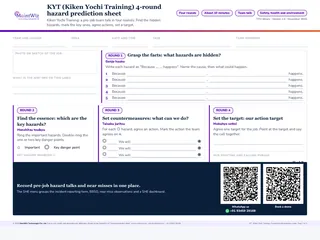 PDFKYT (Kiken Yochi Training) 4-round hazard prediction sheet
Run the four-round KYT team talk before a job: find the hazards, mark the key ones, agree actions and set one target
- Pages
- 2
- A4 landscape
- Created
- 5 November 2026
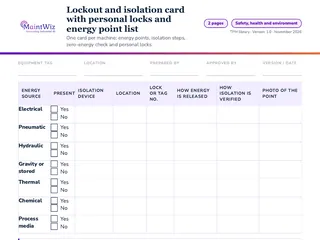 PDFLockout and isolation card with personal locks and energy point list
One card per machine: energy points with a photo each, the isolation steps from prepare to try-start
- Pages
- 2
- A4
- Created
- 5 November 2026
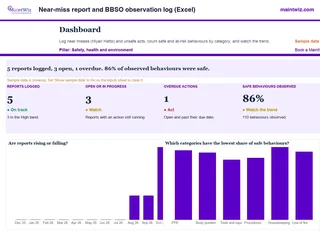 ExcelNear-miss report and BBSO observation log (Excel)
Log every near miss (Hiyari Hatto) with potential severity and occurrence
- Sheets
- Dashboard, Inputs, Reports, BBSO, Read me
- A4
- Version
- v1.0, 2 November 2026
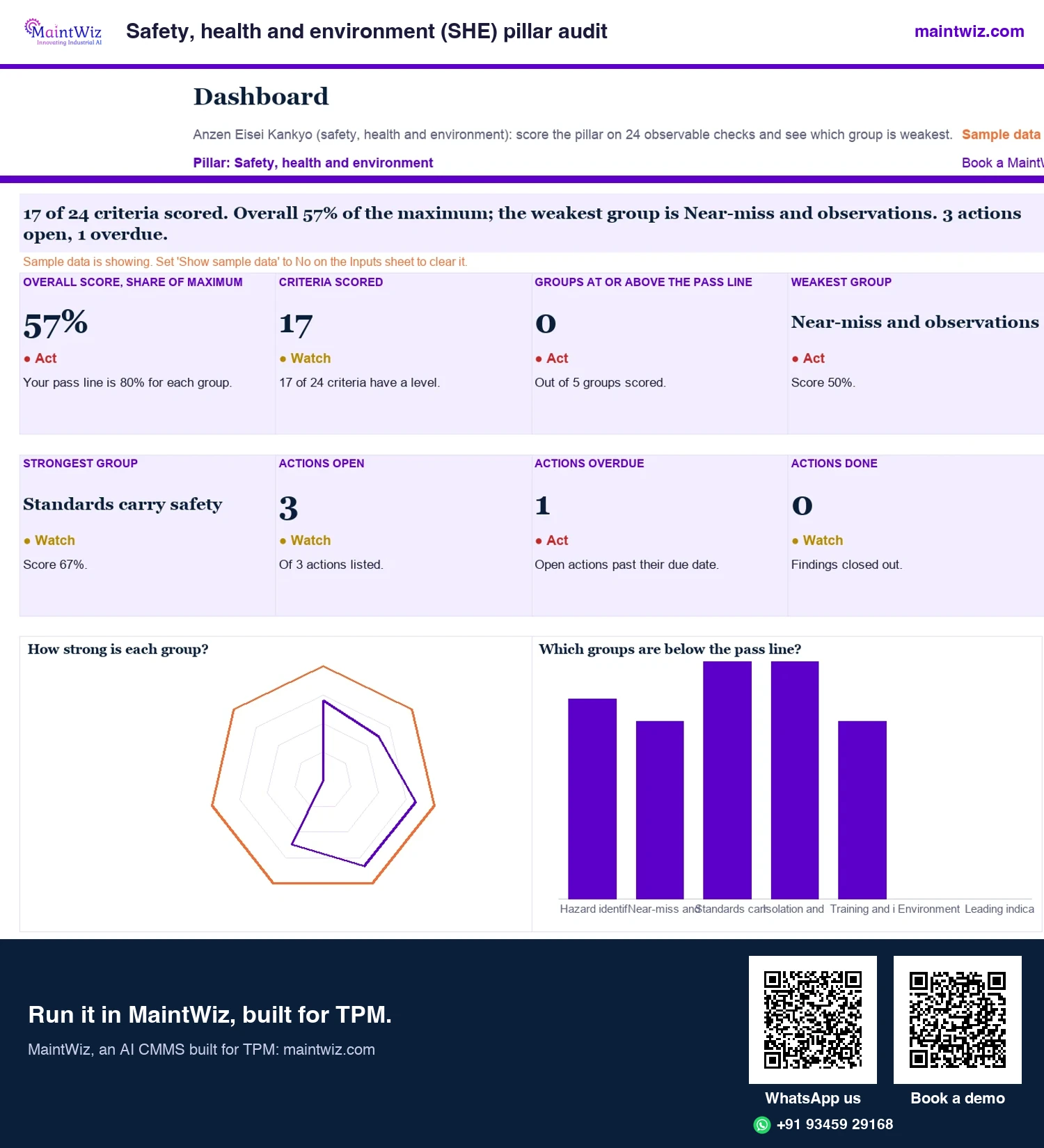
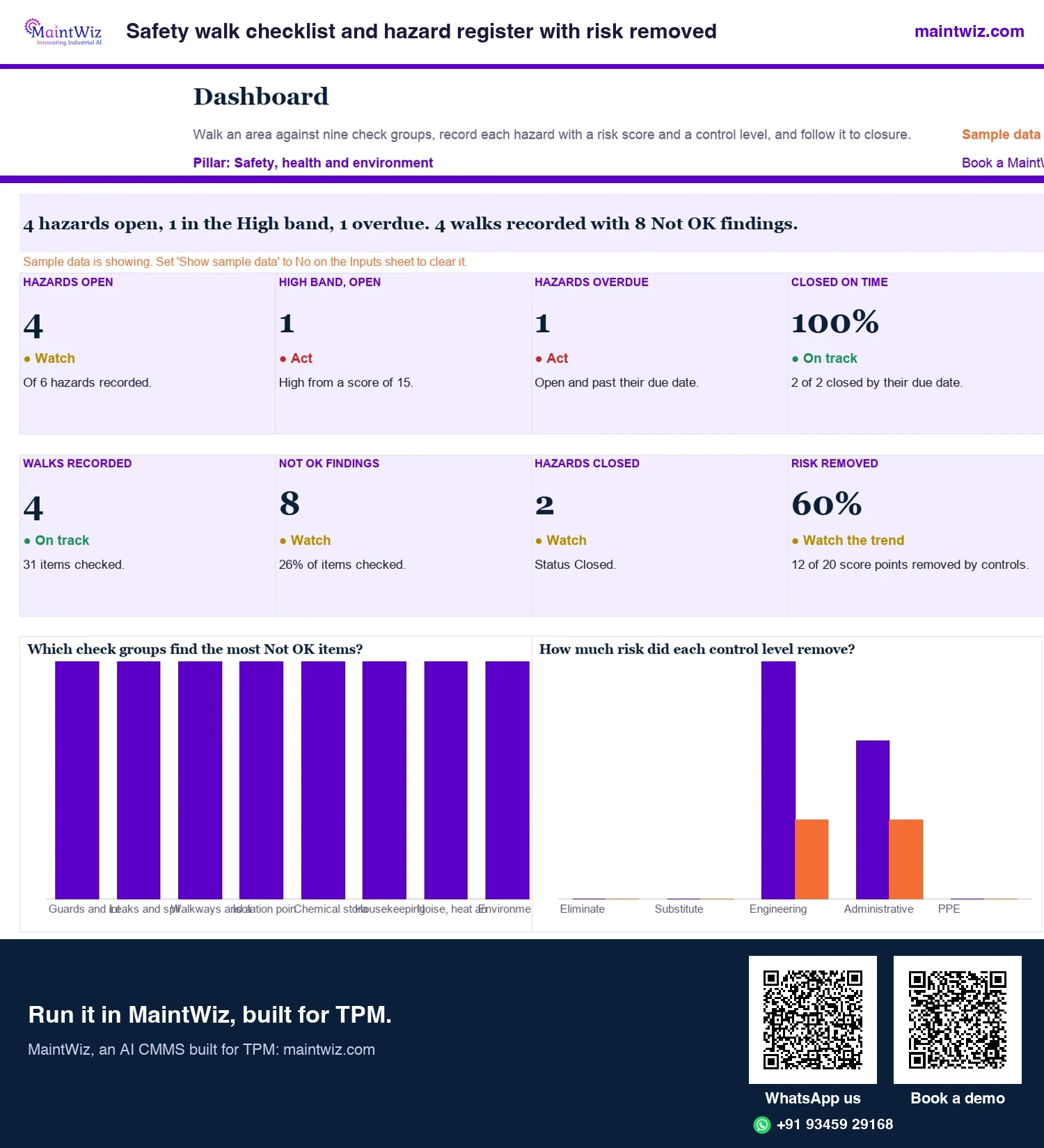
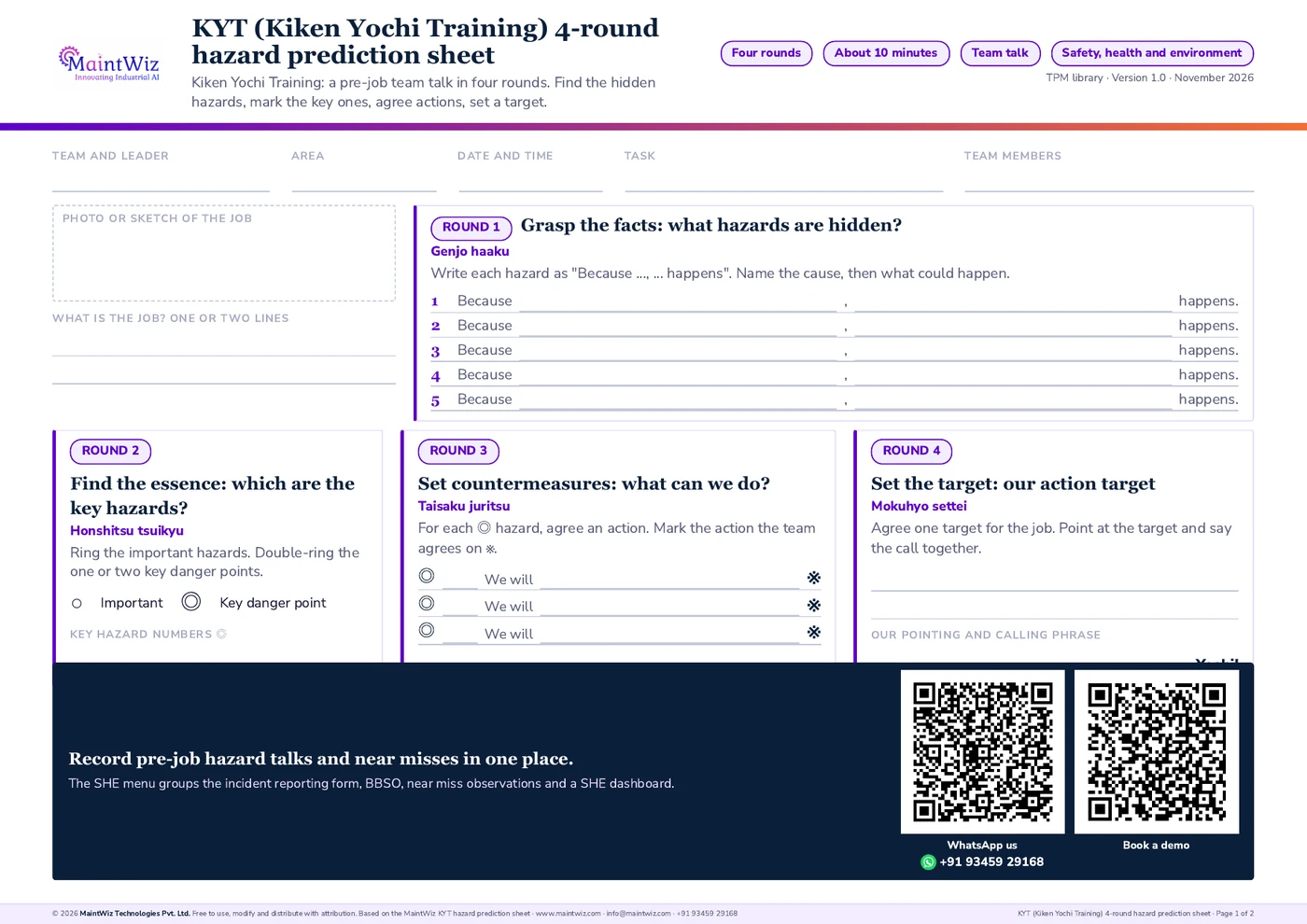
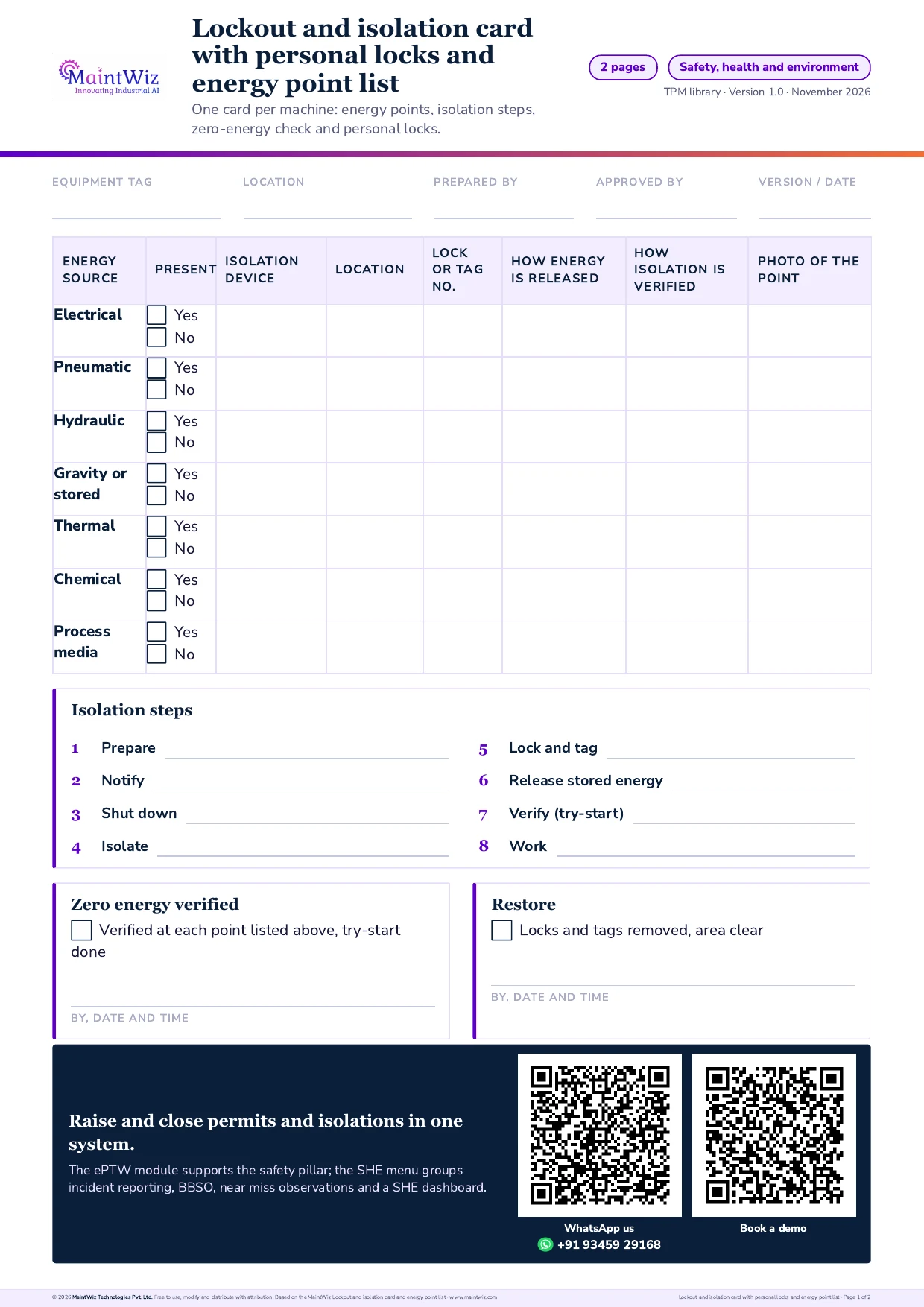
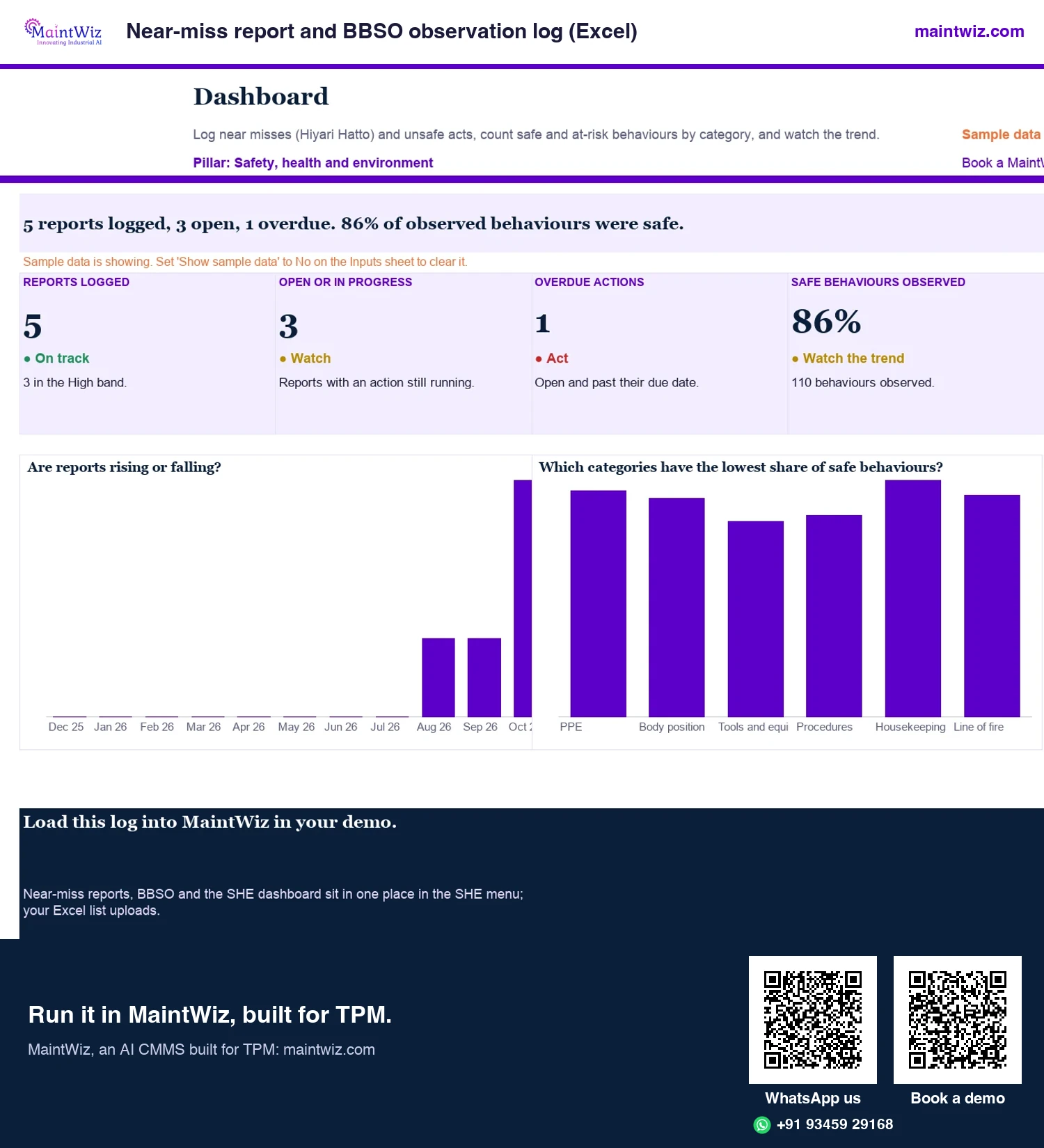
Bring your near-miss log and hazard register to a demo: MaintWiz loads them with Excel upload.
Hazards revealed
Which hazards do TPM activities reveal?
| Activity | Hazards it can reveal | What to record |
|---|---|---|
| Initial cleaning (Jishu Hozen step 1) | Leaks, spills, damaged guards, exposed parts, trip hazards | Tag with location, hazard and owner |
| Contamination and access improvement (step 2) | Places that are unsafe to reach for cleaning, inspection or lubrication | Countermeasure and date |
| Inspection routines (steps 4 and 5) | Wear on safety-critical parts, failed interlocks | Finding, equipment, closure |
| Near-miss reporting | Conditions and behaviours that nearly caused harm | What happened, risk rating, action |
| Behaviour observations | At-risk behaviours and safe behaviours seen | Counts and feedback given |
Hazards found in Jishu Hozen steps 1, 2 and 4
Each one goes on the tag register as a safety fuguai
| Jishu Hozen step | Hazards it reveals | What to do |
|---|---|---|
| Step 1 Initial cleaning | Pinch points, hot surfaces, stored energy: lock out first | Raise a red tag (safety fuguai) |
| Step 2 Contamination sources | Leaks and slip hazards | Raise a red tag (safety fuguai) |
| Step 4 General inspection | Electrical and pressure risks | Raise a red tag (safety fuguai) |
maintwiz.comAI CMMS built for TPMWhatsApp us+91 93459 29168Book a demoWhich measures does SHE track?
- Incidents and near misses reported, and the share closed by the target date.
- Open high-risk actions and how many are overdue.
- Share of observed behaviours that were safe.
- Environmental releases or leaks logged and closed.
A rise in near-miss reports can mean a better reporting culture, not a worse plant: read the trend with the closure rate.
Log each near miss and each BBSO observation in the near-miss and BBSO observation log so that the trend and the closed-on-time share are read from one list.
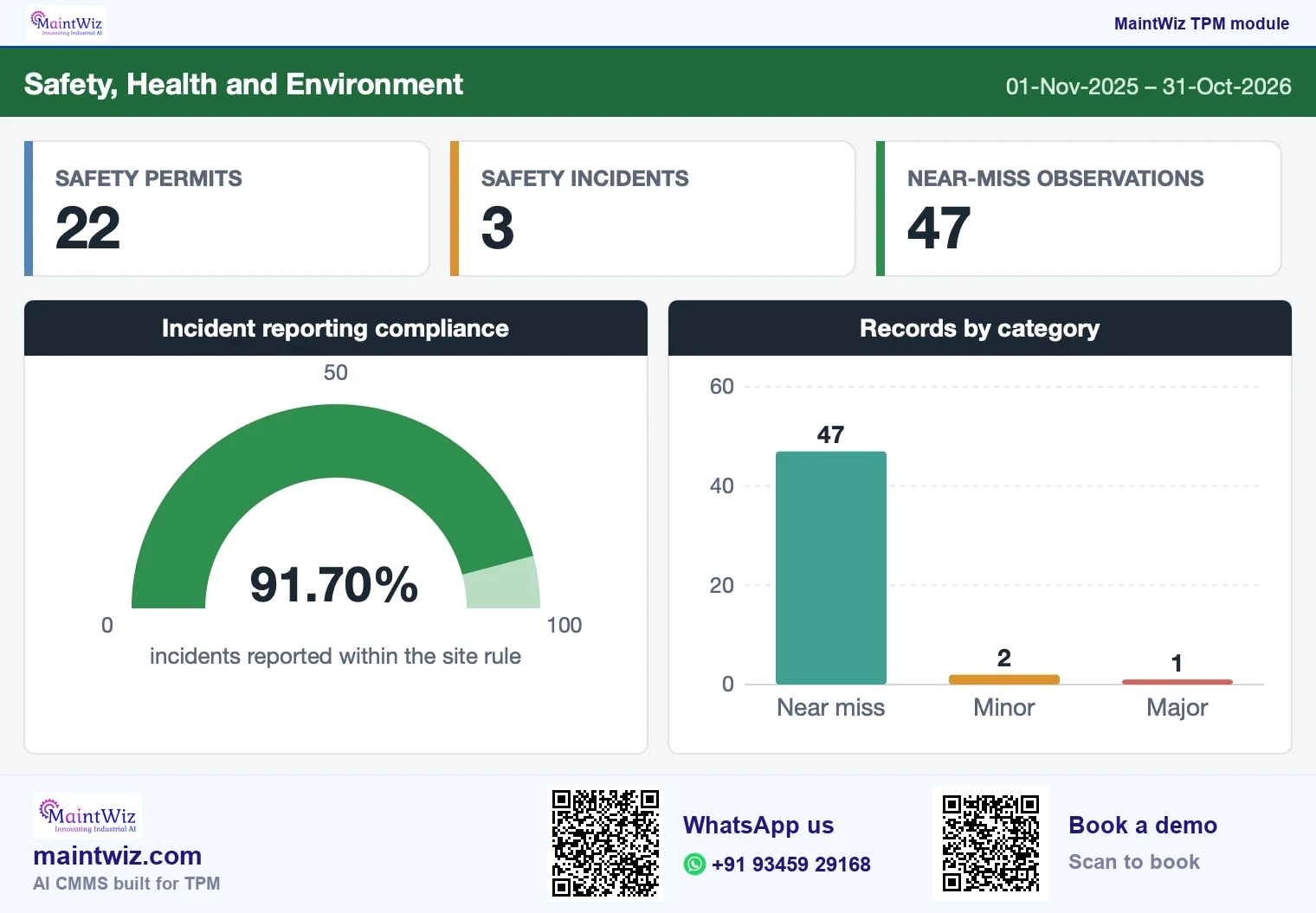
Tags, near misses and BBSO observations give the SHE dashboard its equipment-level evidence.
Roles
Who does what in SHE at the equipment?
| Role | SHE contribution |
|---|---|
| Operator | Reports hazards and near misses; follows the safety rules in the standard; tags unsafe conditions |
| Supervisor | Checks closure of safety actions; gives feedback on observed behaviours |
| Maintenance | Fixes hazards found; keeps guards and interlocks in working order |
| Safety function | Owns the safety management system, risk assessments and permit rules |
| Management | Sets priorities, provides time and removes obstacles |
How tags and one point lessons support safety
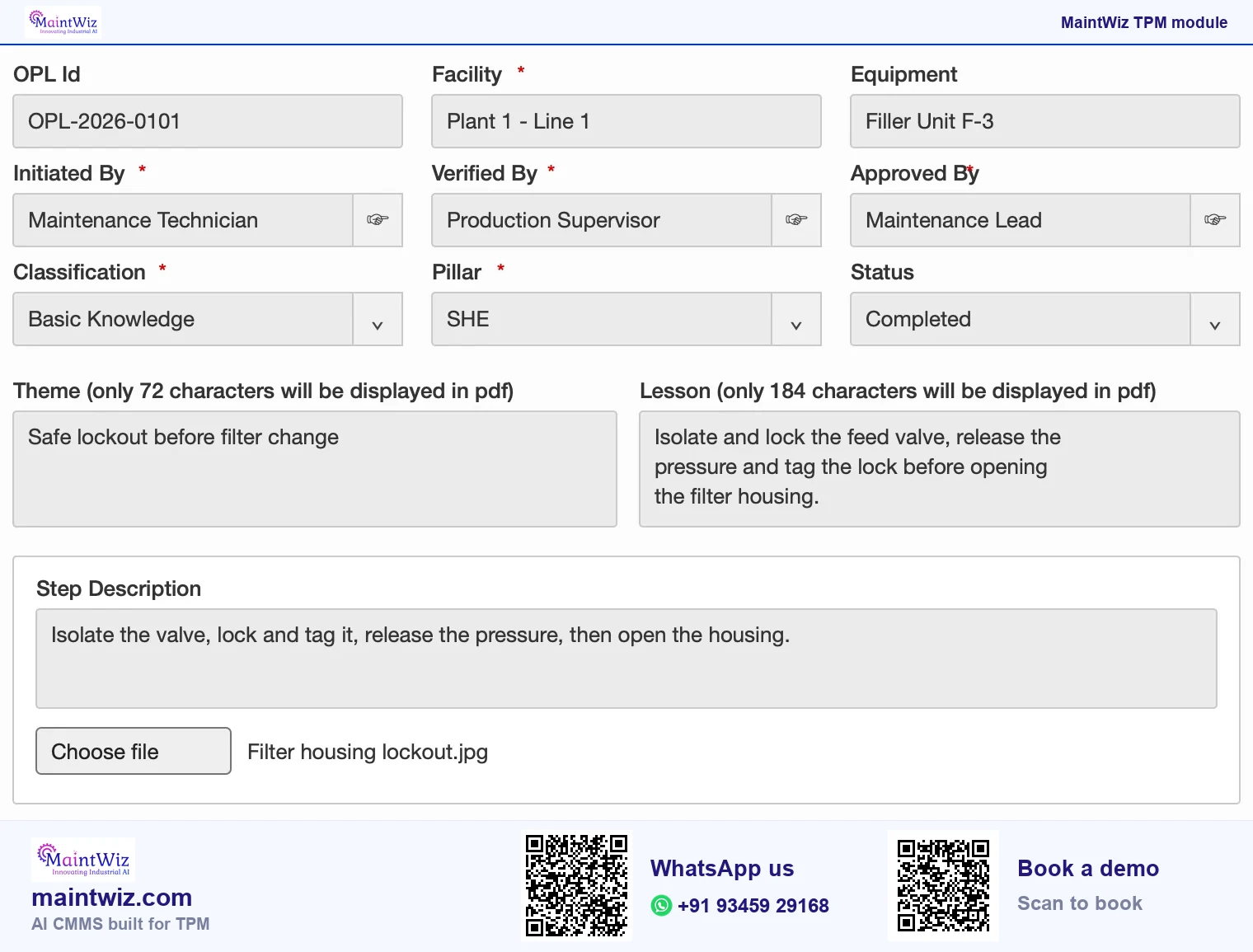
A hazard found while cleaning belongs in the same register as any other abnormality: location, hazard, owner, date and closure. A one point lesson then passes the lesson on, for example why a guard must be refitted before restart. This keeps safety in the routine rather than in a separate campaign.
Hazards in TPM work
Which hazards can cleaning and inspection introduce?
| Activity | Hazards to plan for | Typical controls |
|---|---|---|
| Cleaning and inspection | Moving parts, stored energy, hot surfaces, chemicals, slips | Isolation and lockout where required, guarding, procedures, PPE |
| Lubrication | Reach points near moving parts, spills | Remote lubrication points, procedures, spill control |
| Working at height | Falls | Access platforms, procedures, training |
| Confined or hazardous areas | Atmosphere, entrapment | Permit systems and competent supervision |
| Chemical cleaning | Exposure, reaction | Safety data sheets, PPE, ventilation |
Work that needs a permit runs on the MaintWiz permit to work, through eight statuses from saved and waiting for approval to closed.
For isolation and lockout, the lockout and isolation card and energy point list puts every energy point and its isolation step on one sheet beside the machine.
Safety walks and observations
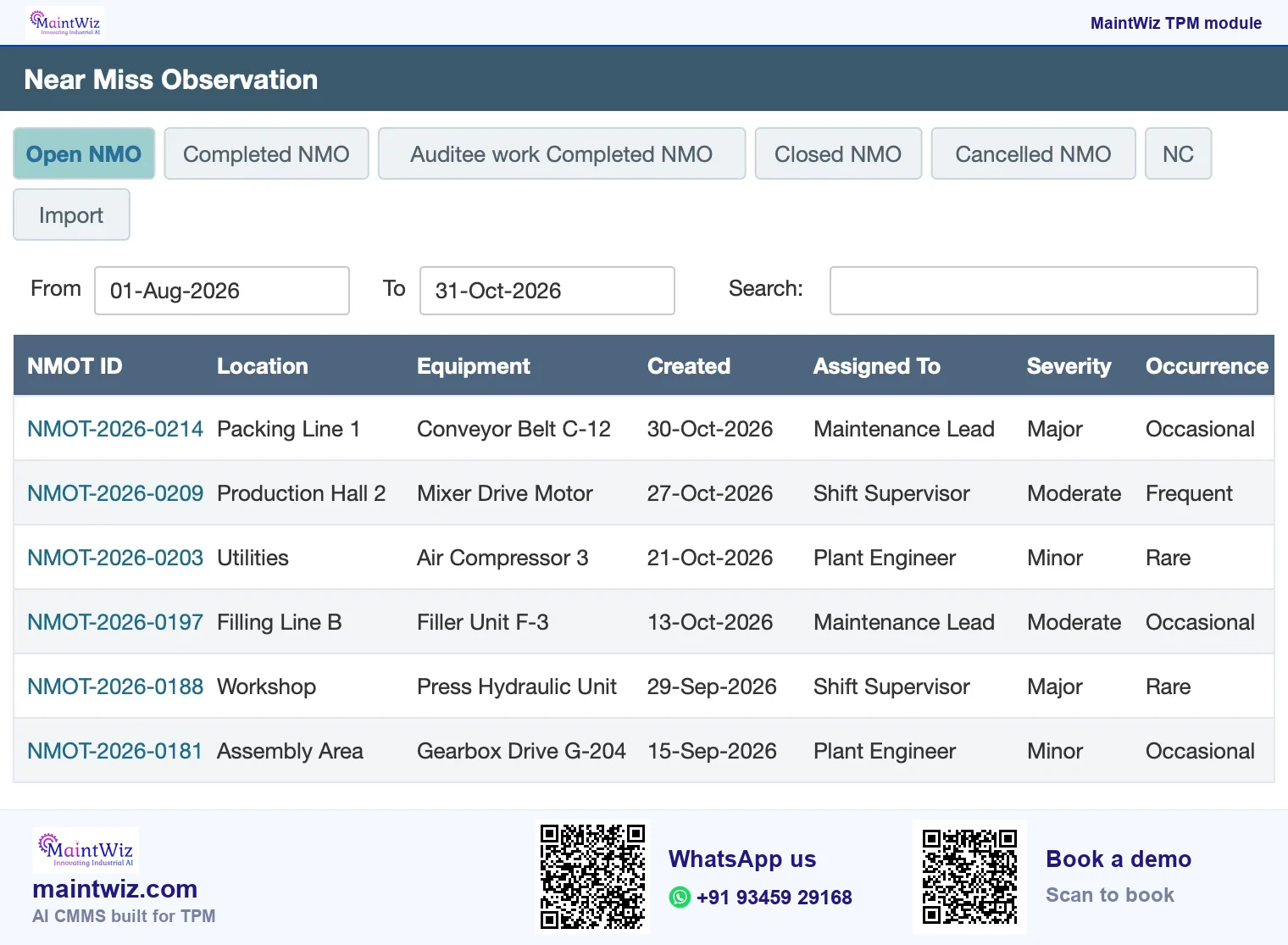
A safety walk is a short, regular walk through an area by a leader and an operator, looking for conditions and behaviours. Behaviour-based observation records what was seen, safe and unsafe, and discusses it with the person observed. The aim is learning, not blame. Observations, near misses and conditions are leading indicators; plants track them beside lagging measures such as incidents. MaintWiz near miss and BBSO software logs each near miss with location, severity potential and occurrence date (Figure 9).
What is KYT hazard prediction?
KYT, Kiken Yochi Training (hazard prediction training), is a four-round team method. Round 1 finds the hidden hazards in a picture or a task. Round 2 marks the key hazards. Round 3 sets the countermeasures. Round 4 agrees the team's action goal. Use the KYT hazard prediction sheet for each task before cleaning, inspection or repair.
Safety measures
What are leading and lagging safety measures?
| Type | Examples | Use |
|---|---|---|
| Leading | Near misses reported and closed, observations made, hazards fixed on time, safety training completed | Show whether prevention work is happening |
| Lagging | Incidents, lost-time injuries, property damage | Show outcomes; too late to prevent |
Contractors and visitors
Contractors work on equipment during shutdowns and maintenance, often unfamiliar with the plant. Include them in induction, permits and hazard briefings, and in the near-miss and observation process. Check that their training records are available to the plant.
Health and environment
How do you manage health and environment under SHE?
Health and environment get the same loss thinking as safety: a health check that lapses, an audit finding left open and a leak that is logged but never closed each cost the plant. In MaintWiz the SHE menu holds health checkup records, a checkup schedule and EHS audits beside the incident reporting form, BBSO, near miss observations and the SHE dashboard.
- Health checkups: health checkup records and a checkup schedule.
- EHS audit: audits recorded in the SHE menu beside health checkups and incidents.
- Environmental releases and leaks found in cleaning and inspection go on the abnormality register with an owner and a target date.
- SHE dashboard: incident reporting compliance and incidents by category, department and body part.
SHE software
What should software for the SHE pillar do?
Software for the SHE pillar captures incidents, near misses and behaviour-based safety (BBSO) observations from the floor and shows them on a dashboard beside the other pillars. In MaintWiz, an AI CMMS built for TPM, the SHE pillar has these parts:
- An incident reporting form.
- BBSO, for behaviour-based safety observations.
- Near miss observations.
- A SHE dashboard with an incident reporting compliance gauge and incidents by category, department and body part.
- Health checkup records, a checkup schedule and EHS audits.
- Hazard tags that convert to work orders, with permits run in MaintWiz ePTW.
- Facility and date filters on the SHE dashboard.
Permits run on MaintWiz electronic permit to work, and incident, BBSO and near-miss reports run on MaintWiz near miss and BBSO software. Book a demo to see the SHE dashboard filtered by facility on your own sites.
FAQ
Frequently asked questions
What is the SHE pillar in TPM?
SHE is the safety, health and environment pillar. It aims at accident-free and pollution-free operation by removing hazards at the equipment level and building safety into standards, training and routines.
What is TPM's role in workplace safety?
TPM finds hazard sources through cleaning and inspection, records them as abnormalities, removes them and builds safety into standards and training, so safety becomes part of the daily routine of the operators who work beside the equipment.
How does Jishu Hozen improve safety?
Cleaning and inspection expose leaks, damaged guards, exposed moving parts and poor access. Tagging them with owners and dates gets them fixed, and step 2 removes places that are hard and unsafe to reach.
What are near misses and why report them?
A near miss is an event that could have caused harm but did not. Reporting and closing them shows hazards before an injury occurs. A rise in reports can mean a healthier reporting culture, so read it with the closure rate.
What is behaviour-based safety observation (BBSO)?
BBSO is a method in which trained observers record safe and at-risk behaviours in the workplace and give feedback. Results are counted as the share of safe behaviours observed and used to guide training and conversation.
Can operators report near misses on a phone in MaintWiz?
Yes. Operators can capture near misses, BBSO observations and incident reports on mobile devices as well as at a terminal. Each record reaches the MaintWiz SHE dashboard, with its compliance gauge and incidents by category, department and body part, for the monthly pillar review.
Is SHE one of the eight pillars of TPM?
Yes. The eight pillars are: autonomous maintenance; focused improvement; planned maintenance; quality maintenance; education and training; safety, health and environment; early equipment management; and office TPM.
What are leading and lagging safety indicators?
Leading indicators, such as near misses reported and hazards closed, show whether prevention work is happening. Lagging indicators, such as incidents and injuries, show outcomes after the fact.
Which hazards can cleaning and inspection introduce?
Moving parts and stored energy, hot surfaces, chemicals, slips and work at height. Plan isolation, guarding, procedures and PPE before the task, and record them on the permit so the controls are checked before work starts.
What is Anzen Eisei Kankyo in TPM?
Anzen Eisei Kankyo is the Japanese name for the safety, health and environment (SHE) pillar of TPM. It works toward accident-free, pollution-free operation. JIPM lists it with education and training as one of the two necessary pillars of TPM.
What should software for the SHE pillar of TPM do?
It should capture incidents, near misses and BBSO observations from the floor and show them on a dashboard. MaintWiz has an incident reporting form, BBSO, near miss observations and a SHE dashboard with an incident reporting compliance gauge and incidents by category, department and body part.
Sources
Sources
- JIPM, About TPM https://www.jipmglobal.com/about/tpm/
- JIPM, About TPM (pillars) https://jipmglobal.com/tpm/about_us_en