
Key takeaways
- Maintenance decides how much energy a plant wastes: air leaks, failed steam traps, misaligned motors, fouled heat exchangers and bad insulation.
- Measure first: set a baseline and read the plant with production stopped to find the waste floor.
- Repairs decay, so leak, trap and insulation checks must repeat on a schedule.
- Meter readings show the energy trend and condition readings explain why it moved.
- An AI CMMS turns each finding into a work order and repeats the surveys; AI proposes and people approve.
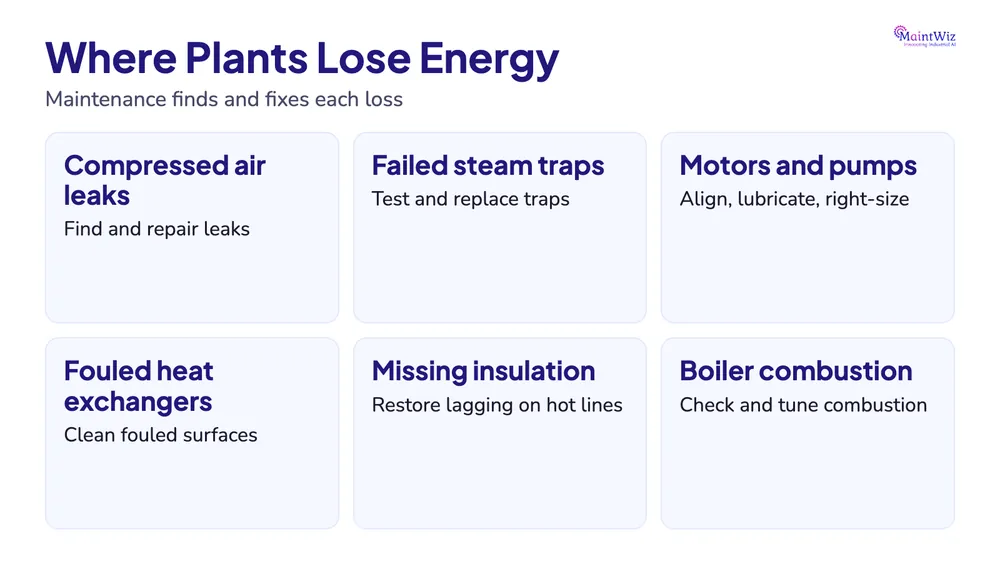
To improve a plant's energy efficiency through maintenance, find the energy that equipment wastes while it runs: compressed air leaks, failed steam traps, misaligned or oversized motors, fouled heat exchangers and bad insulation. Measure each system against a baseline, fix the biggest losses first, and schedule the checks so the waste does not return.
Where does a plant waste energy that maintenance can recover?
Production decides how much energy a plant needs. Maintenance decides how much of it is wasted. A leaking air line, a steam trap stuck open or a motor fighting a misaligned coupling uses energy and makes no product. These losses are quiet: nothing trips, nobody raises a work order, and the bill simply drifts up.
The table below maps each common loss to how it shows up and what the maintenance team does about it.
| Loss | How it shows up | Maintenance action | Check frequency |
|---|---|---|---|
| Compressed air leaks | Compressor loads even when the plant is idle; pressure drops on quiet shifts | Ultrasonic leak survey, tag, repair, re-survey | Quarterly, and after line changes |
| Failed steam traps | Live steam at the trap discharge, or cold, waterlogged lines | Trap survey by sound, temperature or monitor; repair or replace | Per trap criticality, at least yearly |
| Misaligned, worn or oversized motors and drives | High vibration, heat, current above the normal for the load | Alignment, lubrication, bearing checks; right-size or fit a variable speed drive | Condition-based, plus planned PM |
| Fouled heat exchangers, coils and filters | Rising pressure drop, a falling temperature rise on the heated side or a rising approach temperature | Clean at a pressure-drop or approach-temperature limit | Reading-based |
| Damaged or missing insulation | Hot surfaces, wet or torn lagging | Inspect on operator rounds, repair, re-lag | Every round |
| Boiler combustion and heat recovery losses | Stack temperature or excess oxygen drifting above the commissioned value; scale on heat-transfer surfaces | Burner tuning, cleaning of heat-transfer surfaces and economizers, steam leak repair, condensate return checks | Per boiler schedule, with logged readings |
| Equipment running idle | Pumps, fans and lines running with no demand | Shut-down procedure, interlocks, automatic stop | Audit each shift pattern |
How do you find the energy waste?
Start with a baseline, not a survey
A baseline is energy use per system, per line and per unit of output over a normal period; ISO 50001, the energy management standard, uses the same idea of a baseline and performance indicators measured against it. Without it you cannot tell a real saving from a quiet month. Read the main meters, then the sub-meters for compressed air, steam, chilled water and the largest motor loads. Where there is no sub-meter, a portable power logger on a feeder for a week gives a usable number.
Run a no-production test
The cheapest way to find waste is to measure what the plant uses when it makes nothing. On a weekend or shutdown, with production stopped, read the compressor load, boiler steam flow and main feeder power. Whatever is still being consumed is leakage, idle running or standby load. That figure is your waste floor, and every repair should lower it.
Walk the systems with the right instrument
- Compressed air: an ultrasonic leak detector finds leaks in a noisy plant that the ear cannot. Tag each leak with its location and size class, and note the pressure setpoint, since every unnecessary bar of pressure costs more compressor power.
- Steam: test every trap by acoustic, temperature or monitor reading. A trap stuck open loses live steam to the condensate line; a trap stuck closed waterlogs the process.
- Motors, pumps and fans: record current, run hours and vibration. A motor that runs lightly loaded all day, or a valve that throttles a fan or pump, is a candidate for right-sizing or a variable speed drive, because on centrifugal loads power varies roughly with the cube of speed: running a fan or pump 20 percent slower cuts its power by about half.
- Heat transfer: trend the pressure drop and temperature difference across exchangers, filters and coils.
- Insulation: use a thermal camera or surface temperature check on steam, hot oil and chilled lines.
Which maintenance practices cut energy use for good?
Lubrication and alignment matter more than they look. A bearing running dry or a shaft out of line adds friction, and the motor draws more current to deliver the same torque. The fix is a lubrication route done to the right grease type and quantity, and alignment checked after every motor or pump change-out.
Cleaning on a fixed calendar wastes effort, and waiting for failure wastes energy. A better rule is to clean a heat exchanger, strainer or filter when its pressure drop or temperature difference crosses a set limit. That is condition-based maintenance applied to energy, and it needs only a reading and a limit. See what condition monitoring is for how limits and trends are set.
Repairs also decay. Leaks return after line changes, traps fail again, and lagging comes off when valves are serviced. So every fix needs a repeat date: the leak survey, trap survey and insulation round become recurring tasks rather than one-off projects.
How do you measure and track energy performance?
Track a small set of numbers per asset or system, read on a fixed schedule, and compare each against the baseline.
| What to track | How to read it | What it tells you |
|---|---|---|
| Energy per unit of output | Sub-meter kWh or steam flow divided by production | Whether the system is getting better or worse at the same job |
| Weekend or no-load consumption | Meter reading with production stopped | Leakage and idle running |
| Motor current against its normal for the load | Clamp or drive reading, weekly or continuous | Friction, misalignment, fouling or overload |
| Vibration and bearing temperature | Route reading or fixed sensor | Faults that also raise energy use |
| Pressure drop and approach temperature | Gauge or sensor across an exchanger or filter | When to clean |
| Open leaks and failed traps | Count from the last survey | Whether repairs are keeping pace with new faults |
Meter readings give the energy trend; condition readings explain why it moved. Use both. A rise in kWh per unit with a matching rise in motor current points at the machine, not at production. Presenting these trends to leadership is a separate job, covered in how one energy dashboard changed executive thinking about maintenance.
Worked example: turning a weekend reading into a repair list
Illustration only. The numbers are made up to show the method.
- On a no-production Sunday, the maintenance planner reads the compressor: it is still loading for part of every hour while no machine is running.
- An ultrasonic survey finds leaks on drops, couplings and hoses. Each is tagged and listed with its location.
- Each leak becomes a work order with an owner and a due date. Hoses and couplings are quick; a leaking header section is planned for the next stop.
- The next Sunday, the compressor load is read again. If the weekend consumption has fallen, the repairs worked. If it has not, the list is incomplete or the setpoint is too high.
- A quarterly survey task is created so new leaks are caught while they are small.
The same loop works for steam traps and insulation: survey, list, work order, verify against the meter, repeat on a schedule.
Where does a CMMS fit in energy efficiency?
Energy audits fail in the follow-through. The report lists dozens of findings, a few are fixed, and a year later the same leaks are back. A CMMS closes that gap. MaintWiz is an AI-powered CMMS built for TPM, and it supports the work in these ways:
- Every audit finding becomes a work order against the right asset, with an owner and a due date, and the repair history stays with the asset.
- Leak surveys, trap surveys, lubrication routes and insulation rounds run as preventive maintenance schedules, so the checks repeat without anyone remembering to ask.
- Meter reading and condition monitoring schedules are part of planned maintenance, so energy-relevant readings are taken on a set cycle and kept as a trend per asset.
- A work order can be created automatically when a reading breaches its limit, for example a pressure drop across a filter or a motor current that moves out of range.
- MaintWiz integrates with IoT, SCADA, PLC and MES systems, so sensor and meter data can sit beside the maintenance record. See IoT integration, and energy management for monitoring and controlling consumption.
The AI proposes, and people approve: your engineers review the proposed work and decide what to repair and when. Go-live takes 4 to 6 weeks, with guided onboarding by MaintWiz customer success managers and Excel uploads for your asset list.
What should you do first?
Pick one system, usually compressed air or steam, and run the no-production test this month. Record the baseline, survey the system, raise a work order for every finding and set the repeat date. When that loop shows a lower weekend reading, copy it to motors and heat exchangers. Book a demo to see these schedules and limits set up on your own asset list.
FAQs
What is the quickest way to find energy waste in a plant?
Read the main meters and the compressor and boiler loads while production is stopped, such as a weekend. Whatever is still consumed is leakage, idle running or standby load. That no-production figure is the waste floor, and repairs should lower it.
How often should compressed air leaks be surveyed?
Quarterly is a common practice, plus a survey after any line change, since new leaks appear whenever pipework is moved or added. Use an ultrasonic detector, tag each leak, raise a work order and re-check the weekend reading afterward.
How do failed steam traps waste energy?
A trap stuck open passes live steam into the condensate line, so the boiler burns fuel for steam that did no work. A trap stuck closed waterlogs the process. A scheduled trap survey finds both before they run for months.
Do motors and drives really affect energy efficiency?
Yes. Misalignment, poor lubrication and worn bearings raise current for the same output, and oversized or throttled motors waste power at part load. On pumps and fans, a variable speed drive cuts power sharply because power varies roughly with the cube of speed.
How does a CMMS help reduce plant energy use?
It turns each audit finding into a work order with an owner and due date, repeats leak, trap and insulation checks as preventive tasks, schedules meter and condition readings, and can raise a work order when a reading breaches its limit.