Key takeaways
- Lean Maintenance streamlines operations and enhances efficiency in manufacturing industries.
- MaintWiz CMMS offers the tools and features necessary to implement Lean Maintenance practices effectively.
- Data analytics, IoT, and AI play pivotal roles in driving data-driven Lean Maintenance decisions.
- Lean Maintenance aligns with overall operational excellence strategies and contributes to improved OEE and profitability.
- Lean tools such as 5S, Kaizen and value stream mapping work best when results are tracked in a CMMS.
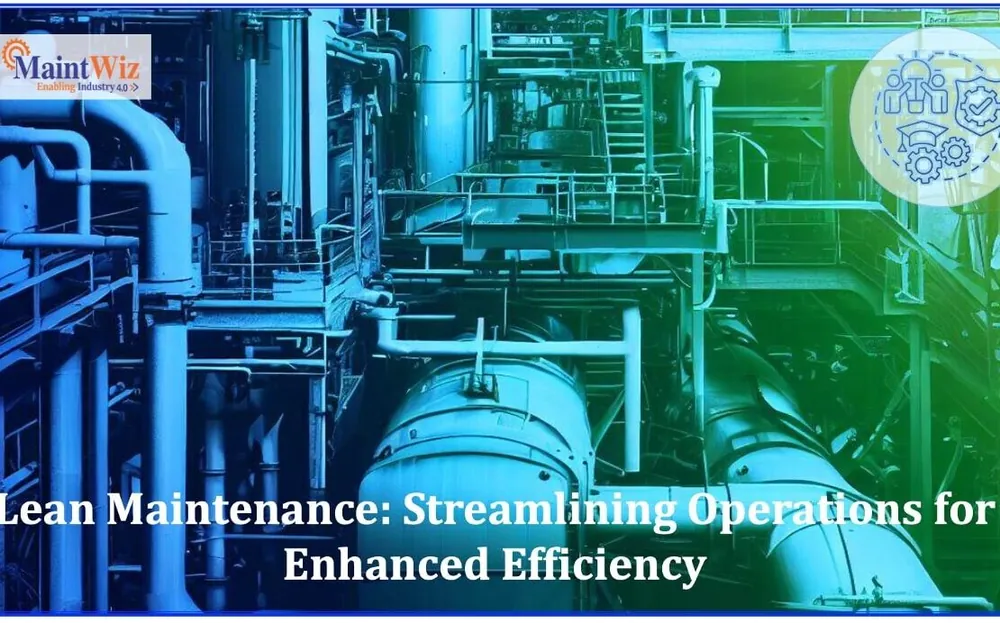
Lean maintenance is the practice of removing waste from maintenance work so that every task protects uptime, quality or safety. It uses tools such as 5S, Kaizen, value stream mapping, standard work and Total Productive Maintenance, and tracks the result through OEE, backlog and mean time to repair.
What Is Lean Maintenance?
Lean Maintenance is a strategic approach that focuses on eliminating waste and optimizing processes to enhance efficiency and productivity. In industries like manufacturing, where downtime and inefficiencies can have a significant impact on profitability, Lean Maintenance plays a crucial role in ensuring smooth operations and reducing costs.
Understanding the Principles of Lean Maintenance
Lean Maintenance is built on core principles such as continuous improvement, waste reduction, and employee empowerment. By identifying and eliminating non-value-added activities, organizations can achieve higher productivity and resource optimization.
Benefits of Implementing Lean Maintenance in Industries
Implementing Lean Maintenance practices results in numerous benefits, including reduced downtime, improved asset reliability, increased equipment lifespan, and enhanced overall equipment effectiveness (OEE). These improvements directly translate into cost savings and higher production output.
Key Pillars of Lean Maintenance
Lean Maintenance usually rests on a few practices: standardization, visual management, continuous improvement, employee involvement, and data-driven decision making. Together they support operational excellence in maintenance operations.
Role of Lean Maintenance in Enhancing Efficiency
Lean Maintenance focuses on streamlining workflows, reducing maintenance backlogs, and fostering a culture of efficiency. By optimizing maintenance activities, organizations can achieve enhanced productivity and competitiveness in the market.
Which Lean Techniques Work in Maintenance?
Lean Management techniques are integral to Lean Maintenance. Let’s explore some of the most effective techniques:
5S Methodology for Organized Workspaces
The 5S methodology (Sort, Set in Order, Shine, Standardize, Sustain) improves organization and cleanliness in workspaces, resulting in reduced downtime and improved safety.
Kaizen for Continuous Improvement
Kaizen, meaning “change for better,” fosters a culture of continuous improvement, encouraging employees to identify and implement small, incremental changes that lead to significant improvements in efficiency.
Value Stream Mapping for Process Optimization
Value Stream Mapping helps identify inefficiencies and bottlenecks in maintenance processes, enabling organizations to optimize workflows and reduce lead times.
Kanban System for Streamlined Material Flow
The Kanban system ensures a smooth flow of materials, parts, and tools, eliminating stockouts and delays, and facilitating just-in-time maintenance.
Total Productive Maintenance (TPM) for Equipment Reliability
TPM aims to maximize the effectiveness of equipment by involving all employees in equipment maintenance, leading to increased asset reliability and reduced maintenance costs.
What Are the Eight Wastes in Maintenance?
Lean describes eight wastes, often remembered as TIMWOODS. Each one has a familiar form in a maintenance department.
| Waste | Example in maintenance |
|---|---|
| Transportation | Technicians walking or driving to a distant store or between plant areas |
| Inventory | Excess spares and a growing backlog of open work orders |
| Motion | Searching for tools, manuals and drawings |
| Waiting | Waiting for permits, parts or a production window |
| Overproduction | PM tasks done more often than the failure pattern needs |
| Over-processing | Inspections and paperwork that add no information |
| Defects | Rework, repeat failures and maintenance-induced failures |
| Skills | Skilled technicians doing clerical or low-value work |
A CMMS makes most of these visible: work order aging shows waiting and backlog, repeat-failure reports show defects, and PM compliance by task shows overproduction.
What Lean Practices Apply to Industrial Asset Management?
Effective implementation of Lean Maintenance practices requires alignment with asset management strategies. Let’s delve into some essential practices:
Implementing Preventive Maintenance Strategies
Preventive maintenance involves scheduled inspections and maintenance tasks to prevent equipment failures, reducing unplanned downtime and repair costs.
Reducing Setup and Changeover Times
Efficient setup and changeover processes lead to reduced idle times and quicker response to changing production requirements.
Optimizing Spare Parts Inventory Management
Lean Maintenance optimizes spare parts inventory, ensuring the availability of critical components while minimizing excess inventory holding costs.
Implementing Autonomous Maintenance
Autonomous Maintenance empowers frontline maintenance teams to take responsibility for equipment care, improving equipment reliability and reducing dependence on central maintenance.
Visual Management and Standardized Work
Visual management tools and standardized work procedures enable easy identification of issues and promote consistency in maintenance activities.
How Does Data Support Lean Maintenance?
Utilizing data and advanced technologies is essential for successful Lean Maintenance implementation. Here are some data-driven approaches:
Leveraging Data Analytics for Maintenance Insights
Data analytics help maintenance teams gain valuable insights into asset health, performance trends, and potential failure patterns, facilitating proactive maintenance.
Real-Time Condition Monitoring of Assets
Real-time condition monitoring allows organizations to detect anomalies and early warning signs, enabling timely interventions to prevent unexpected breakdowns.
Predictive Maintenance for Proactive Interventions
Predictive maintenance utilizes machine learning algorithms to predict equipment failures, allowing maintenance teams to perform interventions before failures occur.
Using IoT Sensors for Performance Monitoring
IoT sensors collect real-time data from equipment, enabling organizations to monitor performance, identify deviations, and optimize maintenance schedules.
AI and Machine Learning in Maintenance Decision Making
AI-driven maintenance decision-making enhances accuracy and efficiency, enabling maintenance teams to make data-backed decisions for asset management.
How Does Lean Maintenance Support Operational Excellence?
Integrating Lean Maintenance with overall operational excellence strategies is vital for maximizing efficiency and achieving business goals. Here’s how it aligns:
Integrating Lean Maintenance with Overall Operations
Lean Maintenance is most effective when it is integrated into the overall business operations, ensuring alignment with production schedules and business objectives.
Key Performance Indicators (KPIs) for Lean Maintenance
Establishing relevant KPIs helps measure the effectiveness of Lean Maintenance efforts, such as OEE, mean time to repair, and maintenance cost per unit produced.
Improving Overall Equipment Effectiveness (OEE)
Lean Maintenance directly contributes to OEE improvement, as it reduces downtime, improves equipment reliability, and optimizes maintenance activities.
Aligning Lean Maintenance with Business Goals
Lean Maintenance initiatives should align with business goals, ensuring that maintenance efforts contribute to overall business success and profitability.
Ensuring Safety and Compliance in Lean Maintenance Practices
Lean Maintenance should not compromise safety standards and compliance requirements. Safety must be a top priority in all maintenance activities.
How Do You Train and Engage the Workforce in Lean Maintenance?
Successfully implementing Lean Maintenance requires a trained and engaged workforce:
Training Employees in Lean Maintenance Principles
Providing comprehensive training on Lean Maintenance principles and techniques equips maintenance teams with the necessary skills and knowledge to implement Lean practices.
Engaging the Workforce in Continuous Improvement
Engaging employees in continuous improvement initiatives fosters a culture of innovation and proactive problem-solving.
Developing a Lean Maintenance Culture
A strong organizational culture that promotes Lean principles and rewards improvement efforts is essential for sustained success.
Recognizing and Rewarding Lean Initiatives
Recognizing and rewarding employees for their contributions to Lean Maintenance encourages greater participation and dedication.
What Challenges Come With Implementing Lean Maintenance?
Organizations may face challenges during Lean Maintenance implementation, such as resistance to change, lack of resources, and data management issues. Addressing these challenges is crucial for successful adoption.
How Does a CMMS Support Lean Maintenance?
Integrating Lean Maintenance practices with CMMS and EAM systems enhances maintenance efficiency:
Utilizing CMMS and EAM Software for Lean Maintenance
MaintWiz CMMS provides a comprehensive platform for managing maintenance activities and streamlining workflows, aligning with Lean principles.
Integrating Lean Maintenance Workflows with CMMS
MaintWiz CMMS records lean maintenance work as work orders, so backlog, repeat failures and PM compliance can be measured and acted on.
Data Management and Reporting in Lean Maintenance
MaintWiz CMMS offers robust data management and reporting capabilities, empowering organizations to derive actionable insights for continuous improvement.
Leveraging Technology for Lean Maintenance Success
By leveraging advanced technologies like IoT, AI, and data analytics, MaintWiz CMMS enhances maintenance decision-making and efficiency.
Future Trends in Lean Maintenance and Technology
As IoT and AI mature, they will feed more condition data into the same work order and KPI workflow.
Which Asset-Intensive Industries Use Lean Maintenance?
Lean Maintenance is applicable to various asset-intensive industries:
Lean Maintenance in Oil and Gas Sector
Implementing Lean Maintenance practices in the oil and gas sector results in optimized equipment reliability and reduced downtime, contributing to enhanced operational efficiency.
Lean Maintenance in Power Generation
Lean Maintenance ensures reliable performance of power generation equipment, leading to improved power plant efficiency and cost-effectiveness.
Lean Maintenance in Transportation and Logistics
Lean Maintenance helps transportation and logistics companies achieve smooth operations, reducing maintenance costs and enhancing customer satisfaction.
Lean Maintenance in Chemical and Petrochemical Industry
Lean Maintenance drives improved equipment reliability and safety in the chemical and petrochemical industry, minimizing unplanned downtime and risks.
Lean Maintenance in Heavy Manufacturing
In heavy manufacturing industries, Lean Maintenance streamlines processes and increases equipment uptime, leading to higher production output and cost savings.
What Is the Future of Lean Maintenance?
Looking ahead, the future of Lean Maintenance is promising:
Evolving Trends in Lean Maintenance Practices
Lean Maintenance will continue to evolve, incorporating new practices and technologies to further optimize maintenance operations.
Industry 4.0 and Lean Maintenance Integration
The integration of Industry 4.0 technologies, such as IoT and AI, will make Lean Maintenance practices more data-driven and predictive.
Sustainable Lean Maintenance Initiatives
Organizations will focus on sustainability, integrating Lean Maintenance practices to reduce environmental impact and promote sustainable operations.
Building Resilience through Lean Maintenance
Lean Maintenance will play a vital role in building organizational resilience, enabling quick adaptation to changing market conditions and challenges.
The Roadmap to Continuous Improvement
Continuous improvement through Lean Maintenance will remain a key strategy for manufacturing industries to achieve enhanced efficiency and competitiveness.
Conclusion
Lean Maintenance is a powerful approach that drives operational excellence and enhanced efficiency in the manufacturing industry. By streamlining operations, leveraging data-driven insights, and integrating Lean principles, organizations can achieve substantial benefits, including increased productivity, reduced downtime, and optimized maintenance costs. MaintWiz CMMS gives maintenance teams the work orders, schedules and KPIs to put Lean Maintenance practices into daily use and measure the results.
Schedule a demo to see how MaintWiz CMMS tracks backlog, PM compliance and repeat failures.
FAQs
What is lean maintenance?
Lean maintenance applies lean principles to maintenance work. It removes activities that do not protect uptime, quality or safety, such as searching for parts, waiting for permits, rework and over-frequent PMs, and uses standard work, 5S and Kaizen to keep the gains.
What are the eight wastes in lean maintenance?
The eight wastes are transportation, inventory, motion, waiting, overproduction, over-processing, defects and unused skills. In maintenance they appear as long walks to stores, excess spares, searching for tools, waiting for permits, rework and technicians doing clerical work.
How is lean maintenance different from Total Productive Maintenance?
Lean maintenance focuses on removing waste from maintenance processes. Total Productive Maintenance is a wider program that involves operators and maintainers in equipment care through pillars such as autonomous and planned maintenance. Many plants use lean tools inside a TPM program.
How do you start lean maintenance in a plant?
Start with one area. Map the current maintenance workflow, list the wastes, apply 5S to the workshop and stores, standardize the most frequent jobs, and track backlog, mean time to repair and OEE. Record work in a CMMS so results are measurable.
Which KPIs show that lean maintenance is working?
Common KPIs are OEE, unplanned downtime, maintenance backlog, mean time to repair, PM compliance and maintenance cost per unit produced. Review them before and after each improvement to confirm the change helped.