Key takeaways
- Energy use per asset is a leading indicator of friction, misalignment and wear.
- Linking energy meters to work orders turns an energy spike into a maintenance action.
- Asset-level energy data lets maintenance justify predictive work in terms executives already track.
- An AI CMMS with IoT and ERP connectivity carries the data from plant floor to boardroom.
An energy dashboard tied to a CMMS shows energy use per asset next to work orders and asset condition, so rising consumption shows up as an early sign of friction, misalignment or wear. Maintenance can then prioritize work by energy risk and show executives the cost of reactive maintenance.
Industrial maintenance rarely gets applause in the boardroom.
It gets questioned.
It gets cost-optimized.
It gets scrutinized.
But it rarely gets celebrated as a strategic growth lever.
Until one day — an energy dashboard changed everything.
When real-time energy intelligence is connected to asset performance, maintenance can be reframed from a “necessary expense” to a profit protection engine.
This article shows how energy-integrated asset management — powered by modern AI-driven CMMS platforms like MaintWiz — is transforming industrial maintenance into a board-level strategic function.
If you’re a plant head, reliability leader, COO, CFO, or sustainability executive, this article will challenge how you view maintenance performance, energy management, and digital transformation.
Why Is Energy a Maintenance KPI?
In most industrial plants, energy is among the largest operating costs. Yet it remains poorly integrated into maintenance decision-making.
The problem isn’t lack of data. It’s lack of correlation.
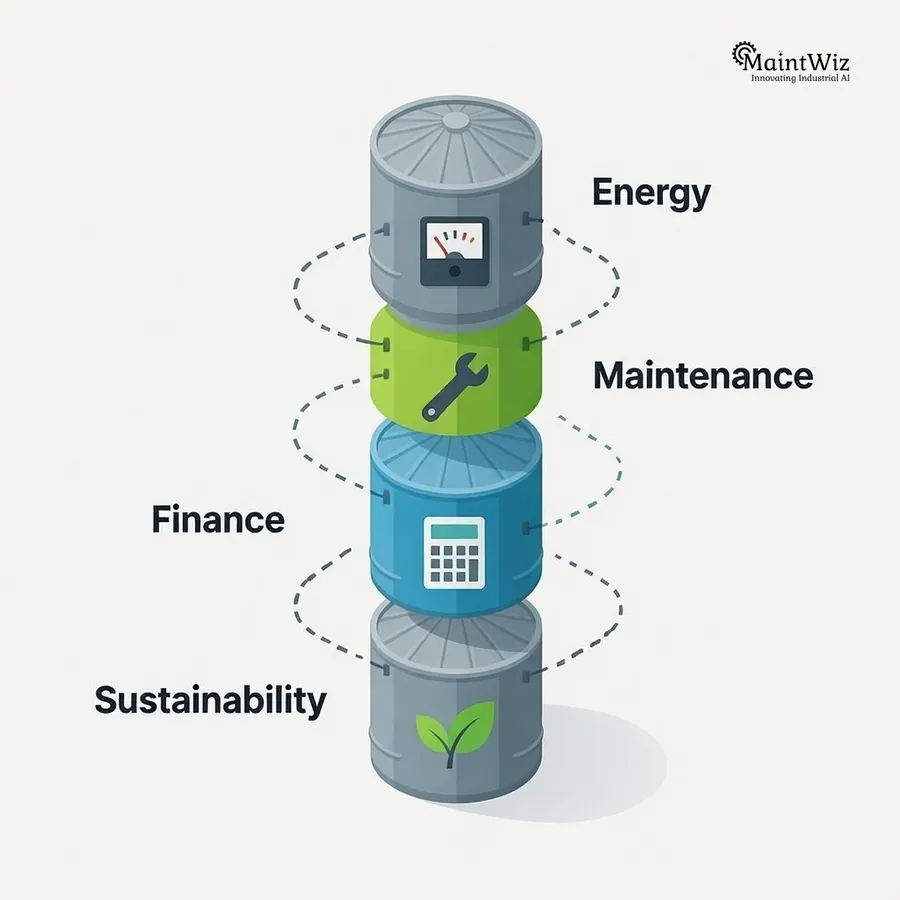
Energy meters record consumption. Maintenance teams manage work orders. Finance tracks costs. Sustainability teams report emissions.
But rarely are these systems unified.
The Energy–Maintenance Disconnect
Here is where organizations lose money:
- Energy as an Overhead Line Item
Energy costs are often aggregated at plant level, not asset level. Without asset-level energy visibility, inefficiencies remain hidden. - Maintenance KPIs Without Energy Correlation
MTBF, MTTR, and OEE are tracked — but not energy intensity per asset. - Reactive Response to Energy Spikes
Energy anomalies are often noticed only after billing cycles, not in real time. - No Predictive Energy Intelligence
Early signs of asset degradation often show up as energy pattern deviations — but go unnoticed.
This is precisely where an integrated energy dashboard becomes transformational.
What Did the Energy Dashboard Show Executives?
Executives respond to clarity.
When a real-time energy dashboard is connected to asset health data inside a CMMS, leadership can see something new:
Energy spikes often line up with maintenance backlog and asset condition.
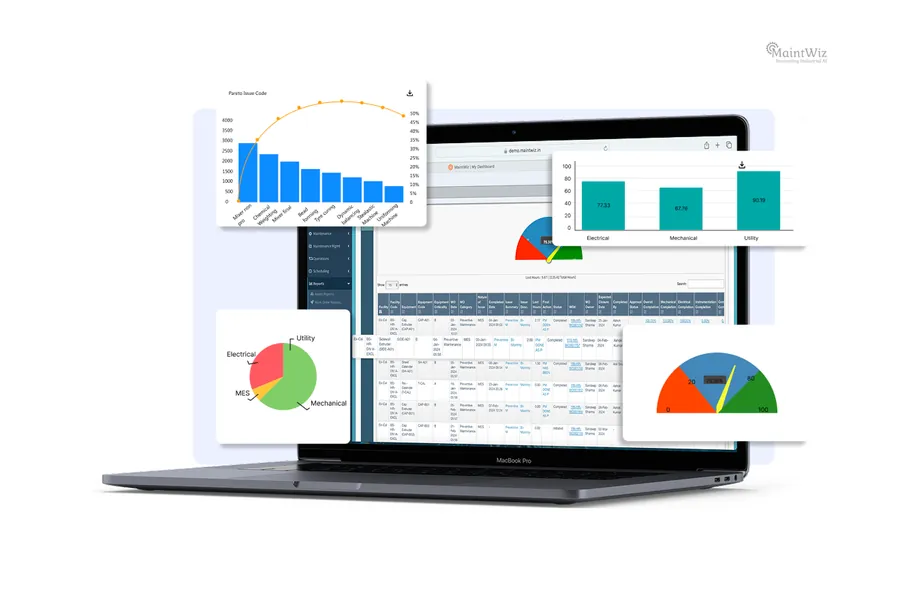
The conversation can shift from “Why is maintenance over budget?” to “Why are we not investing more in predictive maintenance?”
What an asset-level energy dashboard can reveal
- Energy Intensity by Asset
High-consumption assets are often linked to lubrication failures and misalignment. - Shift-Based Energy Variance
Energy use can vary by shift, which points to process discipline gaps. - Compressed Air and HVAC Energy Losses
Hidden leaks and inefficiencies show up quickly. - Predictive Maintenance Gaps
Assets under reactive maintenance tend to show more energy variability.
Energy is a leading indicator, not just a utility expense.
How Does Energy Data Predict Asset Failure?
Energy consumption reflects mechanical truth.
Friction increases? Energy rises.
Misalignment develops? Energy spikes.
Degradation accelerates? Energy pattern shifts.
Modern AI-enabled CMMS platforms can interpret these patterns in real time.
Energy-Driven Asset Performance Strategy
- Energy as a Leading Indicator of Failure
Pattern recognition models detect abnormal consumption before breakdown occurs. - Work Order Prioritization by Energy Risk
Assets showing abnormal energy trends receive higher maintenance priority. - Energy-Based Asset Criticality Index
Energy intensity is integrated into risk scoring frameworks. - Energy-Linked Preventive Maintenance Optimization
PM intervals are adjusted based on energy performance deviations.
This is not theory. This is operational intelligence.
Which energy signals point to which maintenance causes?
| Energy signal | Likely maintenance cause | Typical action |
|---|---|---|
| Motor current rises on a steady load | Friction from lubrication failure or bearing wear | Inspect and lubricate; plan bearing replacement |
| Power spikes with vibration | Misalignment or looseness | Check alignment and mounting |
| Compressor load stays high when production is idle | Compressed air leaks | Run a leak survey and repair |
| More fan or pump power for the same duty | Fouled filters, coils or heat exchangers | Clean or replace |
What Does Energy Integration Add to an AI CMMS?
A CMMS manages maintenance tasks.
An AI CMMS with energy integration also manages performance.
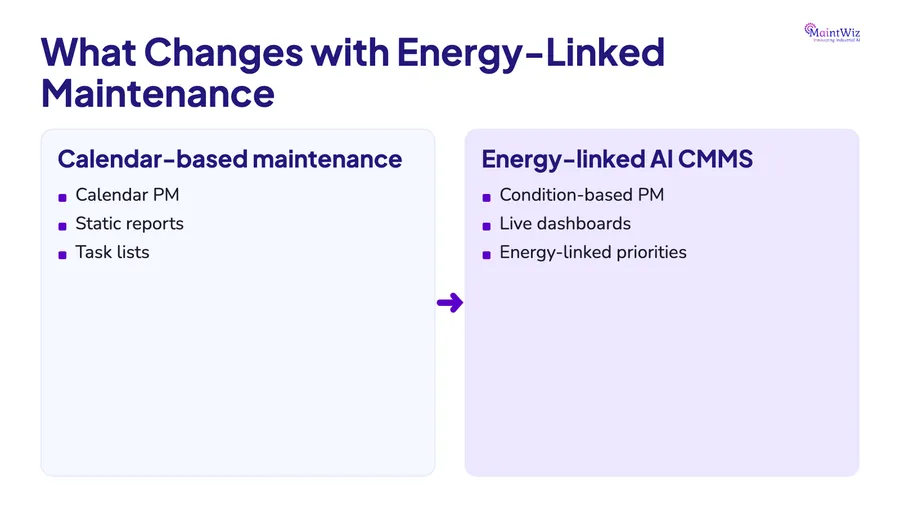
What energy integration adds to a CMMS:
- Data Recording and Data Interpretation
An AI CMMS logs work history and interprets data patterns. - Calendar-Based PM and Condition-Based PM
An AI CMMS runs calendar-based PM and adapts it to asset behavior. - Static Reports and Real-Time Dashboards
It still produces reports, and adds live dashboards. - Siloed Maintenance and Integrated Energy Strategy
An AI CMMS connects IoT energy meters, ERP and asset history.
MaintWiz AI CMMS is architected around this modern paradigm.
What Is the Business Case for Energy-Integrated Maintenance?
Executives think in ROI, EBITDA, and risk mitigation.
Energy-integrated maintenance directly impacts all three.
Quantifiable Impact
- Lower Energy Waste
Real-time anomaly detection reduces unnecessary consumption. - Lower Unplanned Downtime
Energy deviations trigger early interventions. - Extended Asset Life
Reduced stress on equipment lowers lifecycle costs. - Improved ESG Performance
Energy optimization reduces carbon footprint. - Higher Maintenance Productivity
Intelligent prioritization reduces firefighting.
When energy dashboards connect to maintenance workflows, the CFO sees measurable results.
How Does an Energy-Integrated CMMS Work?
Behind the dashboard lies an integrated ecosystem:
IoT + AI + CMMS + ERP + Cloud Analytics.
MaintWiz AI CMMS serves as the orchestration layer.
Integrated Digital Architecture
- IoT Energy Meter Integration
Real-time power data captured at asset level. - AI Analytics Engine
Machine learning models identify anomalies and degradation patterns. - Predictive Maintenance Module
Automated alerts generate work orders. - ERP Integration
Energy savings mapped to financial impact. - Mobile Maintenance Execution
Technicians receive prioritized tasks instantly.
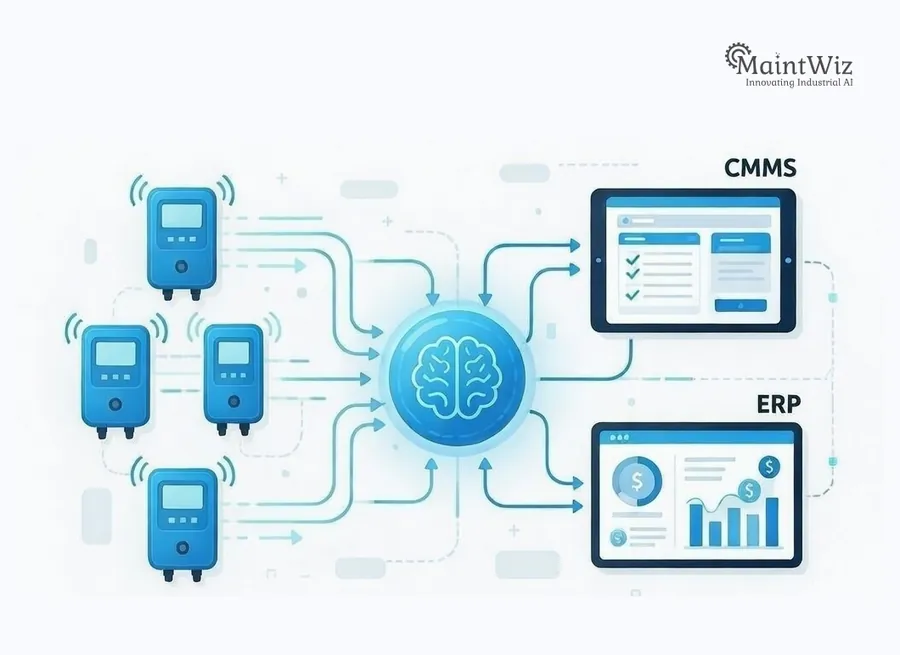
This digital thread connects plant floor to boardroom.
How Does Energy Visibility Change Maintenance Culture?
An energy dashboard changes more than metrics.
It changes mindset.
Organizational Transformation
- Maintenance in Executive Reviews
Energy dashboards can become standard board slides. - Budget Justification via Energy ROI
Predictive investments supported by measurable savings. - Cross-Functional Alignment
Operations, maintenance, and sustainability collaborated. - Data-Driven Decision Culture
Data-backed insight replaces gut feeling.
Energy visibility elevated maintenance credibility.
Why Choose MaintWiz AI CMMS for Energy-Integrated Maintenance?
MaintWiz is an AI-driven CMMS built for TPM, with an Enterprise Asset Management platform purpose-built for industrial energy-integrated maintenance.
Core Differentiators of MaintWiz AI CMMS
- AI-Powered Predictive Maintenance
Advanced machine learning algorithms detect anomalies early. - Integrated Energy Management Module
Asset-level energy monitoring built into maintenance workflows. - Real-Time Executive Dashboards
Decision-ready visual intelligence. - IoT and ERP Connectivity
Seamless integration across IT/OT stack. - Mobile-First Maintenance Execution
Field teams receive prioritized tasks instantly. - Asset Lifecycle Cost Management
Energy consumption included in lifecycle analysis. - Multi-Site Benchmarking Capability
Compare energy and maintenance performance across plants. - Scalable Enterprise Architecture
Suitable for manufacturing, pharma, utilities, heavy engineering.
MaintWiz brings together reliability engineering, AI analytics, and energy management into a unified platform.
When executives see MaintWiz dashboards, they see:
- Risk mitigation
- Energy efficiency
- Sustainability alignment
- Financial impact
- Competitive advantage
That is why the narrative changes.
Can Your CMMS Link Energy Use to Maintenance?
Ask yourself:
- Can you see real-time energy usage per asset?
- Are energy anomalies automatically triggering maintenance actions?
- Does your CMMS integrate energy data with predictive analytics?
- Can your dashboard influence CFO-level decisions?
- Is sustainability embedded in maintenance operations?
If the answer is no, your organization is likely leaving money — and strategic advantage — on the table.
Final Thought: One Dashboard. One Strategic Shift.
Maintenance will always be essential.
But in a world of rising energy costs, sustainability pressures, and competitive margins, it must become strategic.
Energy is no longer just a utility expense.
It is a diagnostic signal.
A financial lever.
A sustainability driver.
A boardroom conversation starter.
And sometimes, all it takes is one intelligent dashboard to make executives see what they were missing all along.
MaintWiz AI CMMS is designed to power that transformation.
FAQs
Why does energy use matter for maintenance?
Energy use reflects mechanical condition. Friction, misalignment and wear make equipment draw more power for the same output, so a rise in consumption is often an early sign of a developing fault that maintenance can fix before it fails.
Can a CMMS use energy data to predict equipment failure?
Yes, when energy meters or IoT sensors feed the CMMS. The AI analytics compare each asset's consumption with its normal pattern, and a deviation can raise an alert and a work order for that asset.
What data does an energy-integrated maintenance dashboard need?
It needs asset-level energy readings, work order and asset condition history, production data and cost data from ERP. Placing them in one view lets teams link energy spikes to backlog, shifts and equipment health.
Which energy losses can maintenance teams find?
Teams commonly find lubrication and misalignment problems, compressed air leaks, HVAC losses and assets running under reactive maintenance with unstable consumption. Shift-by-shift comparison also shows process discipline gaps.
Who uses an energy-integrated maintenance dashboard?
Plant heads, reliability leaders, COOs, CFOs and sustainability teams use it to see energy cost and risk by asset. Maintenance planners use the same data to prioritize work orders and justify predictive maintenance.