
Key takeaways
- High PM compliance does not equal reliability: a poorly designed checklist can be completed on time and still miss the failures that matter.
- Tie every checklist task to a failure mode and rank assets by criticality so effort goes where the risk is.
- Add measurable readings, such as torque and vibration thresholds, to "visual inspection" tasks.
- Capture readings digitally in the CMMS so trends show early and threshold breaches raise corrective work orders automatically.
- Review the checklist after every significant breakdown and standardize it across sites.
A risk-based preventive maintenance checklist ties every task to an asset's criticality and failure modes, so inspections catch the failures that matter. In the account below, one added gearbox task, secondary torque validation with micro-vibration trending, flagged abnormal oscillation three weeks before failure and avoided what the account puts at a $1.2 million loss.
What preventive maintenance task saved a factory $1.2M?
One overlooked line item in a preventive maintenance checklist prevented a catastrophic gearbox failure — saving $1.2 million in downtime, scrap, and emergency repair costs.
That’s not luck. That’s disciplined, risk-based preventive maintenance.
In industrial plant maintenance and asset management, most failures are not “unexpected.” They are uninspected, unmeasured, or unchecked. This article unpacks the preventive maintenance checklist strategy that drives measurable financial outcomes — and how modern CMMS platforms like MaintWiz CMMS operationalize it at scale.
Why do most preventive maintenance checklists fail?
Overview: Many organizations believe they have a preventive maintenance checklist. In reality, they have a static task list disconnected from failure risk, asset criticality, and condition data.
- Activity-Based Preventive Maintenance Checklist: Tasks are created based on OEM manuals without contextual adaptation. These checklists rarely reflect real operating stress.
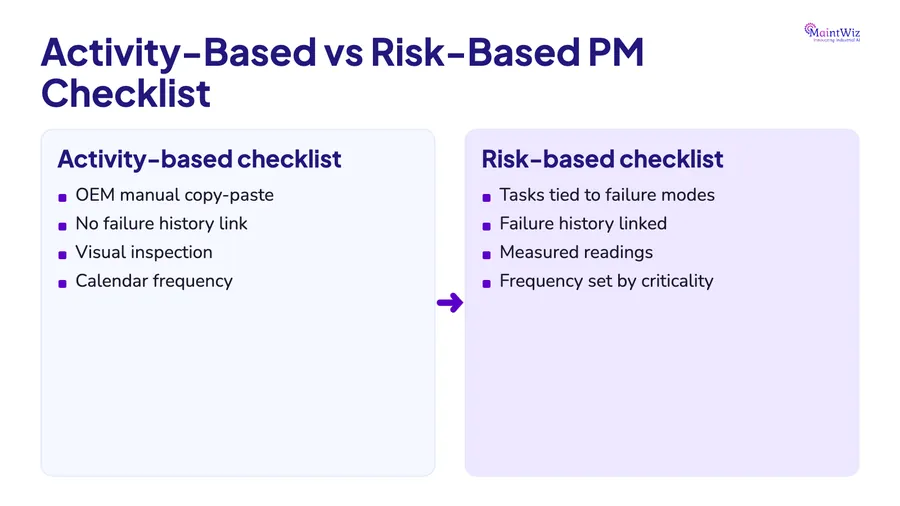
- No Failure Mode Linkage in Preventive Maintenance Checklist: Most PM checklists don’t map tasks to failure modes (FMEA). Without this, teams over-maintain low-risk items and under-protect critical assets.
- Zero Risk Prioritization in Preventive Maintenance Checklist: Every asset is treated equally. In reality, not every pump or motor carries the same financial impact.
- Checklist Completion ≠ Reliability: 100% PM compliance does not guarantee reduced breakdowns if tasks are poorly designed.
The result? Plants experience unplanned downtime despite “high compliance” preventive maintenance checklists.
Which checklist task prevented the gearbox failure?
Overview: The million-dollar saving came from one addition to a preventive maintenance checklist: secondary torque validation and micro-vibration trend capture on critical gearbox fasteners.
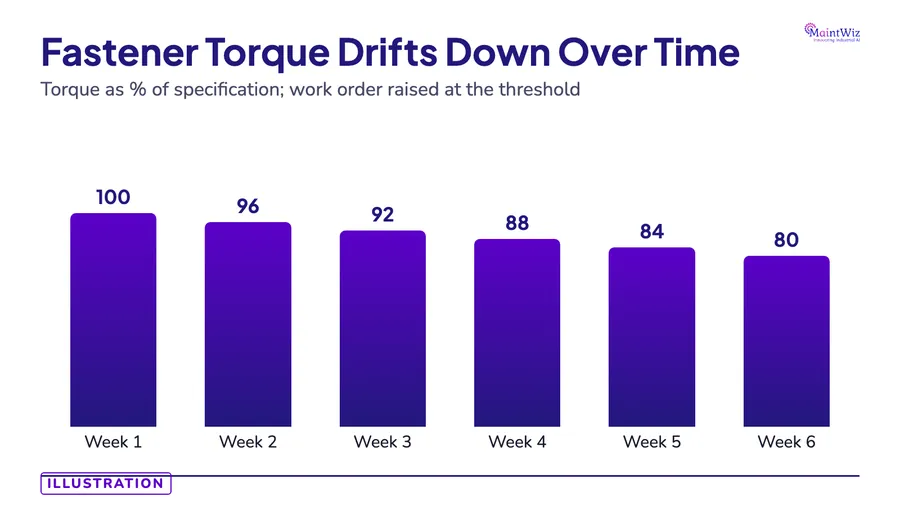
- Torque Drift Monitoring in Preventive Maintenance Checklist: Over time, fasteners loosen under cyclic loading. Traditional PM checklists specify “visual inspection,” which does not detect micro-loosening.
- Micro-Vibration Capture in Preventive Maintenance Checklist: Adding a simple vibration threshold reading identified abnormal oscillation 3 weeks before catastrophic failure.
- Data Logging Within CMMS: The checklist was not paper-based. Readings were captured digitally and trended inside the CMMS.
- Escalation Trigger Integration: Threshold breach automatically generated a corrective work order.
Without that enhanced preventive maintenance checklist task, the gearbox would have failed during peak production, halting operations for 72 hours.
How do you build a risk-based preventive maintenance checklist?
Overview: A high-performance preventive maintenance checklist is not static. It is risk-weighted, condition-informed, and continuously improved.
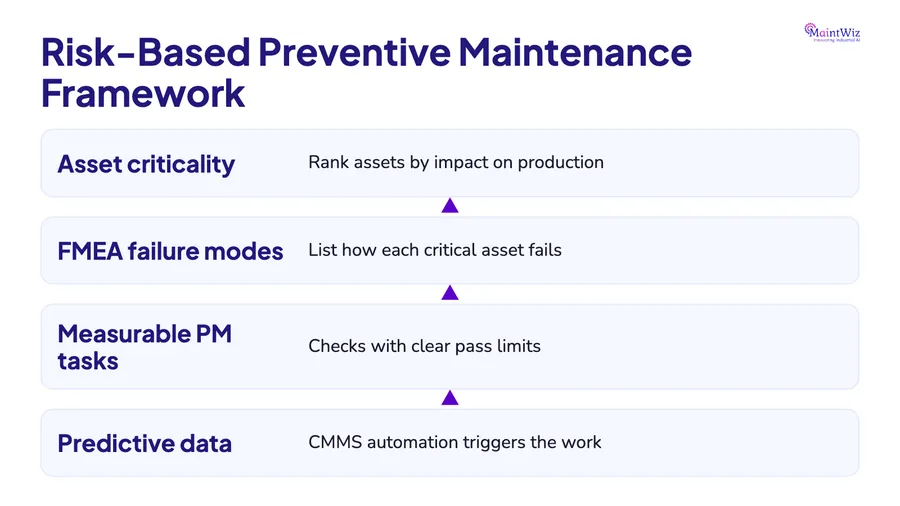
- Asset Criticality Mapping in Preventive Maintenance Checklist
- Financial Impact Assessment: Evaluate production loss per hour.
- Safety Risk Integration: Identify assets affecting personnel safety.
- Environmental Risk Mapping: Factor compliance exposure.
- Failure Mode-Based Preventive Maintenance Checklist
- FMEA Alignment: Every checklist task must mitigate a specific failure mode.
- Eliminate Redundant Tasks: Remove low-value “ritual” inspections.
- Add Predictive Indicators: Incorporate measurable parameters.
- Condition-Integrated Preventive Maintenance Checklist
- Vibration Data Capture: Include thresholds and trend logging.
- Thermal Imaging Checkpoints: Add heat deviation checks.
- Lubrication Contamination Metrics: Move beyond “top up oil.”
What does a good risk-based checklist task look like?
Write each task as an action, a measurement and a standard, so the technician records a value instead of ticking a box.
| Weak task | Risk-based task |
|---|---|
| Inspect gearbox | Check fastener torque against specification and record the value |
| Check oil | Sample gearbox oil, record contamination level and compare with the limit |
| Listen for noise | Take a vibration reading at the bearing point and escalate above threshold |
Preventive vs predictive maintenance: do you have to choose?
Overview: The debate is not preventive versus predictive. The winning strategy integrates both into a unified maintenance strategy.
- Preventive Maintenance Checklist Provides Structure: Scheduled inspections reduce random variability.
- Predictive Maintenance Enhances Intelligence: Real-time monitoring optimizes intervention timing.
- CMMS Integration Creates Closed Loop: Data feeds checklist redesign.
Organizations using integrated preventive maintenance checklists with predictive data report 20–40% reduction in breakdown frequency.
Why digitize the preventive maintenance checklist?
Overview: Paper checklists cannot deliver reliability insights. Digital preventive maintenance checklist systems unlock measurable ROI.
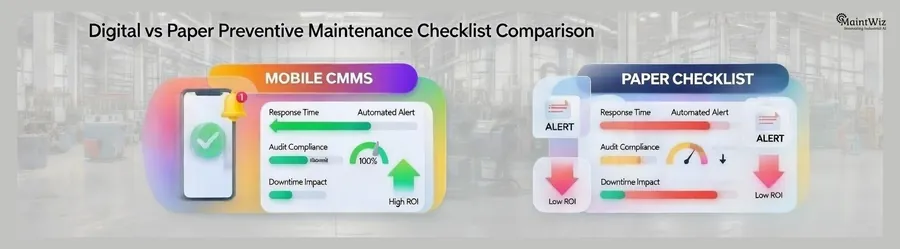
- Mobile Preventive Maintenance Checklist Execution: Technicians capture real-time data via handheld devices.
- Automated Work Order Escalation: Threshold breaches auto-generate corrective tasks.
- Audit Trails for Preventive Maintenance Checklist Compliance: Ensures accountability and regulatory compliance.
- Analytics Dashboard Integration: Leadership views checklist effectiveness.
Explore how Preventive Maintenance Software enables structured, measurable preventive maintenance checklists.
What is the financial impact of an optimized checklist?
Overview: Preventive maintenance checklist optimization is a financial lever — not just a maintenance tool.
- Downtime Cost Avoidance: Each avoided hour of downtime multiplies ROI.
- Extended Asset Life: Proper torque and lubrication checks reduce capital expenditure.
- Inventory Optimization: Data-driven PM reduces emergency spare consumption.
- Energy Efficiency Gains: Well-maintained rotating assets consume less power.
Discover structured asset lifecycle management within Asset Management Software.
Which design principles keep a checklist effective?
Overview: Reliable plants continuously refine preventive maintenance checklists using data feedback loops.
- Checklist Time Optimization: Reduce task fatigue by eliminating low-value steps.
- Failure Back-Analysis: Every significant breakdown should trigger a checklist review.
- Technician Feedback Loop: Field insights improve task clarity.
- Standardization Across Sites: Multi-plant enterprises need uniform preventive maintenance checklists.
Modern CMMS Software platforms enable scalable standardization.
Can a plant with 95% PM compliance still suffer failures?
Overview: A manufacturing plant operating at 95% PM compliance still faced repeated bearing failures. The issue was not compliance — it was checklist design.
- No Contamination Checks in Preventive Maintenance Checklist: Lubrication contamination went undetected.
- No Escalation Workflow: Abnormal noise observations were logged but not actioned.
- No Data Trending: Paper checklists prevented early warning detection.
After digitalizing preventive maintenance checklist workflows and integrating Work Order Management Software, breakdown frequency dropped by 32% within one year.
How does MaintWiz CMMS support the preventive maintenance checklist?
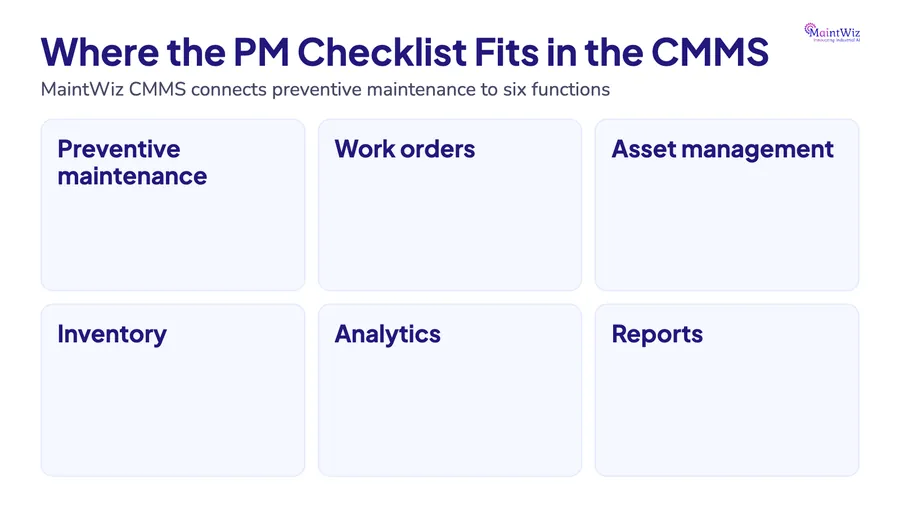
Overview: MaintWiz CMMS turns preventive maintenance checklists from static documents into scheduled, measured, trended work.
- Risk-Based PM Scheduling: Align preventive maintenance checklist frequency with asset criticality.
- Digital Data Capture: Mobile-enabled checklist execution.
- Integrated Condition Monitoring: Trend-based task triggers.
- Spare Parts Planning: Integrated Inventory Management Software prevents stockouts.
- Multi-Plant Scalability: Enterprise-level standardization.
- Analytics & KPI Dashboards: Visibility into preventive maintenance checklist effectiveness.
Explore industry applications in Industry 4.0 capabilities and SAP CMMS integration for plant maintenance.
The lasting gain comes from a checklist built on data, risk ranking and digital execution, not from one task. Static PM templates leave failure risk unchecked.
Turn your preventive maintenance checklist into a risk-based, data-driven routine with MaintWiz CMMS.
FAQs
What should a preventive maintenance checklist include?
Asset and task identification, the action, a measurable standard or limit, the tools and parts needed, safety steps, space to record readings, and an escalation rule that raises a work order when a limit is breached.
How do you make a preventive maintenance checklist risk-based?
Rank assets by criticality, map each to its failure modes with FMEA, then set tasks and frequencies to mitigate those modes. Spend the most effort on assets whose failure costs most in safety, production or compliance.
Is 100% PM compliance enough to prevent breakdowns?
No. Compliance only shows tasks were done on time. If tasks do not target real failure modes, breakdowns continue. Measure breakdown frequency, repeat failures and unplanned downtime alongside compliance to see whether the checklist really protects the plant.
How often should you review a PM checklist?
After every significant breakdown and on a regular cycle. Each failure shows whether a task was missing, too infrequent or too vague, and the checklist should be changed accordingly, with the change recorded and shared with every site.
Can a CMMS automate checklist escalation?
Yes. A CMMS can record readings on mobile devices, trend them, and generate a corrective work order automatically when a threshold is breached, as in the gearbox account above. Escalation no longer depends on someone remembering to report a reading.