Key takeaways
- Equipment breakdowns can have significant consequences, including production delays, safety risks, and increased costs.
- Root cause analysis helps identify underlying reasons for breakdowns, enabling targeted preventive measures.
- Preventive techniques, such as regular maintenance, operator training, and environmental monitoring, reduce breakdown risks.
- MaintWiz CMMS offers advanced technology, such as condition monitoring and predictive maintenance, to identify and prevent breakdowns.
- Root cause analysis and preventive techniques work best when applied together.
- Challenges in preventing breakdowns include resource constraints, resistance to change, and data analysis complexities.
- Documentation, knowledge sharing, and continuous improvement are critical for preventing breakdowns.
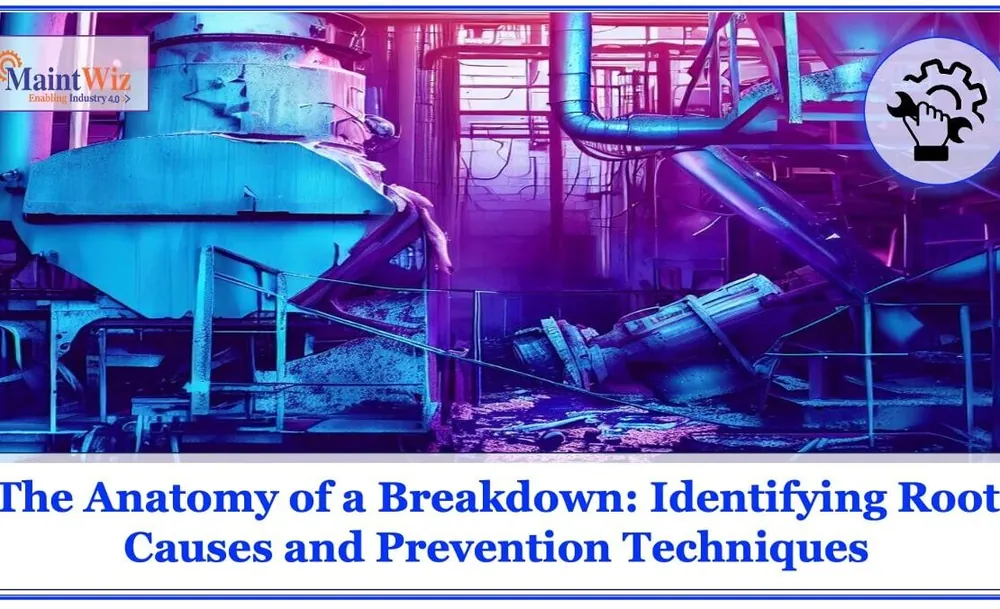
An equipment breakdown is an unplanned failure that stops or degrades a machine. Common causes are missed maintenance or inspection, wear, improper operation, environmental conditions or defective components. Root cause analysis using 5 Whys, fishbone diagrams, fault tree analysis or FMEA finds the cause, so the fix prevents a repeat.
What is an equipment breakdown?
Equipment breakdowns refer to the unexpected failures of machinery or assets that disrupt normal operations. These breakdowns can occur in various industries and have significant consequences, including production delays, safety risks, and increased maintenance costs. It is crucial to understand the root causes of equipment breakdowns to effectively prevent them and minimize their impact.
What are the root causes of equipment breakdowns?
Equipment breakdowns can result from various factors, including:
- Lack of maintenance and inspection: Inadequate maintenance practices can lead to equipment deterioration and failures.
- Wear and tear over time: Continuous usage and aging can cause components to degrade and eventually fail.
- Improper operation or use: Human error or incorrect handling of equipment can contribute to breakdowns.
- Environmental factors: External conditions such as temperature, humidity, and contamination can impact equipment performance.
- Component failure or malfunction: Defective parts or components can lead to equipment breakdowns.
Why is root cause analysis important?
Root cause analysis (RCA) is a systematic approach to identify the underlying reasons for equipment failures. By understanding the root causes, you can implement targeted preventive measures to eliminate or mitigate the risks. RCA helps in:
- Identifying the primary reasons behind breakdowns
- Reducing the likelihood of future breakdowns
- Improving overall maintenance practices
Which techniques identify the root cause of a breakdown?
Several techniques can be employed to identify the root causes of equipment breakdowns:
- Failure mode and effects analysis (FMEA): Systematic examination of potential failure modes and their consequences.
- Fault tree analysis (FTA): Analyzing the logical relationship between potential causes and equipment failures.
- Fishbone diagram (Ishikawa diagram): Visual representation of various factors contributing to a problem.
- 5 Whys technique: Iteratively asking “why” to uncover the underlying causes of a problem.
- Pareto analysis: Prioritizing the most significant root causes based on their frequency or impact.
How do you choose between RCA techniques?
Match the technique to the failure.
| Technique | Best for |
|---|---|
| 5 Whys | A single failure with a linear chain of causes, such as a seized bearing |
| Fishbone diagram | Failures with several possible contributing factors |
| Fault tree analysis | Complex or safety-critical systems with redundancy and interlocks |
| FMEA | Finding failure modes before they occur, as part of the maintenance strategy |
| Pareto analysis | Ranking repeat failures so effort goes to the biggest losses |
What does a 5 Whys chain look like?
Illustration: a pump bearing seized. Why? It overheated. Why? It ran short of grease. Why? The grease point was missed on the lubrication route. Why? The point was not on the preventive maintenance task list. Why? The list was not updated after the pump was modified. The fix is a task-list review after every modification, not just a new bearing.
How do you prevent equipment breakdowns?
Implementing preventive techniques can significantly reduce the likelihood of equipment breakdowns. Some effective preventive measures include:
- Establishing regular maintenance and inspection schedules to identify and address potential issues proactively.
- Implementing appropriate lubrication and cleaning procedures to maintain optimal equipment performance.
- Conducting calibration and alignment processes to ensure accurate equipment operation.
- Providing operator training and education to minimize human errors and optimize equipment usage.
- Monitoring and controlling environmental factors to prevent degradation and equipment damage.
How does technology help identify and prevent breakdowns?
Modern technology plays a vital role in identifying and preventing equipment breakdowns. MaintWiz CMMS offers the following features:
- Condition monitoring systems: Real-time monitoring of equipment health and performance to detect early warning signs of potential breakdowns.
- Real-time data analytics: Analyzing equipment data to identify patterns, anomalies, and predictive insights for proactive maintenance.
- Predictive maintenance tools: Utilizing advanced algorithms to predict equipment failures and schedule maintenance activities accordingly.
- Internet of Things (IoT) sensors: Connecting equipment and assets to collect real-time data, enabling predictive and preventive maintenance.
- Computerized Maintenance Management Systems (CMMS): Streamlining maintenance processes, work order management, and asset tracking for efficient preventive maintenance.
What do root cause analysis examples show?
The scenarios below are illustrative, not named customer results. They show how root cause analysis and preventive techniques are applied:
Manufacturing facility
In a large manufacturing facility, regular root cause analysis helped identify a recurring issue with a critical machine. By implementing preventive measures recommended by the RCA, including equipment maintenance, training programs, and improved documentation, the company significantly reduced equipment breakdowns, resulting in increased productivity and cost savings.
Power plant
A power plant conducted root cause analysis on a turbine failure and identified a maintenance oversight as the primary cause. The plant implemented a preventive maintenance strategy, including enhanced inspection procedures and improved maintenance schedules. This resulted in improved turbine reliability and reduced downtime, ensuring consistent power generation.
Logistics fleet
A logistics company experienced frequent breakdowns in their fleet due to improper vehicle maintenance practices. By implementing a comprehensive preventive maintenance program, including regular inspections, scheduled maintenance, and driver training, the company achieved a significant reduction in breakdowns, ensuring timely deliveries and customer satisfaction.
Hospital
A hospital faced recurring breakdowns in critical medical equipment, leading to potential patient safety risks. Through root cause analysis, the facility identified inadequate maintenance procedures as the main cause. By implementing a CMMS, the hospital streamlined maintenance processes, established preventive maintenance schedules, and improved equipment monitoring. This resulted in enhanced patient care and minimized equipment downtime.
Food processing plant
A food processing plant suffered frequent breakdowns in their production line, impacting their ability to meet customer demands. Root cause analysis revealed issues with equipment lubrication and inadequate maintenance practices. With the implementation of preventive techniques, such as optimized lubrication procedures and regular maintenance, the plant achieved improved equipment reliability, increased production efficiency, and minimized production disruptions.
What makes breakdowns hard to identify and prevent?
Identifying and preventing equipment breakdowns can pose challenges. Some common challenges include:
- Lack of resources and budget constraints to implement comprehensive preventive measures.
- Resistance to change and cultural barriers that hinder the adoption of preventive maintenance practices.
- Data collection and analysis challenges, particularly in complex equipment systems.
- The interconnected nature of equipment and processes, making it difficult to isolate root causes.
- The need for continuous improvement and learning to adapt preventive techniques to changing conditions.
Why do documentation and knowledge sharing matter?
Documentation and knowledge sharing play a crucial role in preventing equipment breakdowns. MaintWiz CMMS facilitates:
- Maintenance logs and records for accurate tracking of maintenance activities and equipment history.
- Incident reports and analysis to capture breakdown details and identify recurring issues.
- Lessons learned and best practices documentation to improve future maintenance processes.
- Training materials and manuals to ensure proper equipment operation and maintenance procedures.
- Effective communication and collaboration among maintenance teams for shared knowledge and problem-solving.
How does continuous improvement prevent repeat failures?
Continuous improvement is essential for preventing equipment breakdowns. MaintWiz CMMS enables:
- Monitoring and tracking performance indicators to identify areas for improvement.
- Feedback loops and corrective actions based on root cause analysis findings.
- Periodic reviews and audits to assess the effectiveness of preventive measures.
- Employee engagement and involvement in maintenance processes and problem-solving.
- Leadership support and commitment to driving a culture of continuous improvement in maintenance practices.
Conclusion
Understanding the anatomy of equipment breakdowns, identifying root causes, and implementing preventive techniques are essential for minimizing downtime, reducing maintenance costs, and improving operational efficiency. MaintWiz CMMS offers a comprehensive solution to streamline maintenance processes, facilitate root cause analysis, and enhance preventive maintenance practices. With MaintWiz CMMS, you can achieve proactive maintenance, prevent breakdowns, and optimize your maintenance operations.
FAQs
What are the most common causes of equipment breakdowns?
Common causes are missed or poor maintenance and inspection, wear and aging, improper operation, environmental factors such as heat, moisture and contamination, and defective components. Most breakdowns have more than one contributing cause.
What is root cause analysis in maintenance?
Root cause analysis is a structured method for finding why a failure happened, not just what broke. It traces the failure back to the underlying cause so the corrective action stops it recurring, rather than replacing the same part again.
How does the 5 Whys method work?
You ask why the failure happened, then ask why of each answer, usually about five times, until you reach a cause you can fix in the process or system. Five is a guide, not a rule. Check that the cause explains the symptom.
How can you prevent repeat equipment breakdowns?
Correct the root cause, update the preventive maintenance tasks and inspection routes to cover it, train operators where practice was a factor, and review the same asset for recurrence. Record the findings so other teams learn from them.
How does a CMMS help with breakdown analysis?
A CMMS keeps the breakdown history, failure causes, work orders and parts used for each asset. That record shows repeat failures, supports root cause analysis, and lets you turn each finding into a preventive task.