
Key takeaways
- Maintenance cost control means classifying, tracking and improving every cost the maintenance team incurs, so spend follows the work that matters.
- Build the budget from last year's actual cost by asset and review it against actuals every month.
- Cut avoidable cost with root cause analysis of repeat failures, planned preventive work and tighter spares control.
- Track cost per unit produced, cost as a percentage of replacement asset value, planned versus unplanned work, PM compliance and MTBF.
To improve maintenance cost control, build the budget from actual cost by asset, track cost against output and replacement asset value, and remove avoidable cost such as repeat failures, overstock and rework. Review the numbers every month. A CMMS keeps labor, parts and downtime on work orders, so the figures are traceable.
Why is maintenance cost so hard to control?
The maintenance budget accounts for a substantial percentage of business revenue but the nitty-gritty that makes up the total maintenance costs are often opaque. Consequences of poorly planned maintenance budget administration and accounting may result in the business leaders perpetually guessing. Reasons are many and range from process deficiencies, poor adoption of systems, fragmented data, and lack of user engagement.
Failure of maintenance budget administration and appropriate cost allocation results in hampering planned efficiencies, sub-optimal spending, over-allocations, and underutilization, all happening concurrently and with little supervisory oversight. Left unmanaged, maintenance cost factors turn into avoidable overheads.
The fix is a maintenance budget that is built from actual cost, allocated by asset criticality and tracked against the same numbers every month.
What is a maintenance budget, and what is maintenance cost control?
The maintenance budget refers to the funds that the organization allocates to all maintenance processes and asset care activities enterprise-wide.
Maintenance cost control is the process of classifying, monitoring, measuring, controlling, and improving the costs associated with the maintenance management activities and services, that the organization uses.
The goal of maintenance cost management or maintenance cost control is to help the maintenance organizations find the most effective ways to maximize the benefits of asset management and plant maintenance, at the lowest possible cost.
What is included under maintenance costs?
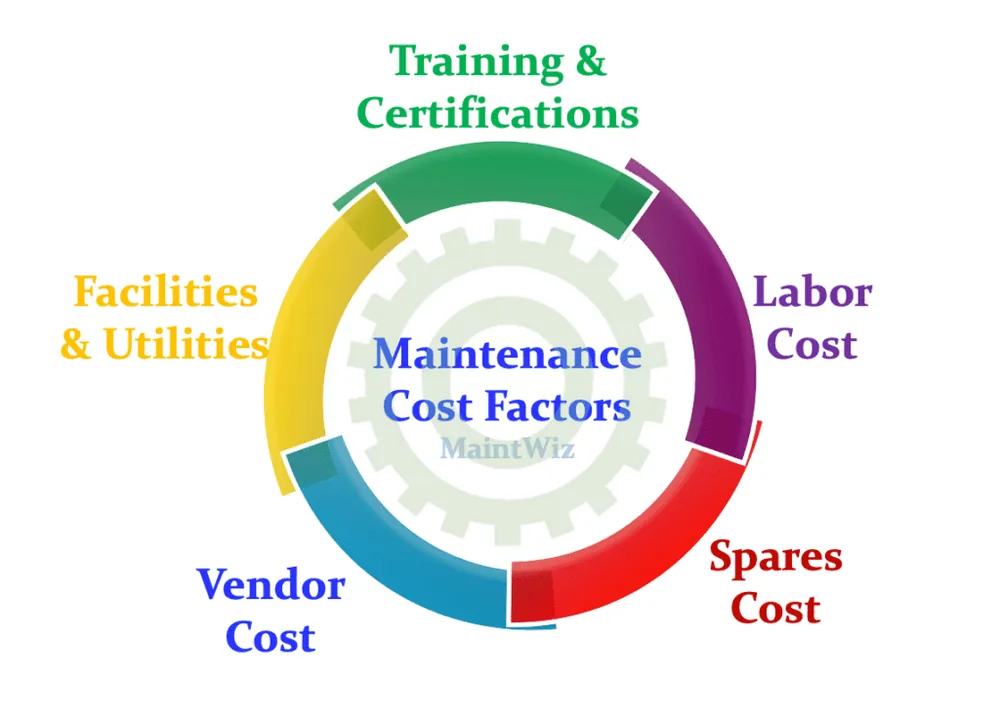
What constitutes maintenance costs or maintenance budget varies across industries and organizations and reflects the scope of services performed by the maintenance organization. Generally, maintenance costs include people costs, administrative overheads, spares and consumables inventory, annual maintenance contracts, contractors and other outsourced labor, vendor and other bought out services, etc. In some organizations, Maintenance Department may manage facilities and utilities, and thus cost of facilities management and utilities maintenance, may also come under the maintenance budget. Other costs may include the cost of molds and die, tool room maintenance, equipment rentals, insurance and warranty, effluent disposal, etc.
Special initiatives like management of change, Capex investments, and shut down management, also come under the maintenance department, but most often are managed with a separate dedicated budget.
What are the advantages of maintenance cost control?
Lower Costs. The most obvious benefit of maintenance cost control is lower cost. Teams that manage cost and allocation proactively spend less on avoidable work.
Return on Investments. Corollary to lower costs is better channeling the available resources and budget to the right areas and getting more business benefits. Improved asset management leads to a better return on investments.
Efficient Usage. Optimizing your maintenance programs can assign the right prioritization of maintenance management activities and efforts, reduce waste, optimize spare inventory, scale up the maintenance team’s delivery, and maximize the benefits. Effective preventive maintenance planning, right skilling of the resources, and condition monitoring of the equipment can help improve the maintenance team’s efficiency.
Visibility. Maintenance cost control gives detailed visibility of spares and labor, preventive and breakdown maintenance costs, expenses by plant/equipment/equipment group, repeat failures, etc. Visibility of equipment details, usage, breakdown history, and performance can lead to better-planned maintenance activities and quick resolution of equipment failures. Visibility also helps in other areas such as spares optimization, cost control, better planning and scheduling, and efficiency improvements
Right Allocation. An advantage of maintenance cost control is the right allocation or ensuring the right equipment gets the right maintenance budget. Overprovisioning is a common habit among maintenance teams, which may lead to underprovisioning elsewhere, leading to unplanned failures or equipment performance deterioration. With the right allocation, critical equipment gets enough maintenance budget, while the other equipment gets commensurate maintenance budget allocation. With the right maintenance cost allocation, plant maintenance teams can ensure smooth and optimal equipment performance, without increasing maintenance costs.
What are the best practices for maintenance cost control?
Maintenance cost control is not just about controlling the cost factors or selecting the cheapest option. It is maximizing the strategic value of overall industrial assets. Focus is more on strategic planning, value delivery, maximum availability and performance, quality of maintenance, extended asset life/asset life cycle management, safety, and sustainability, than short-term considerations of the cheapest solution and cutting corners. Best practices to improve maintenance cost control are often deep-rooted and start from the first principles i.e. strategic business objectives, asset management goals, and maintenance strategy.
Some of the most extensively used approaches for optimizing maintenance budget and maintenance performance include:
Why follow OEM schedules and guidelines?
The most effective way to control maintenance costs is to reduce the number of unplanned failures and associated reactive maintenance. Following the Original Equipment Manufacturer’s (OEM) guidelines on proper usage, loading, operating conditions, regular maintenance, approved spares, and consumables (e.g., lubricants) usage, monitoring performance parameters, and other instructions (cleaning/lubrication / tightening and minor adjustments), will ensure the equipment is in good running condition and avoids potential failures.
How does root cause analysis cut repeat failures?
Despite good preventive maintenance plans in place, unscheduled breakdowns can happen. Analysis of failures to understand the fundamental reason for the breakdown and facilitating factors can help in preventing their recurrence. Root cause analysis (why why analysis) can help in identifying defects and implementing permanent solutions to the problem, via the right set of corrective actions and preventive actions (CAPA actions). Prevention of repeat failures can save the maintenance effort and spare consumption and improve overall equipment effectiveness.
How does preventive maintenance planning cut cost?
Preventive maintenance is the most effective way to reduce unplanned failures and costly equipment breakdowns. A proper preventive maintenance schedule for each equipment and comprehensive maintenance checklists for corresponding PM schedules can ensure that the maintenance tasks are carried out as per OEM specifications. Any unscheduled breakdown implies an opportunity to strengthen the planned preventive maintenance schedules and checklists. Learning from breakdowns and incorporating necessary improvements can improve the effectiveness of preventive maintenance and ensure the best equipment performance.
How does early warning detection save cost?
Listening to symptoms and early warning signs can help identify the potential machinery malfunctions early and much before the catastrophic breakdown. Early detection of potential failures can save cost, time, and effort, and can ensure better planning of the maintenance tasks. Monitoring the critical parameters of the equipment and instituting conditional monitoring systems and alert functionalities can improve equipment condition, performance, and reliability.
How does spares inventory optimization cut cost?
Poor spare parts management and inefficient planning lead to overstocking, which raises carrying cost, or understocking, which delays repairs and equipment restoration. Practices that support cost control:
- Keep accurate bill of materials records, classify spares (vital, essential, desirable) and identify substitutable parts.
- Track spares life and usage, and plan procurement from consumption.
- Return unused parts to stores and balance stock against past usage.
- Manage minimum stock levels, reorder points and economic order quantities.
Why standardize maintenance processes?
Process standardization means a consistent way of handling maintenance requests and repeating maintenance tasks in the most effective sequence.
Preventive Maintenance procedures including schedules and checklists, troubleshooting breakdowns, cleaning and lubrication schedules, routine inspections, non-conformance classifications, and safety processes are all examples of processes that can be standardized. Standardized processes help in uniform and consistent execution by any maintenance team member for optimal breakdown response and quick restoration. It also ensures easier training of maintenance teams, incorporation of best practices, comparison of cycle times, and instituting continuous improvement measures.
Why outline fixed and variable costs in the budget?
Budgeting is an essential part of any business operation. Maintenance budgeting is the process of creating a financial plan for all the maintenance activities, planned for a specific period. It will include all the fixed and variable costs associated with the maintenance department including spares and labor, outlays for in-house and outsourced activities, AMCs and warranties, maintenance audits and inspections, skill development programs and certifications, etc. Budgets are typically pre-defined at the start of each fiscal period. They serve as a check to ensure that the actual maintenance costs do not outweigh the original maintenance plans. Investigate large deviations from the plan as they appear, rather than at year end. The next section shows how to set the budget and measure it.
How does CMMS software help with cost control?
A Computerized Maintenance Management System (CMMS Software) that tracks all the spares and labor usage, preventive and corrective maintenance tasks undertaken, repeat failures and fault tree analysis, etc. gives the cost history of each asset, which is what optimal maintenance and cost control are built on.
CMMS may also include detailed tools for setting up preventive maintenance schedules, and comprehensive maintenance checklist libraries, analyzing failures and instituting corrective measures, tracking spares, consumables, and other material consumption, reviewing fixed and variable costs, and evaluating annual maintenance contracts (AMCs) and warranties, etc. In general, technology enablement can help in standardizing processes and procedures, improving asset intelligence, increasing people productivity, and increasing the effectiveness of maintenance delivery. All of these, directly and indirectly, contribute to improving maintenance cost control, effectiveness, and equipment reliability.
How do you set a maintenance budget and measure it against asset value?
Start from last year's actual cost by asset, then adjust for equipment criticality, planned shutdowns, regulatory work and expected changes in operations. Link the budget to a goal such as less unplanned downtime, and review it against actuals every month.
Which budgeting method fits maintenance?
- Zero-based budgeting: every line is justified from scratch each period. It exposes tasks and contracts that no longer earn their cost.
- Activity-based budgeting: cost is built from the planned work, such as PM routes, inspections and shutdown jobs, so the budget follows the maintenance plan.
- Performance-based budgeting: funding is tied to targets such as downtime, PM compliance or cost per unit produced.
What is the maintenance cost to replacement asset value ratio?
Divide annual maintenance cost by the replacement asset value of the equipment and multiply by 100. Use current replacement cost, not book value. The ratio varies by industry, asset age and operating conditions, so compare it first with your own history and then with similar plants.
A falling ratio is good news only if reliability holds. Cutting spend without protecting critical assets raises future failure costs, so read the ratio together with the measures below.
Which KPIs show whether cost control is working?
| KPI | What it tells you |
|---|---|
| Maintenance cost per unit produced | Whether spend moves with output |
| Maintenance cost as a percentage of replacement asset value | Spend relative to the size of the asset base |
| Planned versus unplanned work | How much of the spend is reactive |
| PM compliance | Whether preventive work is actually done |
| Mean time between failures (MTBF) | Whether repeat failures are falling |
Count downtime and lost production alongside labor, parts, contractors and energy. A cheap repair that stops a line for hours is often the most expensive item on the list. In an AI-powered CMMS such as MaintWiz, labor, parts and downtime are recorded against each asset's work orders, so cost per asset comes from your records rather than from spreadsheets.
FAQs
What is included in maintenance costs?
Maintenance costs include labor and training, spare parts and consumables, annual maintenance contracts, contractors and outsourced services, and the production losses caused by equipment downtime. Utilities, tooling and rentals count where the maintenance department manages them.
How do you set a maintenance budget?
Start from last year's actual cost by asset, then adjust for criticality, planned shutdowns, regulatory work and expected changes in operations. Tie the budget to goals such as less downtime and review it against actuals every month.
How do you calculate maintenance cost as a percentage of asset value?
Divide annual maintenance cost by the current replacement value of the equipment and multiply by 100. Use replacement cost, not book value, and compare the result with your own history and similar plants.
Which KPIs track maintenance cost control?
Common KPIs are maintenance cost per unit produced, maintenance cost as a percentage of replacement asset value, planned versus unplanned work, PM compliance and mean time between failures (MTBF).
How do you cut maintenance cost without raising risk?
Focus on avoidable cost: move repeat failures to planned fixes through root cause analysis, remove tasks that add no value, control spare parts stock and use condition data on critical assets. Review reliability KPIs after each change.