Key takeaways
- The weak link is usually systemic: data, decisions and execution are not connected.
- Five failures cause most of it: fragmented data, reactive culture, poor prioritization, disconnected KPIs and ignored predictive signals.
- Criticality ranking, predictive analytics, smart work orders, financial KPIs and integration close the gaps.
- If you answer no to more than two of the five leadership questions, the weak link is systemic.
The weakest link in most plants is not a machine or a technician but the gap between data, decisions and execution. You find it by checking five structural failures: fragmented asset data, a reactive culture, poor work order prioritization, disconnected KPIs and ignored predictive signals, then close them with an AI CMMS.
What Is the Weak Link in an Industrial Plant?
Your plant isn’t as strong as your best asset. It’s as vulnerable as your weakest link.
In most industrial facilities, the weakest link isn’t a machine. It isn’t a technician. It isn’t even an aging asset.
It’s the gap between data, decision, and disciplined execution.
A recurring pattern in asset-intensive plants: organizations invest heavily in equipment, automation and digital systems, yet lose margin to fragility inside their maintenance and asset management processes.
This article covers:
- How to identify the weakest link in your plant
- Why traditional maintenance models fail at scale
- The role of AI-powered CMMS in closing execution gaps
- And how modern platforms like MaintWiz CMMS enable predictive, resilient, high-performance operations
If you are serious about operational excellence, this is required reading.
What Are the Five Structural Weak Links in a Plant?
Overview: Why Most Leaders Misdiagnose Risk
When production stops, leadership asks:
- Which machine failed?
- Who missed the inspection?
- Why didn’t we see this coming?
But breakdowns are rarely random events. They are systemic outcomes.
The real weak link is often one of these five structural failures:
- Fragmented Asset Data (Data Silos in Maintenance Systems)
- Maintenance history in spreadsheets
- Asset performance in ERP
- Sensor data in isolated IoT dashboards
- Work orders in a legacy system
When systems don’t talk to each other, decision quality degrades.
Impact: Poor prioritization, reactive maintenance, misallocated capital.
- Reactive Maintenance Culture (Firefighting Over Foresight)
Reactive environments reward speed, not strategy.
- Technicians become heroes for emergency repairs
- Preventive tasks get postponed
- Root cause analysis becomes optional
Result: Chronic instability masked as operational resilience.
- Poor Work Order Prioritization (Execution Bottlenecks)
Without intelligent prioritization:
- Critical assets compete with low-impact tasks
- Backlogs grow
- High-risk failures go unnoticed
The issue isn’t workload—it’s prioritization intelligence.
- Disconnected KPIs (Maintenance Metrics Without Meaning)
Many plants track:
- MTBF
- MTTR
- PM compliance
But few connect these to:
- Production throughput
- Financial impact
- Risk exposure
Maintenance metrics must translate into business outcomes.
- Underutilized Predictive Data (Failure Signals Ignored)
Modern plants generate massive data streams from sensors and equipment.
Yet most teams lack AI-driven tools to convert patterns into predictive insight.
Your next failure is already in the data.
The question is: can you see it?
Which symptom points to which weak link?
| Weak link | Symptom you see | First fix |
|---|---|---|
| Fragmented asset data | Decisions made on partial history | One asset register and history in the CMMS |
| Reactive culture | Emergency repairs dominate the week | Track and raise the planned vs reactive work ratio |
| Poor work order prioritization | Critical jobs wait behind low-impact tasks | Rank work by asset criticality |
| Disconnected KPIs | MTBF and MTTR with no cost or output context | Link KPIs to downtime cost and throughput |
| Ignored predictive data | Surprise failures after alarms were raised | Let thresholds create work orders |
The Economic Cost of the Weak Link
Overview: Downtime Is More Than Lost Production
Unplanned downtime is often measured in hours.
Its true cost is measured in strategic erosion.
Let’s break down the hidden costs:
- Direct Production Loss
- Missed output
- Contract penalties
- Overtime labor
- Accelerated Asset Degradation
Reactive fixes shorten asset life.
Emergency repairs introduce secondary damage.
- Inventory and Spare Parts Inflation
Without predictive insight:
- Overstocking becomes insurance
- Capital gets trapped in stores
- Safety and Compliance Risk
Weak links increase:
- Incident probability
- Regulatory scrutiny
- Insurance premiums
- Leadership Fatigue
Constant firefighting erodes confidence and strategic focus.
Operational excellence requires calm systems, not crisis management.
How Do You Move From Maintenance Management to Asset Intelligence?
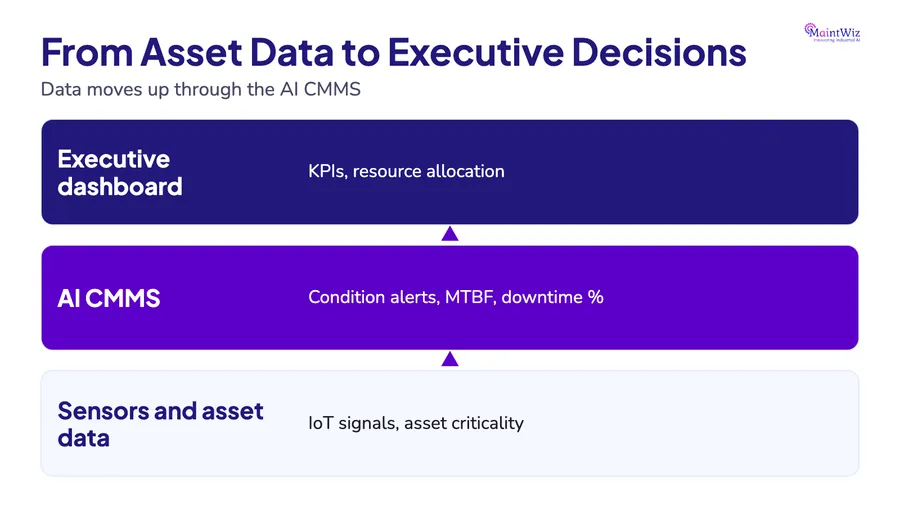
Better scheduling is not enough. High-performing plants connect criticality, condition data and work execution.
High-performing plants operate on five pillars: asset criticality, predictive analytics, intelligent work orders, KPI-driven improvement and an integrated digital ecosystem.
Pillar 1: Asset Criticality Analysis and Risk-Based Maintenance
Overview
Not all assets are equal.
Yet many plants treat them that way.
Risk-based maintenance strategy includes:
- Asset Criticality Ranking
Quantifying impact on safety, production, and compliance. - Failure Mode Analysis (FMEA Integration)
Understanding failure consequences before they happen. - Dynamic Maintenance Planning
Adjusting maintenance frequency based on condition data.
Modern AI-powered CMMS platforms enable automated criticality-based prioritization.
Pillar 2: Predictive Maintenance and AI Analytics
Overview
Preventive maintenance is calendar-based.
Predictive maintenance is condition-based.
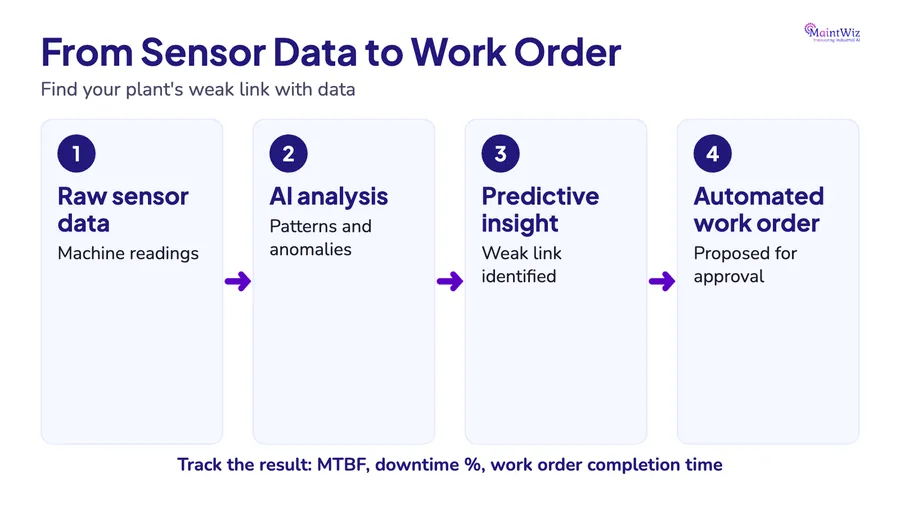
Prescriptive maintenance is AI-driven.
Key capabilities include:
- IoT Sensor Integration
Real-time condition monitoring. - Machine Learning Failure Prediction
Identifying patterns humans miss. - Anomaly Detection Algorithms
Detecting subtle degradation signals. - Prescriptive Work Order Automation
Generating maintenance tasks before breakdown.
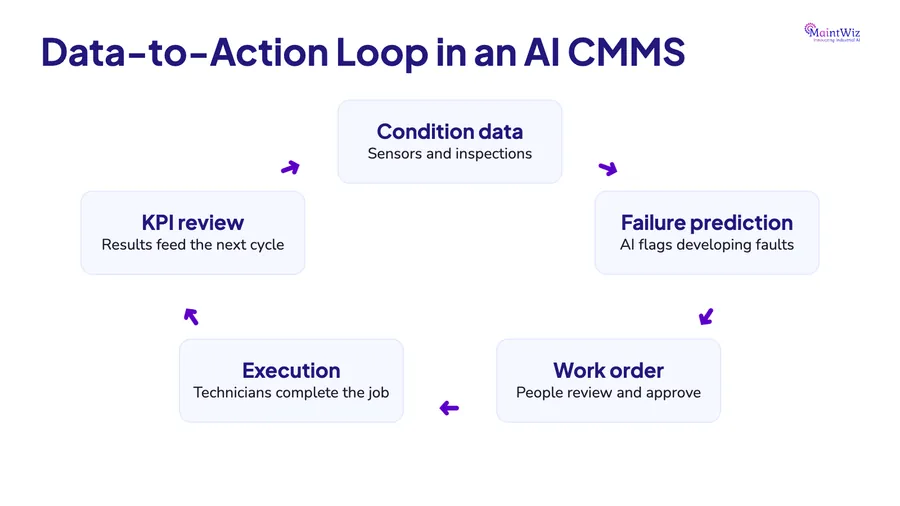
AI-enabled systems like MaintWiz AI CMMS combine predictive models with work orders that a planner reviews and approves—closing the loop from insight to action.
Pillar 3: Intelligent Work Order Management
Overview
Work orders are the heartbeat of plant maintenance.
But without intelligence, they become noise.
Best-in-class execution includes:
- Automated Work Order Prioritization
Ranking tasks by asset criticality and risk. - Mobile Technician Enablement
Real-time updates from the field. - Backlog Optimization Analytics
Identifying hidden workload imbalances. - Digital Documentation and Audit Trails
Improving compliance and traceability.
MaintWiz CMMS integrates mobile work management with AI-driven scheduling to eliminate execution friction.
Pillar 4: KPI-Driven Continuous Improvement
Overview
“What gets measured gets improved.”
“What gets contextualized gets optimized.”
Essential Maintenance KPIs:
- Mean Time Between Failures (MTBF)
- Mean Time To Repair (MTTR)
- Planned vs Reactive Work Ratio
- Maintenance Cost per Asset
- Downtime Percentage
The key is not tracking KPIs—it’s connecting them to financial performance.
Modern CMMS dashboards provide real-time, executive-level visibility across sites.
Pillar 5: Integrated Digital Ecosystem
Overview
Maintenance cannot operate in isolation.
Integration must connect:
- ERP systems
- IoT platforms
- Procurement
- Inventory management
- Compliance systems
A unified digital backbone eliminates data silos and drives enterprise-wide visibility.
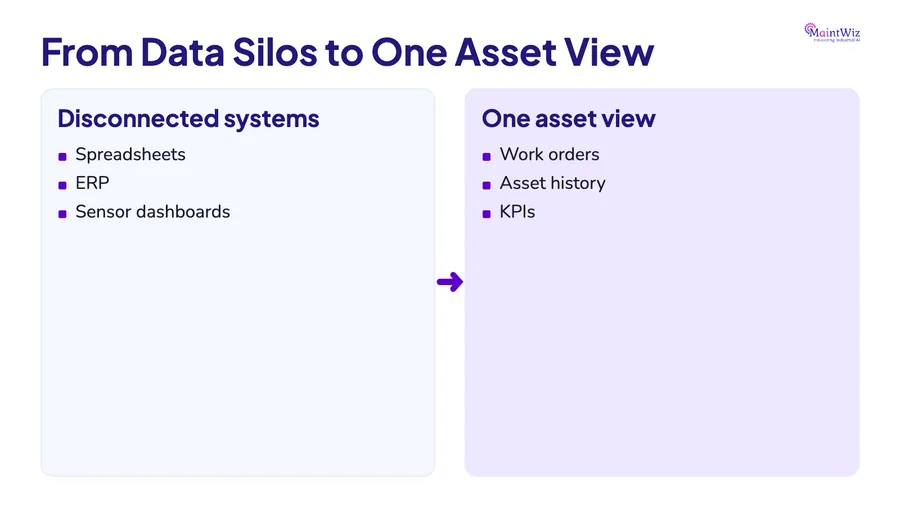
MaintWiz CMMS offers enterprise integration capabilities and IoT connectivity to unify plant systems into a single intelligence layer.
How Do You Diagnose Your Weak Link?
Ask yourself:
- Can you predict your next major asset failure with confidence?
- Do you prioritize work orders based on financial impact?
- Is your maintenance strategy aligned with production strategy?
- Do technicians spend more time wrenching—or documenting?
- Can executives see real-time asset performance dashboards?
If the answer is “no” to more than two, your weak link is systemic—not mechanical.
What Will Industrial Maintenance Look Like Next?
Emerging trends shaping asset management:
- AI-driven predictive maintenance
- Digital twins for asset simulation
- Autonomous inspection systems
- Enterprise-wide CMMS standardization
- Data-driven capital planning
Maintenance is a strategic lever, and plants that act on predictive signals avoid the breakdowns others only repair.
Why Is MaintWiz AI CMMS Built for the Modern Plant?
MaintWiz CMMS is an AI-powered CMMS built for TPM, and it covers the five pillars above.
Here’s why:
- AI-Powered Enterprise Intelligence
MaintWiz integrates machine learning algorithms to:
- Predict asset failures
- Analyze historical performance trends
- Generate intelligent maintenance recommendations
This moves organizations from reactive response to predictive orchestration.
- IoT-Enabled Condition Monitoring
MaintWiz supports IoT integration, enabling:
- Real-time asset monitoring
- Sensor-based alerts
- Automated anomaly detection
This ensures early intervention before catastrophic failure.
- Advanced Work Order Automation
MaintWiz optimizes:
- Work order prioritization
- Technician allocation
- Task scheduling
Reducing backlog and improving execution discipline.
- KPI Dashboards and Executive Analytics
MaintWiz provides:
- Real-time maintenance KPI dashboards
- Asset performance analytics
- Cost visibility reports
Empowering data-driven leadership decisions.
- Mobile-First Maintenance Execution
Technicians can:
- Access work orders on mobile
- Update job status in real time
- Capture asset history instantly
This reduces administrative friction and increases productivity.
- Scalable, Enterprise-Grade Architecture
MaintWiz supports:
- Multi-site deployment
- Role-based access
- ERP integration
- Compliance reporting
Making it suitable for growing industrial enterprises.
Final Thought: Strengthen the Weak Link Before It Breaks
Every plant has a weak link.
But in modern industry, that link is rarely a bearing or a pump.
It is the invisible system connecting data, decision, and disciplined execution.
The future belongs to plants that:
- See failure before it happens
- Prioritize risk intelligently
- Empower technicians with digital tools
- Align maintenance with business strategy
MaintWiz CMMS provides the intelligence layer that transforms maintenance into competitive advantage.
The question isn’t whether your plant has a weak link.
It’s whether you’re willing to find it—before it finds you.
FAQs
What is the weak link in an industrial plant?
In most plants it is not a single machine or person but the gap between data, decisions and disciplined execution. Fragmented asset data, a reactive culture, weak prioritization, disconnected KPIs and unused predictive signals let failures repeat.
How do you identify the weakest link in your plant?
Review repeat breakdowns, the planned vs reactive work ratio, backlog age on critical assets and whether KPIs connect to cost and output. Use the five leadership questions in this article. More than two no answers point to a systemic weak link.
How does a CMMS help close the gap?
A CMMS puts asset history, work orders, schedules and KPIs in one record. An AI CMMS adds criticality-based prioritization, condition alerts that raise work orders, and dashboards that connect maintenance results to cost and output.
Which KPIs should leaders watch first?
Start with MTBF, MTTR, planned vs reactive work ratio, maintenance cost per asset and downtime percentage. Their value comes from linking them to production throughput and financial impact, not from tracking them alone.
Is predictive maintenance needed to fix the weak link?
Not on day one. Criticality ranking, clean asset data and work order discipline come first. Predictive maintenance then adds the most value on critical assets, where early warning of failure is worth the cost of monitoring.