Key takeaways
- Edge AI processes sensor data next to the machine, so anomalies are detected quickly and detection continues if the network drops.
- Data can stay inside the plant network, which reduces exposure compared with sending raw data off site.
- Many plants use edge for fast detection and cloud for model training and cross-site analysis.
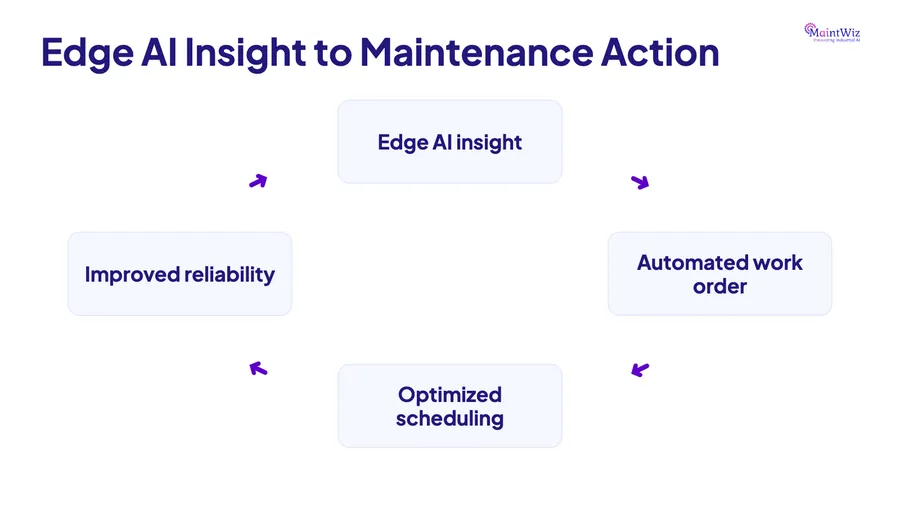
- A prediction only saves money when a CMMS turns the alert into a planned work order, parts and a scheduled job.
- Sensor quality, calibration and legacy machine compatibility decide how well Edge AI performs.
Edge AI for predictive maintenance runs machine learning models on or beside the equipment, so anomalies in vibration, temperature and pressure data are detected locally, in real time, without a cloud round trip. A CMMS then turns each alert into a work order, which is how the prediction becomes a repair.
Why does Edge AI matter for modern maintenance?
Edge AI is shifting intelligence from centralized cloud systems directly to the factory floor, enabling predictive insights where it matters most—next to the machines themselves.
Unlike traditional cloud-centric analytics that introduce latency and dependency on network reliability, Edge AI delivers real-time, reliable, and secure insights by processing data locally at the source. For asset-intensive industries, this means faster decisions, reduced downtime, and improved operational resilience. In this article, we explore how Edge AI transforms predictive maintenance and why integrating it with a modern AI CMMS like MaintWiz can strengthen your maintenance strategy.
What Is Edge AI in Industrial Maintenance?
Edge AI refers to artificial intelligence that operates at the edge of a network—close to the data source, such as machines and sensors—rather than relying on centralized cloud processing. By processing data locally, Edge AI reduces the delays and dependency on continuous connectivity that often hinder predictive models in industrial environments.
Key Benefits of Edge AI
- Real-Time Anomaly Detection
Edge AI can spot anomalies and deviations in sensor data instantaneously without waiting for cloud uploads or batch processing. - Reduced Network Dependency
Since insights are generated locally, systems remain functional even during network interruptions. - Enhanced Data Security
Data stays within the plant network, reducing exposure to external threats associated with transmitting data offsite. - Lower Latency for Immediate Action
Faster detection means maintenance teams can respond quickly, reducing unplanned downtime.
By bringing intelligence closer to the machinery, Edge AI ensures that critical insights are not only accurate but also timely, enabling true predictive maintenance.
Edge AI vs cloud AI: which should a plant use?
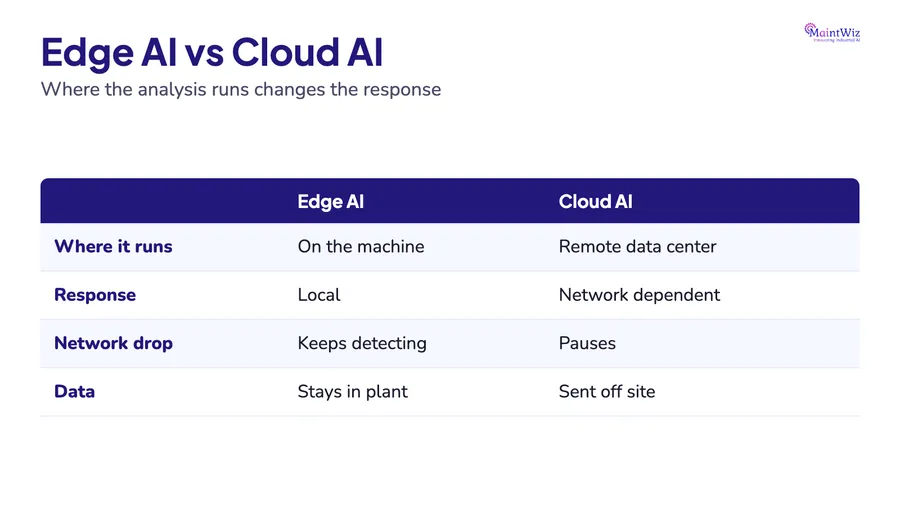
Many plants use both. The edge runs the model next to the machine for fast detection; the cloud trains models and compares assets across sites.
| Edge AI | Cloud AI | |
|---|---|---|
| Where the model runs | On or beside the machine | In a remote data center |
| Response time | Local, no network round trip | Depends on the network |
| If the network drops | Detection continues | Analysis pauses |
| Data location | Stays in the plant | Sent off site |
| Best for | Time-critical fault detection | Model training and fleet-wide analysis |
Why does predictive maintenance matter now?
Predictive maintenance is a strategic shift from reactive (fix after failure) and preventive (scheduled maintenance) approaches to one where insights drive action before a breakdown occurs. With increasing automation and data volumes on production floors, predictive maintenance powered by Edge AI becomes essential for operational excellence.
Key Drivers for Predictive Maintenance
- Minimizing Unplanned Downtime
Predictive models help foresee failures, which can reduce unexpected downtime when paired with real-time data monitoring. - Extending Asset Life
Continuous monitoring and early intervention can significantly extend the useful life of expensive equipment. - Optimizing Maintenance Costs
Avoiding unnecessary maintenance and reducing emergency repairs lowers total cost of ownership. - Enhancing Safety and Compliance
Early detection of failures also means mitigating potential safety risks before they escalate. - Boosting Operational Efficiency
Machines that run at optimal performance without frequent breakdowns contribute to better production stability and output.
Predictive maintenance is now a core operational imperative, not a “nice-to-have” feature. Its effectiveness improves when it is combined with Edge AI-powered real-time insights.
How does Edge AI improve predictive maintenance?
Edge AI transforms predictive maintenance from theoretical value into real operational impact. Instead of waiting for data to travel to the cloud for analysis, models running at the edge can instantly evaluate conditions against anomaly thresholds, health indicators, and failure patterns.
Edge AI Capabilities That Drive Predictive Success
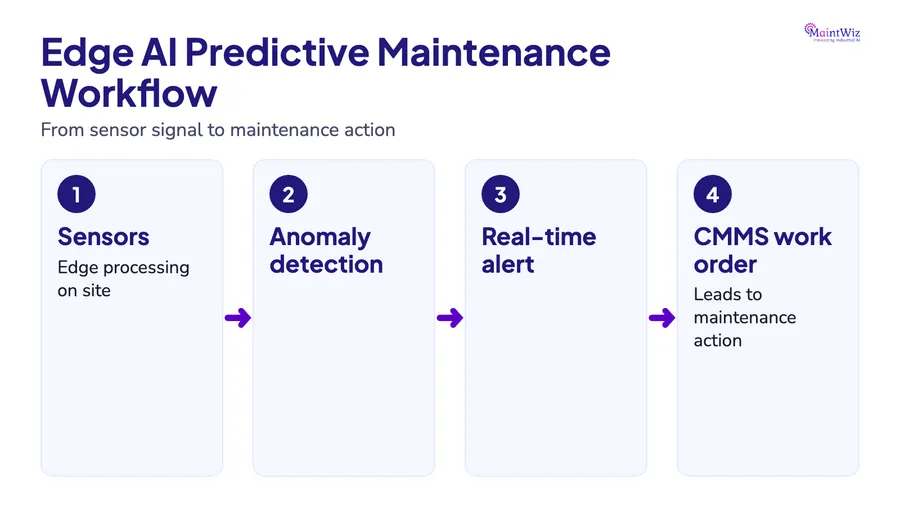
- Local Data Processing for Instant Alerts
Edge AI analysis detects irregularities on-site and triggers alerts without delay. - Hardware State Estimation
Using sensor data like temperature, vibration, and pressure, Edge AI can estimate the health condition of critical components in real time. - Adaptive Models Based on Operational Context
Edge AI can adjust predictive models based on current production cycles and machine conditions. - Reducing False Positives
Local processing helps refine predictions by accounting for machine-specific baselines and environmental variations. - Triggering Automated Actions
Once a potential issue is detected, the system can propose or prioritize work orders in the integrated maintenance system for your team to approve.
Edge AI turns raw data into actionable intelligence at the moment it matters, a key enabler of responsive and proactive maintenance workflows.
How does Edge AI integrate with existing industrial systems?
For many manufacturing and industrial facilities, fully modernizing maintenance requires integrating Edge AI with existing infrastructure. This integration includes sensors, OT systems, ERP platforms, and maintenance management tools.
Key Integration Points
- IoT Sensor Networks
Connects vibration, temperature, and flow sensors to Edge AI units for continuous condition monitoring. - Operational Technology (OT) Systems
Integration with SCADA and PLC systems ensures seamless data flow to Edge AI models. - Enterprise Resource Planning (ERP)
Syncing asset master data and maintenance records with ERPs like SAP enhances visibility across departments. - CMMS Integration
Edge AI insights feed directly into CMMS platforms, automating alerts, work orders, and maintenance planning.
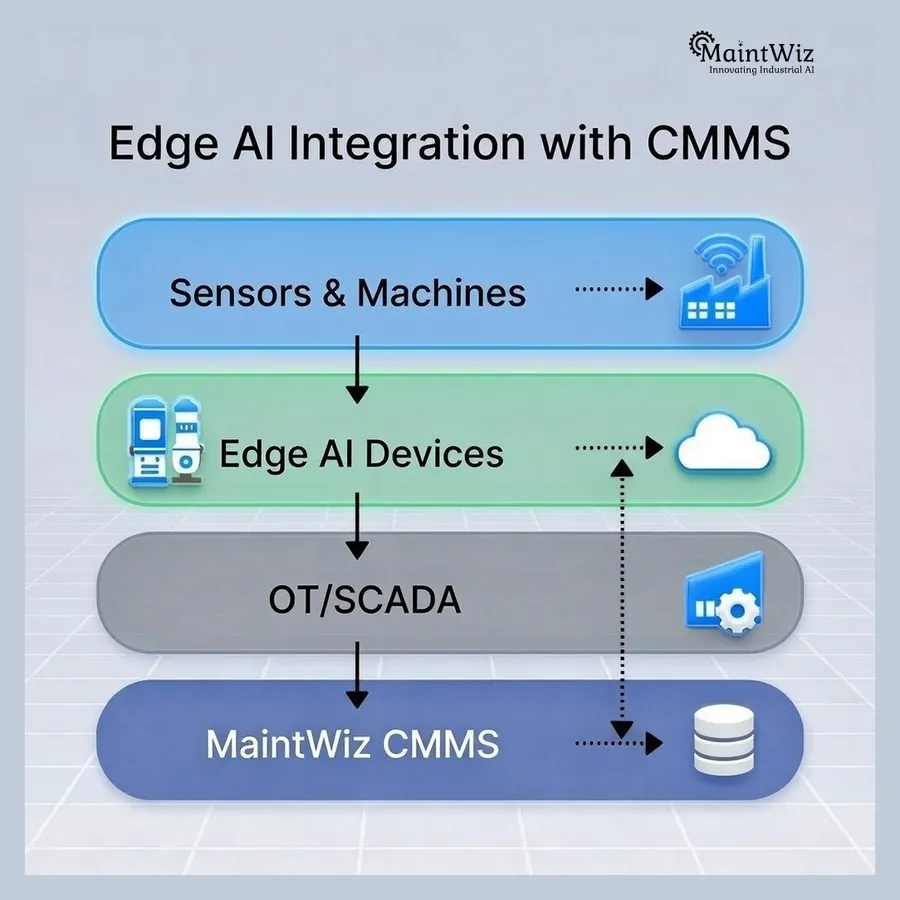
Effective integration ensures that Edge AI insights don’t exist in isolation but drive meaningful operational outcomes across the enterprise.
Where is Edge AI used in industrial maintenance?
Edge AI applies across industries where maintenance reliability directly influences productivity and cost.
High-Impact Use Cases
- Manufacturing Lines
Detect tool wear or vibration anomalies before they lead to production halt. - Heavy Equipment and Motors
Give early warning of motor failure so interventions can be scheduled. - Energy & Utilities
Monitor turbine and generator health continuously and prevent catastrophic failures. - Oil & Gas Facilities
Track pressure fluctuations and corrosion trends that could lead to leaks or hazards. - Process Plants
Ensure continuous operations by spotting early signs of asset degradation.
Across these scenarios, maintenance teams gain visibility and foresight, enabling smarter decision-making and optimized asset performance.
What are the challenges of adopting Edge AI?
Despite its power, implementing Edge AI isn’t without challenges. Understanding and addressing these challenges leads to smoother deployment and better outcomes.
Common Challenges and Solutions
- Data Quality and Sensor Calibration
Solution: Standardize sensors, maintain calibration, and ensure clean data input for reliable Edge AI processing. - Legacy Machine Compatibility
Solution: Retrofit sensors and gateways to bring older assets into the connected ecosystem without full equipment replacement. - Integration Complexity
Solution: Use middleware and standardized data protocols to connect OT, Edge AI, and enterprise systems. - Workforce Skills Gap
Solution: Provide targeted training and change management to help teams interpret and act on Edge AI insights. - Cybersecurity Concerns
Solution: Secure edge devices, restrict access, and leverage on-site processing to reduce external vulnerability points.
These challenges are surmountable with careful planning, and the payoff significantly improves reliability and operational resilience.
What role does a CMMS play with Edge AI?
Predictive insights are transformative, but to realize their value, organizations need a system that operationalizes those insights. This is where a modern AI-integrated CMMS becomes critical.
How CMMS Complements Edge AI
- Automated Work Order Generation
Insights from Edge AI can raise work orders for planners to review and approve, reducing manual planning. - Maintenance Scheduling Optimization
CMMS platforms adjust maintenance schedules based on real-time health data. - Asset Performance Dashboards
Centralized dashboards combine edge insights with historical maintenance data for deeper analysis. - Mobile Access for On-The-Go Execution
Technicians receive alerts and instructions in real time, empowering faster response and execution. - Inventory and Spare Part Forecasting
Predictive data helps avoid stockouts and optimize spare parts usage.
The synergy between Edge AI and CMMS turns data into actionable maintenance intelligence.
Why use MaintWiz for Edge AI-driven maintenance?
MaintWiz is an AI CMMS built for TPM, designed to harness real-time insights, predictive analytics, and seamless workflow automation to drive maintenance excellence.
Top MaintWiz CMMS Capabilities That Amplify Edge AI Benefits
- AI-Powered Predictive Maintenance
Leveraging advanced machine learning models to forecast equipment failures and optimize maintenance strategies. - Real-Time Asset Condition Monitoring
Integrates with IoT and Edge AI systems to provide continuous health metrics and alerts. - Unified Asset Intelligence Hub
Centralizes real-time operational data with maintenance history and performance metrics. - Automated Work Order & Scheduling
Proposes and prioritizes maintenance tasks from predictive insights and live conditions, for your team to approve. - Mobile Maintenance Execution
Supports technicians with on-the-go access to alerts, instructions, and live updates from the factory floor. - Seamless Integration with OT and ERP
Bridges real-time operations with enterprise systems for unified visibility and planning. - Inventory Optimization with AI
Predictive analysis aligns spare parts inventory with maintenance needs to reduce carrying costs. - Digital Twin and Simulation Capabilities
Enables virtual maintenance planning to test strategies without operational risk. - Enhanced Compliance and Documentation
Maintains audit trails and supports industry best practices for regulatory compliance. - Scalable, Enterprise-Ready Platform
Designed to grow with your organization and support complex maintenance environments.
With MaintWiz, organizations can transform real-time predictive data into measurable maintenance performance improvements—a core tenet of Industry 4.0.
Conclusion: The Road Ahead
Edge AI isn’t just another buzzword—it’s a strategic enabler of predictive, proactive maintenance that reduces unplanned downtime, enhances reliability, and drives operational excellence. But real-time intelligence is only part of the equation. The true differentiator lies in how these insights are operationalized—and that’s where leading CMMS platforms like MaintWiz bring transformative value.
By combining Edge AI’s real-time predictive capabilities with a comprehensive AI CMMS, organizations unlock a maintenance ecosystem that is not just reactive or scheduled—but intelligent, dynamic, and future-ready.
FAQs
What is Edge AI in predictive maintenance?
Edge AI runs machine learning models on devices at or near the machine, such as gateways or industrial PCs, instead of in a remote cloud. It analyzes vibration, temperature and pressure data locally to flag anomalies as they develop.
What is the difference between Edge AI and cloud AI for maintenance?
Edge AI processes data locally for fast response, works through network outages and keeps data in the plant. Cloud AI offers heavier computing for training models and comparing assets across sites. Many plants combine the two.
Does Edge AI replace a CMMS?
No. Edge AI detects anomalies; a CMMS decides what happens next. It creates and prioritizes the work order, schedules the job, reserves parts, assigns technicians and records the outcome, so detection leads to completed maintenance.
Can Edge AI work with older machines?
Yes, usually. Older assets can be brought in by retrofitting sensors and gateways, without replacing the machine. Sensor calibration and clean data matter, because the model is only as good as its inputs.
Is Edge AI more secure than cloud processing?
Processing locally means less raw data leaves the plant, which reduces exposure. Edge devices still need security measures: restricted access, patching and network segmentation between OT and IT systems.