
Key takeaways
- Resilience is how little output a plant loses when something fails and how fast it recovers.
- Rank assets by criticality first, then match spares, redundancy and procedures to each tier.
- MTBF shows how often you face failure; MTTR shows how fast you recover.
- Drills and post-failure reviews turn written plans into tested ones.
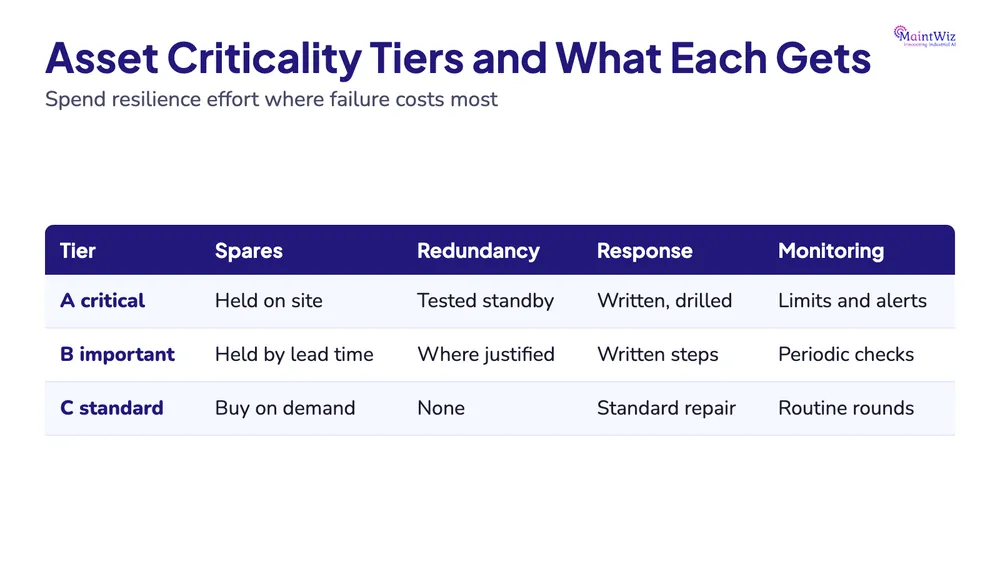
Resilience in plant operations is the ability to absorb an equipment failure, a supply problem or a staffing gap and return to full output quickly. Maintenance and asset management build it by ranking assets by criticality, stocking the right spares, removing single points of failure, writing response procedures, monitoring condition and rehearsing the response.
What does resilience mean for a plant?
Reliability asks how rarely an asset fails. Resilience asks what happens to the plant when something does fail anyway, and how long it takes to be back. A reliable plant can still be fragile if one pump, one supplier or one experienced technician stands between production and a stop.
Three kinds of disruption matter most to a maintenance or reliability leader:
- Equipment failure: a critical asset stops, often without warning.
- Supply disruption: a spare part, lubricant or contractor is not available when the job needs it.
- Workforce disruption: the person who knows the machine is on leave, on another shift or has left.
Resilience has two measurable halves: how much output you lose when a disruption hits, and how long recovery takes. Reliability work lowers the number of events. Resilience work shrinks the damage of each one. Both are needed. For the preventive side, see equipment reliability and plant performance strategies; this article covers what reliability alone does not: surviving the failures that still happen.
How do you decide which assets need resilience first?
You cannot make every asset resilient, so start with a criticality ranking. Score each asset on the consequence of failure and how hard recovery would be, then tier the list. Do the scoring with operations, safety and engineering in the room, not maintenance alone, because production impact and safety exposure are their knowledge.
A simple scoring approach, which you can adapt to your plant:
| Criterion | Question to ask | Score 1 (low) to 5 (high) |
|---|---|---|
| Safety and environment | Can failure injure someone or cause a release? | 1 = no effect, 5 = serious harm possible |
| Production impact | Does the line or plant stop, and for how long? | 1 = no effect, 5 = full stop |
| Quality impact | Does failure produce scrap or off-spec product? | 1 = none, 5 = batch loss |
| Redundancy | Is there a tested standby on a separate path? | 1 = tested standby, 5 = single path |
| Repair lead time | How long to get parts and skills on site? | 1 = hours, 5 = weeks |
Add the scores, then group assets into A (most critical), B and C. Set the cut-offs for your plant, for example A for a total of 18 or more out of 25, and place any asset that scores 5 on safety in A whatever its total. Review the ranking at least once a year, and whenever redundancy changes, for example when a standby pump is out of service. A backup only counts if it is maintained and tested.
How do spares, redundancy and procedures reduce the impact of failure?
Once the tiers exist, match the resilience measure to the tier. The table below shows what each lever does and where it pays off.
| Lever | What it protects against | Best applied to | Watch out for |
|---|---|---|---|
| Critical spares strategy | Long waits for a part | A-tier assets with long lead times | Overstocking low-risk parts while the one critical part is missing |
| Redundancy (standby equipment) | Loss of output when one unit fails | Assets with no tolerance for downtime | Extra units on the same path or power supply fail together |
| Response procedures | Slow, improvised recovery | Likely failure scenarios for A-tier assets | Procedures nobody has read or practiced |
| Cross-training and skills cover | Dependence on one expert | Specialist equipment and every shift | Training records that are not kept current |
| Condition monitoring | Surprise failures | Assets where degradation can be measured | Readings collected but no action tied to limits |
| Supplier and contractor cover | Single-source supply | Parts and services with one source | Agreements that lapse unnoticed |
Spares by consequence, not habit
Link stocking to criticality and lead time. A part for an A-tier asset with a long lead time earns a place on the shelf; a cheap, locally available part for a C-tier asset does not. Review min and max levels against actual consumption, and link each spare to the equipment and schedule that uses it. Spare parts management in the CMMS keeps that link visible.
Redundancy that is real
Check redundancy on the plant, not on the drawing. Two pumps on one electrical feeder or one discharge header share a failure path. Where full redundancy is too costly, cheaper options often close most of the gap: a pre-built spare motor, a documented bypass, or a cross-trained second technician.
Response procedures
For each A-tier asset, write a one-page response for its likely failure modes: who is called, what is isolated, where the spare is, which permit is needed and what the restart checks are. Store it against the asset so it is found in minutes, not remembered. Breakdown management keeps each event, its cause and its repair time on record.
How do data and monitoring help a plant recover faster?
Recovery time is mostly the time to find the problem, get parts and skills, and do the repair. Data shortens the first two, and your MTTR figure only shows it if you record time from failure to restart, not just wrench time. A clean asset register with failure history shows what went wrong last time. Condition monitoring gives early warning, so planned work replaces an emergency.
Track a small set of numbers per asset and per line:
- Mean Time Between Failures (MTBF): operating time divided by number of failures. It shows how often you face a disruption.
- Mean Time To Repair (MTTR): total repair time divided by number of repairs. It shows how quickly you recover.
- Unplanned downtime hours: the loss you are trying to shrink.
- Planned versus reactive work share: a falling reactive share means fewer surprises.
For a worked example, illustration: a pump runs 2,000 hours in a quarter and fails 4 times. MTBF is 2,000 / 4 = 500 hours. Repairs took 6, 10, 8 and 12 hours, so MTTR is 36 / 4 = 9 hours. If a pre-staged spare and a written procedure cut MTTR to 5 hours, the same four failures cost 20 hours instead of 36. That is resilience: the failures did not change, the recovery did. The numbers are for illustration only.
Why should you run drills?
A response plan that has never been used is a guess. Pick one A-tier failure scenario each quarter and rehearse it on paper or on the floor: the alarm, the call-out, the isolation, the spare retrieval, the restart. Time each step and note what was missing, such as a wrong part number, an expired permit template or a contact who is unreachable. Fix those gaps and update the procedure. After every real breakdown, run a short review with the same questions and feed what you learn into the next criticality review.
What does a resilience maturity model look like?
Use this table to place your plant today and pick the next step. It is a practical self-assessment, not a formal standard.
| Level | Criticality and spares | Response and skills | Data and monitoring |
|---|---|---|---|
| 1. Reactive | No ranking; spares bought after failure | Recovery depends on individuals | Failures remembered, not recorded |
| 2. Basic | Informal list of important assets; some spares | Verbal knowledge; some written steps | Work orders recorded, little analysis |
| 3. Defined | Scored ranking; critical spares by lead time | Written procedures for A-tier assets; cross-training plan | MTBF and MTTR tracked per asset |
| 4. Managed | Annual review; redundancy tested | Quarterly drills; post-event reviews | Condition monitoring on critical assets with limits |
| 5. Proactive | Ranking updates with plant changes | Drills and reviews feed the plan | Readings trigger work before failure |
Where does an AI CMMS fit?
Resilience depends on information being in the right place at the right moment. MaintWiz is an AI-powered CMMS built for Total Productive Maintenance, and it supports the work above:
- Risk assessment tools help identify critical assets and prioritize maintenance activities.
- Spare parts link to equipment maintenance schedules, so critical spares stay available when needed, and SAP integration keeps inventory in sync.
- Meter reading and condition monitoring schedules sit alongside planned maintenance, and MaintWiz can integrate with IoT, SCADA, PLC and MES systems. A work order can be created automatically when a reading breaches its limit.
- Failure phenomena are captured at equipment level and root cause analysis is carried out, so recurring failures are removed.
- Technicians reach master equipment data on mobile, so history and procedures are at the asset.
- Equipment Health Cards show each asset's KPIs, breakdown metrics and breakdown list.
AI proposes, people approve: the system points at risk and suggests action, and your engineers decide. Go-live takes 4 to 6 weeks, with guided onboarding by our customer success managers and your data loaded from Excel. See AI-powered reliability-centered maintenance for the criticality and failure-mode side.
What should you do first?
This month, pick one production line. Rank its assets with the five criteria above, name the three A-tier assets, and for each one check three things: is a spare on site, is there a written response, and does a second person know the job? Close the largest gap first, then book your first drill. For the wider strategy, read the asset reliability sprint plan and reactive versus proactive maintenance.
FAQs
What is resilience in plant operations?
Resilience is a plant's ability to absorb equipment failure, supply disruption or workforce gaps and return to full output quickly. It is measured by the output lost during a disruption and the time taken to recover, not only by how rarely assets fail.
How is resilience different from reliability?
Reliability lowers how often assets fail. Resilience limits the damage when a failure still happens, through spares, redundancy, response procedures and skills cover. A plant needs both: fewer events and a faster, cheaper recovery from each one.
How do you rank assets by criticality?
Score each asset on safety, production and quality impact, redundancy and repair lead time, then group assets into A, B and C tiers. Involve operations, safety and engineering, and review the ranking each year or when redundancy changes.
Which spare parts should a plant stock?
Stock parts for A-tier assets, especially those with long lead times or single sources. Low-cost, locally available parts for non-critical assets rarely justify shelf space. Review stock levels against actual consumption and link each spare to the equipment that uses it.
How does an AI CMMS support plant resilience?
An AI CMMS holds the asset register, failure history, spares, schedules and condition readings in one place, and can raise a work order when a reading breaches its limit. AI proposes actions and your people approve them.